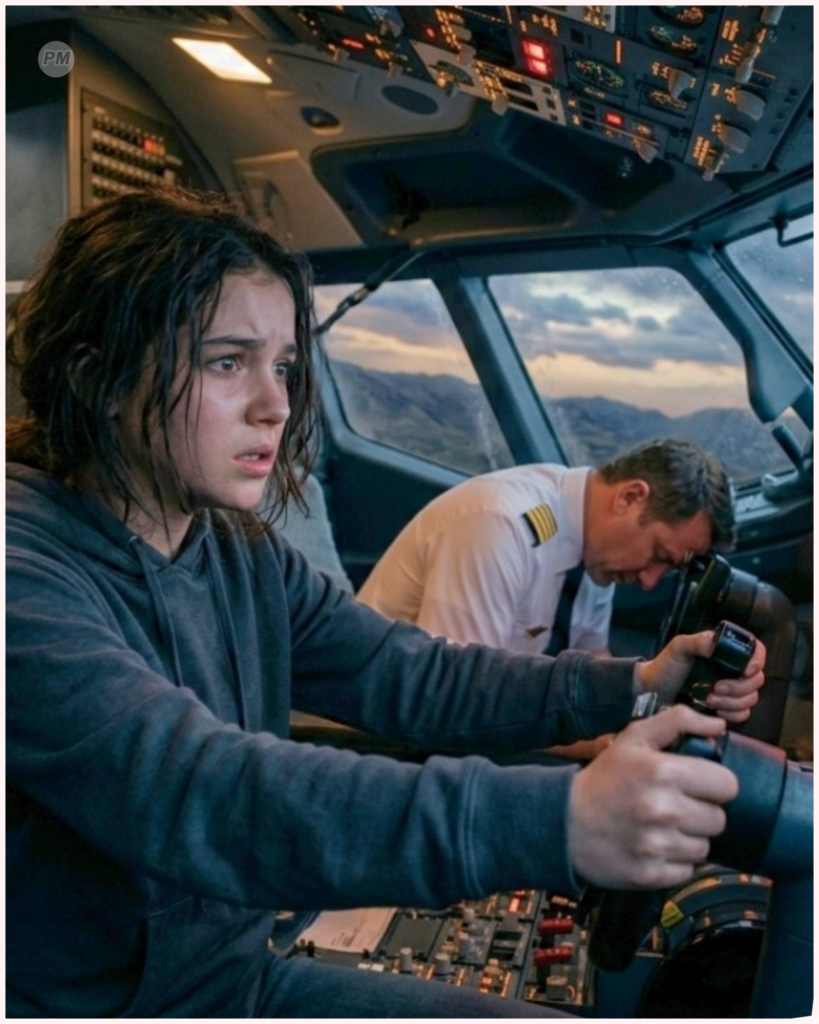
Webb paused
Webb paused. No. Then I’ll be available for your investigation after I land this aircraft.
She keyed off. She did not look at Ryan, but she was aware of him in the doorway, aware of the particular quality of his silence.
The silence of someone who understood that this was not the moment. Go back to the cabin, she said.
Start your brace briefing. Give them the full procedure. I want them ready. How long?
20 minutes to approach. Maybe less. She made an adjustment to the throttle, feeling the engines respond.
Tell them it’s going to be loud. Tell them not to be scared of loud.
Ryan stayed in the doorway for one more second. He was looking at the first officer, at the young man in the right seat who had not moved, who was still breathing, still alive, still held in the deep suspension of a body, waiting for the contamination to clear.
Sarah noticed. She noticed everything. “Go,” she said. He went. The California coast came up below the clouds in pieces.
First the color change in the water from the deep Pacific blue to something shallower and greener and more complicated.
Then the brown edge of the coast itself and then the land the high desert of the Mojave reaching back from the water like something that had been waiting a long time to be seen.
Sarah had flown into Edwards twice before in her career. Both times in an F-15, both times in conditions that had nothing in common with this morning.
But the geography was in her memory, and memory built on the kind of repetition that military flying required was a form of precision.
She knew where the runway was before she could see it. Stu Harwick came back on frequency.
Flight 801, you are 22 mi from the field. Confirm you have the airport in sight or require vectors.
Require vectors. I don’t want to waste a correction. Copy. Turn right heading 084. You’ll intercept the localizer in approximately 8 m.
Wind is 8 knots from the northwest. Runway 22. Left length 15,200 ft. Emergency equipment is in position.
15,000 ft of runway. She was going to need most of it. She began the turn.
The aircraft responded with the particular heaviness of an asymmetrically loaded machine. Being asked to do something its current condition complicated, she felt the pull in the rudder.
Her right leg braced harder. The burn was significant now. The deep fatigue of sustained exertion that did not announce itself with sharp pain, but with a growing insistence that became its own kind of argument.
She held the turn. She leveled. She lined up on the heading. “Tango lead,” she said on the escort frequency.
“I’m going to need you to break off at 5 miles. I’ll have the field by then, and I need the approach clear.”
Garrett Briggs came back without hesitation. Understood. We’ll hold at 5 and watch you in.
You’ve got this ghost talk. She did not respond to the call sign, but she heard it.
She felt it in the place where she had spent 5 years telling herself that person was gone.
The descent continued 16,000 ft. 14. The altimeter unwound with the patience of a clock that didn’t care what was happening in the cockpit, just what was true.
She reached for the flap handle again, left side full extension, right side 22° and no further.
She had known this was coming and had been preparing for it for 20 minutes, calculating the rudder input she would need the aileron.
She would hold the way the aircraft’s natural tendency to roll right would have to be countered through the entire approach with nothing but her own body as the counterweight.
She adjusted. She trimmed. She breathed. Her right leg was running out of arguments. Flight 801, you are 10 miles from the field.
Confirm gear down and landing checklist. Gear coming down now. She reached for the landing gear handle and moved it to the down position.
The aircraft shuddered as 300 lb of landing gear dropped into the airirstream and the hydraulics worked to lock everything into place.
Three green lights, gear down, locked. She let out a breath she had been holding for longer than she’d realized.
Gear is down and indicating, she told Edwards. Three greens. Copy that. Flight 801. You are 8 miles.
You are on glide path. She was on glide path, which was true. She was also flying a crippled aircraft with one leg going numb and a runway that was still 7 mi away and a cabin full of people who were doing exactly what she had asked them to do, which was trust her.
She had never taken that lightly. Not once in 10 years, and not now. The Mojave filled the cockpit glass tan and flat and enormous.
The air base resolving out of it as a cluster of buildings and aprons in the long gray geometry of runway 22 left and beside it the lines of emergency vehicles.
The red and white lights of fire trucks and ambulances and hazmat units parked in their waiting rows like a city that had assembled itself for exactly this moment.
She could see the runway clearly now. Garrett Briggs broke off at 5 miles, pulling away in a clean banking turn that took him out of her approach corridor.
She didn’t watch him go. She was already inside the final approach, already in the place where all the calculation finished, and what remained was just flying.
The radio went quiet. Edwards had given her everything they had to give. The rest was hers.
Ryan Beckett’s voice came over the intercom from the cabin, brace for landing. She could hear in it that he had done exactly what she asked.
His passengers were in position. His crew was ready. 30 seconds later, he pressed the intercom key one more time.
He held it open for two seconds without speaking and through the channel she heard the cabin.
She heard the sound of 300 people breathing together in the particular stillness of human beings who have decided to do the only thing available to them which was to hold on and believe in someone they had met an hour ago and had no reason to trust except that her voice had told them to.
She heard them. She flew. The runway was a mile out when the right rudder pedal gave her the full extent of what she was dealing with.
The asymmetric lift at this speed at this configuration was pulling the nose right with a persistence that required everything her right leg had left.
And her right leg, which had been doing this for 20 minutes, was approaching the end of what it could give.
She could feel the edge of it, not in pain exactly, but in the quality of the effort, the way the last mile of any hard thing has a different texture from all the miles before it.
She pressed harder. She had more. Not much, but more. The runway center line came up in the glass and she aligned with it and she held it and she did not let herself think about anything except this moment and this line and these hands and this aircraft and the 100,000 hours of repetition that had built in her a kind of knowledge that live below thought and above instinct in the place where real competence lives where you stop being someone who knows how to do something and become someone who simply does it.
The threshold markings appeared at the near end of the runway. She brought the nose up.
She cut the throttle. The aircraft settled and then the wheels touched. Not gently. She had not promised gentle.
She had promised heavy and she delivered it. The main gear hit this concrete with a force that went through the airframe and through the seats and through 320 bodies simultaneously.
A single shared impact that said, “We are here. We have arrived. This is the ground and and we are on it.”
The nose came down. She was already on the brakes manual breaking feeling the aircraft resist and then yield the tires smoking against the runway.
The nose gear pulling right and her correcting for it with what her right leg had left which turned out to be just enough.
The aircraft slowed. It slowed the way large things slow. Not instantly, not gracefully, but with the massive gradual honesty of something that has been moving very fast for a very long time and is now choosing to stop.
The emergency net at the end of the runway filled the cockpit glass. She break harder.
The aircraft stopped. 20 ft from the net. In the cabin behind her, a child was crying.
And then someone started to clap. And then everyone did. Sarah Cowwell sat in the left seat of Pacific Airways Flight 801 with her hands still on the yolk and her right foot still on the rudder pedal and her eyes still moving across the instrument panel in the pattern.
They had been moving in for the last 90 minutes, checking and re-checking and confirming the thing she had just done.
The way you reread a sentence you are not certain you read correctly. The engine spooled down, the instruments settled.
The applause continued behind the closed cockpit door. And outside the cockpit glass, the emergency vehicles were already moving.


