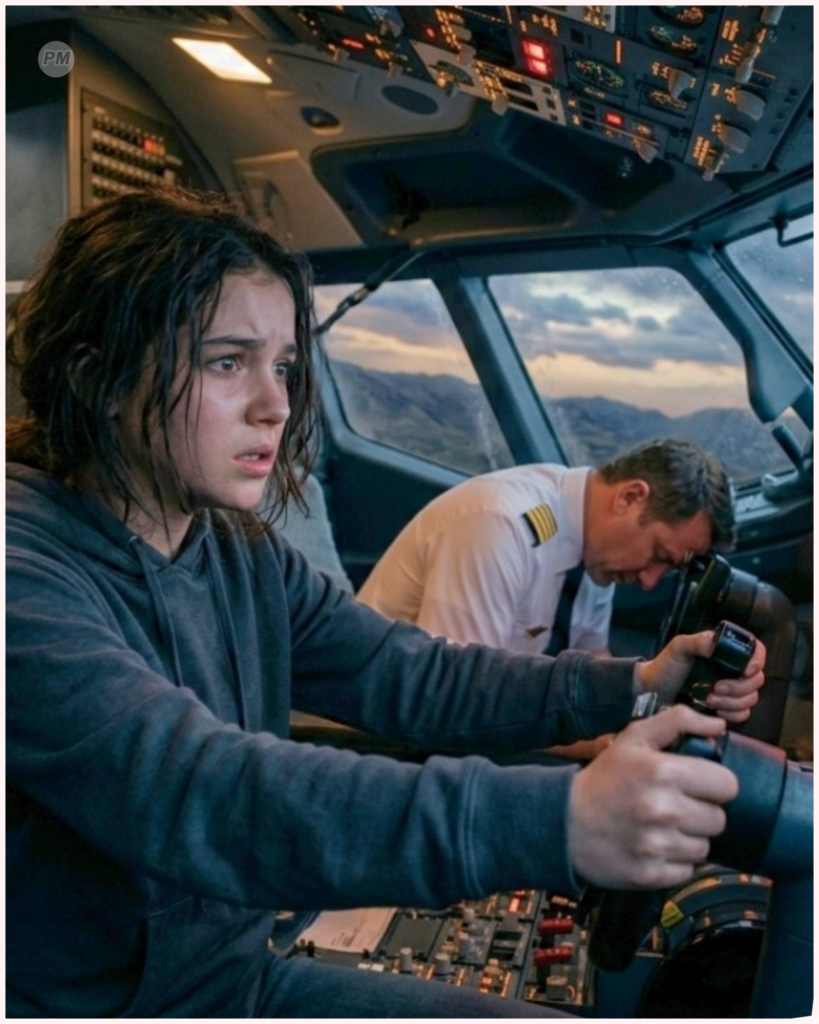
The radar screen at Edwards Air Force Base Control…
The radar screen at Edwards Air Force Base Control didn’t lie. Something was wrong with flight 801.
The controller on duty that Friday morning was a 20-year veteran named Stu Harwick, a man who had talked down everything from engine failures to bird strikes without ever raising his voice above a conversational tone.
He had a coffee mug that said world’s okayest dad, and a framed photo of his golden retriever on the desk beside his monitor.
He was not a man who frightened easily, but when the distress signal blinked to life on his screen and the radio crackled open, something in his chest went cold.
Edwards sent her, “This is Pacific Airways Flight 801. Declaring emergency. Repeat, declaring emergency. Both flight deck crew are incapacitated.
I am manually flying the aircraft. Requesting immediate emergency vector and runway clearance.” Stu leaned there forward.
Flight 801 say again, “Who is on the mic?” A pause just long enough for him to wonder if he’d imagined it.
This is Sarah Caldwell. I’m a passenger. I have FAA commercial certification and military flight hours.
I need a runway now. The room went quiet. Every controller on duty turned from their screens.
Stu Harwick sat down his coffee mug very carefully, the way a man does when he wants his hands free.
Copy that. Flight 801. You have Edwards, runway 22. Left is yours. What is your current altitude and souls on board?
31,000 ft descending 320 souls. Another pause. And Cwell, her voice didn’t waver, not even slightly.
You’re going to want fire and rescue standing by. This landing is going to be heavy.
Then she was gone back to whatever she was fighting up there at the edge of the sky.
And Stu Harwick was already reaching for the emergency line, already thinking about ambulances and hazmat units, and the kind of paperwork that only gets filed when something enormous either goes very right or very wrong.
He didn’t know yet which one it would be. None of them did. 90 minutes earlier, the world had looked entirely different.
Honolulu International Airport on a Friday morning in October had its own particular rhythm, the kind that only airports achieve a tempo built entirely out of other people’s urgency.
Families hauling too many bags. Business people staring at phones like the answers to their lives were somewhere inside the glass.
Children running ahead of parents who had already surrendered to the chaos. Sarah Caldwell moved through all of it like water through rock.
Unhurried, unremarkable. She wore a wide-brimmed straw hat and sunglasses large enough to qualify as a personal policy.
Her shirt was linen, pale blue, half tucked into jeans, worn soft from actual use.
Her bag was canvas, the kind that looked like it had been across a few continents and hadn’t minded.
She carried a paperback novel, a water bottle, and exactly nothing that would make anyone look twice.
That was the point. She had learned over a long career that the most useful skill a person could possess had nothing to do with marksmanship or flight hours or tactical decision-making under fire.
It was this, the ability to be completely present in a room while appearing to be completely elsewhere.
To see everything while being seen as nothing. She had been doing it for so long it had stopped feeling like a skill.
It felt like breathing. Her boarding pass read Sarah Calwell. Her seat assignment was 23B, an aisle seat.
Not the window, which might suggest a tourist wanting views. Not the middle, which served no purpose.
She could calculate the aisle because the aisle gave her options. And Sarah Cowwell had spent enough years in environments where options were the difference between walking out and not walking out at all.
She joined the queue for Pacific Airways Flight 801 to Los Angeles, positioned herself near the middle of the line, and waited.
While she waited, she cataloged. The gate agent, a young woman moving with the practiced deficiency of someone six hours into a 9-hour shift.
The TSA officer near the jetway door relaxed posture, scanning faces without intensity. A man three rows over in the waiting area, tapping his knee with two fingers.
Not nervous, she decided just a drummer’s habit. A mother with an infant asleep in a carrier against her chest.
The mother’s eyes already glazing with the particular exhaustion of someone who had not slept properly in months.
None of it was caused for alarm. Sarah didn’t do cause for alarm. She did preparation.
She did observation. She did readiness without performance. The quiet maintenance of a state of mind that most people only touch for seconds at a time, usually when something had already gone wrong.
She had lived there for years. She was on vacation. The thought almost made her smile.
Hawaii had been her sister’s idea delivered with the specific forcefulness that only older siblings can achieve.
You need to go somewhere, Carol had said on the phone, her voice carrying all the way to 5 years of watching her sister hollow out from the inside.
Somewhere that doesn’t know your name. Somewhere with water and sun and absolutely nothing that requires any version of you to be in charge of anything.
So Sarah had flown to Honolulu. She had sat on a beach for 4 days.
She had read three novels, two of them bad enough to be genuinely restful. She had watched the sun go down over the Pacific twice without thinking once about angles of approach or weather windows or the mathematics of survival.
On the third sunset, she had cried briefly and privately for reasons she didn’t examine too closely.
On the fourth day, she had booked her flight home. She was ready. She was not in any conventional sense at peace, but she was something.
She was functional. She was moving. After 5 years of standing still in ways that had nothing to do with her feet, she was willing to count that.
The boarding call came. Sarah Rose joined the stream and stepped forward into the jetway.
She gave a single nod to the flight attendant. At the door, a young woman with a practiced smile and a name badge that read Leah Merritt.
Leah smiled back with genuine warmth. Sarah moved past her down the aisle past rows of settling passengers and found her seat.
23B, she sat. She tucked her bag under the seat in front of her and opened her novel to a page she had not actually been reading.
Around her, the business of boarding continued, overhead bins slamming, a child three rows back, already asking when they would arrive.
Two men in the row across from her negotiating politely over the armrest in the way that American strangers do formal and apologetic and completely determined to win.
Sarah watched the flight crew. She always watched the flight crew. The senior flight attendant working the forward galley was a man in his mid30s with a calm face and the kind of quiet efficiency that suggested he had done this long enough to stop finding it interesting.
His name badge said Ryan Beckett. He moved with economy no wasted gesture the posture of someone who had learned to inhabit a confined space with grace.
She noted the way he checked the overhead compartments without being asked. She noted the way his eyes swept the cabin at intervals.
Not anxious, just professional. He reminded her of pilots she had respected. That was the highest compliment she knew how to give.
A man in a suit settled into the seat beside her. 23A the window. He was mid-50s tired already opening a laptop before the plane had even pushed back.
He gave her a brief courteous nod. She returned it. Nothing more was required or expected.
Somewhere in the forward section, the cockpit door was open for a few minutes while the ground crew completed their handoff.
Through the gap, Sarah caught a glimpse of the flight deck. Two figures. The captain, older gray, at the temples, moving with the relaxed authority of someone who had made this route enough times to fly it in his sleep, and the first officer.
She saw him for only a moment, young, mid20s at most, dark hair, straight posture, the particular alertness of someone still new enough to the job to be paying full attention to everything.
He glanced back through the open door for just a second, surveying the cabin the way junior officers do when they’re still learning to see the whole picture.
And then the cockpit door closed and he was gone. Sarah looked back at her novel.