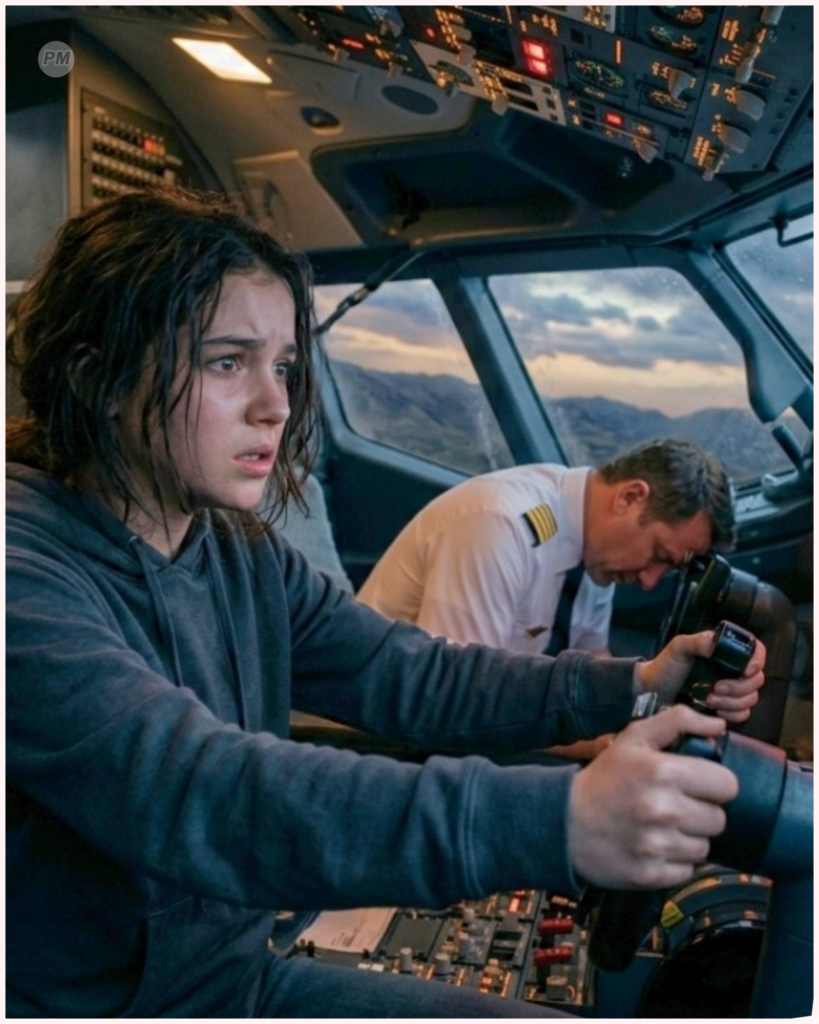
You didn't see it happen
You didn’t see it happen. You felt it. The background noise of 300 lives in progress stumbled.
Interrupted. And in the gap left by that interruption, something colder moved in. Heads came up from screens.
Earphones came out. The child who had been laughing was not laughing anymore. For 3 seconds, nobody moved.
Then Sarah Caldwell stood up. She didn’t rush. She didn’t raise her hand. She didn’t announce herself.
She simply rose from 23B with the quiet finality of someone who had calculated everything and was done calculating.
She picked up the black nylon folder. She stepped into the aisle. Ryan Beckett was already coming toward her from the forward section.
He stopped 2 feet away. He looked at the folder. She opened it. He looked at the credentials for exactly as long as it took to understand what he was seeing.
You’re actually a pilot, he said. I’m your best option right now, she said. Take me to the cockpit.
He didn’t argue. He turned. She followed. The cockpit door was unlocked. Emergency protocol had already disengaged the security mechanism, and the door swung inward as soon as Ryan Beckett pressed the release.
He stood aside. She stepped through. What she saw stopped her for half a second.
Just half a second. The captain was in the left seat, conscious, but barely. His skin had gone the color of old brick.
The particular flushed redness associated not with altitude sickness, but with hypoxia, the body’s vessels dilating in protest as the brain started losing the argument with insufficient oxygen.
His hands were on the controls, but his grip was wrong, too loose, and slightly trembling.
The grip of a man who had told himself he was still flying when he was no longer flying.
The first officer was in the right seat and he was not conscious at all.
He was young, dark hair, the particular stillness of someone for whom the body had simply stopped rather than slowed.
His hands were in his lap. He was the man she had seen through the cockpit door at the gate.
Sarah went straight to the environmental controls. She killed the ventilation draw to the cockpit, cutting off whatever was still feeding in from below.
She found the emergency oxygen supply panel pulled the captain’s mask from its housing and had it on his face before he could protest.
He tried to speak. She told him to breathe. He breathed. Then she looked at the air quality monitoring panel.
The display was blank. Not offline in the way of a system waiting to initialize.
Blank in the way of something that had been told to stop looking and had complied.
The indicator light that should have been cycling green, the one confirming the sensor in the avionics bay below them was doing its job was dark.
Had been dark, she understood, for the entire flight. She looked at it for two full seconds.
Someone had turned it off. She didn’t know when. She didn’t know who. She filed that information in the place where she kept things that mattered but could not be acted on yet.
And she turned back to the captain. His eyes tried to focus on her. You’re the pilot, he managed.
I’m the pilot, she said. She looked at the navigation display. The aircraft had drifted 17 mi south of the planned course during the minutes no one had been fully in control.
The autopilot had disconnected. Manual flight mode was active, which meant the aircraft was doing roughly what it was supposed to do by inertia and trim.
But inertia and trim were not a flight plan and they were not going to get 320 people safely on the ground.
She looked at the fuel gauge. She looked at the altitude. She looked at the hydraulic indicators.
System 2 was running low, not critical yet, but declining. She slid into the left seat.
The controls were in her hands before the thought of it had fully formed, and something happened in that moment that she had not expected and could not have prepared for.
The sensation of the yolk under her palms, the living vibration of an aircraft in flight, transmitted through metal and wire and hydraulic flu fluid, the immediate intimacy of a machine, telling her everything about itself through the pressure of her hands on its controls.
She had forgotten what this felt like. She had spent 5 years trying to forget.
And she had almost succeeded. And now it came back not as a memory, but as a physical truth, the way your body remembers swimming.
Not in the mind, but in the muscles, in the nerves, in the place where training goes, when it has been done long enough to become permanent.
Her hands were steady. They had always been steady. She keyed the radio. Edward Center, this is Pacific Airways Flight 801.
Declaring emergency. Repeat, declaring emergency. Both flight deck crew are incapacitated. I am manually flying the aircraft.
Requesting immediate emergency vector and runway clearance. The response came within seconds. Flight 801 say again who is on the mic.
Sarah looked at the Pacific spread below the clouds. She looked at the instruments. She looked at the long road home and calculated it the way she had calculated a thousand roads in a thousand skies over 10 years of flying.
Things that were never supposed to be general. This is Sarah Caldwell. She said, “I’m a passenger.
I have FAA commercial certification and military flight hours. I need a runway now.” A pause.
The pause of a man doing math very quickly. Copy that. Flight 801. You have Edwards.
Runway 22 left is yours. What is your current altitude and souls on board? 31,000 ft descending.
320 souls. She reached for the intercom, the cabin switch. The button she had pressed 10,000 times in her career and had told herself she would never press again.
Her thumb settled on it. Ladies and gentlemen, she said, “This is Captain Sarah Caldwell speaking.”
She did not say former. She did not say retired. She did not say reluctant or afraid or still carrying something heavy from a runway in Syria 5 years ago that she had never been able to set down.
We have experienced a medical emergency on the flight deck. I have assumed command of the aircraft and I will be flying us to Edwards Air Force Base in California.
I need you to remain calm. I need you to follow every instruction from the cabin crew.
She paused. We are in control. The cabin was quiet in a way that cabins almost never are.
Not the quiet of sleep or distraction. The quiet of 300 people listening. Really listening.
I have over 10,000 flight hours. She said I am certified on Boeing and Airbus platforms.
I am a former Air Force pilot. You are in good hands.” She released the intercom button.
She set her grip on the yolk. Outside the cockpit glass, the Pacific went on forever.
And the sky above it was clear and cold and brilliant. And somewhere below that blue horizon, a runway was being cleared and emergency vehicles were beginning to move.
And the world was mobilizing for whatever came next. Sarah Caldwell had not wanted to fly today, but she was flying.
And the plane was answering her the way it had always answered her, the way every aircraft she had ever touched had answered her with that particular willingness of a machine to be guided by hands that know what they are doing.
Her hands knew. They had always known. The question the one she had been asking herself for 5 years in an empty house in Ohio with a flight jacket hanging in a closet she wouldn’t open was whether she still deserved them.
She didn’t have an answer, but she had 36,000 ft in a crippled aircraft and 320 people who needed her to be something more than a woman on vacation.
So, she flew. The aircraft did not feel like an emergency. That was the strange thing.
From inside the cockpit with the engines pulling steady and the altimeter holding and the horizon sitting level in the glass Pacific Airways flight 801 felt like what it was supposed to be, a machine doing its job, a long crossing over water in clean air.
The kind of flight that pilots describe in their log books with a single word, uneventful.


