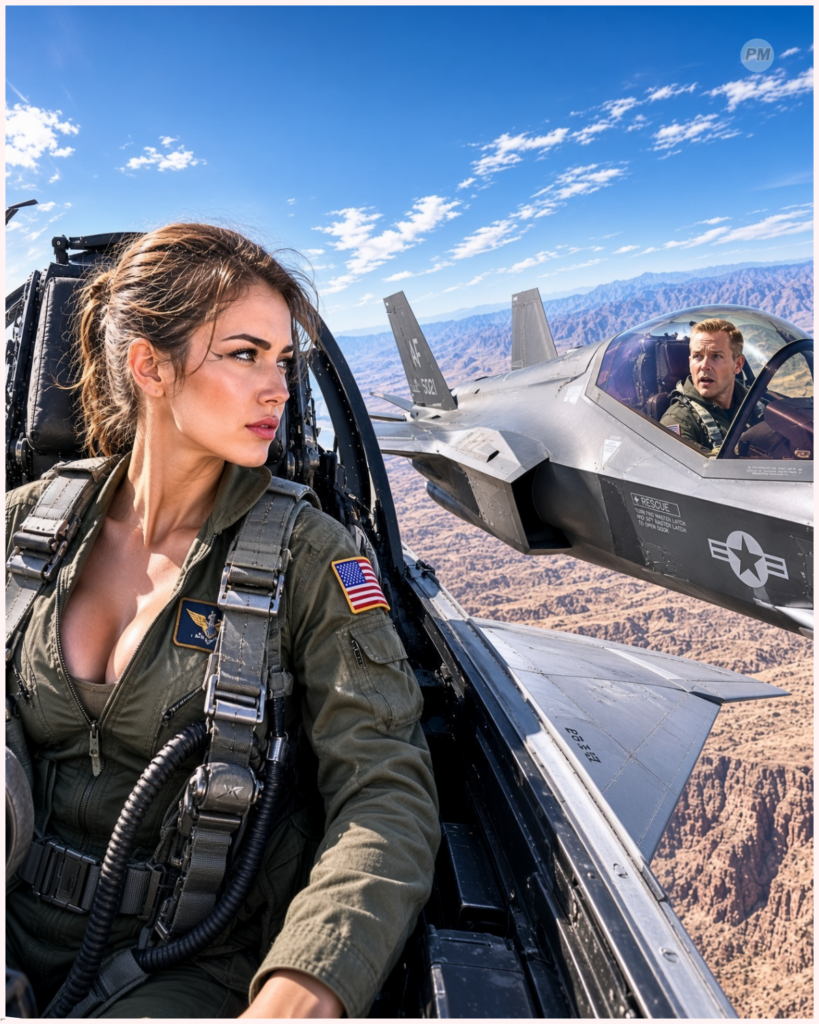
Captain Ethan Reynolds slammed his helmet down on the briefing table so hard the entire room flinched.
He pointed straight at Megan Carter. His face red, his jaw tight, and said in front of every instructor, every elite pilot, every person who mattered in that room, “She doesn’t belong here.
She never did. Send her back to her farm.” Nobody stopped him. Nobody said a word.
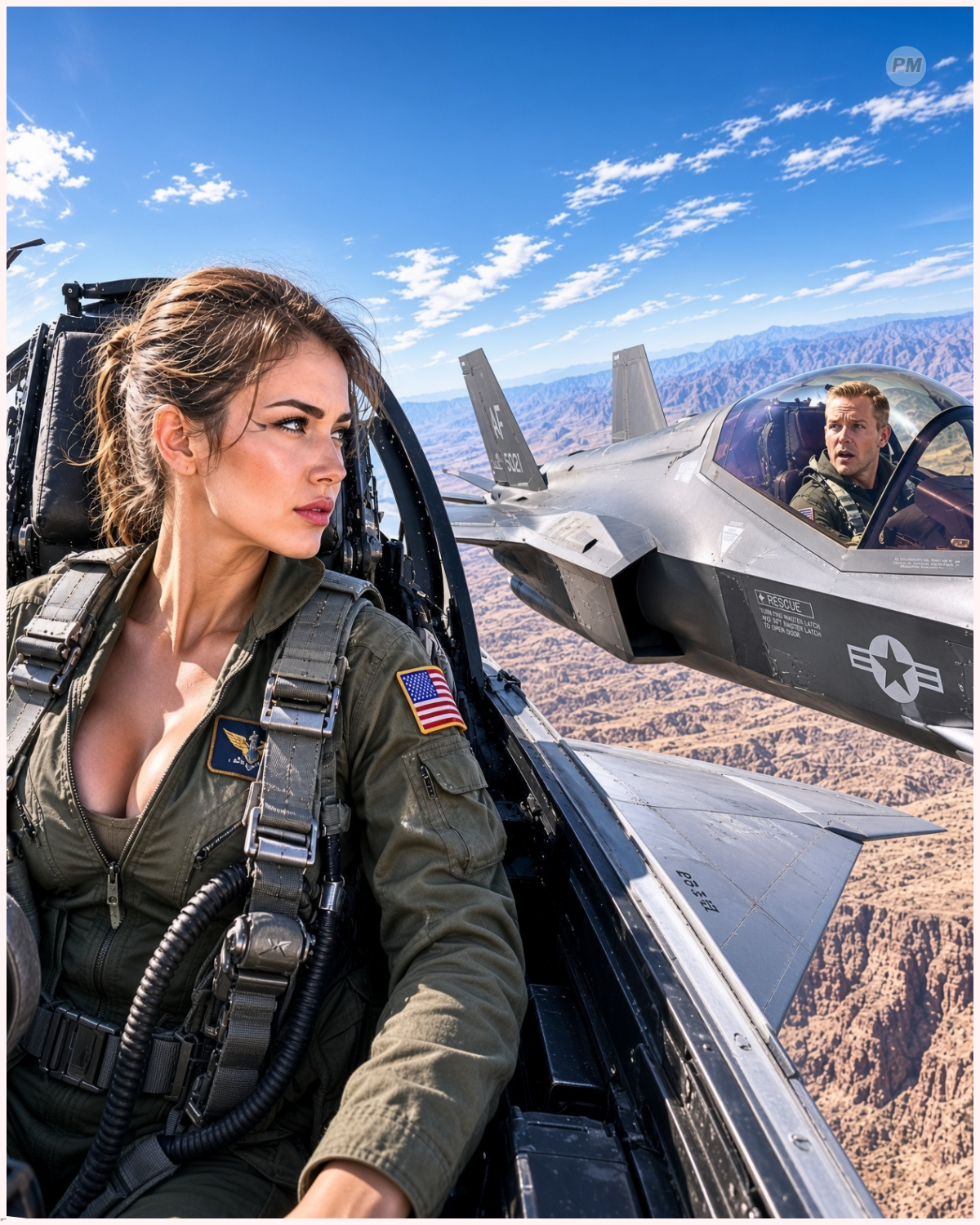
And Megan Carter just stood there completely still. Her eyes locked on his with something burning behind them that none of them could quite read yet.
If this story moves you, please subscribe to our channel, hit that notification bell, and follow Megan’s journey all the way to the end.
Drop a comment and tell me what city you’re watching from. I want to see just how far this story has traveled.
The wheat fields of Clearwater County, Montana stretch from one horizon to the other like an ocean that never moved and never ended.
On most mornings, the only sound was wind cutting across the tall dry stalks and the occasional cry of a hawk circling high above.
>> [snorts] >> But on the mornings that mattered, there was another sound, a low rattling engine cough from an old Piper Pawnee crop duster that sounded like it was always on the edge of dying, but somehow never did.
James Carter had bought that plane with borrowed money when Megan was 3 years old.
He had done the math on paper, and the math said it was too risky.
But James Carter was not a man who lived by paper math. He was a man who had spent eight years as an Air Force aircraft mechanic, had crawled inside engines that most people only saw from the ground, and had learned something that no manual ever put into words, that machines talk to you if you are willing to get quiet enough to listen.
He talked about that plane like some men talked about a difficult but loyal friend.
>> [clears throat] >> It had bad wiring in the port wing. The throttle cable had a soft spot at 3/4 pressure.
The left rudder pedal needed about 15% more input than the right because of a subtle twist in the linkage that nobody had ever quite corrected.
Most pilots would have grounded that aircraft or sent it to a shop. James Carter flew it every single day and he knew every one of its quirks the way a doctor knows an old patient, not from charts, but from time and attention and respect.
Megan learned the plane the same way, not from books, not from diagrams, from sitting in the co-pilot seat before she could properly reach the pedals.
Watching her father’s hands, listening to his breathing, feeling how the plane responded to every small adjustment he made.
By the time she was 8 years old, she could tell from the sound of the engine whether the fuel mixture was slightly too rich or too lean.
By 10, she knew that when the wind shifted from the northwest in the afternoon, you had to add a half second of reaction time on your approach to the low field near the creek because of the way the terrain funneled the air into a diagonal push that caught you if you were not expecting it.
Don’t just look at the instruments, James told her once when she was 9 and had made the mistake of fixating on the altimeter during a crosswind approach.
The instruments are telling you what already happened. You need to feel what’s happening right now.
She never forgot that. She also never forgot the morning. Everything changed the morning James Carter got into his old pickup truck to drive to the neighboring town for a replacement fuel pump and never came home.
The accident happened on a two-lane highway that most people in Clearwater County drove every day without thinking.
A semi-truck with a brake failure on a long downhill grade, a blind curve, two seconds that rearranged everything.
Megan was 15 years old. The weeks that followed were the kind that leave marks you carry for the rest of your life.
The farm had a mortgage. There were debts that James had kept quiet because he did not want to worry his daughter.
Debts from a bad harvest 2 years before and a repair bill on the irrigation system that had cost twice what they budgeted.
Her mother Sandra did her best. She was a strong woman, a quiet woman, the kind of person who kept things together through sheer will.
But the math on the farm was the same brutal math that swallows small family operations every year across the American heartland.
They sold the farm 18 months after James died. They sold the truck. They sold most of the equipment.
The old Piper Pawnee went to a man from Great Falls who planned to restore it.
Megan watched it loaded onto a flatbed trailer on a cold November morning, and she made herself stand there and watch until it disappeared around the bend in the road.
She did not cry. She had already done that privately in the workshop where her father used to work on the engine.
She had allowed herself exactly 1 hour of crying in that workshop, and then she had made a decision.
She was going to fly. Not crop dusters, not agricultural aircraft. She was going to fly the most demanding machines in the world in the most demanding conditions, and she was going to be so good at it that no amount of money or connections or elite training could put anyone ahead of her.
That was not a dream. It was a plan. She was 16 years old, and she already had more flight hours than most recruits had when they entered a military aviation program.
Those hours were not clean, smooth air hours in a modern trainer. They were hard hours, gusty, mechanical failure hours, hours flown in aircraft that demanded every ounce of your attention because the margin between a manageable situation and a disaster was always about 3 seconds wide.
He told her that her instrument scan was occasionally too loose. That when she was flying by feel, she sometimes let too much time pass between formal instrument checks.
He told her that in good conditions, it was fine, but in actual instrument meteorological conditions, that habit could get her into trouble.
She nodded. She went home and made a training schedule. She flew with a hood 3 days a week for the next 6 months.
When she turned 18, she walked into a United States Navy recruiting office in Billings, Montana.
She was wearing clean jeans and a flannel shirt cuz those were the nicest clothes she owned, and she had driven 2 hours to get there in a car that needed an oil change.
The petty officer behind the desk looked at her for a moment and said with a particular brand of a practiced neutrality that military [clears throat] recruiters develop after years of meeting people from every possible background, “What can I do for you today?”
“I want to fly fighters,” Megan said. He looked at her again, then he reached for a form.
The evaluation process was longer than she had expected. There were written tests, physical tests, aptitude tests, psychological evaluations, interviews with officers who asked questions designed to find out who you really were under pressure.
There were moments when she sat in small rooms across from men with ribbons on their chests and degrees from the Naval Academy, and she could see them looking at her background, Clearwater County, Montana farming family, no college degree, yet no famous last name, and doing their own private calculation.
One lieutenant commander, a lean man with close-cropped silver hair, looked at her file for a long moment, and then looked up at her and said very directly, “Miss Carter, I’m going to be honest with you.
We have people applying to this program who have been training in advanced simulators since they were 12 years old.
They have aerospace engineering degrees. They have family members who flew combat missions. What makes you think you belong in this conversation?”
Megan did not hesitate. “Because when the simulator breaks down,” she said, “those people wait for someone to fix it.
When my aircraft broke down, I was already 200 ft in the air, and I had to figure it out myself.”
The lieutenant commander looked at her for a long moment, then he wrote something on his notepad.
He never told her what it was, but 3 months later, she received her acceptance into the Navy aviation pipeline, and when she reported for initial flight training at NAS Pensacola, she had in her file a handwritten note from that same Lieutenant Commander that said simply, “Pay attention to this one.”
Flight training at Pensacola was nothing like flying crop dusters over wheat fields, and it was nothing like Megan had expected, and it was also in some ways exactly like what she had spent her entire life preparing for.
The aircraft were modern, the training was structured, the instructors were experienced professionals who had seen hundreds of student pilots come through the program, and they had developed a kind of professional detachment that allowed them to assess ability without letting personality or background interfere with the evaluation.
Megan [clears throat] appreciated that. Back home, she had sometimes felt the invisible weight of being James Carter’s daughter, people expecting her to either perfectly match what her father had been or to fall short of it.
Here she was, student naval aviator Carter, and what mattered was whether you could fly.
She could fly. Her first T-6B Texan two checkout flight was with Lieutenant Commander Patricia Walsh, a small intense woman from New Hampshire who had close to 4,000 hours in tactical jets and zero patience for what she privately called passenger pilots, people who sat in the cockpit and managed what the aircraft was doing rather than actually commanding it.
Walsh put Megan through a standard evaluation profile, straight and level climbs, descents, turns, stalls, basic instrument work.
Then she said, “All right, Carter, let’s see what you actually know. You have the aircraft.”
She reached over and covered the attitude indicator with a Post-it note. Megan flew for 40 minutes on partial panel in turbulent air with Walsh introducing subtle control inputs every few minutes to test whether Megan could feel the difference between intended aircraft movement and externally induced drift.
When they landed, Walsh sat in the debrief room for a long moment without saying anything.
Then she said, “Where did you learn to do that?” “Montana,” Megan said. Walsh looked at her.
“Montana,” she repeated. “My father had a Piper Pawnee with a bad attitude indicator,” Megan said.
“He told me if I was going to fly his plane, I needed to know how to fly without it.”
Walsh put down her pen. “How old were you?” “11,” Megan said. Walsh was quiet for just a moment.
Then she picked her pen back up and wrote something in her evaluation notes that Megan would not read until years later, when she received a copy of her training record.
“Exceptional natural awareness, non-standard background, translates to genuinely distinctive capability. Do not lose this student.”
But not everyone saw it that way. There was a group of four student pilots in Megan’s class who had come through a different door than she had.
They were graduates of elite university ROTC programs, sons of career naval officers, products of expensive aviation academies that started training candidates in their early teens.
They were not bad pilots. Two of them were genuinely talented, but they had grown up in a world where the hierarchy of the program was familiar territory, where knowing the right names and having the right background meant something, and they had not yet entirely separated that world from the one they were now in.
Their unofficial leader was a tall, sharp-featured young man from Virginia named Parker Whitfield, whose grandfather had been an admiral, whose father had flown F-14s in the 1990s, and who had grown up flying in a T-34 with private instruction from the time he was 14.
Parker was good. He knew he was good, and he had decided within approximately 48 hours of Megan’s arrival that she did not belong.
He never said it directly. Men like Parker rarely did, but it showed up in small ways, the way he would look past her during briefings, as if she were not entirely present.
The way he would address comments that she had just made directly to the instructor, as if he were summarizing for someone who had not understood.
The way he would mention in casual conversation the names of aircraft and bases and training programs in a manner that was clearly designed to highlight that he had grown up inside a world she was only now entering.
One evening, 3 weeks into the program, the student pilots were gathered in the squadron ready room reviewing a briefing for the next day’s flight schedule.
Megan had just finished a question and answer exchange with the duty instructor about energy management in a specific scenario, a recovering turn after an unusual attitude, and had walked through the answer in a way that was technically precise and also showed a physical understanding of the forces involved that went beyond textbook knowledge.
Parker waited until the instructor left the room. Then he said loudly enough for everyone to hear, “That’s a nice way to explain it for somebody who’s used to flying in a straight line over a wheat field.”
The room went quiet. Megan [clears throat] looked at him. She did not look angry.
She did not look embarrassed. She looked at him the way her father had once looked at a storm front building on the western horizon, with complete attention assessing, measuring, filing the information away.
“When was the last time you flew an aircraft with a system failure?” She asked.
Parker blinked. “That’s what simulators are for.” “When was the last time a simulator failed while you were using it to practice a system failure?”
Silence. “Because that happened to me,” Megan said, “twice, in actual flight before I turned 17.”
She picked up her briefing folder. “A wheat field is only straight if you’re looking at it from high enough that nothing matters anymore.”
She walked out. Three of the other students in the room had to work very hard to keep neutral expressions.
From that point forward, Parker Whitfield made it his private mission to be better than Megan Carter at every measurable thing the program offered.
Formation flying, instrument work, emergency procedures, navigation. He practiced harder, stayed later, studied longer. His grades improved, Megan’s improved faster.
It was not that she was trying to compete with him. She barely seemed aware of him as competition.
She was competing with herself, with the standard she had privately set the night she made her plan standing in her father’s empty workshop with her face still wet from the hour of crying she had allowed herself.
She was going to be the best. Not to prove something to Parker Whitfield or to the recruiting officer or to anyone else.
She was going to be the best because James Carter had taught her to respect the machine, to respect the sky, and to never ever settle for almost good enough.
That internal fire, that quiet relentless drive, it showed in everything she did. And the instructors noticed it before Parker did because instructors in a program like that one develop a sensitivity to it over years of training students.
They had seen talented students before, plenty of them. What was rarer, much rarer, was a student who combined talent with the specific kind of earned confidence that comes from having already survived things that would have broken someone without it.
Lieutenant Commander Walsh mentioned it to her department head one afternoon after watching Megan execute a split S recovery from an unusual attitude with a precision that she had genuinely not seen from a student at this stage of the program.
“She doesn’t fly like she’s learning,” Walsh said. Her department head, a veteran of two carrier deployments, looked at the film from Megan’s flight on his monitor and was quiet for a moment.
“No,” he agreed. “She flies like she already knows.” “The Montana crop duster background?” The department head asked.
Walsh nodded. “Her father flew and maintained the aircraft himself. She was flying it solo at 16.
Not in a simulator, not with a safety pilot, by herself in real-world conditions in an aircraft that had legitimate mechanical quirks she had to compensate for every single flight.
The department head watched the film for another moment. He watched the way Megan’s control inputs were always slightly early, not late, not reactive, but anticipatory, as if she were already inside the next moment before it arrived.
“Make sure she stays in the pipeline,” he said quietly. She did. She graduated from initial flight training with the highest academic score in her class and the second highest flight evaluation score, second highest only because a particularly gifted student from the Naval Academy had one more hour of accumulated T-6B time than she did by the final evaluation date and had used it with exceptional skill.
She did not argue about it. She did not complain. She shook his hand, congratulated [clears throat] him genuinely and filed away the knowledge of what she still needed to improve.
Her call sign came the night of the graduation dinner in the chaotic, good-natured tradition of Naval Aviation where call signs were either given to you by your peers based on something you had done or invented from the most embarrassing available material.
What happened in Megan’s case was this: During a formation flight evaluation 3 weeks before graduation, the flight was disrupted by an unexpected close approach from a civilian aircraft that had wandered outside its assigned airspace.
The resulting radio calls that necessary break from formation, the subsequent repositioning, it could have unraveled the entire evaluation.
Every other student in the formation followed standard procedure, which was technically correct and also meant that the formation was compromised for nearly 4 minutes.
Megan, reading the geometry of the situation in those first 2 seconds, made a non-standard call, altered her position in a way that maintained partial formation integrity, and then guided two other aircraft back into position in a sequence that her instructor watching from the ground later described as the best three-dimensional spatial thinking I’ve seen from a student in this program in 7 years.
After the debrief, one of the other students said, “She moves like a raven. You never know where she’s going to be.”
The call sign stuck immediately and universally. From that point forward, she was Raven. And when the orders came down and she read the words that told her where she was going next, she sat down for a moment and put the paper on the table in front of her and looked at it.
Top Gun, Naval Air Station Fallon, Nevada. The Naval Strike and Air Warfare Center. The place where the best went to be tested against the best.
She picked up the paper. She thought about her father. She thought about the old Piper Pawnee and the bad attitude indicator and the November morning when it went away on a flatbed truck.
She thought about what her father had told her sitting in that rattling cockpit over the Montana wheat fields when she was 9 years old and learning to trust her hands more than the instruments.
Computers can calculate the sky, Megan, but they will never feel it. She folded the orders.
She started packing. And somewhere in Nevada in the most elite tactical air warfare training program in the world, a man named Captain Ethan Reynolds, call sign Viper, was already the undisputed top of the class, already the pilot everyone agreed was going to define the future of American air combat, already so certain of his place at the top of that particular sky that he had never once seriously considered that anything could change it.
He had not heard of Megan Carter yet. He had not heard of Raven yet.
I had no way of knowing that the woman who was going to walk into his world and rearrange it completely had just quietly folded a piece of paper in a room in Florida and was already thinking about what she needed to learn before she got there.
She was thinking about what she needed to improve. She was thinking about what her father would have told her to pay attention to.
She was not thinking about Ethan Reynolds at all. That was already in a way that neither of them understood yet a profound advantage because the pilot who has nothing to prove fights differently than the pilot who has everything to defend.
And Megan Carter, daughter of a Montana crop duster mechanic call sign, Raven had spent enough time in the real sky over the real Earth to know something that no simulator had ever taught anyone.
The moment you start flying to protect what you already have, you stop flying forward.
Her father had shown her how to always fly forward. She intended to remember that every single day over the Nevada desert, every single second in that cockpit.
And on the day that everything came to a point, the day the warning lights went red, and the instructors stared at the screen, and the radio carried her voice across the silence of the command center, she would still be flying forward the same way she always had, the same way James Carter had taught her, the same way the sky over Montana had demanded without mercy and without apology from a girl who had learned to listen to the machine beneath her long before anyone thought she was old enough to matter.
She arrived at Naval Air Station Fallon on a Tuesday morning, and the [clears throat] first thing she noticed was not the base, not the aircraft, not the desert heat that pressed down on everything like a physical weight.
The first thing she noticed was the way people looked at her when she checked in at the front gate and gave her name.
The petty officer on duty typed it in, looked at his screen, looked back at her, and then looked at her again with an expression she had learned to recognize over the past several years, a kind of rapid internal recalculation, >> [snorts] >> the moment when someone’s expectation collides with what is actually standing in front of them.
“Raven,” he said reading her call sign off the screen, “Carter Megan, reporting [clears throat] for Top Gun Class 7.”
“That’s right,” she said. He handed her a badge and said, “Welcome to Fallon, ma’am,” with the precise professional neutrality of someone who had been trained to say exactly that, regardless of what he was thinking.
She picked up her bag and walked onto the base. She had 1 hour before the class orientation, and she used it the way she always used transition time, not to settle in, not to get comfortable, but to observe.
She walked through the corridors of the building where the briefing rooms were located, and she listened to the sound of the place.
She was cataloging voices, tones, the rhythm of how people talked to each other, the invisible social architecture that every organization builds around itself over years of shared experience and shared language.
It did not take long to understand the basic structure of the room she was walking into.
There were 12 pilots in the class, nine men, three women. Every one of them had distinguished themselves in their fleet squadron.
Every one of them had been selected through a process so competitive that merely being considered was a significant achievement.
In a different context, any one of them would have been the most capable pilot in the room.
This was not a different context. This was Top Gun. And in this context, what Megan immediately felt was not the collective talent she had expected, that but the collective weight of each person’s awareness of their own talent.
It was a room full of people who had spent years being told they were exceptional, and who had come to a place designed to find the upper limit of exceptional, and who had not yet been entirely certain whether they would find that limit inside themselves or somewhere in the person standing next to them.
She found a seat near the back of the briefing room and set her folder on the table.
To her left, a pilot named Lieutenant Commander Sarah Okafor, call sign Switch, gave her a brief nod.
Okafor was a carrier experienced F-18 pilot from Georgia with a reputation for aggressive tactical thinking and a calm that [clears throat] apparently did not break under any conditions the sky had been able to produce so far.
Megan noted the nod, returned it, and said nothing. This was the right language for this room, and she spoke it naturally.
To her right, two seats away, sat Captain Ethan Reynolds. She knew who he was before she saw him.
Everyone in the Navy’s tactical aviation community knew who Ethan Reynolds was. He had come from a family of military aviators, the way some people come from families of doctors or lawyers.
It was not simply a career choice. It was a genetic inheritance and identity so deeply embedded that separating the person from the profession was essentially impossible.
His grandfather had flown Corsairs in Korea. His father had flown F-14s in the first Gulf War, and then instructed at Miramar before it closed.
Ethan had grown up on flight lines and hangars in the structured world of military aviation, and he had absorbed it so completely that by the time he got to his first fleet squadron, he flew not like someone who had learned, but like someone who had always known.
But he was genuinely gifted. She had read his record because she read everyone’s record before walking into a new environment.
He had 6 years of fleet experience, close to 3,000 hours in tactical jets, and two combat deployments.
He had been selected for Top Gun a year ahead of the standard timeline because his performance evaluations were by any objective measure exceptional.
He also had, according to the informal intelligence network that runs through every military aviation community, an absolute and complete confidence in his own superiority that had never, as far as anyone knew, been seriously challenged.
Megan looked at him for exactly the amount of time it takes to form a reliable first impression, about 4 seconds, and then looked back at the front of the room.
He was talking to another pilot on his right, a relaxed ease in his posture, the comfortable body language of someone who understood that this was his territory.
His voice was the kind that carried naturally, not because he was trying to project it, but because he had spent his entire life in rooms where he was the person people listened to.
Class 7, he was saying, “Historically, it produces the most interesting tactical development. It’s when the program was redesigned after the analysis of the Gulf War engagements.
The curriculum shift to beyond visual range integration changed everything about how we train for close-in work.”
The pilot he was talking to nodded. The other pilots nearby were listening. Megan was listening, too, but she was listening differently.
She was noting what the content of the statement revealed about how Ethan Reynolds organizes thinking.
He was historically oriented. He understood the program’s evolution in terms of doctrine and institutional development.
That was genuine intellectual depth. It also suggested, in a way she filed quietly in the back of her mind, that he understood air combat primarily as a discipline, a structured system with best practices that could be studied, mastered, and applied with consistency.
That was not wrong. It was, in fact, mostly right. It was just not the whole picture.
The lead instructor for Class 7 walked into the room at exactly the scheduled time, and every conversation stopped with the precision of a switch being thrown.
Commander Daniel Hayes had the physical presence of someone who had spent decades in a profession where confidence was currency, and he carried it without effort or display.
He set his folder on the podium, looked at the room for a moment, and said without preamble, “Welcome to Top Gun.
Most of you are here because you are the best tactical pilots your squadrons have produced in the last several years.
I want you to understand something clearly before we go any further. Being the best in your squadron got you into this room.
What happens in this room has nothing to do with what you did before you got here.
He poor paused. Everything resets today. Megan felt a slight shift in the room’s energy, the almost imperceptible adjustment that 12 accomplished people made to that statement.
Some of them straightened slightly. Some of them did nothing externally, but she could see the internal recalibration in the set of their shoulders, the small tightening around the eyes.
Ethan Reynolds did not move at all. He sat with the same relaxed ease and looked at Commander Hayes with an expression of respectful attention that revealed nothing except perhaps a very subtle suggestion that he had already processed this particular reality and was comfortable with it.
Hayes went through the class schedule, the evaluation criteria, the structure of the program. He talked about what Top Gun was and what it was not.
He said things that were important and specific and that Megan cataloged carefully. And then near the end of the orientation, he said something that she had not expected.
We have an unusual configuration in this class. We have pilots flying different generations of aircraft.
Most of you are in F-35 Lightning II’s. One of you is flying an F-18 and one of you is flying an F-16.
He looked up from his notes. The F-16 pilot is Lieutenant Carter, call sign Raven.
Every head in the room turned toward her. She was already looking at Hayes, so she felt the attention rather than saw it, but she did not look around.
She kept her eyes on Hayes. The reason I’m mentioning this specifically, Hayes continued, is because the aircraft differences are going to create interesting tactical problems throughout this class.
The F-35 is a fifth generation aircraft with significant sensor and stealth advantages. The F-16 is a fourth generation aircraft with significant agility advantages.
How pilots use what they have versus how pilots fight the aircraft they wish they had is one of the things we evaluate here.
Anyone who thinks this is going to be a straightforward technology comparison is going to be surprised.
He looked at the room without dwelling on any individual face. Questions? There were none.
Good. Flight schedule goes up at 0600 tomorrow. Get some sleep. The room started to move.
Pilots collected their folders. Conversations began again. The organized energy of a group of people who have a great deal of work ahead of them and intend to approach it professionally.
Ethan Reynolds stood up and as he turned his eyes landed on Megan. She was already standing her folder under her arm.
They looked at each other for a moment with the particular assessment that pilots conduct when they recognize another pilot as a potential opponent.
Rapid professional specific. Raven, he said. Viper, she replied. He looked at her for a beat longer than the standard acknowledgement would have required.
Then he said said, you flew the Montana Ag circuit right before the Navy. She looked at him with the same level expression she had used on Parker Whitfield 100 years ago in Pensacola.
Clearwater County, my father’s aircraft. Agricultural flying, he said and his voice carried something that was not quite contempt but was in the neighborhood.
That’s an interesting background for this program. It is, she agreed. He waited for her to elaborate.
She did not. He smiled a clean sharp smile that she recognized as the social equivalent of a small test.
He was checking whether she would get defensive or deferential or aggressive. These were the responses he expected because they were the responses that defined his social world.
She gave him none of them. See you in the brief, she said and walked past him toward the door.
She heard him say something quiet to the pilot next to him as she left.
But she did not turn around to hear what it was. It did not matter.
What mattered was the tactical information she had just gathered, which was that Ethan Reynolds read the room with precision and confidence.
That he was used to winning social exchanges before the actual competition even began and that she had just declined to participate in that game.
He would notice that. He would think about it and the small thread of uncertainty that comes from an unknown quantity behaving unexpectedly would lodge itself somewhere in the back of his mind and stay there.
This was not manipulation. This was economy. She had learned it from her father who had learned it from years of dealing with weather systems that did not care about human expectations.
That the best way to deal with something unpredictable was not to try to control it, but to stop giving it information about yourself.
She walked back to her quarters, set her alarm and went over the next day’s flight schedule until she understood exactly what was being asked of her.
Then she ate, did 50 push-ups and a half hour of the visualization practice she had developed over years.
Not imagining success, but walking through the specific physical sensations of flying, the feel of the aircraft’s responses, the weight of the G forces, the spatial geometry of the maneuvers and went to sleep.
Tomorrow was the first evaluation flight. She intended to be ready. The first week of Top Gun class seven moved at a pace that compressed time the way extreme pressure compresses material.
Everything that happened in those five days felt both immediate and somehow already historical, already significant in a way you could not quite process while it was happening.
The morning briefs were dense with doctrine, with tactics, with the analysis of historical engagements and the specific lessons the program had extracted from them.
The instructors were demanding in the precise way that genuine expertise produces. They asked questions that had specific answers, expected those answers to be correct and treated errors not as failures, but as tactical problems to be corrected before they became habits.
Megan did well in the briefs. She always had the analytical side of flying, the ability to think through tactical geometry in three dimensions came as naturally to her as the physical flying itself.
What she was more carefully evaluating was the dynamic of the class, particularly the relationship between the F-35 pilots and everyone else.
There were six F-35 pilots in class seven. They had not explicitly organized themselves as a group, but they moved with the unconscious solidarity of people who shared a common language.
The F-35’s sensor fusion, its data link integration, its ability to share information across aircraft in real time, >> [snorts] >> these things shaped how its pilots thought about air combat in ways so fundamental that they were barely aware of it.
They thought in networks, they thought in information flow. They thought about individual aircraft performance secondarily to the question of what the system as a whole was doing.
That was a powerful way to fight. In many scenarios, it was the dominant way to fight.
It was also Megan had been thinking since the day she got her orders a way of fighting that had a specific and under-explored vulnerability.
She kept that thought to herself. Ethan Reynolds in the first week was exactly what his record suggested he would be.
In the briefs, he was precise, articulate, and consistently correct. He had an instinct for identifying the doctrinally important point in any complex tactical situation and articulating it cleanly.
The instructors acknowledged his contributions without excessive warmth. >> [snorts] >> They were professionals, not an audience, but even their measured responses carried the faint undertone of recognition that comes when an expert encounters another expert.
In the air, he was better than precise. He was smooth. Flying an F-35 at the level Ethan flew, it was a kind of translation.
You had to take the aircraft’s sensor picture and convert it into spatial awareness that let you position your aircraft within that picture with maximum effectiveness.
It required a specific combination of information processing and three-dimensional thinking that not every talented pilot possessed.
Ethan possessed it fully, and watching him work through a tactical problem in the air, Megan could see why people spoke about him the way they did.
She also noticed him the third day the specific thing that nobody else seemed to have noticed yet.
It happened during a beyond visual range exercise, a simulated intercept against an aggressor aircraft flown by one of the Top Gun instructor pilots.
The engagement was designed to test how the F-35 pilots use their sensors to manage the intercept timeline.
Ethan executed the intercept nearly perfectly, bringing his simulated weapons employment to within about 3 seconds of the textbook solution.
But in the debrief, when Hayes walked through the film and asked him to talk through his decision-making, Ethan narrated it as a single clean sequence of correct responses to the sensor picture.
Every step followed from the previous one with perfect logic. The aircraft system said this, so he did that.
The geometry developed this way, so he responded in that way. Hayes nodded. He said, “Good.”
Then he said, “Walk me through the moment at 47 seconds when the aggressor’s transponder signal broke lock for 2 seconds.”
Ethan paused for a fraction of a moment. Then he said, “The lock reestablished before it affected my intercept geometry.”
“But you didn’t change anything during those 2 seconds,” Hayes said. It was not a question.
“The lock reestablished.” “What if it hadn’t?” Hayes asked. A slightly longer pause. “I would have transitioned to a visual search.”
“How quickly?” “Standard transition time.” “Exactly,” Hayes said. He moved on to the next pilot.
Megan did not look at Ethan, but she stored the exchange with the precision of someone who had learned that the details you notice when nobody else is watching are the ones that matter most when everything is moving fast.
The moment the sensor picture broke, Ethan had waited for 2 seconds, which in a dynamic air combat environment was not nothing.
He had trusted the system to reestablish. And it had, and the outcome was fine, but the dependency was there.
The habit of waiting for the system to resolve the uncertainty rather than immediately transitioning to something else was there.
She thought about her computer and the bad attitude indicator. She thought about the hundreds of times she had been flying and something had stopped working and she had already been doing something else before she consciously registered the failure.
She thought about what that difference meant in a one-on-one engagement at close range. On day four, they flew their first close-in maneuvering exercise.
Not against each other, against instructor pilots flying as aggressors. It was an evaluation, not a competition, and the explicit purpose was to establish a baseline for each student’s visual range maneuvering skills.
Megan flew against an aggressor instructor in an F-16 identical to her own aircraft. The fight lasted 6 minutes and 40 seconds.
She won it in the conventional sense, achieved a simulated gun solution, but what interested her afterward was not the outcome but the conversation.
The aggressor instructor, a laconic man from Texas named Commander Jim Sledge Kowalski, sat across from her in the debrief room and looked at the film without talking for about 90 seconds.
Then he said, “How long have you been flying the Block 50?” “About 18 months,” Megan said.
“Because that thing you did at 3 minutes and 22 seconds,” he said, pointing at the frozen frame on the screen, “that’s not something people learn in 18 months.
That’s a feel thing. That’s years.” She looked at the frame. She knew what he was pointing at.
In the middle of a high-speed overshoot by the aggressor, she had used a specific combination of control inputs, rolling into the overshoot direction, reducing power loading G that had reversed the geometry in a way that should not have been possible given the relative energy states of the two aircraft.
My father’s crop duster, she said, it overshot its own turns all the time because of the spray equipment weight distribution.
I learned to reverse the geometry on an overshoot when I was 13. Kowalski looked at her for a long moment.
Then he looked back at the screen. Your father know you fly like this? She was quiet for a moment.
He taught me. He nodded slowly. He did not say anything else for a moment.
Then he said, he taught you well. She stood up to leave. At the door he said, Carter.
She stopped. Whatever you’re working on in that head of yours, don’t stop working on it.
She walked out. On the evening of day five, the dynamic that had been building since the first day broke open in the way that things break open in high-pressure environments, not slowly, not with warning, but all at once like a split in a fuselage that goes from invisible to catastrophic in the space of a second.
It started in the debrief room after the day’s final flight. Hayes was reviewing a section of film from an exercise that had not gone well for one of the F-35 pilots, a young lieutenant named Cross who had allowed himself to get maneuvered into a low energy corner by an aggressor who had read his turn pattern and simply waited for him to run out of options.
Hayes was not cruel about it, but he was thorough. He walked through every decision point, every missed opportunity to change the geometry, every moment when Cross had defaulted to what the doctrine said instead of what the developing situation demanded.
By the end of it, Cross was sitting with a particular straight-back stillness of someone who was holding something in with considerable effort.
Then Hayes said something that shifted the room’s temperature. He said, the aircraft you’re flying, lieutenant, is the most capable fighter ever built.
It can see things that your father’s generation couldn’t imagine and it can share that picture with every other aircraft in your formation in real time.
That is an extraordinary advantage. It is also, and I want you to hear this clearly, a crutch if you let it become one, Rakesh Nallam.
He let that sit for a moment. The enemy gets a vote. And the enemy’s vote in a real engagement is very often to do something your system hasn’t specifically been programmed to expect.
Ethan Reynolds said calmly and without apparent aggression. With respect, Commander, the F-35 sensor fusion architecture is designed to handle non-standard threat behavior.
The system integrates inputs from multiple sources specifically to avoid the single point of failure problem.
Hayes looked at him. “It is,” he agreed. “And when all those inputs are working perfectly and the threat is behaving in a way that falls within the design parameters, that integration is decisive.”
A pause. “We’re training for when it isn’t,” Ethan said. “With an aircraft like the F-16 or the F-18, I’d agree that degraded system scenarios need more emphasis.
With fifth-generation aircraft, the redundancy built into the system architecture means that genuine degraded sensor scenarios are significantly less likely.”
Hayes said, “Less likely is not impossible.” Ethan said, “Of course, but training emphasis should reflect probability, not hypothetical edge cases.”
The room was very quiet. Megan had been sitting with her hands folded on the table watching this exchange with the same expression she had used the first time she walked into a storm front in the Pawnee, completely attentive, completely still measuring everything.
Hayes looked at Ethan for a moment. He said, “I hear your argument, Captain Reynolds.
I’d be curious what the rest of the class thinks.” And Megan said before she had consciously decided to speak, “I think the edge case is the only case that matters.”
Every head in the room turned to her. Ethan turned to her. She kept her eyes on Hayes for a moment, then looked at Ethan directly because this was a conversation with him, and there was no point in pretending otherwise.
The probability argument works if you’re training to win most engagements, she said. But the engagements where the system works perfectly and the enemy behaves predictably, those are the ones you’re already going to win.
You don’t need special training for those. The only engagement that you need to specifically prepare for is the one where something is wrong that you didn’t expect and you’re the only resource you have left.
She paused. That’s the one that kills you if you’re not ready. Ethan looked at her with an expression she could not immediately classify.
Not contempt, not dismissal, but something sharper. It was the expression of someone who has just heard an argument that does not align with his framework and is deciding what to do with it.
Flying a fourth generation aircraft, he said, means you’re already operating in a degraded state by comparison.
I understand why that perspective makes sense from where you are sitting. The room held its breath.
Megan let a moment pass. She said, “You’re right. I fly a less capable aircraft.
I know that. And because of that, I’ve had to spend every flight asking myself what I do when the thing I’m depending on stops working.”
Another pause. That question is very useful. You might want to try it sometime. She stood up, collected her folder, and said, “Good brief, Commander Hayes.”
And walked out of the room with the same quiet, complete composure she had walked into it with.
Behind her, the silence lasted for a full 3 seconds before the room exhaled, and the careful, complex, professional response to what had just happened began.
She did not hear any of it. She was already thinking about tomorrow’s flight. She was already thinking about what she had seen in Ethan Reynolds’ eyes in that final moment before she turned away.
Not the official response, not the social performance, but the raw flash of something underneath it.
Something that had not had a name yet in his experience, but that she recognized immediately from years of flying an aircraft that demanded her full honesty.
It was the very beginning of doubt. Not about his ability, not about his aircraft, but about whether the complete integrated certainty he had built around both of those things was in some small, specific, important way leaving a gap that he did not yet know was there.
She had planted nothing. She had manufactured nothing. She had simply said what was true in front of people who needed to hear it in the plain language that her father had used to teach her about the sky.
But seeds do not announce themselves when they land. >> [clears throat] >> They just take root in the dark.
And Ethan Reynolds lying in his quarters that night, staring at the ceiling the way she knew without seeing it that he was was already without knowing it beginning to grow one.
The second week was when the real work began. Not the scheduled evaluations. Not the official flight profiles.
The real work, the private unspoken competition that runs beneath the surface of every Top Gun class like a current beneath water, began the morning.
Ethan Reynolds was on the flight line 40 minutes early and found Megan Carter already there doing a pre-flight inspection on her F-16 with the methodical hands-on attention that she had learned not from a checklist, but from her father who had believed that a pilot who did not know what the aircraft felt like when nothing was wrong had no business knowing when something was.
He stopped. He watched her for a moment. She was working her way through the inspection with a kind of focused physical engagement.
Hands on surfaces, checking tolerances, testing movement that you did not see from pilots who had come through a fully modern training pipeline because the modern pipeline taught you to trust the maintenance crews and the electronic self-test systems, which was generally correct and efficient and also meant that many pilots had a relationship with their aircraft that was slightly abstract.
She did not have that relationship. She had the other kind. He walked past without speaking.
She did not look up. He climbed into his F-35 and ran through his own preflight and somewhere in the middle of it, he sat for a moment in the cockpit with his hands still and thought about what she had said in the debrief the previous evening.
I thought about it for about 30 seconds. Then he put it away because he had a flight brief in 25 minutes and 30 seconds was not a useful amount of time to spend on a philosophical argument from a fourth-generation pilot who was, whatever else she was fighting from a position of disadvantage.
He told himself that. The morning flight was a formation exercise. All 12 pilots working through a complex tactical scenario in two six-ship formations.
Megan was in the opposing formation, notionally an adversary force working against the six F-35s.
The scenario was designed to test the F-35 formation’s ability to leverage its sensor advantages to manage a complex multi-aircraft threat environment.
The F-35 formation executed beautifully for the first six minutes. The sensor fusion was working exactly as designed.
The formation maintained perfect tactical discipline. The adversary formation, Megan’s group flying a mix of F-16s and F-18s, was being systematically positioned, picked apart, neutralized.
At 6 minutes and 12 seconds, Megan did something that was not in the expected pattern.
It was a small thing, a turn, but the timing and the geometry of the turn, the specific way it was placed in the middle of the developing engagement, caused a brief 6-second period in which the sensor track on one of the F-35s was incomplete.
The data link update rate stressed by the geometry change produced a small gap in the tactical picture that the F-35 systems flagged for resolution before acting on.
Those 6 seconds were not in the plan. They were not supposed to exist. Two of the F-35 pilots during those 6 seconds made decisions based on the last known position rather than the actual one.
The decisions were tactically logical given the information they had. They were also wrong and the result was that two of the adversary aircraft that should have been neutralized were instead in a position to press forward on the engagement.
The debrief was measured and professional and genuinely useful because Hayes was good at his job and made every post-flight analysis educational rather than punitive.
He walked through the sequence, identified the decision points, asked questions, listened to answers. When he got to the 6-second gap, he asked how it had developed and worked through the geometry and pointed out that the turn sequence Megan’s formation had used was not a standard adversary maneuver pattern.
He looked at her. Raven, walk me through the thinking on that turn. She said, “I was looking for the place in the formation pattern where the data link geometry would create the longest update lag.
The turn put three aircraft on a specific relative bearing that I knew would stress the fusion picture.”
She paused. “Then I waited for the gap.” Hayes looked at her for a moment.
“You calculated that in flight?” “I’ve been looking for it since the brief,” she said.
“I just waited for the moment when the geometry was right.” Ethan Reynolds was looking at her.
She did not look at him. Hayes said, “How did you know the data link would lag on that bearing?”
She said, “The F-35 sensor fusion is excellent, but it integrates inputs across a data link that has a physical architecture.
The architecture has geometry. Geometry has angles. Angles have limitations. A pause. I don’t fly fifth generation aircraft.
So, instead of matching what it can do, I thought about what it can. The room was very quiet.
Hayes said, “Good.” Then he moved on. But across the table, Ethan Reynolds sat for the first time in this class, for possibly the first time in years, in the specific discomfort of a man who has just encountered a way of thinking that he did not account for in his model of the world.
It was not a large discomfort. It was not something that showed on his face in any way that the room could read.
But it was real. And Megan Carter, still looking at Hayes, knew it was there without looking.
Her father had taught her that, too. “You don’t need to see the turbulence to know it’s there,” James Carter had told her once when she was 14 and learning to read the sky over the fields.
“You feel the aircraft move and you know.” The aircraft had moved. She felt it.
The seed Megan had planted in that deep brief room did not stay quiet for long.
By the third week of class seven, the temperature inside the program had shifted in a way that every experienced instructor recognized immediately because they had seen it before.
That specific moment when a Top Gun class stops being a group of exceptional individuals managing their awareness of each other from a professional distance and becomes something rarer, something more urgent, something closer to what the program was actually designed to produce.
The polite surface tension had been building since day one, and Megan’s analysis of the F-35’s data link geometry had cracked it open in a way that could not be smoothed back down.
Ethan Reynolds came in on Monday of week three earlier than he had come in on any previous day, earlier than Megan.
That was a first. He was already in the brief room when she arrived, his coffee untouched beside him.
His notepad covered in writing that she could see from across the room was detailed, specific, technical, structured.
He had spent the weekend doing what she had done before she arrived at Fallon.
He had been doing research. He had been identifying vulnerabilities. He looked up when she walked in.
Their eyes met for exactly 1 second. He looked back at his notepad. She took her seat.
Nobody in the room said anything, but everyone in the room felt it that invisible shift in air pressure that happens when two people carrying an unfinished conversation enter the same space and neither of them acknowledges it out loud.
Commander Hayes walked in at 0700, looked at the room for 1 second more than usual, and then opened the brief without comment.
The morning’s exercise was a two versus one engagement. Two F-35s working as a section against a single adversary aircraft.
The scenario was designed to test how a section could leverage the F-35’s sensor sharing capability to coordinate against a maneuvering threat that one aircraft alone could not solve cleanly.
It was tactically one of the scenarios where the F-35’s network advantages were most decisive.
The section had shared situational awareness. The single adversary did not. The expected outcome against any conventional opponent was a clear and rapid sensor-driven solution.
Ethan was leading the section. His wingman was Lieutenant Commander Okafor Switch, whose aggression and spatial awareness made her an exceptionally effective partner for this kind of coordinated work.
Meghan was the single adversary. Hayes announced the pairing at the end of the brief, and for exactly 2 seconds the room did not produce a sound.
Then the normal sounds of pilots collecting gear and moving toward the flight line resumed, but the quality of those sounds had changed.
There was a tightness in them, a focused energy that was different from the professional efficiency of the previous days.
Switch caught Meghan’s eye on the way to the door. She said nothing, but there was something in her expression, a precise measuring look that contained both assessment and very briefly something that might have been respect before she turned and followed Ethan out.
Megan [clears throat] finished her coffee. She looked at her notepad one more time at the specific number she had calculated the previous night, the geometry of the engagement zone, the radar coverage arcs, the specific angular positions where a single aircraft could maximize the difficulty of coordinated pursuit without having the energy to sustain a prolonged fight.
She memorized the relevant angles, closed the notepad, and walked to the flight line. She did her preflight with her hands the same way she always did.
She talked to her aircraft the way her father had taught her, not literally but attentively, with the specific physical engagement of someone who understood that every surface and every system had a story to tell if you paid it the right kind of attention.
The F-16 told her it was ready. She climbed in and started her checks. In the sky over the Nevada desert at 22,000 ft in air so clear it felt almost aggressive the engagement began.
The first 90 seconds went exactly as the scenario design predicted. Ethan’s section established a coordinated intercept geometry using the F-35’s shared sensor picture.
Switch maintained position on the eastern side while Ethan worked the primary intercept from the west.
The idea was to bracket Megan’s aircraft so that any maneuver she made toward one of them opened her to a shot from the other.
It was a good tactic against a conventional opponent, it would have been decisive. Megan did not give them a conventional opponent.
At 90 1 seconds into the fight, she did something that took Hayes watching from the ground exactly 3 full seconds to understand.
She turned cold directly away from both aircraft, reducing her radar signature, and simultaneously reduced her throttle to a power setting that was not in any standard tactical reference as a useful combat option because it was not aggressive enough for maneuvering and not economical enough for energy conservation.
It was a power setting that belonged to a different kind of flying. It was a crop duster power setting, an agricultural survey power setting.
It confused the section sensor picture. Not completely, not in a way that broke the track, but in a way that created a tiny uncertainty in the system’s prediction of where she would be 30 seconds from now.
Because the system predicted pilot behavior based on tactical doctrine, and what she was doing was not in the tactical doctrine.
Ethan recognized something was wrong in the sensor picture 5 seconds after she made the move.
He said to switch on the tactical frequency, “She’s doing something weird with her power.”
Switch said, “Tracking is still green.” “I know,” Ethan said. “I don’t like it.” That was the most tactically honest thing Ethan Reynolds had said in 3 weeks.
Because it revealed something important. He trusted his sensor picture, but he was starting to trust his instincts about her more than his confidence in the picture would normally allow.
And that in a two versus one engagement was the beginning of a coordination problem.
Because Switch was still flying to the sensor picture. Ethan was starting to fly to something else.
And the gap between those two things as the engagement developed through the next 45 seconds grew from imperceptible to significant.
At 2 minutes and 17 seconds, Megan reversed her turn and went to full power in a direction that neither the sensor picture’s prediction nor Ethan’s instinct had anticipated.
She was heading directly into the gap between the two aircraft, the specific corridor that had opened because Ethan [clears throat] and Switch had stopped being perfectly coordinated.
Switch called it immediately. “She’s going through the gap. Ethan, I’m turning.” “I see her,” Ethan said.
He was already maneuvering. What happened in the next 40 seconds was the kind of close-in maneuvering that does not [clears throat] fit in any description that makes full sense unless you have felt it from inside a cockpit, the specific physical violence of high G turns the tunnel vision at the edges of consciousness.
The geometry changing faster than any system can predict because now both aircraft were reacting to each other at ranges where the prediction horizon compressed to almost nothing.
Switch got a shot at Megan, a clean geometry shot within parameters that would have been a valid kill in a real engagement.
She did not take it. The reason she did not take it was that Ethan was in her shot line for 3/10 of a second at the critical moment and her training told her not to press a shot that put a friendly aircraft in the firing solution.
Those 3/10 of a second were the gap Megan needed. She was through the section and turning and now the geometry had inverted.
The two F-35s were no longer bracketing her. She was behind Switch. Ethan realized what had happened before the deconfliction call even came over the radio.
He reversed his turn in a maximum performance break that he executed with the specific aggressive commitment of a pilot who is not accepting the situation he is in.
It was a brilliant piece of flying. Technically, it was exactly right. The problem was that it placed him exactly where Megan had already calculated he would place himself, not because she had predicted him perfectly.
She had done something different. She had thought about what the two available correct responses were and then she had positioned herself so that both of them were useful to her.
Her father had taught her that in a two-engine aircraft over a bad field. “If you can’t pick the best option,” James Carter had told her, “put yourself somewhere that makes both options work.”
She had been putting herself there for the last 4 minutes. At 3 minutes and 8 seconds with the fight still officially in progress, Megan placed her aircraft in a position behind Ethan’s F-35 that was by the simulation system’s formal calculation a valid gun employment geometry.
Hayes’s voice came over the command frequency, calm and precise. “Knock it off. Knock it off.
Knock it off. Fight complete.” In the air there was no sound except the engines.
Ethan flew back toward the field without saying a word on the frequency. The debrief room had a specific quality to it when they all walked in.
It was not the comfortable productive tension of a class that had just done good work and was ready to learn from it.
It was something else, a charged tight quality that comes when something more than an exercise has just happened and everyone in the room knows it and nobody is ready to name it.
Hayes ran the debrief with his usual methodical precision. He went through the film. He identified the decision points.
He asked questions. He listened to answers. When he got to the moment where Switch had not taken the shot, he addressed it directly and professionally.
“It was the correct decision. No fault, but it identified a coordination gap that the section needed to work on.”
When he got to the power reduction move, he looked at Megan and said, “Raven, that power setting [clears throat] at 90 seconds, walk me through it.”
She said, “It’s a survey pattern power setting. Agricultural aircraft use it for low and slow precision work over fields.
It doesn’t look like anything in the tactical doctrine because it isn’t. The system’s prediction engine was looking for a combat power setting.
I gave it something it wasn’t specifically trained to expect.” Hayes said, “You knew the prediction engine would have that gap.”
“I suspected it would,” she said. “Everything the system learns from is tactical data. There’s no agricultural flying in the threat database.”
A pause. Hayes said, “So you exploited a gap in the system’s training data.” “Yes, sir.”
Hayes looked at her for a long moment. Then he looked at the room. “That,” he said, “is exactly the kind of thing we are here to find.”
Ethan said, with respect, “Commander, in a real-world engagement, an adversary aircraft would not have access to agricultural power settings that the threat library has in catalog.
The approach depends on the enemy doing something genuinely outside the system’s reference library. That’s a low-probability scenario.
Megan said without looking at him. It was a low-probability scenario 30 minutes ago. Now it’s in the threat library.
The room was silent. Hayes said, “Captain Reynolds, she’s right. It is. Now that’s how the library grows.”
He closes folder. “Good debrief. See you tomorrow.” Ethan was the last one out of the room.
Megan was close to the door when he said her name. Not Raven, her name.
Carter. She stopped. She turned around. He was standing by the table with his hands at his sides and an expression on his face that she had not seen before.
Not the competitive assessment, not the smooth social confidence, not even the flash of doubt she had seen in week one.
This was something more direct than all of those. It was the expression of a man who has something specific to say and is deciding whether to say it honestly.
He said, “That was a good fight.” She looked at him. “Yes,” she said, “it was.”
He said, “I’m going to fly differently against you next time.” She said, “I know.”
He said, “So am I what you expected when you got here?” She thought about it for a moment.
Not the polite second, the social pause, an actual second, a real consideration of the question.
Then she said, “You’re better than I expected in the aircraft. You’re more honest than I expected out of it.”
He looked at her. Something crossed his face that she could not quite name. Then he said, “Fair enough.”
And walked past her out of the room. She stood there for a moment. She thought about what he had just done, which was extend a hand, not literally, but in the way that people who are competing at the limit of their ability sometimes do when the competition strips away everything except the essential thing, and the essential thing turns out to be mutual recognition.
She had not expected that. She had been prepared for continued resistance for the armor to stay on.
His willingness to step out of it, at least in that one private moment, changed something small but real in the geometry of what was happening between them.
She walked out into the Nevada afternoon. The heat was immediate and physical. She stood in it for a moment thinking, she was winning.
Not on a scorecard, the program did not have a scorecard in that sense. But in the more important way, the way that mattered for what she was actually trying to accomplish, here she was creating something in the room.
She was making people think differently. She was making them question assumptions that had gone unquestioned because they had never been seriously pressured before.
She was also, she knew, building towards something. The class was 6 weeks total. They were in week three.
Somewhere in the remaining 3 weeks, the thing she had come here to do was going to arrive.
She did not know exactly what form it would take, but she had been living long enough in the space between preparation and event to recognize when she was close to the moment that everything had been leading toward.
She went back to her quarters, ate, ran through her visualization practice, and then did something she had not done since she arrived at Fallon.
She took out a photograph. It lived at the bottom of her flight bag wrapped in a piece of cloth her mother had given her on the morning she left for Pensacola.
A piece of the flannel shirt James Carter had been wearing in the photograph, cut from the sleeve after the shirt got too worn to use anymore.
The photograph was James Carter standing beside the Piper Pawnee on a summer morning. One hand on the wing, squinting slightly into the sun, smiling in the way that people smile when they are holding something they love and they know it.
He looked at it for a while. Then she put it away and thought about what she still needed to solve.
Because there was something she had not figured out yet, something about Ethan Reynolds that she could not quite bring into focus.
She understood his flying. She understood his thinking. She understood the architecture of his confidence and the specific place where it relied on the system more than it needed to.
What she did not fully understand was what happened to him when all of that was taken away.
Not degraded, not stressed, taken away. What happened to Ethan Reynolds at the moment when the aircraft became just metal and the sensors became just electronics and the only resource left was the pilot.
She needed to know that before the important moment arrived because if she got to that moment without knowing it, she was flying blind into the only part of the fight that actually mattered.
She thought about it for 2 days. On Thursday of week 3, she got her answer.
It came from an unexpected direction. The way the answers she needed most always seemed to not through the formal structure of the program, but through the accidental unplanned moments that happen when a group of people under significant pressure exist in close proximity to each other for long enough that the professional distance collapses.
She had stayed late in the flight planning room working through a tactical problem. She had set herself a specific geometry question about how a single aircraft could create maximum coordination stress against a three ship formation with sensor sharing.
She was deep in the problem, her notepad covered in diagrams that would have looked incomprehensible to anyone who had not spent years thinking in three-dimensional flight geometry when she heard the door open.
She did not look up immediately. She heard him come in, heard the particular sound of someone who is not expecting anyone else to be there and is adjusting to the discovery that they are not alone.
She heard him put his folder on the table at the far end of the room.
Then she heard him say very quietly, almost to himself, “That’s not right.” She looked up.
I was standing at the far table with his own notepad open staring at something he had written, >> [clears throat] >> and the expression on his face was not the confident, polished Ethan Reynolds expression that she had cataloged over 3 weeks.
It was something rather than that. It was the expression of a man who has just found an error in his own thinking and is feeling the specific discomfort of that discovery.
She said, “What isn’t right?” He looked up. He seemed momentarily surprised that she had spoken.
Not that she was there, but that she had stepped into the moment. Then he said, “My energy management in the debrief scenario for tomorrow.
I’ve been calculating the turn up performance assuming a specific entry speed, but I calculated the entry speed wrong.
The whole thing is off.” She said, “By how much?” “I’m He said, “Enough to matter.”
He looked back at the page. He said, “6 knots at the entry to the final turn.
It changes the geometry by about 12° at the point where I thought I had the solution locked.”
She said, “So, recalculate.” He looked at her. Something in his expression shifted the discovery that she was not pointing out the error.
She was simply moving past it toward the solution. He said, “I’ve been running this scenario for 2 hours.”
She said, “I know. I can see the work on the page from here.” She stood up and walked to the far table and looked at the notepad.
She studied his calculations for a moment. He stood beside her and was quiet, which she noted he was not explaining, not defending, just letting her look.
She said, “Your turn radius at that power setting and weight is different from the standard reference table because you’re at a lower fuel state than the table assumes.
Add 3 and 1/2 degrees of available turn performance back to your calculation and see what you get.”
He picked up the pen. He worked through it. He was fast. The calculation took him about 45 seconds, and she could see the quality of his mathematical thinking in the speed and organization of what he wrote.
He said, “That puts the solution geometry at 14° of lead.” She said, “Which is inside parameters.”
He said, “Yes.” A pause. I wouldn’t have caught that tonight. She said, “You would have caught it in the debrief.”
He said, “That’s too late.” She said, “Yes.” He looked at the notepad for a moment.
Then he looked at her directly without the social performance, without the assessment in the confidence display, and said, “Why did you help me?”
She thought about it. She said, “Because you found the error yourself. I just told you where the correction was.”
He said, “That’s not an answer.” She said, “It’s the only answer I have.” She picked up her own notepad.
The work is the point, Reynolds, not the outcome. The work. She walked back to her table.
He was quiet for a long moment. Then he said, “Your father said something like that.”
She stopped. She turned around slowly. “How do you know what my father said?” He said, “I read your personnel file before you got here.”
He said it with the directness of someone who has decided to stop managing information and is seeing what happens.
There was a letter in it from your recruiting officer. He quoted something you said in the interview that your father taught you that a pilot who doesn’t know what the aircraft should feel like has no business knowing when it’s wrong.
She stood very still. He said, “I’ve been flying fifth generation aircraft for six years.
I know exactly what every system is supposed to do, every sensor, every fusion architecture, every redundant pathway.”
He paused. “I realized last week that I have never once asked myself what the aircraft feels like when nothing is wrong because I’ve never needed to.
The systems tell me.” The room was very quiet. She said, “And now?” He said, “And now I think that might be a problem.”
She looked at him for a long moment. Not the competitive assessment, not the measuring look.
Something different. She was looking at him the way she had looked at her father’s aircraft on that November morning when it went away on the flatbed truck with the specific attention of someone who is watching something that matters and wants to remember it completely.
She said, “It’s not a problem. It’s a starting point.” She walked to the door.
At the door, she said without turning around, “You should come to the flight line at 05:30 tomorrow.
There’s a preflight inspection technique my father taught me that the standard checklist doesn’t cover.
I think it would be useful to you.” She left. In the room behind her, Ethan Reynolds stood alone at the far table looking at his corrected calculations and felt the specific unfamiliar sensation of being genuinely uncertain about something he had believed was settled.
Not uncertain about the calculation that was solved. Uncertain about something larger. About the relationship between what the machine told him and what he actually knew.
About the gap between those two things and what lived in that gap and whether he had ever seriously explored it.
He stood there for a long time. At 05:25 the next morning, he was on the flight line.
She was already there. She looked at him when he arrived and she did not say anything about the fact that he had come.
She just said, “Start with the leading edge. Put your hands on it. Feel for any variation in surface temperature.
Not because there will be one. There won’t be. The aircraft is fine. Because you need to know what it feels like when there isn’t one.
So, you know the difference the day there is.” He put his hands on the aircraft.
She watched him. She did not say anything else. She went back to her own preflight and let him learn what she was showing him through his hands.
The way her father had always taught, not by explaining but by doing. Not by describing the knowledge but by creating the conditions for it to arrive on its own.
The morning air was cold. The flight line was quiet except for the sounds of the aircraft and the ground crews working at the far end of the line.
She worked through her inspection and did not look at him again until she was climbing up to her cockpit.
She paused at the top of the ladder and looked back. He was still on the leading edge, both hands on the surface, eyes closed, feeling.
Something moved in her chest that she did not immediately have a word for. It was not satisfaction.
It was older than that, quieter than that. It was the feeling her father had described once at the end of a long day’s flying, sitting in the workshop with his coffee going cold on the bench.
“The best thing you can do for another pilot,” James Carter had said, “is give them something real, not a technique, not a number, something real, the kind of thing they can’t get from a book.”
She had just given Ethan Reynolds something real. She did not know yet what he was going to do with it, but she was about to find out.
Cuz the moment the class had been building toward the specific high-stakes engagement that all the preceding weeks had been organizing themselves around was now less than four days away.
And in those four days, what Megan had started on the flight line in the early morning cold was going to develop in ways that neither of them could fully predict.
Because the most important things in any fight never unfold the way you plan them.
They unfold the way they need to in the space where preparation meets something true about the people involved.
And the truth about these two people, the farm girl from Montana and the Navy’s best F-35 pilot, was just now in the cold morning air of the Nevada desert beginning to come fully into focus for both of them.
The four days after the flight line conversation moved differently than any other days in the program had moved.
Something had shifted in the architecture of the class, and every person in it could feel the change without being able to articulate exactly what had caused it.
The room had a different quality. The briefs had a different quality. Even the silences between things had a different weight to them.
Fuller, more loaded, like air before a storm that you can feel in your chest before you see anything in the sky.
Ethan Reynolds came to the flight line at 05:30 every morning for all four of those days.
He never asked Megan if it was all right. She never told him he was welcome.
He simply showed up and she was already there. And they worked through the pre-flight inspection with a silence between them that was not empty, but full.
The specific [clears throat] silence of two people who have found a shared language and do not need to describe it out loud to use it.
On the first morning, she showed him the leading edge temperature check. On the second, she showed him the control surface resistance test.
Not the checklist version, which measured deflection angles and forces against specifications, but her father’s version, which was about feeling the progression of resistance through the full range of motion and learning to hear the difference between mechanical compliance and mechanical health.
On the third morning, she showed him something that had no name in any manual she had ever read, the way of listening to the engine at low power with your hand on the fuselage skin, reading vibration harmonics that the cockpit instruments translated into numbers, but that the skin of the aircraft delivered as something more immediate and specific.
I was a fast learner, faster than she had expected, and she had already expected him to be fast.
What surprised her was not the speed, but the quality of his attention, the way he received what she was showing him, not as a technique to be cataloged, but as a genuine experience to be understood.
He was not managing the information. He was absorbing it. And the absorbing was changing something in him that she could see developing across those four mornings in the set of his hands.
The specific way he approached the aircraft less like an operator interfacing with a system, more like someone in a relationship with a machine that had its own language.
On the third morning, he stood up from the leading edge and said without preamble, “I’ve been flying aircraft for 9 years and I have never once done a preflight that felt like this.”
She said, “What does it feel like?” He thought about it for a real second, not the social pause, a genuine moment of consideration.
Then he said, “Like the aircraft exists, not as a platform, as a thing.” >> [clears throat] >> She looked at him.
She said, “That’s what my father meant.” He looked back at the aircraft. He said, “I understand now why you flew differently than any of us expected.
It’s not a technique, it’s a relationship.” She said, “Yes.” He said, “How do you build that in an F-35?”
She said, “The same way you build it in a Piper Pawnee. You put your hands on it before you put your hands on the controls.”
He was quiet for a moment. Then he said, “The final exercise is in 4 days.
Hayes posted it this morning.” She said, “I know.” He said, “It’s a one-on-one full engagement, no restrictions on tactics.”
He paused. “It’s you and me.” She had known it was coming. She had been building toward it for 3 weeks, not because she had engineered the pairing.
She had no way to do that, but because the narrative logic of what the class had become made it inevitable.
Two pilots, two philosophies, 6 weeks of accumulated pressure, and a program designed specifically to find the breaking point of excellence.
She said, “I know.” He said, “I want you to know something before it happens.”
He was not looking at her. He was looking at the aircraft. “Whatever the outcome is, I’ve learned more in these 3 weeks than in the previous 3 years, and most of what I’ve learned came from watching how you think.”
She was quiet for a moment. Then she said, “Don’t tell me that before the fight, Reynolds.
Tell me after.” He looked at her. For a fraction of a second, something passed across his face, not quite a smile, but the emotional relative of one.
Then he said, “Fair enough.” And picked up his bag and walked back toward the briefing building.
She stood on the flight line alone for a moment. The morning was cold and still and the sky above the Nevada desert was the deep saturated blue that comes just before sunrise fills in the full color range.
She looked up at it. She thought about her father the way she always did when something large was approaching.
She thought about what he would say if he were standing next to her right now.
She did not have to think about it for long. She already knew. He would say, “Pay attention and trust your hands.”
She picked up her bag and went in to study the engagement zone. The brief for the final one-on-one was at 0600 on Friday of week five.
Hayes ran it personally, which was unusual. The standard one-on-ones were briefed by the duty instructor.
The fact that Hayes was there told every pilot in the room something without him having to say it.
He ran through the engagement parameters with his usual precision, the altitude block, the lateral boundaries, the specific rules of engagement for the simulation system.
He identified the evaluation criteria. He answered two questions from other students about the scoring methodology.
Then he said, “This engagement is on the schedule as an evaluation. I want to tell you something about what that means and what it doesn’t mean.”
He looked at the room. “The formal evaluation criteria are specific and objective. We measure geometry, we measure timing, we measure decision quality at key points.
What we cannot measure formally, but what every one of us in this room will observe is the quality of the thinking that produces the decisions.
The how, not just the what.” He paused. “That’s the part that matters most. That’s always the part that matters most.”
He looked at Ethan. He looked at Megan. He said, “You have two hours to brief yourselves.
Launch is at 0830.” He left the room. Megan did not brief with anyone. She sat alone in the corner of the planning room with her notepad and worked through the engagement geometry in the specific way she had learned over years of flying aircraft that did not have the luxury of computational support, building the picture in her head from first principles, using the spatial reasoning that her father had developed in her, and the program had sharpened.
She was not planning tactics. She was preparing for a conversation, the specific high-speed three-dimensional conversation that two aircraft have when both pilots are fully committed.
She knew what Ethan’s aircraft could do. She knew it better now than she had 3 weeks ago because she had spent those 3 weeks watching him fly and learning the specific grammar of how he translated the F-35’s capabilities into tactical choices.
She knew where he was decisive, where he was brilliant, and because of the exchanges in the debrief rooms, in the flight line mornings, in the late night, in the planning room, she knew something else that was more important than any of it.
She knew where his thinking stopped being about the aircraft and became about himself. She knew that Ethan Reynolds, at the deepest level of his competitive architecture, measured his performance against an internal standard that he had built over years of being the best person in every room he entered.
That standard was rigorous and demanding and had made him genuinely exceptional. It was also, in a very specific tactical sense, a weight.
Because a pilot who is measuring himself against an internal standard of perfection fights differently than a pilot who is fighting for something outside himself.
The first pilot manages error. The second pilot accepts error as data and keeps moving in a prolonged engagement across many decision cycles.
Those two orientations produce different outcomes. Her father had not taught her that in words.
He had taught it through the way he had responded when things went wrong in the air.
Not with frustration, not with the freeze that comes from measuring a bad outcome against [clears throat] an expected good one, but with immediate forward-facing adjustment.
“The mistake is already behind you,” he had told her once after a badly misjudged approach in a crosswind.
The aircraft is in front of you. Go there. She intended to go there. No matter what happened in the next 2 hours.
At 0820, she walked to her aircraft for the third pre-flight check of the morning.
She had already done two. This one was not about finding anything new. It was about the relationship about arriving at the moment of the flight already in conversation with the machine, already inside the specific attentive state that her father had taught her was the only state worth being in when the stakes were real.
She was on the nose section when she heard footsteps. She did not look up.
Ethan said, I did my own pre-flight this morning. All of it. She said, I know.
I saw you. He said, I found something in the left elevator trim actuator, a slight increase in resistance through the mid-range.
It’s within limits, but I felt it. She stood up and looked at him. Did you write it up?
He said, yes. Maintenance looked at it. They say it’s fine. I believe them. He paused.
But I know it’s there now, and I know what it feels like. And if it changes during the flight, I’ll know that, too.
She held his gaze for She said, your father ever tell you anything like that about the aircraft?
I was quiet for a second. Then he said, my father told me the aircraft was a tool, a very powerful tool.
He said, respect the tool, and the tool will respect you. He paused. He was not wrong.
She said, he wasn’t wrong. She picked up her inspection checklist. But my father said something different.
He waited. She said, he said the aircraft is a partner, and a good partner tells you the truth if you’re willing to listen.
She climbed up to her cockpit. In the air at 0843, the engagement began. Hayes was in the command center with the full class gathered behind him.
>> [clears throat] >> Every screen was up. Every data feed was running. The simulation system had full telemetry from both aircraft.
12 pilots and six instructors watched the tracks appear on the tactical display. One blue, one red, converging at 20,000 ft over the Nevada desert at a combined closing speed that left approximately 90 seconds before the visual merge.
In the first 90 seconds, Ethan did something that surprised every person in the command center.
He did not use the F-35 sensor advantage to manage the intercept from range. He came at her.
No offset, no angled approach designed to establish a geometry advantage before the merge. He came straight in at altitude at combat power.
Lieutenant Commander Okafor, standing behind Hayes, said very quietly to the pilot next to her, “He’s not using the radar.”
The pilot said, “Why?” Switch said, “I don’t know.” In the command center, Hayes said nothing.
He watched the tracks converge and his expression revealed nothing except the specific attentiveness of an expert watching something he has not seen before and wants to understand.
In her cockpit, Megan saw Ethan coming straight at her and felt the immediate tactical calculation run through her.
The approach angle, the closure rate, the geometry of the merge, and then felt something unexpected underneath the calculation, something that took her about 2 seconds to identify.
He was doing what she had done on the first day of the two versus one exercise.
He was doing something she had not planned for. He was not fighting the engagement she had prepared for.
I was fighting a different engagement entirely. The merge happened at a combined speed that compressed the available decision time to fractions of seconds.
Both aircraft went through the pass with a separation of approximately 300 ft and in those fractions of seconds, something fundamental about the nature of what was happening announced itself to both of them simultaneously.
I was not relying on the sensors. He was flying by feel. He was flying the way she had taught him on the flight line at 05:30 for four consecutive mornings.
The turn after the merge was not the technically perfect system optimized turn she had been expecting and had spent two hours preparing for.
It was an instinctive turn, a field turn, the kind of turn that comes from hands and body awareness and spatial sense, not from a heads-up display and a sensor picture.
It was also, and this took her breath away for exactly one second, a brilliant turn.
He had found the geometry intuitively that the system would have calculated for him, but he had found it 3/10 of a second faster than the calculation would have produced it because he had stopped waiting for the calculation and trusted his hands.
Hayes said very quietly to the room behind him, “Look at that.” Nobody responded. 12 pilots and six instructors were looking at it.
Megan responded in the second after the merge with the turn she had prepared, the energy management sequence that her father had taught her in the Pawnee, the specific geometry that exploited the relationship between turn radius and energy state in a way that should have taken the engagement in a direction she controlled.
She was good. She was very good. But Ethan was not where she expected him to be.
I was half a beat ahead of where her calculation had placed him, and that half a beat changed the geometry enough that her first response did not produce the advantage she had designed it for.
She was not in trouble. She was in a neutral position. In a one-on-one engagement at visual range, a neutral position is a fight, and a fight is an opportunity.
She went vertical, not because it was in the plan. The plan was already behind her.
She went vertical because the geometry demanded it and because she trusted what her hands were telling her more than she trusted what she had written in the planning room.
The vertical gave her an energy exchange she could use. It also gave Ethan a clear view of her aircraft below his nose, which was a risk, but a calculated one.
The geometry of his approach to the vertical engagement required him to commit to a specific pursuit curve, and she knew what she was going to do when he committed.
He committed. She did what she had done with the crop duster overshoot when she was 13 years old.
She reversed the geometry in the last possible window, rolled into his overshoot unloaded, and used the half second of his recovery from the pass to reposition her nose.
In the command center, two of the younger instructor pilots said the same word at the same moment.
Hayes said nothing. On the tactical display, the two tracks twisted around each other in a pattern that the simulation system’s playback algorithm would later take 11 seconds to reconstruct into a coherent sequence because the maneuvering was complex enough that the real-time display had difficulty keeping the geometry current.
The fight lasted 4 minutes and 17 seconds. In those 4 minutes and 17 seconds, there were 11 distinct moments that any of the people watching would later identify as the one where they thought they knew how it was going to end.
In each of those 11 moments, they were wrong. Ethan was flying the best fight of his career.
Not the most technically perfect, the flight line mornings had given him something real, but had not had time to fully integrate into the decades of system dependent flying that lived in his muscle memory.
He was making errors, small ones, real ones, the kind that you make when you are trying to operate from a newly acquired capability that has not yet become instinct.
But the quality of his decision-making in the spaces between the errors was extraordinary. He was reading her, learning her in real time, adjusting to her in a way that no sensor picture had ever needed to teach him because the sensor picture had always been there to do it for him.
He was flying her now, reading her directly, and he was good at it. At 3 minutes and 40 seconds, he got a geometry that was the closest thing to a valid shot solution that anyone had achieved against Megan Carter in 5 weeks of Top Gun class 7.
Switch behind, Hayes in the command center said under her breath, “He’s got her.” Megan felt it before the simulation system registered it.
She felt the geometry change, not from an instrument, not from a warning, but from the specific physical awareness of her aircraft’s position in space relative to another aircraft that she had been developing since she was 9 years old, and her father first told her to close her eyes and feel where the aircraft was pointing.
She had 3/10 of a second. She used them the way her father had used the unexpected crosswind on 100 approaches to 100 difficult fields, not by fighting it, but by going with it and through it and out the other side into something the other aircraft had not been able to predict because it had been looking at the approach, not the exit.
What she did in those 3/10 of a second was not in any tactical manual.
It was not in the threat library. It was not in the aggressor database. It was in the body memory of a girl who had learned to fly in an agricultural aircraft with a bad attitude indicator over Montana wheat fields, and who had spent years being forced by necessity to solve problems with resources that should not have been sufficient.
She used the elevator trim actuator resistance, not as a problem, as information. She had felt in her left hand through the stick in the specific way that a pilot who has been taught to listen to aircraft feels things before the instruments report them.
The slight increase in mid-range resistance that Ethan had found in his preflight inspection on her own aircraft, an identical anomaly too small to matter to any system, exactly large enough to matter to a pilot who was listening.
She used it to produce a control input that was precisely 3° off what the trim system would have produced without the resistance.
3° in a high-G maneuvering environment at close range. It was enough. The geometry that Ethan had built, the careful instinct-driven, genuinely brilliant geometry that was the best flying he had ever done, it assumed an aircraft response that was standard.
The 3° deviation put her out of the solution window in the one direction he had not covered.
His shot solution dissolved. The engagement continued for 37 more seconds. In those 37 seconds, both of them knew how it was going to end.
Not because either of them gave up, neither of them gave up, not for a single moment.
But because the geometry had spoken, and both of them were good enough to hear it, and hearing it was the one thing they shared completely.
Megan’s voice came over the command frequency at 4 minutes and 17, Megan steady and flat and clear.
Gun solution, fights on. Hayes said, “Knock it off. Knock it off. Knock it off.”
In the command center, nobody moved for 3 full seconds. Then Switch said very quietly, “She used the trim resistance.
She had seen it in the telemetry. She felt it in flight, and she used it.”
Hayes said without turning around, “Yes.” Switch said, “That’s impossible.” Hayes said, “No, it’s exactly what we’ve been talking about for 5 weeks.”
The room started breathing again. In the air-to-air aircraft, turned back toward the field. In Ethan’s cockpit, he flew for a long moment without pressing any radio call.
He flew with his hands on the controls and felt the aircraft beneath him, really felt it.
The way Megan had taught him, the way her father had taught her, and somewhere in that feeling, in the specific physical truth of the machine beneath his hands, something that had been building in him for 3 weeks finished arriving.
It was not defeat. It was something more honest than defeat and more useful than victory.
It was understanding. He pressed the radio. He said in a voice that every person in the command center heard and that Hayes would later describe as the most important radio call he had heard in 20 years of running this program.
Good fight, Raven. That was a good fight. Her voice came back after a pause that was exactly the right length, long enough to be real, short enough to stay in the air.
Good fight, Viper. The debrief room had 43 minutes of silence in it before Hayes spoke.
Not literal silence. People were moving, chairs were being pulled out, equipment was being set down.
But the communicative silence, the silence of a room that does not yet know how to talk about what it just witnessed, lasted 43 minutes from the moment the first pilot walked through the door to the moment Hayes set his folder on the podium.
He looked at the room. He looked at Ethan. He looked at Megan. He said, “I’m going to show you the film, and [clears throat] then we’re going to talk about what it means.
And I want to be clear before we start what I am about to show you is not a lesson about old aircraft beating new aircraft.
It is not a lesson about instinct beating technology. It is a lesson about a specific question, and that question is this.”
He paused. “What do you know when you know nothing else?” He started the film.
The room watched in silence for the entire 4 minutes and 17 seconds. Nobody moved.
Nobody said anything. The film showed the two tracks, the telemetry data overlaid on the geometry, the specific decision points Hayes had already identified.
When it reached 3 minutes and 40 seconds, when the trim resistance input appeared in the telemetry data, Ethan Reynolds said out loud, not to anyone in particular, “I found that in the preflight.”
The room turned to him. He said, “I found the trim resistance during the preflight inspection this morning.
I wrote it up. Maintenance cleared it.” He was looking at the screen. “I didn’t think about it during the fight.
She did.” He looked at Megan. She met his eyes. He said, “How did you feel it in the air in a high-G environment at that closure rate with everything else happening?
How did you feel something that small?” She said, “Because I knew it was there.
From the preflight, I had felt it with my hands and my hands remembered it.”
He said, “That’s not a technique.” She said, “No.” He said, “That’s years.” She said, “Yes.”
He looked at the screen again for a moment. Then he said something that the room was not expecting, something that came out of him with the specific quality of a man who has just discovered that a belief he held completely was incomplete and is choosing to say that out loud in front of people rather than quietly adjusting it in private.
He said, “I have been flying for 9 years and I have been excellent for most of them.
And I came into this class believing that excellence was cumulative, that the more capable the system I flew, the more capable I became, and that the direction of improvement was always forward into better technology.”
He paused. “I was not wrong about that, but I was incomplete. And incomplete is a different kind of wrong than just being wrong because it’s harder to see.”
He looked at Megan. She completed the picture. The room was very quiet. Hayes let the silence stand for exactly the right amount of time.
Then he said, “Captain Reynolds, what you just said is the most important thing spoken in this room in the 5 weeks of this class.”
He looked at the room. “I want every one of you to carry that sentence out of here and think about where in your own flying you are excellent but incomplete.”
He looked at Megan. He said, “Raven, anything to add?” She thought about it. She thought about her father and the Pawnee and the November morning and everything that had come after it.
She thought about Pensacola and Ethan Reynolds and the flight line at 05:30 and the moment in the air when she had felt the trim resistance through her hands and known exactly what to do with it.
She said, “My father told me something when I was learning to fly. He said the aircraft is a partner and a good partner tells you the truth.
She paused. Both aircraft told the truth today. I just happened to be listening to both of them.
Hayes nodded. He closed his folder. And in the back of the room, a young lieutenant who had come into the class 3 weeks ago, absolutely certain that fifth-generation technology was the final answer to every tactical question in the sky, quietly opened his notepad to a clean page and wrote two words, “Listen more.”
The debrief room emptied slowly that afternoon, the way rooms empty after something significant has happened.
Not all at once, but in small groups, people peeling away in twos and threes, carrying the weight of what they had witnessed in the particular private way that experienced professionals carry things that have genuinely moved them.
Nobody was loud. Nobody [clears throat] was performing a reaction. The pilots of Top Gun Class 7 walked out of that room changed in a way that most of them would not be able to fully articulate for months, and some of them would still be trying to describe accurately years later.
Megan [clears throat] was one of the last to leave. She stayed in her seat while the room cleared, not because she was waiting for something, but because she needed a moment of stillness.
The fight had taken everything she had, not physically, though the physical demand had been real, but in the deeper sense, the way that any genuinely full commitment takes everything.
She had brought her whole life into that cockpit today. Her father’s teaching, her mother’s quiet strength, the years of hard flying over impossible fields, the Pensacola nights studying when everyone else slept, the weeks at Fallon watching and learning and preparing.
>> [snorts] >> All of it had been in that aircraft with her, and all of it had been necessary.
And now she sat in the emptying room and let herself feel the weight of what had just concluded.
Commander Hayes was the last other person in the room. He had been packing his materials with his back to her, and she had assumed he would leave without further comment.
Hayes was not a man who added words when silence served. But he stopped at the door.
He turned around. He looked at her with an expression she had not seen from him before.
Not the measured professional assessment of an instructor evaluating a student, but something more personal than that, more direct.
He said, “Your father was Air Force correct aircraft mechanic.” She [snorts] said, “Yes, sir, 8 years.
Then agricultural work after he separated.” He said, “He ever fly fighters?” She said, “No, sir, he maintained them.”
He said, “He preferred being the person who made sure other people could fly them safely to being the person who took all the credit for what the aircraft could do.”
Hayes was quiet for a moment. He said, “That sounds like someone who understood the work.”
She said, “He understood everything about the work.” He nodded. He said, “What you did today, the trim resistance, read the pre-flight habits, the way you built your tactical picture from physical information rather than system information, none of that is in our curriculum, and it should be a I mean he paused.
“I’m going to propose a curriculum addendum, a module on degraded sensor pilot awareness, physical aircraft feedback, pre-flight sensory habits, the integration of non-system information into tactical decision making.”
He looked at her directly. “I want to credit it to your father.” She felt something move in her chest that was sudden and undefended.
She had been composed all day through the brief, through the fight, through the debrief with the specific composure that her training and her nature combined to produce.
But this broke through it cleanly the way certain things do when they come from a direction you were not watching.
She said after a moment, “He would have said you didn’t need to do that.”
Hayes said, “I know, that’s why I’m doing it.” He left. She sat alone in the room for a while longer.
She did not cry, but she let herself feel it, the fullness of the moment, the specific grace of what Hayes had just offered, the weight of carrying her father’s name into this room, and being told that it was worth keeping here after she left.
Then she stood up, collected her materials, and walked out into what was left of the Nevada afternoon.
Ethan Reynolds was waiting outside. He was leaning against the wall with his arms crossed and his flight suit still on, and when she came through the door, he pushed off the wall and stood up straight with a directness that told her he had been there for a while and had made a decision about something while he waited.
He said, “I owe you an apology.” She looked at him. “For what specifically?” He said, “For the first day in the briefing room.
The agricultural flying comment.” He said it flatly without performance. “It was dismissive, it was wrong, and it was the kind of thing I said because I was measuring you against a standard you hadn’t agreed to be measured by.”
She said, “It didn’t change how I flew.” He said, “I know. That’s part of what I’m apologizing for.
The fact that it didn’t affect you at all is what told me how wrong I had it.”
She looked at him for a moment. She said, “Apology accepted.” He said, “That’s it?”
She said, “What else should there be?” He was quiet for a second. Then he said, “I expected you to say something wise about it.”
She said, “Accepting an apology from a person who means it is the wise thing.
There’s nothing else needed.” He almost smiled. Then he said, “I want to ask you something and I want you to be honest with me.”
She said, “All right.” He said, “In the fight today at 3 minutes and 40 seconds, when you had maybe 3/10 of a second and you used the trim resistance, did you plan that before the fight?
Did you know you were going to use it?” She thought about it. She gave him a real answer, not a polished one.
“I knew it was there. I felt it in the preflight. I did not have a specific plan to use it, but I had taught myself to listen to the aircraft and the aircraft told me it was available and I used it.”
She paused. “That’s the difference between a plan and preparation. A plan tells you what to do.
Preparation tells you what’s possible.” He was quiet for a long moment. He said, “Your father taught you that.”
She said, “My father taught me everything that mattered.” He said, “Mine, too.” A pause.
“Just different things.” She said, “Not so different. He taught you to respect the machine.
Mine taught me to listen to it. Those are the same lesson from two different directions.”
He looked at her. Something in his face settled, not resigned, but resolved. The expression of a man who has arrived somewhere he needed to be and recognized the place when he got there.
He said, “I’m going back to my squadron in 3 weeks. When I get back, I’m going to change how I train my junior pilots.
The preflight habits, the physical awareness work, the sensor independence drills. I’m going to build it into the syllabus.”
He paused. “I want to tell them where it came from.” She said, “Tell them it came from a Piper Pawnee with a bad attitude indicator over a wheat field in Montana.”
He said, “They’re going to ask who flew it.” She said, “Tell them a man named James Carter and that he taught his daughter and his daughter passed it on.”
He nodded slowly. Then he extended his hand. She shook it. He said, “Good fight, Raven.”
She said, “Good fight, Viper.” He walked away down the corridor and she watched him go and she thought that what she was watching was not a defeated man.
She was watching a man who had been expanded, genuinely, permanently expanded. The fight had not taken something from him.
It had added something to him that he could not have gotten any other way and he was going to carry it back to his squadron and pass it to the pilots under his care.
And those pilots would carry it into the sky and it would multiply in ways that neither of them could predict or trace.
She thought about seeds again, about the morning 3 weeks ago when she had said what was true in a briefing room and watched it land in him.
About the flight line mornings, about the night in the planning room when she had shown him the fuel state calculation error and he had said that the work was what mattered.
She had not changed Ethan Reynolds by defeating him. She had changed him by insisting from the very first day on being completely and uncompromisingly herself.
On bringing her father’s aircraft and her father’s teaching and her Montana fields and her hard years into this room and refusing to apologize for any of it.
The defeat had clarified things, but the change had started long before the fight. She walked back to her quarters.
She took out the photograph of James Carter and she looked at it for a long time.
She looked at his hand on the wing of the Piper Pawnee. She looked at the squint in his eyes and the specific quality of his smile.
She looked at the flannel cloth that wrapped the photograph, the sleeve of the shirt her mother had cut for her on the morning she left for Pensacola.
She said out loud to the man in the photograph, “I think you would have liked him.
Once he started listening.” She put the photograph back. She picked up her notepad. She started writing.
What she wrote was not a debrief and not a tactical analysis and not a lesson plan.
It was something she had been composing in the back of her mind since the day Hayes told her about the curriculum addendum.
A set of principles as clean and plain as she could make them drawn from everything James Carter had taught her and everything the years of flying had taught her and everything the 6 weeks at Fallon had confirmed.
She wrote them for herself first the way you write the things that matter most.
Then she wrote them again more carefully the way you write things you intend to give to someone else.
She was still writing 2 hours later when a knock at her door interrupted her.
It was Switch. Lieutenant Commander Sarah Alcafor stood in the doorway with two cups of coffee and an expression that contained multiple things at once.
The competitive pilot who had been watching this unfold for 6 weeks, the professional who understood what had happened today in terms of its institutional significance and something else, something more personal that had been building since the first week when Megan had said the edge case is the only case that matters and every person in the room had felt the truth of it.
Switch said, “I brought coffee. Can I come in?” Megan said, “Please.” Switch sat down across from her.
She set one cup on the table. She looked at the notepad. She said, “What are you writing?”
Megan said, “Something my father should have had the chance to write himself.” Switch said, “Can I read it when you’re done?”
Megan said, “Yes.” Switch drank her coffee. She was quiet for a moment in the way that pilots who are thinking about important things quiet, not social silence, but working silence.
Then she said, “I’ve been flying for 11 years. I’ve been to every major training program the Navy offers.
I have been in rooms with pilots who were technically better than anything I had seen before.”
She paused. “I have never been in a room with someone who changed how I think about what flying is.”
Megan looked at her. She said, “You changed how I think, too.” Switch raised an eyebrow.
“How, Guam?” Megan said Megan said, “The shot you didn’t take in the two versus one.
You had the geometry. You didn’t press it because Ethan was in the line.” Switch said, “That was the correct decision.”
Megan said, “Yes, but watching you make it in real time at that closure rate under that G load, I understood something about how you think.
You don’t just calculate the shot. You calculate the cost of the shot.” A pause.
“Most pilots calculate the benefit. You calculate both simultaneously. That’s unusual.” Switch was quiet for a moment.
She said, my first Rio taught me that. He said every decision has a price tag and most pilots only read the front of it.
Megan said he was right. Switch said he died on a training flight 3 years later.
Spatial disorientation in IMC. He knew everything about the aircraft except what it felt like when it was lying to him.
She set her cup down. She looked at Megan directly. What you showed this class today, what you showed Ethan, I think Marcus would have wanted to learn that.
I think it might have She stopped. Megan said nothing. She let the silence be what it was.
After a moment Switch said, “I’m sorry. That was” Megan said, “Don’t apologize. What you just said is the most important reason for why any of this matters.”
Switch looked at her. Megan said, “The people we lose in training, in accidents that shouldn’t happen, some of them happen because a pilot trusted a system that was failing and did not have the physical awareness to know it was failing before the instruments told them and the instruments were the thing that was failing.”
She paused. “My father taught me to feel the aircraft because the aircraft’s instruments were not reliable.
He taught me as a survival skill, not as a philosophy. But the philosophy was always inside the survival skill.”
Switch said, “You should teach this formally, not just the curriculum addendum Hayes is proposing, a full module, mandatory for every Navy tactical aviation student.”
Megan said, “That’s not my decision.” Switch said, “No, but it’s your idea and it’s right.
And the right idea in the right hands at the right moment” She looked at Megan with something that was not quite a smile, but was the structural equivalent.
“You know how that ends.” Megan [clears throat] looked at her. She thought about seeds.
She thought about the debrief room and the planning room and the flight line at 05:30.
She thought about the lieutenant in the back of the debrief room who had opened his notepad and written two words.
She picked up her pen. She kept writing. The graduation ceremony for Top Gun Class 7 was held on the last Friday of the sixth week in the main briefing auditorium at NAS El Centro in Fallon in front of an audience that included not only the 12 pilots of the class and their instructors, but also for reasons that Hayes had communicated through channels without much elaboration.
Three senior officers from the Naval Air Forces command staff who had come specifically to observe.
Hayes spoke first. He talked about the class in the way that Hayes always talked directly, specifically, without decoration.
And what he said about Class 7 was different in quality from what he might have said about a standard class.
He talked about the quality of PRE’s tactical thinking the class had produced. He talked about the specific exercises and what they had revealed.
He talked about what the program was for, which was not to certify excellent pilots, but to change how excellent pilots thought.
Then he said something that brought the room to a specific charged attention. Who said, “In six weeks of Class 7, this program learned something that it did not previously have in its curriculum.
It learned it from a pilot who brought it from a place that none of us expected from a wheat field in Montana, from an aging agricultural aircraft, from a father who believed that the most important thing you could give a pilot was not a better aircraft, but a deeper relationship with the one they had.”
He paused. “Effective immediately, the Top Gun curriculum will include a mandatory module on physical aircraft awareness and sensor independent pilot perception.
It will be called the Carter module.” He looked at Megan. “Lieutenant Carter, stand up, please.”
She stood. The room’s response was immediate and unambiguous. 12 pilots and 20 instructors and three senior officers stood at the same moment, and the sound they made was not the polite, measured applause of a formal ceremony, but something more genuine than that.
The specific, full-throated acknowledgement of people who understood exactly what they were recognizing and meant every part of it.
Ethan Reynolds was on his feet before anyone. He was looking at her with an expression that she had seen develop across 6 weeks from certainty to doubt, to understanding, to something that had no tactical name, but was absolutely real.
The expression of a man who has been changed by something and is grateful for it, even though the changing was not comfortable.
He caught her eye. He nodded once. She nodded back. She sat down. After the ceremony in the corridor outside the auditorium, the three senior officers from Naval Air Forces found Hayes and had a conversation with him that lasted 12 minutes.
Megan was nearby and could hear the broad shape of it without the specific words, and what she could hear was that it was a serious conversation.
A consequential one, the kind that generates follow-on meetings and institutional decisions. One of the senior officers, a rear admiral whose name she recognized from the aviation community, stopped on his way out and looked at her directly.
He said, “Lieutenant Carter, I want to ask you something.” She said, “Sir.” He said, “The curriculum addendum Hayes is proposing, can it scale?
Can it be adapted for other platforms, other training environments, pilots who don’t have your specific background?”
She said, “Yes, sir. The principles are not specific to agricultural aviation. They’re about the relationship between a pilot and an aircraft, any pilot, any aircraft.
The specifics of how you build that relationship change depending on the platform. The foundation doesn’t.”
He looked at her for a moment. He said, “How long would it take to develop a full training syllabus?”
She said, “If I had good support and access to maintenance expertise for the relevant platform, 6 months.
Maybe less.” He said, “Hayes told me you’re a good teacher.” She said, “I had a good teacher.”
He said, “Your father.” She said, “Yes, sir.” He nodded. He said, “We’ll be in touch, Lieutenant.”
And walked out. Hayes appeared at her shoulder approximately 30 seconds later. He said without preamble, “That conversation means what you think it means.”
She said, “What do I think it means?” He said, “That in about 90 days you’re going to receive orders to a new assignment.
And that assignment is going to involve building something.” He paused. “Something that didn’t exist before you walked into this program.”
She looked at him. She said, “The Carter module.” He said, “Something bigger than a module.”
He said it quietly without drama in the plain voice he used for things that were certain.
“Your [snorts and clears throat] father’s idea that a pilot needs to know the aircraft the way a partner knows a partner, that idea is going to be in every major training program in naval aviation within 5 years.
And it’s going to save lives.” He looked at her. “Real lives, not metaphorical ones.
Pilots who would have died because a system failed and they didn’t know it was failing before the instrument told them, those pilots are going to come home.”
She [clears throat] stood very still. He said, “I wanted you to know that before you left here.”
She said, “Thank you, Commander.” He said, “Thank your father.” He walked back inside. She stood alone in the corridor for a long moment.
The building had the sounds of an event concluding around her, voices, movement, the organized activity of a ceremony wrapping up.
She was not fully present in any of it. She was somewhere else, somewhere specific, standing in her father’s workshop on the night after the funeral with the smell of oil and metal around her, and the photograph on the workbench in front of her, and her face still wet from the hour of crying she had given herself.
She was 15 years old and she had made a plan. She had not known then what the plan would become.
She had known it was the right plan, the only plan available to her, the plan that honored what James Carter had given her by using it fully rather than keeping it safe.
She had not known that the plan would lead here to this corridor, to this specific moment, to the words that Hayes had just said.
“Pilots who would have died are going to come home.” She closed her eyes for 1 second.
She said silently into the person who had taught her everything, the person whose hand was in every maneuver she had ever flown, whose voice was in every piece of wisdom she had ever passed along, whose photograph was wrapped in flannel at the bottom of her flight bag.
“I hear you, Dad. I hear you.” She opened her eyes. She walked back into the auditorium.
The weeks and months that followed moved with the specific momentum of something that has been set in motion by a genuine force rather than an institutional decision, faster than schedules predicted, more organically than plans designed in directions that surprised even the people who had initiated them.
The curriculum proposal moved through review with an efficiency that was unusual for a bureaucratic process and that Hayes attributed privately to the fact that the three senior officers who had been at the graduation had each gone back to their respective commands and had each independently had conversations about what they had seen.
Megan spent those months the way she spent every significant period working. She was assigned to a curriculum development team at Pensacola, which was where she had started, which had a symmetry she noticed and appreciated without being sentimental about it.
She worked with instructors, with maintenance personnel, with human factors specialists, with pilots from every platform in the Navy’s tactical inventory.
She built the physical awareness curriculum from the ground up in the same way she built everything from first principles, from what she knew to be true, from the knowledge that had come to her through her father’s hands and her own years of flight.
She also in those months received a letter. It came from Ethan Reynolds who was back in his squadron and who had as he had said he would already begun implementing changes in how his junior pilots were trained.
The letter was two pages handwritten on plain paper and it was one of the most direct pieces of communication she had ever received from another pilot.
He described what he had done. He described the responses he had gotten from his students, the confusion first then the engagement, then the specific moment in each student’s development when the physical awareness clicked into place and they stopped being operators and started being pilots in the full sense.
He said near the end of the letter, “I have a lieutenant who joined the squadron six months ago.
He is technically excellent. He has been flying the F-35 for two years and he is very good at managing what it tells him.
Last week during a maintenance check flight, he caught a hydraulic anomaly that the aircraft self-diagnostic system had not yet flagged cuz he felt it in the rudder pedal before the sensor registered the pressure drop.
The maintenance chief said if he had not caught it when he did it would have become a critical failure within 40 minutes.”
He paused in the writing. She could feel the pause in the space on the page.
“I told him where that awareness came from. I told him about James Carter and the Piper Pawnee.
I told him about a girl who learned to feel the sky before she learned to read it.
Then he asked me her name. I told him. He wrote it down.” She read that letter four times.
She folded it and put it with the photograph and the flannel cloth in the bottom of her flight bag where the most important things lived.
She thought about the lieutenant writing down her name. She thought about what he would carry forward and what the pilots he taught would carry forward and what the long chain of that carrying would produce across years and decades she would never see.
She thought about her father on a summer morning with his hand on the wing of the Piper Pawnee squinting into the sun holding something he loved and knowing it.
She thought about what it meant to pass a thing along. Not the technical version of it, not the institutional version encoded in curriculum documents and training syllabi, but the living version, the version that existed in the hands of a pilot feeling the leading edge of an aircraft in the early morning cold or in the ears of someone listening to an engine at low power for the specific harmonic that told them something real.
That version did not belong to any program. It did not belong to any curriculum or any Navy or any institution.
It belonged to the long unbroken human line of people who had learned something true and refused to keep it to themselves.
James Carter had learned it from years of maintaining aircraft that other people flew. He had he had given it to his daughter in the rattling cockpit of an aging crop duster over Montana wheat fields.
She had carried it to Pensa- cola and Fallon in a debrief room where a man named Ethan Reynolds had sat in the discomfort of being incomplete and chosen to become something more.
And Ethan had carried it to his squadron and his lieutenant had caught a hydraulic failure before it became a catastrophe and that lieutenant would carry it forward in ways that none of them would be there to see but that were already invisibly already real.
The sky does not care where you learn to read it. It only asked that you paid attention.
And Megan Carter, daughter of a Montana crop duster mechanic call sign Raven instructor and builder of what would become the most widely adopted physical awareness curriculum in Navy tactical aviation had paid attention to the sky her whole life from the first moment her father put her in the co-pilot seat of an aircraft that was held together by experience and necessity and love to the morning.
She felt a 3-degree trim deviation through her hands at 4 Gs over the Nevada desert and knew exactly what to do with it.
She had paid attention. She had not wasted a single thing she had learned. She had passed all of it forward and the pilots who were going to come home because of it would never know her name and that was exactly perfectly completely all right with her because her father had taught her that the work was the point, not the credit and the work was in the sky and the sky remembered everything that was ever given to it honestly.
James Carter had given the sky everything he had. His daughter had done the same and the sky in return had given them both exactly what they deserved.
Not safety, not certainty, not the comfortable promise that nothing would ever go wrong, but the one thing that mattered more than all of those things combined.
The truth.


