The desert doesn’t care about your ego. It doesn’t care about the unit patches on your shoulder or the swagger in your step.
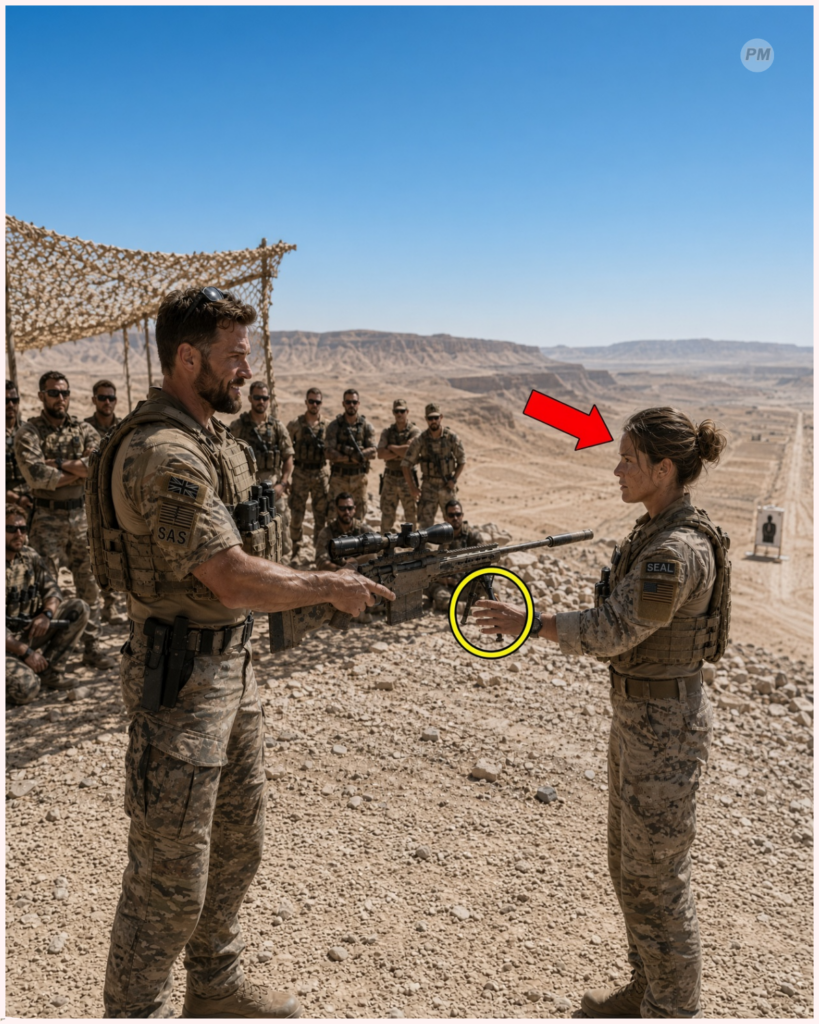
When a British SAS sniper shoved a customized rifle toward a quiet Navy SEAL and smirked, “Want to try?”
He didn’t realize he was handing a loaded weapon to the deadliest shooter in the fleet.
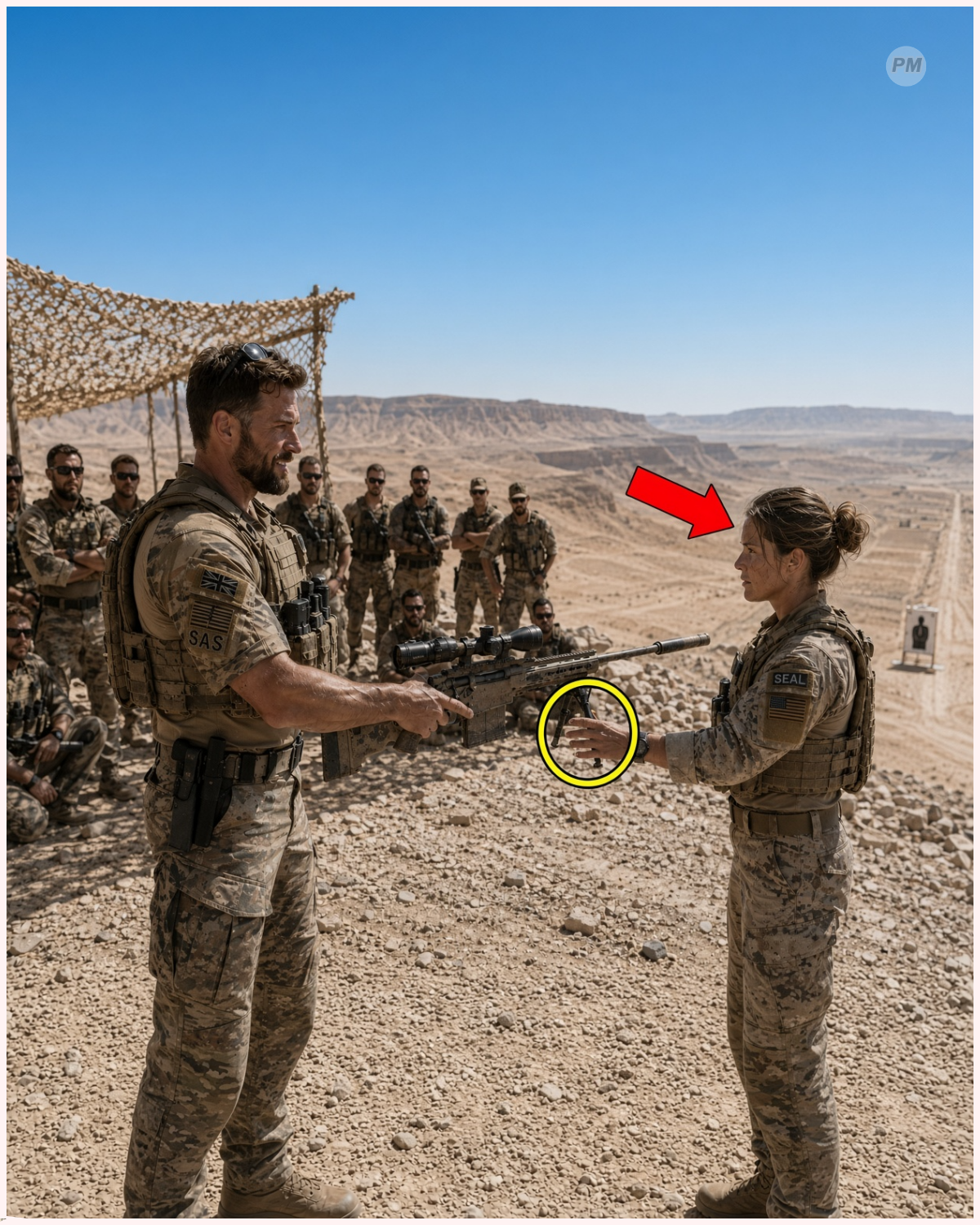
The air over the firing range didn’t just shimmer, it fractured. Heat mirage twisted the barren Djibouti landscape into a watery, vibrating mess.
It was 114° in the non-existent shade. The dirt dirt was the color of crushed bone and it got into everything.
It coated the sweat on the backs of the men’s necks, ground into the threads of their optics, and settled like a bitter film on their teeth.
Camp Lemonnier was a miserable place to sit still, but sitting still was what snipers did best.
A joint NATO training exercise had shoved a detachment of US Navy SEALs and a squad of British Special Air Service operators onto the same dusty stretch of earth for 3 weeks.
Familiarity breeds contempt, but heat and boredom breed something worse. Ego. The long-distance range, a jagged canyon stretching out toward the horizon, had become an unofficial proving ground.
Gareth Davies lay prone in the dirt. The stock of his Accuracy International L115A3 pressed into the pocket of his shoulder.
He was a 14-year veteran of the SAS. He had the relaxed, heavy posture of a man entirely comfortable with violence.
He smelled of old sweat, copper, and confidence. “Send it.” His spotter muttered. Gareth exhaled.
The heavy rifle bucked. A plume of dust kicked up from the muzzle break. 2 seconds passed, then a faint metallic tink echoed back down the canyon.
1,200 m. A solid torso hit. A low murmur of approval rippled through the half dozen British operators sitting on surplus ammunition crates behind him.
A few of the American SEALs nodded in grudging respect. It was a good shot.
The wind was fishtailing down the valley, shifting directions entirely every 400 m. Reading it was like trying to predict the path of a fly in a moving car.
Quinn Harper sat 30 yd back, leaning against the sun-baked tire of a Humvee. She wasn’t looking at the steel target at the end of the valley.
She was looking at the dust blowing across the middle distance. Quinn was quiet. She was new to this specific troop, a recent transfer whose file had more black ink redactions than readable text.
The men in her platoon knew she was a SEAL, knew she had made it through the same brutal pipeline they had, but they didn’t really know her.
To them, she was a small, quiet presence who kept her gear impeccably clean and rarely spoke in the mess hall.
She wore the same faded desert cammies, the same scuffed boots, but she lacked the boisterous, chest-thumping energy that usually defined the Tier One community.
She was invisible by choice. Gareth racked the bolt of his rifle, ejecting the spent brass.
It hit the dirt with a dull clink. He was feeling it now. The applause, subtle as it was, fueled him.
Push it out. Gareth said, not taking his eye off the glass. The white plate, what is that?
1,600? 1,640. His spotter replied, peering through a spotting scope. Wind is picking up. Left to right at the muzzle, right to left at the target.
You’re going to have to hold the edge of the plate and pray.” Gareth scoffed.
“I don’t pray.” He settled back in. The range went dead silent. Only the mechanical hum of a distant generator broke the stillness.
Quinn took a slow sip from a plastic water bottle that had been sitting in the sun too long.
The water was hot and tasted like plastic. She watched the mirage. The heat waves near the 800 m mark were leaning hard to the right.
The wind down range was doing something entirely different. It was an impossible read for a standard holdover.
You couldn’t just do the math. You had to feel the way the air was moving in three dimensions.
Gareth fired. The crack of the .338 Lapua Magnum round shattered the quiet. Everyone waited.
The seconds stretched. Nothing. No metallic ping. Just a small puff of dust in the berm, 3 ft wide of the steel plate.
Gareth cursed under his breath. He racked the bolt hard and fast this time. Frustration was creeping in.
He fired again. Another puff of dust, low and left. “You’re chasing the wind, mate.”
The spotter warned. “It’s swirling.” “I’m not chasing anything.” Gareth snapped. He sat up, pushing himself off the dirt, wiping a streak of grimy sweat from his forehead.
He looked back at the peanut gallery. His eyes scanned the American seals, stopping on Quinn, who was still leaning against the tire, her face completely blank.
Gareth’s pride was stung, and he needed a lightning rod. He saw the quiet American woman sitting in the back, the one who hadn’t touched a rifle all day, the one the other Americans seemed to treat with a bizarre, hands-off indifference.
“Something funny, sweetheart?” Gareth asked. His voice carried, cutting through the heavy air. The casual banter on the range died instantly.
A few of the American SEALs shifted uncomfortably. They didn’t know Quinn well, but they knew the unwritten rules.
You didn’t single someone out unless you were ready for the consequences. Quinn didn’t blink.
She lowered her water bottle. “No. You’ve been staring a hole in the back of my head for 20 minutes.”
Gareth said, his tone thick with condescension. He picked up his rifle, holding it by the pistol grip, and walked a few paces toward her.
“You think you you see something that I don’t, or are you just enjoying the show?”
“You’re rushing your trigger press.” Quinn said flatly. “And you’re completely misreading the updraft at the 1,000 m mark.”
A couple of the British operators snickered. A SEAL beside Quinn winced. Gareth stopped. He looked at her, really looked at her, and let out a short, harsh laugh.
He held the heavy sniper rifle out toward her, the barrel angled at the dirt.
“Is that right?” He said, his lips curling into a smirk. “Want to try? Or is the recoil a bit much for you?”
The silence that fell over the firing line was heavier than the heat. Gareth stood there, the expensive, meticulously tuned rifle held out like a dare.
It was a classic trap. If she refused, she proved his point that she was just a tourist in their world.
If she accepted and missed the notoriously difficult 1,640 m shot, she became the punchline to a joke that would be told in every team room from Hereford to Coronado.
Quinn didn’t sigh. She didn’t scowl. She just pushed herself off the Humvee tire. She walked past her own teammates.
They watched her with quiet apprehension. She stopped inches in front of Gareth. She didn’t look at his face.
She looked at the weapon. She took it from him. The L115A3 was heavy, weighing over 15 lb.
But Quinn handled it like it was an extension of her own arm. She didn’t rush.
She walked to the firing line and lay down in the dirt, exactly where Gareth had been.
Careful. Gareth mocked loudly, crossing his arms. Scope bite will leave a nasty mark on that face.
Quinn ignored him. She settled behind the glass. The dirt was still warm from his body.
She didn’t touch his windage or elevation turrets. She needed to know exactly what he had dialed in.
She checked the parallax. She adjusted the ocular focus just a fraction of a millimeter.
She opened both eyes. Through the scope, the world narrowed down to a circle of dancing, distorted light.
The white steel plate at 1640 m looked the size of a postage stamp, bouncing erratically in the heat mirage.
She didn’t look at the target. She looked at the space between the muzzle and the target.
Show, don’t tell. Quinn felt the grip in her right hand. She didn’t squeeze it.
She pulled it straight back into her shoulder, locking the rifle into her skeletal structure so her muscles wouldn’t introduce micro-tremors.
She placed the pad of her index finger on the lower third of the trigger shoe.
She watched the dust. At 300 m, it was drifting right. At 800 m, the mirage was boiling straight up.
An updraft caused by the sun baking a specific patch of black shale. At 1,200 m, a piece of dry scrub brush was twitching to the left.
Gareth had dialed for a consistent left-to-right wind. He was wrong. The bullet was going to get pushed right, lifted by the updraft, and then slammed back left in the final 400 m.
Quinn calculated the spin drift of the bullet. She factored in the Coriolis effect, the actual rotation of the earth beneath the bullet during its 3-second flight time.
She didn’t dial the scope. She used the reticle. She held 2 mils low and 3 and 1/2 mils into the empty dusty air to the right of the target.
You’re holding completely off the plate. Gareth’s spotter muttered, looking through his own glass. You’re aiming at a rock in the berm.
Quinn didn’t answer. She inhaled. The dry, dusty air filled her lungs. She exhaled halfway.
Her heart rate, already slow, dropped further. The crosshairs floated in the empty air, perfectly still.
She broke the trigger. It wasn’t a pull. It was a surprise break. The rifle roared, kicking back violently.
Quinn absorbed the recoil, keeping her eye perfectly aligned with the scope. She watched the trace, the visible ripple in the air caused by the supersonic bullet displacing the atmosphere.
The trace arced high, drifted right, caught the updraft, leveled out, and began to curve back to the left, exactly as the wind caught it in the final stretch.
2 and 1/2 seconds of dead silence on the firing line. Smack. It wasn’t a tink.
It was a vicious, authoritative slap of lead destroying itself against AR500 steel. Dead center.
Nobody moved. Nobody breathed. Quinn didn’t lift her head. With a smooth, mechanical flick of her wrist, she racked the bolt back, ejecting the smoking brass, and slammed a new round into the chamber.
She watched the mirage. The wind shifted slightly. The scrub brush downrange stopped twitching. The updraft settled.
She adjusted her hold. One mil low. Two mils right. She exhaled. She fired again.
The rifle roared. The trace flew. Two and a half seconds. Smack. Another dead center hit.
Two rounds back-to-back at a mile in shifting winds using a rifle she had never fired zeroed for another man’s eye.
Quinn racked the bolt one last time, leaving the chamber empty and the action open.
She pushed the safety on. Only then did she lift her head from the stock.
She stood up. The dirt fell off her uniform. The British spotter was staring through his glass, his mouth slightly open.
Gareth Davis looked like someone had just hit him in the chest with a sledgehammer.
His arrogant smirk was gone, replaced by a pale, tight-lipped shock. The American SEALs were dead silent, staring at the woman they had spent the last two weeks ignoring.
Quinn picked up the rifle by the grip and held it out to Gareth. He didn’t move to take it.
He just stared at her. She stepped forward and pressed the rifle firmly into his chest, forcing him to take the weight of it.
The recoil’s not bad. Quinn said, her voice quiet, completely devoid of triumph or malice.
Just a statement of fact. But your barrel’s heating up. You might want to let it cool before you try again.
She turned and walked back to the Humvee, picked up her plastic water bottle, and sat back down on the ammunition crate.
She took a sip of the warm, plastic-tasting water, her eyes settling back on the dusty horizon, as if the last 3 minutes had never happened.
The reality of special operations is 99% boredom and 1% sheer, unadulterated chaos. 3 weeks after the incident on the Djibouti firing range, the boredom evaporated.
The joint task force was spun up for a time-sensitive target in the Horn of Africa.
The briefing was sterile and brief. A warlord, heavily armed, moving through a ruined border town.
Capture or kill. The operational tempo shifted overnight from lethargic range days to the high-voltage tension of a live raid.
Quinn Harper sat in the belly of the MH-60 Black Hawk. The vibration of the rotors rattling her teeth.
The cabin was completely dark, save for the faint green glow of the pilot’s instrument panels reflecting off the crew chief’s visor.
She smelled aviation fuel, hydraulic fluid, and the sharp, nervous sweat of the men packed in tightly around her.
Gareth Davis sat directly across from her. His face was painted in disruptive patterns of green and black camo cream.
The arrogance from the range was gone, replaced by the hard, blank stare of a professional walking into the unknown.
He held his short-barreled carbine across his chest. His primary sniper rifle was secured in a drag bag.
In close-quarters urban environments, a bolt-action rifle was a liability until you found a perch.
Quinn carried a suppressed SR-25, a semi-automatic precision rifle. It bridged the gap between a sniper system and an assault weapon.
It was heavy, and the suppressor made it front heavy, pulling constantly at her shoulder sling.
She adjusted her plate carrier, shifting the 30 lbs of ceramic armor, magazines, and water off her collarbone.
Her knees ached. The romance of the job had died years ago, replaced by a cynical appreciation for ibuprofen and dry socks.
Overhead radio. Chalk one, 1 minute. LZ is hot. Repeat, LZ is hot. We have small arms fire in the vicinity of the target building.
Nobody spoke. Gareth checked his chamber. Quinn checked hers. The helicopter flared hard, the nose pulling up, gravity crushing them down into their canvas seats.
The doors slid open, letting in the suffocating night air and the distinct popping cracks of AK-47 fire.
Go, go, go! The crew chief shouted over the turbine roar. They poured out into the dust.
The rotor wash blinded them, kicking up a storm of dirt and debris. Quinn moved automatically, trusting her night vision goggles.
The world was a grainy monochromatic wash of emerald green. She found her sector, raising her rifle, scanning the crumbling concrete walls of the compound surrounding the landing zone.
The element moved like water, flowing over walls and through shattered doorways. They were a mixed unit, British SAS pushing the left flank, American SEALs taking the right.
For the first 10 minutes, it was methodical. Breach, clear, move. Then, the ambush snapped shut.
They were pushing through a narrow alleyway connecting two main courtyards when the world tore apart.
It wasn’t random militia fire. It was coordinated. A heavy machine gun, a DShK, opened up from a second-story window at the far end of the street.
The rounds were massive, half-inch chunks of steel designed to chew through light armor. They struck the adobe walls with the sound of a jackhammer tearing into concrete.
Brick shattered. Dust choked the air, instantly blinding their night vision. “Contact front!” Hayes, one of the SEAL point men, screamed, diving behind a burned-out vehicle.
Quinn threw herself flat against a low retaining wall. A volley of rounds chewed through the top of the masonry inches above her helmet, showering her neck in hot grit.
The noise was absolute. The booming thud of the heavy machine gun drowned out their communications.
She ripped her night vision goggles up. In the sudden ambient darkness, she could see the massive muzzle flashes illuminating the second-story window down the street.
“We’re pinned!” Gareth’s voice cracked over the localized comms. His element was stuck on the opposite side of the alley, trapped behind a pile of rubble that was rapidly disintegrating under the DShK’s fire.
Quinn peeked around the corners of the wall. She raised the SR-25. She found the window in her optic, but the angle was wrong.
The gunner was deeply entrenched, firing through a narrow murder hole knocked into the brick.
If she fired from here, she’d be shooting at the wall. She needed an angle.
She looked up. To her immediate right was a three-story residential building, its roof partially collapsed.
It offered a plunging fire angle into the enemy strong point. But to get there, she had to cross 15 ft of open alleyway currently being stitched by heavy machine gun fire.
Hayes! Quinn barked over the radio. I need covering fire. Give me 5 seconds of hate on that window.
You’re out of your mind, Harper. Hayes yelled back. Do it. Quinn didn’t wait for a confirmation.
She pulled her legs up under her like a sprinter in the blocks. She tightened the sling on her rifle so it wouldn’t swing and hit her knees.
The SEAL element opened up. Suppressing fire isn’t about killing the enemy. It’s about making them duck.
The combined roar of five M4 carbines filled the alley. Tracers lashed out, sparking violently against the window frame where the machine gunner sat.
The DShK paused for a fraction of a second. Quinn ran. She didn’t sprint upright.
She stayed low, driving off her toes, a compact shadow moving through the dust. The heavy machine gun roared back to life just as she reached the doorway of the adjacent building.
Sparks rained down on her back as a round clipped the door frame, taking a chunk of the wall with it.
She tumbled into the dark interior, coughing on the plaster dust, her heart hammering against her ribs like a trapped bird.
She was in. Now, she had to climb. The interior of the building smelled of rot, old spices, and raw sewage.
Quinn didn’t use her flashlight. She pulled her night vision back down, bathing the ruined stairwell in green light.
She moved fast but silently, rolling her feet from heel to toe, avoiding debris. The stairs were missing chunks of concrete.
The structural integrity of the entire block was questionable at best. Down in the street, the firefight was reaching a fever pitch.
The SAS element, Gareth included, was pinned tight. Over the comms, Quinn heard the strain in their voices.
The rubble they were using for cover wasn’t going to hold much longer. She reached the third floor.
It was a single, large room facing the street. The roof had taken a mortar hit years ago, leaving a jagged hole that exposed the night sky.
Quinn crawled on her belly toward the street-facing wall. She didn’t go to the window.
Amateurs shoot from windows, silhouetting themselves against the dark interior. Professionals shoot from the shadows, deep inside the room, firing through a loophole.
She found a jagged crack in the masonry near the floorboards. It gave her a clear line of sight straight down the alley, directly into the side of the enemy’s strong point.
She slid the bipod legs of her SR-25 open and planted them on the uneven floor.
She pushed her body weight directly behind the rifle, loading the bipod so the weapon wouldn’t jump.
She settled her eye behind the optic. Show, don’t tell. The geometry was completely different up here.
She was looking down at a 30° angle. Shooting at a downward angle means gravity has less perpendicular effect on the bullet’s flight path.
The bullet will strike high if you don’t account for it. She ranged the target.
210 m. Point-blank for a sniper, but the environment made it a nightmare. Smoke from the burning vehicle below was drifting up, obscuring the target and distorting the ambient light.
Through the scope, she finally saw the machine gunner. He was a large man, protected by sandbags, violently working the spade grips of the DShK.
But there was someone else. Deep in the shadows behind the gunner, a second figure was moving.
This one wasn’t frantic. He was calm. He was holding an SVD Dragunov sniper rifle, resting the barrel on a sandbag, waiting for one of the NATO operators below to break cover.
It was a textbook L-shape ambush. The heavy gun pins you down, the sniper picks you off when you try to run.
Quinn keyed her mic. Her voice was flat, devoid of panic. Gareth Harper, do not move.
You have an enemy marksman waiting for you to break. My cover is gone, Harper.
Gareth grunted over the net, his breathing heavy. We have to move in 10 seconds or we’re getting chewed to pieces.
Quinn exhaled. The dust from the floorboards blew away from her lips. She had two targets.
One massive threat suppressing the element, one precision threat waiting to execute them. She had a semi-automatic rifle.
She could take them both, but the transition had to be flawless. She dialed the magnification on her scope down to give herself a wider field of view.
She centered the crosshairs on the designated marksman in the shadows. He was the immediate lethal threat to Gareth.
She pressed the trigger to the wall, feeling the crisp metallic resistance right before the break.
She fired. The suppressed SR-25 coughed. The recoil pushed straight back into her shoulder. Through the scope, the shadowy figure slumped backward, his rifle clattering against the brick wall.
Before the brass casing even hit the floor beside her, Quinn swung the rifle 2° to the right, driving the reticle onto the heavy machine gunner.
The gunner hadn’t even registered the man dropping behind him. He was still holding down the trigger, the DShK vibrating violently.
Quinn didn’t aim for center mass. The sandbags covered his chest. She aimed for the narrow gap between the gun’s armor shield and his helmet.
A space no bigger than a grapefruit. She fired again. The heavy machine gun stopped abruptly.
The massive echoing booms in the alley died, replaced by the ringing silence of a sudden ceasefire.
The gunner slumped forward, draping heavily over the spade grips of his weapon. Down below, the silence stretched for two long seconds.
Then the assault element surged forward, closing the distance, clearing the remaining structures with brutal efficiency.
Quinn didn’t move. She stayed on the gun, scanning the dark corners of the enemy room, waiting for another target to present itself.
Only when Hayes called “Building secure.” Over the net, did she engage the safety on her rifle.
She pulled herself back from the wall, stood up, and brushed the filth off her plate carrier.
Her hands weren’t shaking. They never did. 10 minutes later, the task force consolidated at the extraction point.
The helicopters were 3 minutes out. The men were quiet, adrenaline crashing, leaving them hollow and exhausted.
Gareth Davies sat on a ruined concrete block. His uniform was torn, his arm bleeding superficially from flying masonry.
He looked up as Quinn walked past, her heavy rifle slung across her back, her face hidden behind the green glow of her night vision mounts.
He didn’t smirk. He didn’t offer a cocky remark. He stood up, towering over her, and stepped into a path.
Quinn stopped, looking up at him, her expression blank. Gareth didn’t say a word. He simply reached out and tapped his fist twice against her shoulder plate.
A quiet, undeniable acknowledgement. Quinn nodded once. She walked past him and took a sip from her plastic canteen.
The water was warm and it tasted like plastic. It tasted exactly like victory. Ego talks, but survival proves the point.
From a dusty range in Djibouti to a brutal rooftop in the Horn of Africa, Quinn Harper showed that the deadliest operators don’t need to brag.
They let the brass do the talking. If you appreciate gritty, grounded stories about the reality of tactical mastery, hit that subscribe button right now.
Leave a like, share this video with someone who respects quiet professionals, and stay tuned for the next mission.