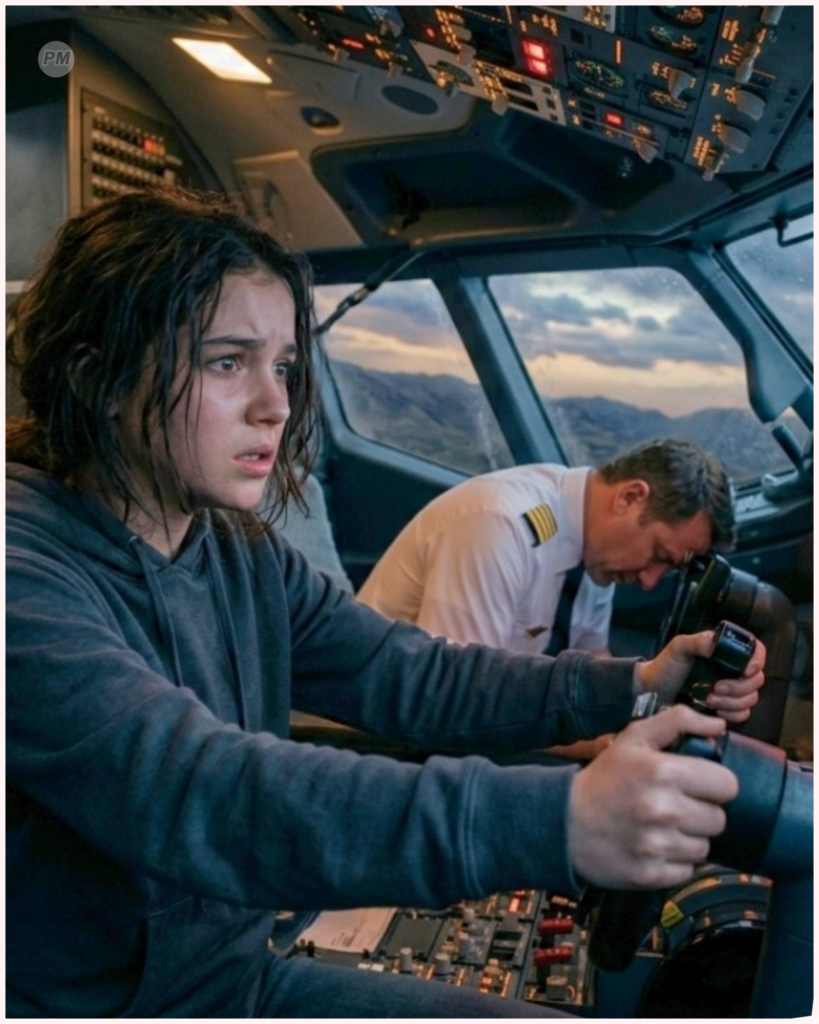
She wondered what they were making of it
She wondered what they were making of it. She didn’t have to wonder long. The radio crackled on the emergency frequency.
Flight 801, this is tango flight lead. We’re alongside to escort. State your status. Tango lead.
This is flight 801. Sarah said, “Both flight deck crew are incapacitated. I have manual control.
Currently managing a hydraulic pressure loss on system 2 in a flight control response issue.
Estimating Edwards in approximately 30 minutes.” A pause, not a long pause. A 3-second pause, which on a military frequency means something different than 3 seconds anywhere else.
On a military frequency, 3 seconds is the sound of someone recalibrating. The voice that came back was measured, but there was something underneath it.
Flight 801. Can you confirm the name you gave Edwards center? Sarah Caldwell. Confirmed. Another pause.
Shorter. Ghost talk. It wasn’t quite a question. It wasn’t quite a statement. It was the sound of the man confirming something he already knew the answer to.
Sarah said nothing. This is Captain Garrett Briggs. The voice continued. I flew out of Bram in 2017.
You wouldn’t remember me, but I remember you. You pulled a full burn intercept at night in a crosswind that my whole squadron said was unservivable.
Then you landed clean. Sarah kept her eyes on the instruments. I remember the landing, she said.
Yes, ma’am. I figured you would. A beat. I’ve told that story at every squadron dinner for 7 years, and I just told Edwards that ghost hawk is on the stick.
His voice had found its register now, past surprise, and into something steadier. They asked me if I trusted it.
I told them to clear the runway. Sarah did not let herself feel the thing that tried to move through her chest at that.
Appreciate the escort, Briggs, she said. Hold your current position and keep clear of my wing tip.
I may need to make corrections. Understood. We’re with you. She keyed off and went back to the aircraft.
The hydraulic problem was getting worse. System 2 was declining in the gradual uneven way of systems stressed beyond their design parameters.
She had been watching the pressure numbers for 20 minutes. System 2 controlled the left inboard flight surfaces and the nose gear steering actuator.
At the pressure she was seeing now, she had partial function. At the pressure she would likely see by the time she reached Edwards, she would have less.
She could manage that. What she could not manage as cleanly was the flap situation.
She reached for the flap handle and moved it to 15°. The left flap extended normally.
The right flap moved to 22° and stopped. She tried it again. 22°. The actuator was reading a jam.
Mechanical obstruction somewhere in the right outboard track. She cycled it twice more with the same result and then stopped cycling it because you don’t keep asking a broken thing to be unbroken.
You accept what you have and you build a plan around it. What she had was asymmetrical lift.
The aircraft wanted to pull right. It was doing it subtly now at cruise speed.
A gentle persistent pressure that she was countering with left aileron input and left rudder.
Her foot braced on the pedal as muscles of her lower leg beginning the long slow burn of sustained exertion.
At approach speed with the left flap fully extended and the right at 22, the asymmetry would be more pronounced.
She would need more rudder, more aileron, more of everything. She would need her body to keep doing what it was doing for another 25 minutes.
Her right leg was beginning to argue. She pressed the rudder and held it and breathed and looked at the horizon.
Ryan Beckett had been in aviation for 11 years. And in those 11 years, he had developed what he thought of as a professional relationship with fear.
Not the elimination of it. You didn’t eliminate it. You learned where it lived, and you learned to work around it.
You just didn’t put anything near that heat that you couldn’t afford to lose. He moved through the cabin with a thorowness that was partly professional and partly the need to keep moving.
He checked seat belts. He redistributed oxygen masks. He spoke in a low, steady voice to the people who met his eyes and said nothing to the ones who had found a private space inside themselves and were managing from there.
There was a woman in row 14 who was praying. Her lips moved without sound and her hands were flat on her thighs and her eyes were closed.
Ryan adjusted the shade on the window beside her and moved on without disturbing her.
There was a man in row 19 who had been a pilot once. Prop planes, he said 30 years ago.
Small stuff, Cessnas. But I know enough to know she’s doing something up there that isn’t easy.
Ryan agreed that she was. There was a child in row 7, a girl of about five, who had fallen asleep against her mother’s arm with the magnificent indifference to catastrophe that only very young children and the very old can achieve.
Her mother was not asleep. Her mother was staring at the seat back in front of her with the focused stillness of someone who had made a decision to hold it together and was keeping that decision one breath at a time.
Ryan gave her a bottle of water and a look that tried to say everything that words in a cabin full of listening people could not say.
She took the water and nodded and went back to holding it together. He was passing the forward galley on his third sweep of the cabin when the secondary communication line crackled.
The channel that ran directly from ground operations to the cabin crew, which Ryan had used exactly twice in his career, he picked up.
The voice on the other end was clipped and official. This is agent Marcus Webb, National Transportation Safety Board, coordinating with the FBI field office in Los Angeles.
I need to speak with whoever is managing the cabin on flight 801. This is Ryan Beckett, senior flight attendant.
I need you to relay a message to your pilot. Can she take a communication on the dedicated emergency channel frequency 121.775?
I’ll tell her. Ryan went to the cockpit. He knocked once. He pushed the door open.
Sarah was exactly as he had left her. Hands on the yolk, eyes moving in their precise, professional sweep.
The two F-16 IIS were visible at the edge of the view, one off each wing hanging there with the patience of machines that had been told to stay.
There’s a federal agent asking to speak with you, Ryan said. NTSB coordinating with FBI frequency 121.775.
She did not look up. Get me the frequency. He reached across and dialed it.
She keyed the radio. Flight 801, this is Caldwell. Captain Caldwell, this is Agent Marcus Webb, NTSB.
We’ve been conducting a rapid review of the maintenance records for this aircraft since your emergency declaration.
I need to make you aware of something. Go ahead. The cockpit air quality sensor, the device that should have detected contamination in the avionics bay ventilation and triggered an automatic alarm, that sensor was deactivated.
It was not a malfunction. The deactivation was performed manually during a scheduled maintenance inspection 4 days ago by a technician named Craig Dver.
Dver was terminated by the airline 3 weeks before the inspection he was not authorized to be performing.
The cockpit was very quiet for a moment. You’re telling me the sensor was disabled on purpose?
Sarah said, “We’re telling you the evidence is consistent with that conclusion. There is an ongoing investigation and no final determination has been made.
But captain, you need to understand that this aircraft was not adequately protected from the condition that incapacitated your crew, and the absence of that protection appears to have been deliberate.
Sarah looked at the instruments. She thought about the blank display she had found in the cockpit when she first sat down.
The indicator that was dark before she ever touched a switch. She had known something was wrong with that panel the moment she saw it.
Now she knew the shape of what was wrong. Is there anything in that information that changes what I need to do in the next 20 minutes?