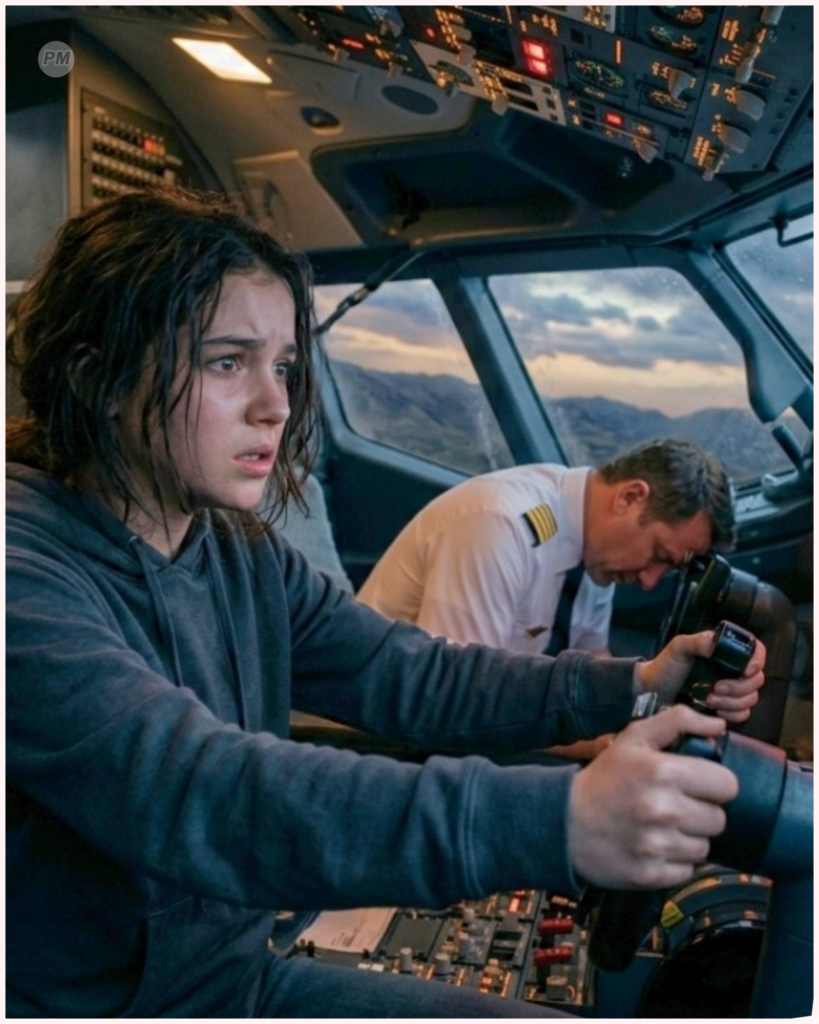
I didn't think it would be like this
I didn’t think it would be like this. Sarah took the envelope. She looked at the handwriting on the front.
She knew every angle of it. She had known it from briefing notes and log books and the back of a photograph she had carried for 5 years.
Her name in his hand. She did not open it immediately. She held it in both hands and breathed and understood that this was one of the moments that a life pivots on that she would remember the quality of the light in this room and the sound of the base outside the window and the expression on this young man’s face for as long as she had a life to remember it with.
Then she opened it. The letter was two pages handwritten. The pemmanship of someone who had grown up before typing replaced thinking through your fingers.
She read it privately, each line arriving and settling before the next one came. He wrote about the mission.
He wrote about the decision he had made in the air that day, the one she had never known about the one that had taken him out of position to cover someone else and left her without a wingman in the window that mattered.
He wrote that it had been his call entirely his made in the 3 seconds available to him and made because he believed it was right and would make it again, even knowing the outcome.
He wrote, “I need you to hear that it was not your fault. I need you to hear it from me because I know you have been arguing with a version of events that leaves you responsible for something you did not do and could not have changed.”
He wrote about the sky. He wrote about what it meant to him to fly not the technical dimension of it, not the career of it, but the essential fact of being a person who moved through the air and found in that movement something that could not be found on the ground.
A clarity, a simplicity, a version of yourself that was only available at altitude. He wrote, “If Ghost Hawk is still flying, tell her I never blamed her.
Tell her the sky isn’t the place where I died. It’s the place where I was most alive.
Don’t let her leave it because of me.” And at the bottom, in the same handwriting that had written for now, the same pen, the same loops.
The numbers always matched when you were flying. That’s the thing I want you to know.
Sarah folded the letter. She sat in the chair beside James Holt’s bed, and she held the envelope in both hands, and she did not look at anything for a while, just down at the envelope, at her own hands around it, at the particular reality of something that had been true for 5 years and was only now being delivered.
James let her sit. He was his brother’s brother in that way, the same understanding of when a person needed to be left to something.
After a while, Sarah reached into her pocket and took out the photograph. She set it on the table beside the bed.
She set the letter beside it. Two pieces of the same story from opposite ends of meeting on a surface in a room in the California desert.
He was the best wingman I ever had, she said. Her voice was steady. It was always steady.
But there was something in it now that had not been there before. Something that had come through from the other side of steady, from the place beyond control where things were simply true.
James looked at the photograph. He looked at his brother laughing beside an F-15. “Yeah,” he said.
He was like that with everyone. Sarah stood up. She put the photograph back in her pocket against her heart where it had lived for 5 years and where it would live for the rest of whatever came next.
She left the letter on the table for James because it was his two had always been his too.
At the door, she stopped. When you’re back in the air, she said without turning around.
Fly the way he talked about it. How did he talk about it? Like it mattered.
She walked out into the hallway. She walked to the end of it and stood at the window and looked out at the desert for a long time.
And what moved through her was not grief. Or not only grief, it was something that had been stored under pressure for 5 years.
Finally finding a release valve, not exploding, just releasing the slow and complete exhale of something that had been held past the time for holding it.
She breathed out. She breathed in. She was still standing at the window when Colonel Frank Harmon found her.
He had driven from the Pentagon, which was the kind of thing Frank Harmon did, without announcement or explanation.
He arrived the way he had always arrived with the economy of someone for whom preparation was habitual.
An entrance was just a function of being wherever he needed to be when he needed to be there.
He was older than she remembered from the last time she had seen him, which was 5 and 1/2 years ago in a hallway at Langley, where she had handed him her resignation, and he had accepted it without argument, which had been, she understood now, his form of respect.
He found her at the window and he stood beside her and looked out at the same desert for a moment before he spoke.
Hell of a morning, he said. “Yes, runway 22 left is going to have to be resurfaced.
You left a considerable amount of tire on it.” She almost smiled. They stood side by side for another moment in the way of people who have shared enough history that silence between them is a form of communication.
Then Harmon reached into the breast pocket of his jacket and drew something out and held it in his palm between them.
Metal wings, small, the kind issued to Air Force pilots on certification worn on the left chest of the uniform above the name tape.
Hers. She knew them by the small scratch on the lower left pinion where she had knocked them against the fuel gauge housing in an F-15 cockpit her second year and had never had them replaced because the scratch was accurate and replacements wouldn’t have been.
You turned these in, Harmon said. I did. I kept them. He didn’t offer a reason.
He didn’t have to. She understood that it was the same impulse that had made James Holt carry an envelope for 4 years.
The refusal to let go of something that wasn’t finished. There’s talk of a formal commenation.
Harmon said, “FAA, probably D as ao, you’ll be called to Washington.” I know. I told them you wouldn’t want a ceremony.
You were right. I told them you’d accept a letter in a handshake. That’s generous.
I’ll take the letter. Harmon closed his hand around the wings for a moment, then opened it again and held them out to her.
She looked at them in his palm. She picked them up. They were exactly as heavy as she remembered, which is to say not heavy at all.
The weight of a small piece of stamped metal, the weight of nothing except what they represented, which was not nothing at all.
She put them in her pocket beside the photograph. Harmon nodded once the nod of a man who has done what he came to do and is at peace with it.
The Air Force is reviewing options, he said. If you ever wanted to come back in any capacity, consulting instruction, evaluation, nothing operational.
Nothing that would require you to be anyone you don’t want to be. I’ll think about it.
That’s more than you said last time. He pulled his jacket straight. That’s enough. He left the way he had arrived without performance without looking back.
She watched him go and then she turned back to the window in the desert.
And after a while she stopped seeing the desert and started seeing what was beyond it.
The long flat interior of the country, the plains and the river valleys. And somewhere in Ohio, a small airfield and a Cessna 172 and a retired instructor named Pete Callahan who had left her a voicemail 3 months ago asking if she ever wanted to take a plane up just for the sake of it, just to remember what it felt like.
She had not returned the call. She was going to return it now. The debrief with Agent Webb took 4 hours and covered everything from the moment she had first noticed the vibration in her seat to the final break application on runway 22 left.
She gave him the technical detail he needed in the chronological sequence his report required.
And at the end, she signed three documents and was given two business cards and told that her cooperation would be appreciated.
She told him she would cooperate fully. She meant it. The media request list, which the BAS’s public affairs office delivered to her on a printed sheet at the end of the afternoon, ran to 37 outlets.
Morning shows, cable news networks, newspapers, podcast producers, a documentary company, and four separate entities describing themselves as literary agents.
She read the list carefully. She gave it back. The public affairs officer looked at her with the professional composure of someone absorbing a disappointment they had been trained for.
“Is there anything you would like us to communicate on your behalf?” He asked. Sarah thought about it.
Tell them the aircraft is out of service pending inspection, she said. Tell them the crew is recovering.
Tell them the passengers are safe. She handed him back the list. Everything else that matters is in the flight data recorder and she left the base at 6:00 in the evening, driven by a liazison officer to a hotel in Lancaster.