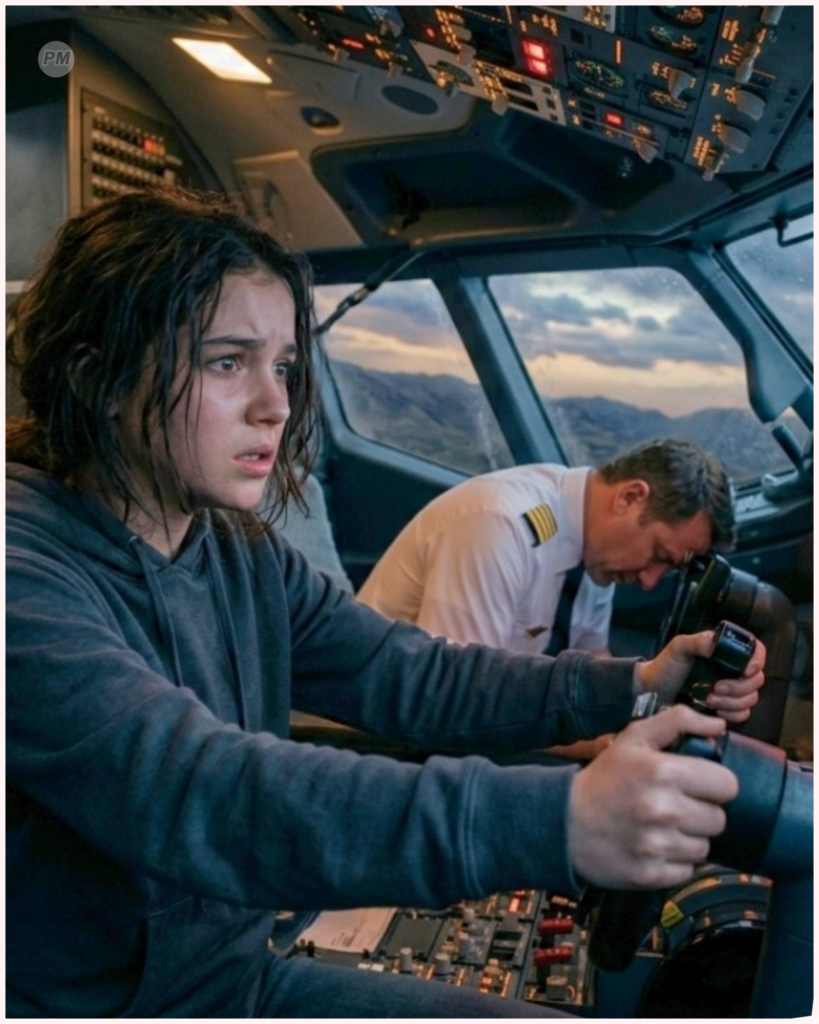
Red and white lights cutting across the morning de…
Red and white lights cutting across the morning desert coming toward her from both sides of the runway with the speed of people who had been waiting and were now done waiting.
She took her hands off the yolk. She sat back. She looked at the desert through the glass flat and brown and brilliant in the morning light.
The kind of landscape that didn’t apologize for anything that just was what it was and that had been here before her and would be here after and did not need her to have done anything remarkable to keep existing.
She found that restful in a way she couldn’t fully explain. In the right seat the first officer breathed.
His name was James Holt and she did not know yet what that meant. She keyed the intercom for the last time.
Ladies and gentlemen, this is Captain Caldwell. We are on the ground at Edwards Air Force Base.
Emergency crews are alongside. Please remain seated with your seat belts fastened until the crew instructs you otherwise.
She paused. It has been an honor to fly with you today. She set down the handset.
Outside the first of the emergency vehicles reached the aircraft. The world was coming back in all of it.
But not yet. For now there was only the desert and the silence of an aircraft that had carried everything asked of it and arrived and a woman in the left seat who had done the same.
For now that was enough. The first thing they did was open the doors. Not the cockpit door, the cabin doors, the rear ones first, the way protocol required.
And the air that came in was desert air, dry and sharp and carrying the particular clarity of high altitude California morning.
The kind of air that had never been breathed before by anyone and would never be breathed again in quite this combination of molecules and motion.
320 people took that first breath of outside air simultaneously. And the sound they made was not applause, and it was not crying, and it was not anything that would translate cleanly into language.
It was the sound of bodies remembering that they were alive, which is a sound most people only hear once or twice in a life and never forget after.
Sarah heard it through the cockpit door. She sat where she was. The emergency crews had boarded within 2 minutes of the aircraft stopping paramedics first, then hazmat in their full protective gear, then base personnel moving with the organized urgency of people who had drilled for this and were discovering that the drill, however thorough, had not fully prepared them for the reality of a commercial aircraft on their runway with a woman in the captain’s seat who was not the captain.
She answered their first questions without turning around. Pilot identification, medical status of flight deck crew, last known fuel state, hydraulic system condition.
She gave them everything they needed in the order they needed it efficiently and without embellishment.
When the lead paramedic reached the cockpit and began working on the first officer, Sarah finally stood.
She stood slowly, not from weakness, though her right leg registered a complaint she acknowledged and set aside.
She stood slowly because the transition from the person responsible for everything to the person responsible for nothing required a moment she had learned over the years to take deliberately.
She picked up her canvas bag from the floor. She looked at the first officer one more time.
James Halt, 27 years old. His color was better now. The oxygen had been working for 40 minutes and it showed the flush of hypoxia giving way to something closer to normal.
His breathing deeper and more regular. One of the paramedics had a hand on his wrist and was counting, and the number on his face was a good number, the number of someone who was going to be fine.
She did not know yet that she knew him. She turned and walked out of the cockpit.
The cabin was largely empty by the time she reached the aisle, the rear rows already deplained through the back doors, the middle rows moving in the careful, slightly dazed shuffle of people who were not entirely trusting their legs yet.
Ryan Beckett was at the forward door directing the remaining passengers with a precise economy of someone who had been running on adrenaline for 90 minutes and had decided through sheer professionalism that the adrenaline could wait until everyone was safely off the aircraft.
He saw her. He looked at her for a moment with an expression she couldn’t fully read.
Something layered and complicated that lived behind his professional composure. And then he gave her a single nod, the kind of nod that means more than it looks like, and went back to his passengers.
Sarah walked to the door and stepped out into the California morning. The brightness was immediate and total as desert sun at 9:00 in the morning, having made its decision about the day and committed to it fully.
She stood at the top of the mobile stairs and looked out across the airfield.
The emergency vehicles had arranged themselves along both sides of the runway in the ordered formation of a response that had been waiting and was now executing.
Beyond the perimeter fence, there were cameras. She had expected them. News traveled faster than aircraft now.
And the story of a passenger taking control of a commercial flight was the kind of story that moved at the speed of a text message.
She understood that the life she had been living for 5 years, the quiet, unremarkable life of a woman who had walked away from everything she was, that life had ended somewhere over the Pacific.
She walked down the stairs. Agent Marcus Webb met her at the bottom. He was younger than his voice had suggested mid-40s with the careful grooming of a federal official who had learned that appearance communicated authority before words could.
He had a tablet under his arm and a look on his face that was professional and thorough.
And underneath both of those things, genuinely relieved, he shook her hand. Captain Caldwell, I want to be the first person to say that what you did this morning was extraordinary.
I’d prefer you to be the first person to tell me the status of the flight crew, she said.
He took that without offense. Captain Morrison is conscious and stable. He’ll be transferred to Analopee Valley Hospital within the hour.
The first officer is still unconscious, but his vitals are strong. The medical team expects a full recovery for both.
Sarah nodded. And the investigation Webb fell into step beside her as a base liaison directed them toward the mobile command vehicle.
Inside it smelled like coffee and electronics and the particular tension of a situation that was still being processed.
We’ve confirmed the mechanism of incapacitation, Webb said, pulling up a technical diagram on his tablet.
A slow accumulation of fumes from the avionics bay conducted through a gap in the cockpit ventilation system.
Under normal circumstances, the air quality sensor would have detected elevated levels within 15 minutes and triggered both an audible alarm and a ventilation redirect.
The sensor that was manually disabled, Sarah said. Yes, he met her eyes. We have Craig Dver on video in the maintenance bay 4 days ago.
He had been terminated 3 weeks prior. He used a former colleagueu’s access badge to enter the facility.
He was in that bay for 11 minutes. Long enough. Why? Webb paused. Not because he didn’t have the answer, because the answer was the kind that resisted simple framing.
Dver filed a wrongful termination suit 6 months ago. It was dismissed. He filed an appeal that was dismissed as well.
He had been with Pacific Airways for 14 years. Webb looked at the diagram. We found a journal.
It’s consistent with someone who had decided that if the institution wouldn’t hear him, he would make himself hurt another way.
He didn’t target a specific flight. He targeted a specific aircraft. He didn’t know who would be on it.
Sarah looked at that for a moment. The terrible arithmetic of a man’s grievance and 320 people who happened to be on the wrong aircraft on the wrong Friday morning.
He’s in custody. Arrested this morning. Federal charges. Sarah looked out the narrow window of the command vehicle at the aircraft sitting on the runway.
From this angle, it looked entirely ordinary. Silver fuselage. Pacific Airways livery. The kind of machine that flew this route three times a week without incident without anyone in row 23 needing to know what a hydraulic pressure reading meant.
I’ll give you whatever you need for the investigation, she said. Full statement, technical debrief, flight data walkthrough, whatever is useful.
We’ll need a few days to compile the flight data recorder information before the formal debrief.
Web set his tablet down and looked at her directly. I’ve been doing this for 18 years.
I’ve worked engine failures, structural events, pilot incapacitation. I have never in 18 years seen anything remotely like what you did this morning.
He held her gaze. How did you know you could do it? Sarah thought about that honestly.
I didn’t, she said. I just knew I was the only one who had a chance.