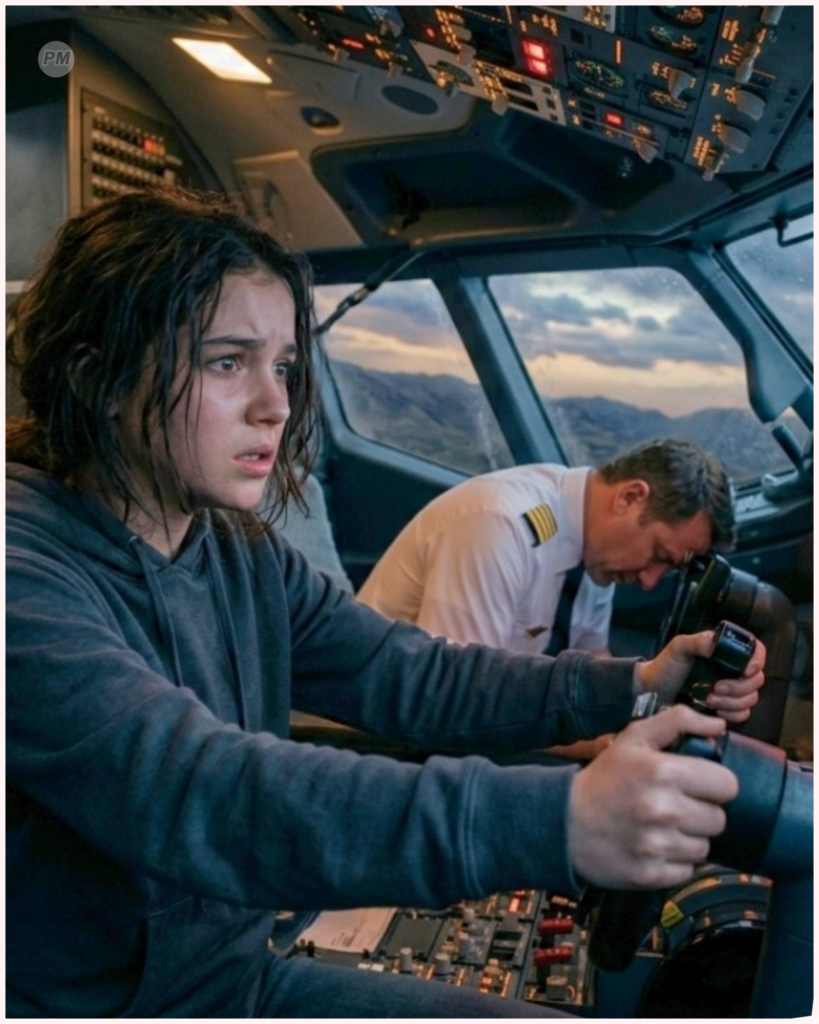
But Sarah knew better than to trust the instrument…
But Sarah knew better than to trust the instruments alone. She could feel the aircraft the way you feel a conversation going wrong before anyone says the wrong thing.
Something in the pressure of the yolk. Something in the very slight resistance when she made small corrections.
A heaviness that had no business being there at cruise altitude and still air. The hydraulic system was not failing.
Not yet. But it was not well. She kept her hands light. You never fought an aircraft that was still willing to fly.
You guided it. You So you reasoned with it. You asked it through the thousand small conversations of pressure and trim and throttle to keep doing what it knew how to do for just a little longer.
The captain had lost consciousness 3 minutes after she took the left seat. He had gone the way people go when the body is done negotiating, not dramatically, not with warning, but with a kind of quiet finality, his head settling back against the seat and his breathing going deep and slow and beyond his control.
She had checked his pulse strong enough. She had repositioned his oxygen mask and told herself he would be fine, which was the only thing she could afford to tell herself right now.
The first officer had not moved. Sarah did not look at him again after the first time.
There was nothing she could do for him and everything she could do for the 320 people behind her.
And she was not a woman who spent energy on what she couldn’t change. She had learned that the hard way and she had learned it permanently.
The radio was active. Edward center had handed her off to a dedicated frequency with a single controller whose job was now entirely Flight 801.
His name was Stu Harwick and his voice had the particular quality that good controllers shared with good pilots.
An unhurried authority that communicated competence without performing it. He gave her altimeter settings and wind data and the weather picture between her current position and the California coast.
And he did it clearly and without embellishment because she didn’t need anything from him except information.
She updated him on the hydraulic pressure. She gave him a fuel state. She told him her current descent rate and her estimate for the coast.
And he fed all of it into the coordination happening on his end. The emergency vehicles being staged, the airspace being cleared, the notifications being made to people whose job it was to prepare for the various ways this could end.
Sarah filed those possibilities and focused on the outcome she intended to produce. Behind the closed cockpit door, the cabin was doing what cabins do when 300 people have been told something terrifying by a voice that didn’t sound terrified.
They were holding on. They were holding each other. They were staring at the backs of headrests and out of small oval windows at the Pacific Ocean and doing the private arithmetic of mortality that human beings have been doing since the first of them looked up and understood that height has consequences.
Ryan Beckett was managing it. She could hear the intercom clicks brief and regular as he coordinated with Leam Merritt and the rest of the crew.
His voice when it reached the passengers was exactly what it needed to be. Calm without being dismissive, honest without being catastrophizing.
He told them to stay seated. He told them to keep their belts fastened. He told them the crew was trained and the pilot was experienced and that following instructions was the only job anyone in the cabin needed to do right now.
He did not tell them what he was thinking. Neither did Sarah. 40 minutes into the flight from Honolulu, Ryan Beckett had discovered something about himself that he would spend a long time afterward processing.
He had discovered that he was capable of functioning at full professional capacity while carrying a weight in his chest that he could not put down and could not look at directly.
A weight that had no name yet because the words for it were still forming somewhere in the back of his mind.
It had started with a name tag. He had gone to the cockpit to check on Sarah 20 minutes after she took command.
Not because he doubted her. He had stopped doubting her within 30 seconds of watching her work.
He went because it was his job to be useful and he had nothing else to offer except presence.
The small gesture of another person letting you know that you are not entirely alone.
She had not needed his presence. She had not needed anything from him except for him to stay out of the way and keep the cabin from coming apart.
And he was doing that. But he went anyway and he pushed the cockpit door open and he stood for a moment in the threshold watching her hands move over the controls with the fluency of someone who had been doing this so long it had stopped being a skill and become an extension of will.
She did not look up. Her attention was on the aircraft. All of it. Every gram.
And Ryan’s eyes had moved the way eyes do when they are looking for something to settle on in a room full of things they don’t fully understand.
And they settled on the first officer in the right seat. On the young man with dark hair who had the careful professionalism of someone still in his first years of the mom, still paying full attention to everything because nothing had yet become routine enough to stop demanding it.
His name tag was visible from the doorway. James Holt, first officer, Ryan looked at it for a moment.
Something moved in his mind. Not recognition exactly, but the early tremor of it, like the feeling you get when a name is almost but not quite familiar.
When the brain is running a search you didn’t consciously initiate. Hold. He had seen that name recently.
His eyes moved to Sarah’s canvas bag on the floor by the captain’s seat. The front pocket was slightly open.
He could see the edge of something inside. The corner of a photograph. He should not have touched it.
He knew that even as he was doing it, his fingers found the corner anyway and drew it out just far enough to see what it was.
A photograph. Two people in flight suits, old enough to have that warmth that photographs get from being handled too many times.
He turned it over without looking at it longer than necessary. The handwriting on the back was loose and confident, the kind of writing that belongs to someone who thinks faster than they transcribe.
We made it out for now. D. He stood there with the single initial. D.
Halt. James Holt. First officer was 27 years old. Ryan knew this from the crew manifest.
If this man had an older brother, that brother would be in his early 30s.
Old enough to have been in the military in 2019. Old enough to have been flying aircraft like the one in that photograph.
Old enough to have known Sarah Caldwell in whatever capacity two people in the same flight suit know each other.
Old enough to have died. Ryan did not know for certain. He was constructing a story from very few pieces.
And he understood that stories built from very few pieces were often wrong. But the weight in his chest had a name now, and the name was grief anticipatory and secondhand and entirely out of place in a cockpit at 36,000 ft.
But real in the way that all uninvited things are real. He slid the photograph back into the front pocket of the bag.
He straightened up. He looked at Sarah Caldwell, who was still working, still entirely present in the aircraft, still doing with complete focus, the thing that was keeping every person on this plane alive.
She did not know. Ryan Beckett stood in the doorway of that cockpit for three more seconds.
He breathed in. He breathed out. He filed everything he had just understood into a place where it could not interfere with what he had to do next.
And then he turned around and walked back into the cabin and went back to work.
He sat in the forward jump seat for a moment before standing again. His hand pressed flat against his chest pocket, holding it there briefly, feeling nothing through the fabric because the photograph was back in Sarah’s bag.
He could not have said why he was doing it. He did not try. He stood up.
He went back to his passengers. He kept going. The F-16 appeared at roughly the same moment the hydraulic problem became impossible to ignore.
Sarah saw them in the peripheral sweep of her instrument scan. Two shapes resolving out of the high blue to the northwest, flying a converging course with the precise geometry of military escort.
She did not have to look at their profiles to know what they were. The proportions were in her muscle memory.
She had flown beside aircraft like these for 10 years. She had been one of the people in them.
They pulled up on either side of flight 801 with the smooth confidence of pilots who owned this part of the sky.
Their wing markings were Edwards. They were close enough for Sarah to see the cockpit glass and close enough for the pilots inside to see her.
She could imagine what they saw. A commercial Boeing, a woman in the left seat, no uniform, a canvas bag on the floor.