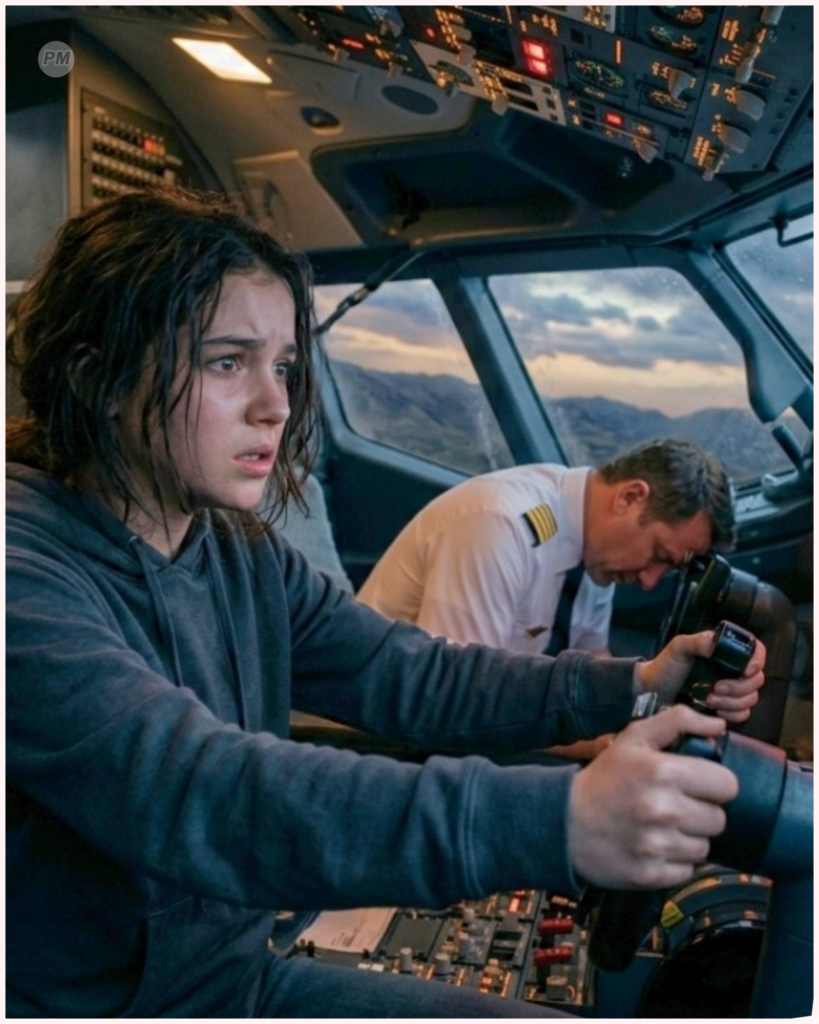
She did not know why she kept thinking about him
She did not know why she kept thinking about him. She told herself it was nothing.
Professional habit. The way doctors clock other people’s symptoms without meaning to. The way architects see structural flaws in buildings while having dinner inside them.
You spent enough time in a cockpit and you started reading flight crews the way civilians read faces.
It was automatic. It meant nothing. She turned a page she hadn’t read and let the boarding noise wash over her.
That was when her hand found the photograph. She hadn’t planned to look at it.
She had tucked it into the front pocket of her bag 3 days ago without much thought.
The way you put something in a place where you know it is, but don’t have to look at it directly.
An arms length arrangement, a manageable distance, but her fingers found the edge of it anyway.
And she drew it out. It was old. The colors had that particular warmth of a photograph that had been handled too many times.
The corners softened the surface slightly clouded by years and fingerprints and the accumulated weight of being carried everywhere.
She held it between both hands and looked at it. Two people in flight suits, both young, both laughing.
Behind them, a gray expansive tarmac and the unmistakable silhouette of an F-15. Its twin engines like two fists braced against the sky.
She was on the left, he was on the right. She had not looked young in that photograph, even when it was taken, not in the way civilians mean young, soft, and uncertain.
But there was something in her face that was gone now. A particular quality of openness, the expression of someone who had been through enough to know that things could go wrong, but not yet through the thing that would make her stop expecting them to go right.
He was grinning. He was always grinning. It was the most reliable thing about him.
The kind of grin that made the people around him feel like whatever came next was probably going to be all right because how bad could it get when someone standing next to you was smiling like that.
She turned the photograph over. The handwriting on the back was his. She knew every loop and angle of it from years of shared log books and briefing notes and the occasional message left on her instrument panel when he wanted to make a point without starting an argument.
We made it out for now. D he had written it as a joke. That was what she needed to remember.
He had written it as a joke because they were 20 minutes off base after a run that had come closer than either of them was willing to say out loud.
And he had borrowed a pen from the ground crew photographer and scrolled it on the back of the print because that was who he was.
The man who turned the close calls into punchlines because the alternative was sitting with him and he had never been able to sit still.
She had laughed when she read it. She had kept laughing for two more years and then Syria 2019.
And the laughter stopped and everything else stopped with it and nothing she had done in in the five years since had quite managed to restart it.
She put the photograph back in her bag. The plane began to push back from the gate.
Sarah closed her novel and looked out across the cabin past the man with the laptop through the small oval of the window at the heat shimmering off the tarmac outside.
Honolulu was bright and flat under the October sun. The kind of morning that made the world look like a postcard, safe, lit, uncomplicated.
She let herself believe that for exactly as long as it took the wheels to leave the ground, Pacific Airways Flight 801 climbed smoothly out of Honolulu, banking south before curving northeast toward the mainland.
The Pacific opened beneath it, enormous and dark blue and indifferent to the small silver machine cutting through the air above it.
Inside the cabin, the rituals of commercial flight began. Laptops opened, headphones went on, the beverage cart emerged from the forward galley and began its slow progression down the aisle.
Sarah declined everything. She kept her novel open on her lap and her hands still on the armrest, and her attention spread evenly across the cabin, the way you keep a fire low, not consuming, just present.
Always present, she noted Leah Merritt pausing at a row near the back, bending slightly to speak with an elderly couple, her posture easy and warm.
She noted Ryan Beckett moving through the midc cabin, working efficiently, making small conversation with the ease of someone who had decided it was part of the Mong and had chosen to do it well.
She noted the shift in engine tone as the aircraft reached cruising altitude, and the autopilot settled in that slight settling of a machine into its rhythm, the way a long-distance runner finds their pace.
36,000 ft, smooth air, clear skies all the way to the coast. It should have been quiet, and it was quiet.
For a while, Sarah was 40 minutes into a chapter. She had not retained a single sentence of when she felt it.
Not heard, felt a vibration in the seat beneath her that had no business being there.
It lasted perhaps 2 seconds, a subtle, almost subliminal tremor, the kind that might belong to a patch of light turbulence, except that the air outside was perfectly still, and there had been no weather advisory, and the surface of her water bottle was not disturbed in the slightest.
She sat up straighter. The vibration was gone. The engine sounded normal. The cabin continued its unremarkable hum.
Two rows ahead, a child was laughing at something on a tablet screen, and the man with a laptop was typing, and nobody else had moved.
But Sarah’s hands had come off the armrest and into her lap. And her shoulders had shifted back almost imperceptibly, and her eyes had stopped moving in their easy sweep and fixed on nothing, the way the eyes fix when the brain is working on something faster than the body can keep up with.
She knew that vibration. She had felt it before, not on a commercial aircraft, but in training runs, in an actual operations and machines that were being asked to do something their systems hadn’t planned for.
It was the vibration of a compensating system. Not turbulence, not mechanical failure, something internal, a trim correction triggered by a manual input it hadn’t been expecting.
A system responding to something it needed to account for. Something was being corrected up front during cruise, which did not happen on a clean flight.
She waited 5 minutes of sitting perfectly still while her mind ran through every benign explanation it could construct.
Pilot adjusting course manually, a minor navigation, update, routine system check, and found each one slightly less convincing than the last.
Leah Merritt passed her on the way to the forward galley. Sarah watched her go.
The flight attendant’s face was arranged in his professional register. But her walk had a quality Sarah recognized the slightly elevated pace of someone who was not panicking, but had moved two degrees closer to it than they wanted to be.
3 minutes later, Leah emerged from the galley and walked to the phone mounted at the forward bulkhead.
She lifted the handset, waited, set it down, lifted it again, set it down again.
The cockpit was not answering. Sarah uncrossed her legs. She looked around the cabin. The other passengers were largely insulated in their own private worlds.
Headphones and screens and sleepbeat beautiful obliviousness of people who had bought their ticket and release control of everything.
None of them had noticed. People on commercial flights almost never noticed because the entire architecture of modern aviation was designed to make them not notice.
Sarah noticed. She noticed Ryan Beckett now standing at the forward galley entrance speaking quietly with Leam Merritt.
His body angled in the way that people angle when they’re trying to have a serious conversation without appearing to have one.
She noticed the very small tension in the set of his jaw, the particular stillness of a man holding himself together, cuz there are 319 people in the room, and not a single one of them can be allowed to see him not holding together.
She reached under the seat in front of her and opened her bag. Her hand found the black nylon folder inside slim and flat.
The kind of thing that sat quietly at the bottom of every bag she owned because she had not once in 17 years left home without it.
She pulled it out. She opened it inside a laminated FAA commercial pilot certificate, an instrument retaining a type rating for Boeing 737 and 747 platforms.
And behind those still current by four months in airbusting 320 certifications she had maintained out of a habit she couldn’t quite bring herself to break beside those a federal identification card she looked at it for a moment at the photograph on it at the name below the photograph then the intercom chimed it was a different sound from the standard chime shorter lower in frequency and the voice that followed it was Leah Merritt’s carefully composed the voice of someone who had been trained for exactly this moment and was discovering that Training and experience are not the same thing.
Ladies and gentlemen, this is your cabin crew. We apologize for the interruption to your flight.
If there is a licensed pilot aboard any licensed pilot, we ask that you please identify yourself to the cabin crew immediately.
The cabin changed. It changed the way a room changes when someone opens a window in winter.