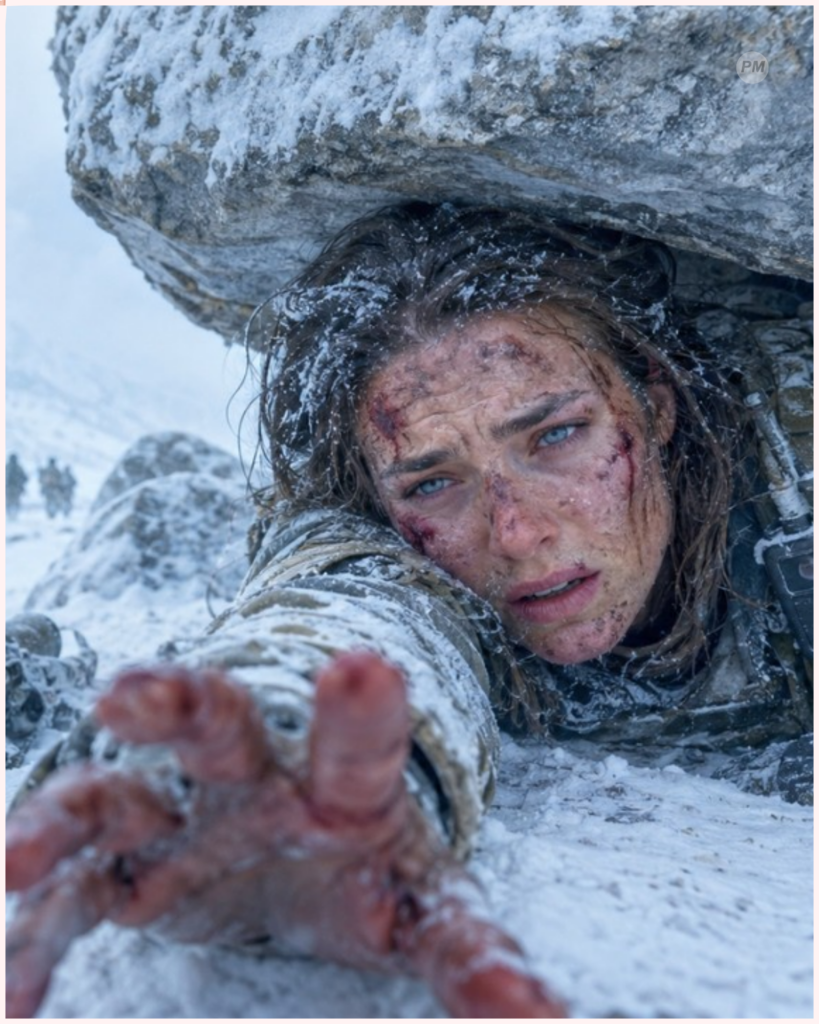
The track that was suggested and then dropped
The track that was suggested and then dropped. The team lead slot she’d been next in line for twice that had somehow never materialized.
Every time she’d been told the timing wasn’t right, the slot wasn’t available. The unit needed her where she was.
She had suspected pieces. She had not seen the whole shape of it until right now.
He had not just sold a route. He had spent four years building a box around her future, one signature at a time and calling it her job.
She was getting reassigned anyway. The sentence in the snow, the careless thing she was never meant to hear, the small, cold animal that had shown her its face.
It had been true. There had been an order. He had processed it. And then he had killed it the way he had killed all the others.
Because a ghost with her own team was a ghost he couldn’t keep close. And a ghost he couldn’t keep close was as a ghost who might one day find something he needed buried.
She breathed through it the way she breathed through pain. Expressing it, acknowledging it, filing it, deciding with great care exactly what she was going to do with it, which was stand here and let it be true in front of witnesses and not give it one inch more of her than that.
And then Fen reached into the folder beside him and produced one more document. He set it on the table in front of Elena.
There’s something else you should see, he said. She looked down at the page. It was a supplemental report filed 3 days ago.
Timestamped 412 hours, less than 2 hours after she’d been pulled off the snow, filed by a soldier who had been on the extraction bird, a soldier who had come back to Phobe Callahan and instead of sleeping, instead of decompressing, instead of doing any of the things a man does after the worst night of his deployment, had sat down and written 11 pages that contradicted point by point almost everything in lark’s afteraction report, filed voluntarily without being asked, without knowing she was alive to ever need The name at the top of the report was Corporal Seth Puit.
Ellena read the first paragraph, then the second. She stopped and she looked away from the page for exactly 1 second, just one.
The only time, 3 days, the only time in this entire long story, from the moment the grenade left the rgeline to the moment she stood in this quiet room on a crutch, that she had needed to look away from anything at all because Puit had not done it for her.
He couldn’t have. He had thought she was dead. He had sat down in the dark believing with no reason to believe otherwise that he was writing a report that would go into a file that a dead woman would never read in service of a truth the dead woman would never know had been told on her behalf.
He had done it because he could not live with the alternative because the training goes only so far.
Because orders and pressure and rank and authority can move a man’s feet, can make him turn and walk 14 steps into a storm against everything his gut is screaming.
But they cannot in the end move a man’s conscience if that conscience is still alive in him.
Because Seth Puit had walked away from a ravine on Christmas Eve following an order he had not been able to refuse and had spent the next 90 minutes on a helicopter trying to make his peace with what he had done and had failed and had landed and not slept and done the only thing left in the world that he could do.
He had written the truth for nobody for her. Elena folded the report carefully with her bandaged hands, put it in the breast pocket of the hospital robe, said nothing about it because there was nothing she could have said that would not have been smaller than the thing itself.
Column spoke and her voice had the quality of a door closing. Captain Arc Jag Council is being contacted.
This session is suspended pending their arrival. You will remain in this facility. She looked at the two military police against the wall and they moved forward with the quiet efficiency of people executing a decision that had already fully been made.
Lark stood. He looked at Elena one more time and she understood in the way he looked at her that he was searching her face for something.
Some last sign that anything he had been to her, any of the four years still registered, still had the power to land.
A flinch, a flicker, some evidence that he could still, even now, even here, manage her.
She gave him nothing. Not anger, not contempt, not the satisfaction of seeing that anything he found in her face still mattered to him.
She gave him the same flat, present, cleareyed attention she gave a target in her scope, completely there, completely beyond his reach.
They took him out of the room, the door closed. And the thing she had been holding at arms length for 3 days.
The thing she had managed by staying focused on the investigation, on mobility, on the surgeon’s criteria, on the next immediate objective, arrived finally all at once.
Not grief exactly, not betrayal in the simple sense. Something more complex and more permanent.
The specific loss of a piece of the framework you’d built your trust on. Piece you hadn’t known was loadbearing until the moment it wasn’t there.
Colum moved to stand beside her. She didn’t say anything for a moment, just stood there present, not filling the space, which Elena recognized as a deliberate kindness and a rare one.
Choice to be there without making the being there about yourself. You okay? Callum said finally working on it.
Fair answer. 3 weeks later, Phobe Callahan, 1400 hours, the fixator was gone. The crutch was gone.
She walked with a slight favoring of the left leg that the physical therapist said would fully resolve within 6 months.
A small unevenness in her gate, pitch you’d only notice if you were looking, and most people weren’t looking.
Her hands were functional. The frostbite healed, the sense seeched back to baseline. She had been cleared for limited duty 2 days ago, and Aldridge had looked at her chart one final time and said with genuine bewilderment in his voice, “Remarkable.
I keep using that word, and I keep meaning it.” She was in Callum’s office when it happened, not a briefing.
She’d been called in informally, which was either good or indicated something she hadn’t anticipated.
And she had been doing this job long enough to know that informal meetings in a base commander’s office were rarely in any real sense informal.
Callum was standing behind her desk. Fen was there, and a third person she had not expected, Brigadier General Warren Hol, theater commander, a man whose name she knew from orders and from the chain of command that existed above her daily operational life.
The way weather exists above a city, present, powerful, and usually entirely abstract. It was not abstract right now.
He was standing in this office looking at her with the focused attention of a person who has reviewed a file very thoroughly and is now comparing the file to the human being in front of him checking the match.
Sergeant Ror, he said, “Sit down.” She sat. He sat. Callum and Fen remained standing, which told her something about the topology of the meeting before anyone said another word.
I’ve read the full afteraction, Holt said the corrected version. The intelligence assessment of the transmitter data, the investigation findings on Lark, he folded his hands on the desk.
I’ve also read six years of your personnel file, your qualification records, your commander’s assessments going back to your first deployment.
Elena said nothing. Your first deployment commander wrote, and I’m quoting directly, “Surgeent Ror demonstrates tactical instincts that are genuinely unusual and an ability to operate under extreme stress that I have not observed at this level in this context.”
Holt looked at her steadily. He recommended you for a specialized reconnaissance track. He noted that you should be considered for team leadership within 18 months.
A pause. That was 6 years ago. You were not given the track. You were not given the team leadership consideration.
You continued as a specialist asset within a line unit. He let it sit. Do you know why?
I have a theory, she said. So do I, he said, and the investigation findings support it.
Lark’s communications with the enemy network include references to a managed unit structure. His words.
Our analysts believe he was deliberately suppressing personnel actions that would have moved you out of his direct authority.
He let that land. He needed you subordinate. A ghost with her own team was a ghost he couldn’t use.
The room was quiet architecture. Someone had built a box around her career, one signature at a time, and called it a road, and told her the lines were for her own good.
“What happens now?” She said. Hol reached into the full folder in front of him and and produced a single sheet of paper.
He turned it to face her and slid it across the desk. She read it.
A promotion order. Sergeant to sergeant first class. Effective immediately with a notation of acceleration citing exceptional operational conduct.
Attached to it, a second document, a unit activation order, joint special operations command task force ghost six billets.
One team lead slot, her name was typed in the team lead line, she read it twice.
The task force activation is contingent on your full medical clearance, Holt said, which your surgeon projects at 8 weeks.
Team selection is yours. You’ll have access to the full personnel roster for the theater and you may request anyone not currently assigned to an active operation.
A pause. The mission profile is reconnaissance and direct action against the remaining nodes of the network identified on your transmitter.
You know the intelligence better than anyone alive. You built the foundation of this operation.
He looked at her. I want you to finish it. She looked at the activation order at the team lead line at her name in that space.
Typed in standard military font, ordinarylooking, entirely unremarkable, and completely extraordinary. She thought about every room she had ever walked into, where the assumption had been that she was in the wrong room, every range score that had been double-checked, every recommendation filed and quietly lost.
Every time she’d been told, in language that ranged from the explicit to the architectural, that the space she was trying to occupy had not been designed for her, she thought about a ravine in a blizzard, and a voice saying, “Then we go.”
And the decision she’d made in the silence after 14th footsteps faded. Not the decision to survive, the decision to complete the objective.
Not because anyone was watching. Not because there was any guarantee that anyone would ever know, but because the mission was the mission and she was the only one left to run it.
Yes, she said, not elaborated, not qualified, just yes. Clean and direct and final the way she made every decision that mattered.
Hol nodded once. Callum picked up her coffee. Fen was already on his tablet, beginning whatever came next.
Alina folded the activation order, put it in her left breast pocket, the same pocket as the photograph.
She stepped out of the office into the corridor and found a quiet corner near a window that looked out over the base.
The sky over Fob Callahan was the particular gray of a sky that hasn’t yet decided what it wants to be.
Not threatening, not clear, just holding the way a held breath holds. She pulled out her phone dialed.
It rang twice. Elena Ruth Ror’s voice. 76 years old and still the clearest sound she knew.
Hey, Grandma. A pause. Specific pause of a woman who has spent 76 years learning to read silences and who can hear in a single spoken name that her granddaughter has been somewhere and come back changed.
Missions done. Elena said Ruth was quiet for a moment. Which one? Elena looked out the window at the gray sky at the base below.
Ordinary and occupied going about the serious daily business of people who had decided that certain things were worth protecting and had organized their whole lives around the protecting of them.
She thought about 41 people who had eaten breakfast that morning without knowing why they were still alive to eat it.
She thought about Seth Puit writing 11 pages in the dark for a dead woman who wasn’t dead.
She thought about a transmitter full of 14 months of evidence in an intelligence office somewhere in this building and four nodes on a map and six billets waiting to be filled by six people she had not yet chosen.
She thought about the activation order folded against her chest beside a photograph from 1952.
The first one, she said. Ruth made a sound that was mostly an exhale and partly something else.
Something that had been waiting 11 years to come out and was only now quietly allowing itself come home.
Elina looked down at her left leg at the slight favoring that would resolve in 6 months, and that she had already privately decided to keep, not the limp itself, but what it stood for.
At her hands, functional again, wrapped around a phone instead of a rifle for once in their lives.
“Working on it, Grandma?” She said. Working on it, she put the phone away and she pressed her palm flat against her chest for exactly one second, felt the small stiffness of the photograph through the fabric and the activation order beside it.
The anchor and the line both there both holding. Then she straightened up and she walked down the corridor with the slight favoring of the left leg that would resolve in 6 months and that she had decided to keep not as a reminder of the pain but of the decision.
The decision made in the silence after 14 footsteps walked away because the mission doesn’t end just because someone decides it’s inconvenient.
Because a woman named Ruth Ror had written seven words on the back of a photograph in 1952.
And every choice her granddaughter had made since she was old enough to understand them had been in the end in service of what those seven words actually meant until Task Force Ghost had six billets and four nodes and a network that had spent 14 months believing it was invisible.
And it was about to learn what Alexa Drav had already learned in the fire light with a standown order in his own mouth.
What Podor Mel had understood the moment she walked through his door. What Gideon Lark was at this very hour sitting in a cell being forced finally to reckon with that the most dangerous thing a person can do in any weather on any ground in any war is to look at Elena Ror and decide that she is already finished.
She walked like she knew exactly where she was going because she


