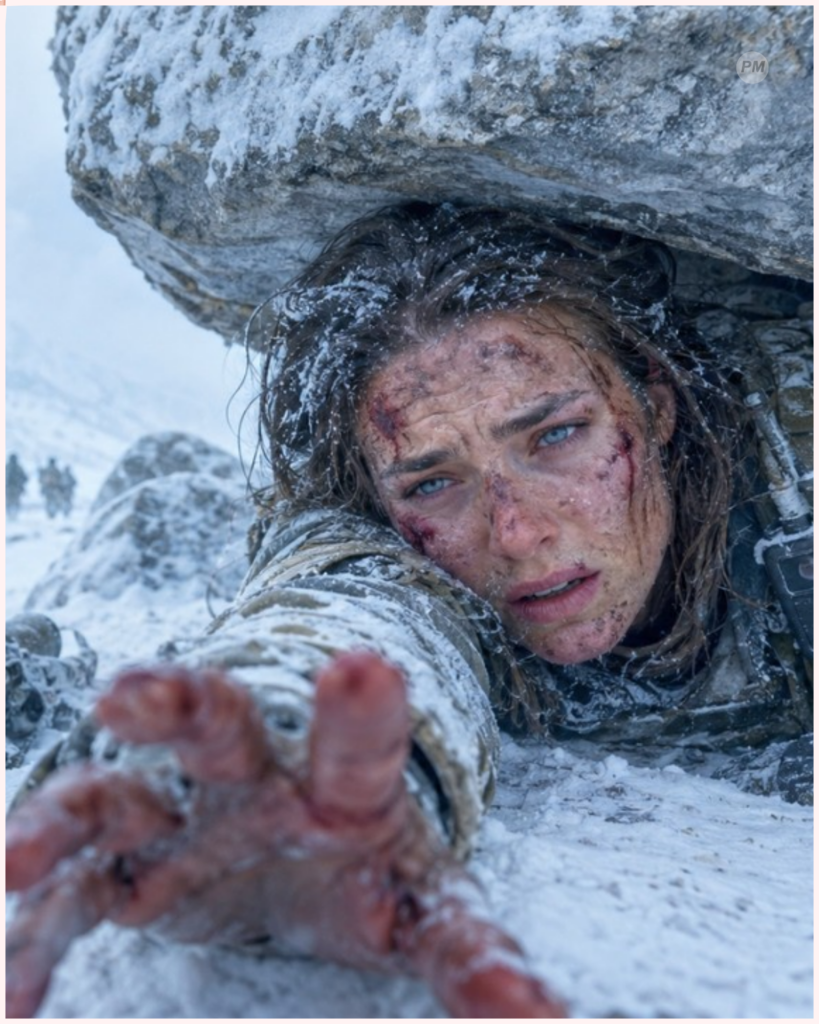
In the dead of Christmas Eve, a blizzard screamed…
In the dead of Christmas Eve, a blizzard screamed across the frozen valley like something alive.
Eight figures moved in perfect silence, white on white, threading the narrow frozen creek bed between jagged ridge lines.
No words passed between them. Only the wind and the soft crush of snow beneath their boots.
Then every light on the far ridge died at once, not dimmed by weather. Switched off deliberately, as if someone had been waiting for this exact moment to arrive.
Grenade arched out of the darkness from the left slope. The blast tore the night open.
One body was hurled over the edge, tumbling down the ravine wall in a brutal spinning fall.
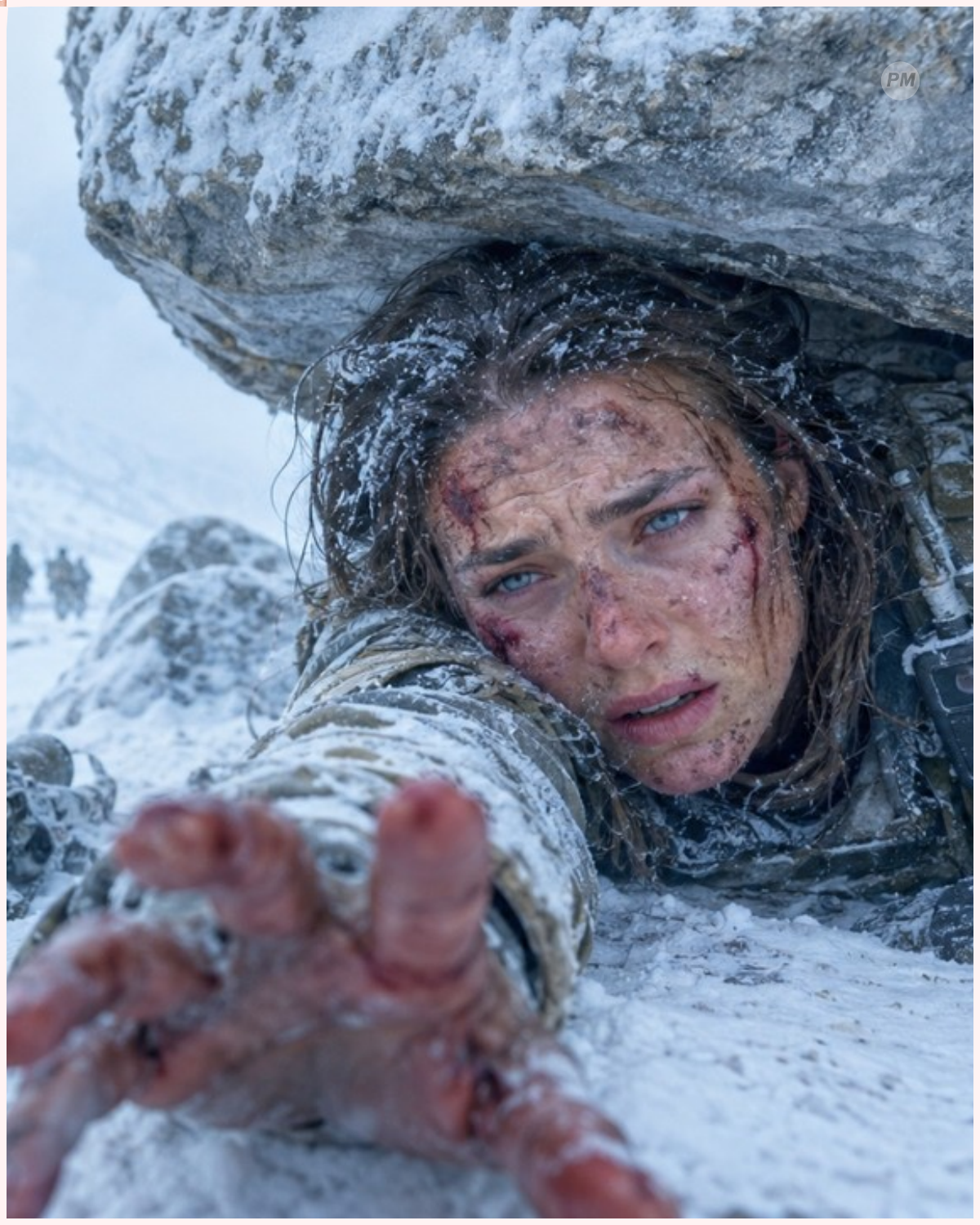
Snow swallowed the impact. Bones broke. Steam rose from blood against the white above. Boots scrambled.
Voices cut through the storm. She’s gone. A pause. Then the cold final order. Then we go.
14 footsteps faded into the blizzard. Down in the ravine, the fallen soldier lay face down in the snow, chest heaving.
She did not call out. She did not scream. She only listened as her own team walked away.
Then her gloved hand reached slowly into her left breast pocket. Not for a weapon, for something small, something that had no place in war at all.
She pressed it against her chest and began to climb. 2312 hours Christmas Eve. Sergeant Elena Ror would hear her team walk away.
She didn’t know that yet. Right now, it was 6 hours earlier. And she was sitting on the edge of a gray wool bunk in a barracks that smelled of bleach and old coffee and the particular metallic cold that gets into a building when the heat can’t quite keep up with the weather.
She was doing the only thing that ever made the hours before a mission bearable.
Checking her kit, not because it needed checking. It never needed checking. She’d cleaned the rifle that morning.
She’d counted the rounds twice already. She checked it now because the checking was the ritual.
And the ritual was the anchor. And the anchor was what kept a person from thinking too hard about all the ways a thing could go wrong once they stepped outside the wire and into a dark that did not care whether they came back.
So she laid it out on the blanket. Piece by piece, the McMillan task suppressed.
Thermal optic calibrated two days ago by her own hands in this same room under this same flickering fluorescent light.
She ran a thumb along the stock the way you’d run a thumb along the spine of a book you’d read so many times you no longer needed the words.
10 rounds in the magazine, one chambered. She pressed each round with the pad of her finger.
Feeling for the seat of it the way her first instructor had taught her. Your hands will know before your eyes do, he’d said.
Train your hands. She trained her hands. Side arm. Two spare magazines. One grenade. Medical kit.
The contents memorized so completely she could find any of it in full dark with frozen fingers.
And the flare. The flare she’d been carrying for four deployments without ever once using.
She turned it over in her palm. Orange casing pull tab worn smooth. She thought the way she always thought when she touched it about the day she’d been issued it at Fort Benning.
22 years old. Sure of everything. You’ll need it eventually, the instructor had told her.
Sergeant first class Dillard. A voice like gravel dragged over concrete and a mustache that looked like something that had crawled onto his face and died there.
Carry it like you believe that. The day you stop believing it is the day it stops being there when you reach for it.
She’d carried it ever since. She said it in the vest pocket, buttoned the flap.
Then she reached for the last thing, the small thing, the thing that wasn’t kit.
The thing that had no tactical function whatsoever and never would. The thing she always checked last because checking it first would have felt like admitting it mattered more than the rifle, and she had spent 7 years learning not to admit out loud or to herself that anything mattered more than the rifle.
A photograph 4 in by 3, black and white, the edges gone soft, almost felted from years of being handled by hands that knew exactly how much pressure a thing could take before it tore.
A woman in a nurse’s uniform standing in front of a canvas tent somewhere in South Korea, 1952.
The woman was 24 years old in the photograph. She was standing very straight. She was not smiling because smiling was for people who weren’t holding the weight of a field hospital on their shoulders.
Behind her, you could see the corner of a stretcher and a stack of crates and the kind of mud that gets into everything and never fully comes out.
But the woman in front of the tent looked like she had decided sometime before the shutter clicked that the mud and the crates and the weight were not going to be the thing people saw when they looked at her.
Her eyes were doing something. Not quite a smile, not quite defiance, something in between, something steadier than either.
Elena had spent her entire life trying to learn whatever that was. The woman’s name was Ruth Ror.
She was 76 years old now. She lived in a white house in Asheville, North Carolina, with a porch that wrapped around two sides and a garden she tended in all weather with the same methodical patience she’d once applied to triage under mortar fire.
18 months in Busousan, she had come home. She had raised a daughter who had raised Elena.
And when the daughter, Elena’s mother, had decided that a granddaughter who wanted to enlist was a granddaughter making the worst mistake of her life, it had been Ruth who drove 4 hours to the recruiting office to sit beside Elena in the waiting room.
Ruth had never talked much about Busousan. She had never needed to. Elena turned the photograph over seven words.
Her grandmother’s handwriting, the letters sloped and certain. The ink had faded over the years to the color of a winter sky just before snow.
The mission doesn’t end until you come home. Not come home safe. Not come home soon.
Not the soft civilian version of the sentence that people said when they were frightened and wanted comfort and couldn’t think of anything truer.
Come home. Full stop. The rest was your job. Elena had been carrying those seven words for 11 years.
She’d carried them through Benning. Through her first deployment, when she was so green she’d flinched at her own rifle.
Through the second when she’d stopped flinching. Through the night, she’d made a shot that two grown men swore was impossible and then asked very politely whether someone could verify the numbers because surely the numbers were wrong.
She’d had the photograph in her pocket that night, too. She slid it into her left breast pocket now, buttoned the flap, pressed her palm flat against her chest for exactly one second.
Not a prayer, she didn’t pray, just a way of confirming that the thing was where it was supposed to be, that the anchor was still attached to the line.
Then she picked up her rifle and she went to the briefing. Captain Gideon Lark ran the briefing the way he ran everything efficiently, precisely, with the particular confidence of a man who had never once, in Elena’s four years of serving under him, appeared to doubt himself, 38 years old, face that looked carved rather than grown.
All flat planes and clean angles, the kind of face that photographed well and gave away nothing.
He spoke in clipped declarative sentences. The speech of someone who had decided long ago that uncertainty was a resource to be managed rather than a feeling to be experienced.
She had liked him once. That was the part she would have trouble explaining later to people who only knew the ending.
She had liked him. She had respected him. There had been a time early in her second deployment when a senior NCO had stood up in a room very much like this one and said that Lark was too cautious, too slow, too fond of the safe option.
And Elena had stood up after him and said that caution was not the same as cowardice, that she had watched Lark bring eight people home from a situation that should have cost at least two, and that she would follow him into the next one without hesitation.
She had believed every word of it. She would think about that moment a great deal in the weeks to come.
The way you think about a door you walk through without looking, only to learn later what had been waiting on the other side.
The mission was simple. Reconnaissance. Firebase Vastto. Enemy installation approximately 11 mi northeast. Satellite imagery confirmed a mobile artillery unit operating from the site.
Get eyes on the unit. Confirm its position. Relay coordinates for an air strike. Extract clean.
4 hours maximum. Elena sat in the third row and listened. She noted the grid references.
She noted the extraction point. She noted the patrol route, a long arc approaching Vastto from the southwest, riding a frozen creek bed as a concealment corridor.
And she noted for the third time in 3 weeks that something was wrong. She’d written the first report 22 days ago.
She remembered the exact language because she’d chosen it carefully, the way she chose everything she put on paper.
Primary source is single human. Unverified. No corroborating signals data. Recommend delay pending. Secondary confirmation.
Filed. No response. Second report. 9 days later. Southwest approach passes through a natural choke point at grid 447229.
Yeah. If the enemy has any awareness of our operational patterns, this is the most predictable possible vector.
Recommend alternate approach or modified timing filed. No response. Third report. Four days ago. She’d laid both concerns out together, and she’d added a third anomalous radio traffic she’d picked up on a frequency that had no business being active, a coalition frequency, internal kind of thing that should only ever have been talking to itself.
She’d flagged it and requested a meeting with Lark directly. He’d sent back three words through his aid.
We proceed as planned. So, here they were, proceeding as planned. Fine, she told herself, watching Lark’s laser dot crawl across the satellite imagery.
You’ve run missions with bad intel before. You’ve run missions where the route wasn’t perfect and the timing wasn’t yours to choose.
You do the job you’re given with the skills you have, the people you have.
That’s the work. That’s all the work has ever been, except except she kept looking at grid 447 229 on the map.
That narrow place where the two ridge lines pinched together and the creek bed had no choice but to run straight through the middle of them.
And she kept thinking about that frequency and she kept not being able to make the unease go anywhere.
It just sat in her chest low and steady. The way a sound sits in a room after the thing that made it has already stopped.
After the briefing, Lark stopped her at the door. You filed another report, he said.
I did. You think I didn’t read it? I think you read all three. A pause.
Face did the carved thing. The small recalibration of a man choosing which version of patients to deploy.
Ror, you’re a sniper. The best shot in this battalion. Probably the best I’ve ever served with.
He said it the way you’d say something to close a subject. A compliment built like a wall.
Let the planning be the planning. That’s what I’m trying to do. Then we’re aligned.
He smiled. It moved his mouth and nothing else. We move at 2217. He walked away.
She watched him go, and she thought, not for the first time, but more sharply than usual.
Sharp enough that it almost surfaced into words that she had been told to stay in her lane so many times by so many people in so many tones.
She had begun to lose track of whether the lane was real, whether there had ever been a road at all or whether someone had simply painted lines around her very carefully over a number of years and then told her the lines were for her own good.
She let the thought go. She’d gotten good [clears throat] at letting that particular thought go.
You had to. You couldn’t carry it into the field. The field didn’t have room for it.
She had a mission. She went to get ready. They moved out at tune 217 hours.
Eight soldiers. Full winter kit. White over gray. The camouflage that turned the person into an absence against snow.
Thermal suppressors on every weapon. 11° Fahrenheit and dropping. The air so dry and cold it had a taste.
A thin mineral edge like licking the back of a spoon. The sky was the particular opaque black of a sky that has already decided to become a blizzard before morning and is simply waiting for the right moment to commit.
Elena walked third behind Lark behind Corporal Seth Puit. Puit was 26 and built like a man who had spent his whole life being told he was too big for tight spaces and had made a quiet career out of proving that theory wrong.


