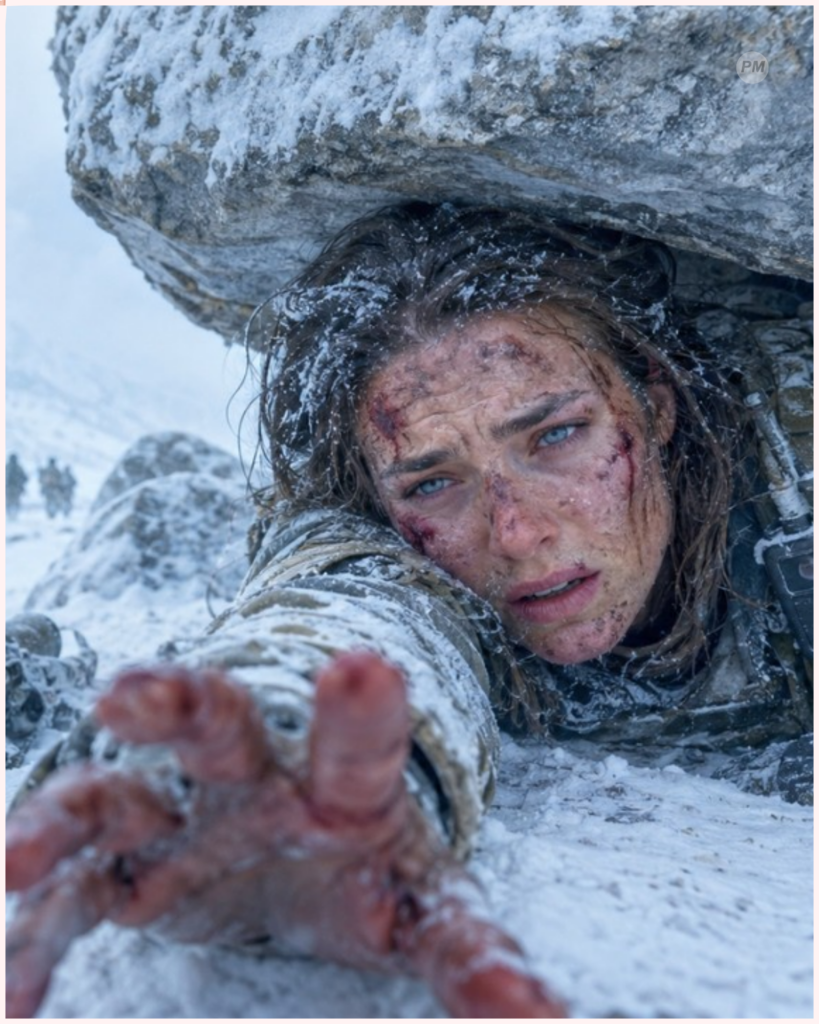
Coalition position 30 km south, window at 0430
Coalition position 30 km south, window at 0430. She checked her watch. 019 hours, just over 3 hours.
She She nodded once and turned to the equipment. She worked fast, fingers moving over the dials and the keying mechanism, reading the labels she could read and inferring the ones she couldn’t from the shape of the equipment, which was old and Soviet pattern and not so different from systems she’d trained against in a cold room in Alaska two winters ago.
The coalition frequency was there. She found it in under 2 minutes. The signal strength was poor.
The blizzard was throwing interference across everything, but it was enough. Barely, but enough was a word that meant something to her tonight that it had never quite meant before.
She keyed the transmit button, and she started talking. Coordinates, timeline, the grid reference for the artillery unit drawn from the overlay on the table behind her, which she’d taken in at a glance and burned into memory the way she burned everything.
Call sign ghost far to the south in a coalition operations center where a duty officer was three hours into a quiet overnight shift and thinking probably about coffee in the end of his watch a radio crackled to life with a voice he did not recognize female controlled Zeiss giving coordinates giving a timeline giving a grid reference for an artillery unit that was 2 hours from firing on a position that had been considered safe he sat up straight he asked for verification the voice on the radio said The verification is that I’m still here.
Write it down. I’ll wait. There was a pause on the far end. A long one.
She could picture him. Could picture the exact face of duty officers when a transmission breaks every protocol he knows and is somehow more credible for it.
He wrote it down. She released the button, checked the watch. 0134. She looked at Malc.
He was still against the wall watching her with an expression she couldn’t fully read.
And she found herself in the small space between tasks, wanting to read it, wanting to understand why a man who had every reason to scream for help.
Every reason to lunge for a weapon or a door was instead standing very still and watching her work as if she were weather, as if she were something that happened rather than someone you fought.
“Why are you helping me?” She said, not really asking. Filling the silence the way she’d let him fill it, he was quiet for a moment.
When he spoke, his careful English came slower as if he were translating not just the words but the thing underneath them.
You are going to win. He said you don’t know that. I have been in this place 11 months.
Mel said I have watched many men decide they are going to win. I know the look.
It is a loud look. It shouts and it points and it is gone by morning.
He tipped his head. The smallest gesture, the leg, the rifle, the blood at her temple she hadn’t known was there.
You do not have that look. You have the other one. The quiet one. I have only seen it twice.
A pause. Both times the quiet one was right. She held his gaze for a second longer than the mission allowed.
Sit down, she said. Stay quiet. She pulled the chair from the second operator’s station, checked his restraint, and turned for the door.
Then she went back out into the storm. She had work to do, and the warmth had been a lie, and the cold was waiting for her the way it had been waiting all night.
Patient, enormous, indifferent. And it took her again the moment she stepped through the door.
Not gradually, aggressively, as if the few minutes inside had been a truce, and now the terms were off.
She moved through Firebase Vastto, the way water moves through a pipe, following the path of least resistance, always flowing, never stopping in a corner where a corner could close on her.
The blizzard had driven the garrison indoors, and what patrols remained were minimal and miserable.
Men with their heads down and their collars up, walking the shortest possible routes between one heated building and the next.
They were not looking for a ghost. They were looking for the door first. The armory.
Always the armory. She had a rule about that. An old one drilled in by the same tactics instructor who had given her the line she’d never been able to shake.
You take away their weapons before you take away their voices. A man with a rifle and no radio is still dangerous.
A man with a radio and no rifle is just someone calling for help that isn’t going to arrive in time.
She counted four centuries between her and the armory door, and she spent 12 precious minutes watching their patterns before she moved.
12 minutes in which her leg felt like it was being slowly disassembled from the inside.
Each minute a small negotiation between her body and the part of her that had decided the negotiations were over.
She took three of the four with shots spaced carefully enough that none of them heard the others fall.
Whisper, a gust, a whisper. Storm carrying each sound away before it could mean anything to anyone.
The fourth she had to take by hand because the angle was wrong and the risk of a missed shot was a risk she couldn’t afford.
With her count running down, she got close without him seeing her. Used the butt of her sidearm, fast and precise.
The way they drilled it, he went down hard but quiet. Eight rounds left. One grenade.
The armory door was secured with a standard Soviet pattern padlock. A model she’d trained against twice.
Once on a course, once in a cold building in Alaska where a master breacher had timed her until she stopped being slow.
She had it open in 90 seconds with a pick she kept in her boot, a habit Dillard had called paranoid, and that she now thought of as prophetic.
Carry it like you believe you’ll need it. She had believed, she had needed. Inside she moved fast and methodical, and the cold logic of the next half hour assembled itself in her mind as she went.
She left three things behind that had not been there before. A trip wire drawn taut and low behind the primary ammunition cache connected to a white phosphorus grenade she’d found racked beside the standard frags.
She’d rigged it with a remote detonator. Standard issue because she always rigged things with remote detonators because the first demolitions instructor she’d ever had used to say the best bomb is the one you can set off from somewhere else.
When you choose, where you choose. A severed fuel line on the vehicle parked inside.
The third vehicle, the one that hadn’t been in the photographs, which she filed even as she compromised it, and a complete mental map of the room’s loadbearing structures, the exact geometry of how much fire it would take and where to bring the whole thing down.
She wasn’t going to pull the thread yet. You don’t blow an armory if you want to control the aftermath.
She remembered her instructor saying, his voice like gravel, his mustache like something a cat had left on the porch.
You blow it if you want to make a statement. So, make sure the statement is the right one and make sure it’s the right time because you only get to make it once.
She was going to make a statement. She was just going to wait until the moment chose itself.
Then, the motorpool 200 m east. 12 vehicles under a corrugated metal roof that was groaning softly and continuously under the accumulated weight of the snow.
A low metallic protest like a long exhausted breath that didn’t quite end. A mix of troop transports and two armored personnel carriers, all parked nose in all dusted white.
She went to the fuel line on the nearest transport first, confirmed it was the same model she’d trained on during a vehicle interdiction course in Germany 2 years ago.
The same access panel, the same routing, her hands knowing the work before her eyes confirmed it.
90 seconds on the fuel system, then the second vehicle, then the fourth. Not all of them.
There wasn’t time, and time was the only thing she was truly short of. She was building a chain sequence.
When the right heat source was introduced at the right moment, this motorpool was going to solve several problems at once.
It was going to draw eyes and draw bodies and add its voice to a chorus she was composing one compromised fuel line at a time.
She was on the fourth vehicle when she heard the shout, a single sharp voice from the direction of the communications building.
The kind of voice that doesn’t yet know it’s already too late and is trying through sheer volume to will the world back into the shape it had 10 minutes ago.
One of the operators she’d left unconscious had come around. She’d expected it. She’d been more conservative than lethal in that room, and she’d known even as she made the choice the clock was running on it.
Listened. She The shout was followed by more voices and then by the distinct sound of boots hitting frozen ground at speed.
Three men, maybe four, converging on the communications building. The base was waking up. Not all at once, not yet.
But the first nerve had fired, and the body it belonged to was beginning slowly to understand that something was wrong inside its own walls.
She finished the fourth vehicle in 45 seconds. Did the arithmetic without sentiment, four compromised, eight operational and acceptable ratio, and moved because there was a thing she’d heard earlier on the radio on a second frequency.
Sharper than the first, more urgent, and in it she had caught one word clear through the static and her own limited Russian.
A word that had changed the texture of the whole night window, agon. But the time notation that had followed it had not sounded the same.
She didn’t have enough Russian to be sure, and not sure was not a foundation you built a strike timeline on.
Not sure got people killed. The people 30 km south who were trusting without knowing they were trusting that the woman inside the firebase had her facts straight.
She needed the operation center. She needed to see the map. She started for the command building.
The command building was warmer than the communications building, and the warmth this time was a wall she walked into.
It hit her in the chest and the face and made her body suddenly riotously aware of every single degree of cold it had been carrying and ignoring for hours.
The cold in her fingers, the cold in her feet, cold that had set up somewhere deep behind her sternum and meant to stay.
Her knees went soft. Her vision swam at the edges. For one second, she was not a soldier inside an enemy command post.
She was a body and the body was failing and the failure was very close.
She planted her right foot, redistributed her weight onto the leg that still worked, and she kept moving because the alternative, stopping sitting, letting the warmth do what warmth does to a body that’s been pushed past its limits, was a kind of death dressed up as relief, and she had not climbed out of a ravine to be undone by central heating.
The interior was a single long corridor, four doors on the left, two on the right.
She had studied this operation center at the far end, commander’s office, second door on the right.
Briefing room adjacent. She needed the operation center first, not the commander. Not Drav. Not yet.
You don’t move on the man who drew the map until you’ve read the map yourself.
You read it first in full so that when you finally face him, you already know more than he thinks you know.
And the gap between what he thinks and what’s true is the only weapon that never runs out of rounds.
The operation center door was partially open. She approached from the side, took one breath, in through the nose, out through the mouth, and went in fast.
Three men, one at the map table, two at communications terminals. All three turned at once.
The man at the map table was a major. She clocked the insignia in the first quarter second, and and the rest of him in the second.
The way he moved with the instinctive authority of someone who had spent years expecting to be obeyed, his hand already traveling toward the sidearm at his hip as he turned.
The motion smooth and trained in a halfbeat too slow. “Don’t,” she said in Russian.
One of the 12 words she knew well enough to use under pressure, and something in her voice, not the volume, there was no volume, but the flatness of it, the absolute and total absence of doubt, stopped his hand before it reached the holster.
The two operators at the terminals looked at each other. Neither of them moved. In a room with three armed men and one wounded woman, the math had already been decided, and they could all feel it, even if only she could have explained why.
She crossed to the map table in three uneven sensed steps. Her Russian was limited.
But military maps have a universal grammar, a language older than any of the ones people argue about.
She read it fast. Grid lines, unit markers, timing notations. A red arrow pointing souths southwest, fat and confident.
She found the timing notation on the artillery position marker. She read the number not 0430.


