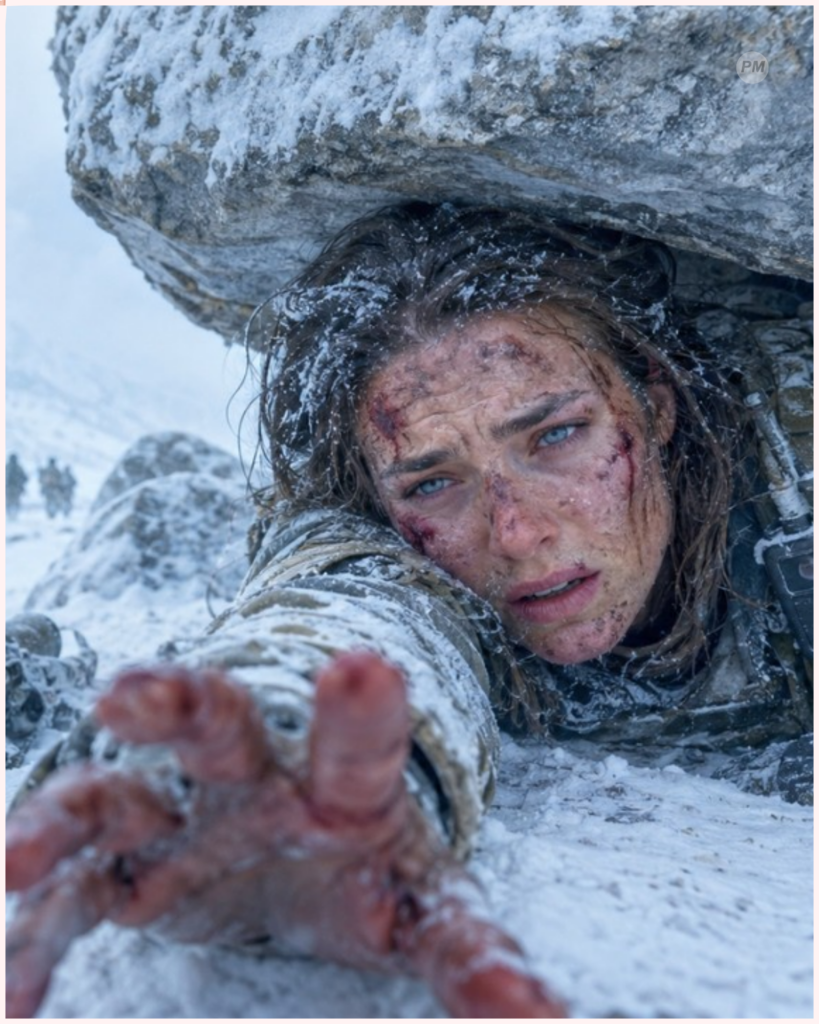
He moved through terrain the way some people sing,…
He moved through terrain the way some people sing, a low unconscious efficiency. Every step placed before it landed.
Elena had noticed it on the first exercise they’d run together two years and one deployment ago, and she had respected it ever since.
He didn’t talk during movement. Neither did she. They had developed over time the comfortable concommunication of two people who understood each other well enough not to need words to fill the silence.
He glanced back at her about 40 minutes in. When they were picking their way along the frozen creek bed, and the wind had begun to pick up, throwing the first scouting flakes of the storm sideways across their path, she looked back at him.
He raised one eyebrow. A fraction of an inch, a question with no military designation, but a perfectly clear meaning.
Something feels wrong to you, too? She gave him smallest, smallest possible nod, he returned it, and that was the whole conversation.
Two soldiers in the dark agreeing that the night had a shape they didn’t like.
Neither of them said it out loud. Out loud would have meant a decision, and the decision wasn’t theirs.
The decision belonged to the man walking point. The man who had read all three of her reports and answered them with three words.
They kept moving. The choke point at grid 44729 was exactly what the map had promised.
A gap between two frozen ridge lines narrowing to maybe 20 ft at its tightest.
Creek bed ran straight through the center of it because there was nowhere else for the creek bed to go.
Snow had drifted hard against the walls on both sides, packed by wax then jid into something nearer ice than snow.
And above them on the ridges same wind had carved the formations into jagged, deliberate looking shapes, shapes that had the unsettling quality of architecture, as if someone had designed the place to funnel anything that entered it into a single undefended line.
Elena had been looking at this place on a map for 3 weeks. She had described it in writing.
She had recommended against it twice. Now she was standing 30 feet from the mouth of it.
And that was when she saw the lights, the enemy patrol lights off. Not dimmed, not redirected, not flickering in the storm.
Off completely as if someone somewhere on the far side of the choke point had reached out and flipped a switch at a very specific moment and dropped the whole eastern approach into darkness.
Patrol turns its lights down when the weather worsens. A patrol turns its lights off when it has somewhere better to be or when it has been told to make a place look emptier than it is.
The thought arrived with the cold clarity of a fact that has just finished assembling itself out of pieces a person has been carrying for weeks without knowing they fit together.
They turned the lights off before we got here. They’re not reacting to us. They were waiting.
Her mouth opened. The word contact was already forming, already moving from her chest toward her teeth.
The grenade came from the left ridge. She never saw who threw it. The blast threw her 6 ft, maybe more.
She was in no position to measure given that she was airborne when it happened, and the landing was less a landing than a collision.
Her body meeting the frozen wall of the ravine that dropped away below the ridge line, then the slope, then the bottom.
In three distinct impacts her nervous system would replay for her individually over the next several seconds.
The sound she heard somewhere in the middle of all that was her left leg.
It was not a sound she could have described to anyone who hadn’t heard their own bones do something similar.
It came from inside. A wet structural crunch that her brain registered as information before it registered as pain.
The way you see lightning before you hear thunder. Then she was at the bottom face down in the snow and she lay still.
Not because she was unconscious. She was furiously electrically conscious. She lay still because stillness was the first decision, the one before all the other decisions, the one her body had been trained to so many times that it made it now without consulting her.
You don’t move until you know the field. So she took inventory from the bottom up the way you do.
Left leg broken. The angle was wrong. She could feel that without looking, the weight of it had redistributed itself in a way legs don’t do when they’re working.
Femur, probably maybe the tibia, too. She would find out later. Later was a category she was already building.
Placed to put things she couldn’t deal with in the next 5 minutes. Rifle still on her back.
The strap had held. She could feel the press of it across her spine vest intact.
Grenade, sidearm, medical kit, flare. She ran the inventory by the small pressures of each item against her ribs.
All present botfiskies against ice. So cold it stopped burning and started doing the other thing.
The numb thing. The thing that in another context on another night she would have known to be afraid of.
She was breathing slowly, quietly in through the nose, out through the mouth, the way Dillard had drilled into her at 22, standing over her in the Georgia heat while she gasped through a stress course and wanted to quit.
Breathe like the breath is yours and nothing else is because sometimes the breath is all you’ll have and you’d better know how to spend it.
She was breathing and she was listening above her on the ridge voices roars down that wasuit 40 ft up and to the east maybe less and there was something in his voice that she cataloged without sentiment because sentiment was a luxury and the field was not the place for it not grief fear he was afraid I saw her go over the edge the blast captain she’s gone you sure lark the voice from a 100 briefings clipped flat the voice of a man doing math in his head the calculating kind of math math kind where a person stops being a person and becomes a variable in an equation about acceptable losses.
I’m sure we can’t go back for her. Perimeters collapsing. Three more minutes and we’re all in that ravine with her.
A pause, she counted it. Counting was what she had. 1 3 4. Then we go, Lark said just like that.
She heard the scramble of gear, the crunch of boots accelerating across packed snow. The sound of her team, her team, the people she had eaten with and trained with and bled near for two years, moving north away into the storm 14 steps.
She counted those two then nothing. She stayed perfectly still for a full minute after the last sound faded.
Training. Pure training. Even as everything inside her, everything that was 22-year-old Elena on the stress course.
Everything that was the girl in the recruiting office with her grandmother beside her. Everything that was just a human being who had been left alone in the cold to die.
Wanted to scream, to call out, to demand they come back, to howl at the indifferent dark that she was alive, that she was right here, that all they had to do was look, the training held.
And then, as she finally began the slow agony of getting an elbow under herself, she heard one more thing, Lark’s voice.
From a distance now already moving away. A sentence pitched low and meant only for Puit delivered with the easy unguarded confidence of a man who believes he is among the living and speaking to the living and that the dead conveniently are no longer in the conversation.
She was getting reassigned anyway. Elena stopped moving. The cold pressed against her face. The wind moved through the ravine with a sound like something very large, very patient, breathing in the dark, reassigned the word landed in her chest and sat there, not like a stone.
Stones are dead weight. This was alive. This was a small, cold animal that had been hiding under the floorboards of her career for years and had just in a single carelessly spoken sentence shown her its face because she had never been told.
Because for 6 months 6 months, every time she had asked about the reconnaissance track she’d been recommended for 4 years ago, the answer had been the same.
Every time she’d asked about the team lead slot that two separate commanders had told her, to her face, she was next in line for the answer had been the same.
Not we need you where you are. The slot isn’t available. Soon soon, and the man delivering the answer every single time had been Larco said something very quiet, very far back in her head.
The voice you only hear when you’re alone. When there’s no one to perform for, when the truth has nowhere left to hide.
Oh, there it is. She didn’t have time to finish the thought. She filed it under later.
In the place that was getting crowded, because she had a leg to deal with and a mission to deal with, and the largest item, the one she was deliberately not looking at directly, she had people somewhere 30 km south who did not yet know that the artillery unit at Firebase Vastto had a window.
She was, as of approximately 90 seconds ago, the only person on the friendly side of this entire valley who did.
She pulled herself up onto her elbows. Her jaw clenched so hard her teeth achd in their sockets.
The pain had changed character. It wasn’t sharp anymore. Sharp would have been better. Sharp was a knife, and you could locate a knife.
This was deeper and wider. A deep spreading wrongness. Something hot and heavy had been poured into the marrow of her bones and was now trying to find its way back out.
She breathed through it, in through the nose, out through the mouth. She reached back, pulled the rifle around, checked the action with fingers that were only just beginning to stiffen.
It cycled clean good. She counted what she had. 10 rounds, one grenade, sidearm, and two spare magazines, one flare, four deployments unused.
What do I have? What do I need? What is the first step? She did not let herself do the other math, the big math, the survival math, which asked questions like, “Can a person with a femur fracture cross two miles of snow in a blizzard and and live?”
Because that math produced an answer she didn’t want, and an answer you don’t want is just a way of talking yourself out of moving.
She did the small math, the 5-minute math. The first step was getting out of the ravine.
She used the rifle as a crutch. She hated it. Hated the stress it put on the barrel.
Hated everything she’d ever been taught about treating a weapon like the precision instrument it was.
But hating it was a luxury, and luxuries were for people whose options numbered more than zero.
And her options numbered exactly zero. So she climbed arms, right leg, something that wasn’t quite courage and wasn’t quite anger, but lived in the narrow country between them.
The place a person goes when the only directions left are up and give up.
And give up has simply stopped being a word they know. Every foot of elevation cost her.
The snow’s waist deep in places, loose and unpacked. And every time she found purchase, the broken leg would shift, and the pain would crest so high and so white that for a second or two she would lose the ravine entirely, lose the dark, lose her own name, and float in a hot, bright nowhere until her vision came crawling back.
She counted every second. Counting kept her focused. Counting kept her from listening to the small, cold animal in her chest.
Counting kept her from hearing on a loop. Two words walking away into the storm.
Then we go. Two words. Most expensive two words anyone had ever spent on her life.
She made it to the top in 11 minutes. She knew because she had counted every one of the 660 seconds.
At the top she pressed herself flat against a snow-covered boulder, chest heaving, and looked east.
And there it was Farsvastto 2 miles out. The glow of its lights smeared by the blizzard into a soft, steady halo above the snow.
Not the harsh point lights of a temporary camp, but the diffuse glow of a permanent installation, heating systems, fuel storage, a communications array, a place that intended to be there in the morning.
She knew the layout the way she knew her grandmother’s house, the corridors, the choke points, the blind spots.
She had studied it for 3 days before the mission, leaning over the satellite imagery until her eyes achd, memorizing it the way she memorized everything that mattered.
She had memorized it as a target. Now she looked at it as a destination and she reached into her left breast pocket.
The photograph was still there. Ruth Ror, 1952, 24 years old, standing very straight in front of a canvas tent in a country that had tried for 18 months to convince her she was somewhere she did not belong.
Not smiling, eyes doing that thing, Elena did not take it out. Her hands weren’t steady enough and the wind would have taken it.
She just pressed her gloved fingers against the button flap, against the small stiffness underneath, and she read the seven words in her memory where they had lived for 11 years.
The mission doesn’t end until you come home. Ruth had not written come home first.
She had not written come home before anything else, before duty, before the people who need you, before the thing you swore you’d do.
She had written come home. The rest was the job, and the job was not finished.
Alena pressed the flap one more time. Then she let her hand drop and she turned her body inch by agonizing inch till she was facing the lights and she started moving toward them.
Two miles took 40 minutes. 40 minutes of crawling and half dragging and using the terrain like a third limb.
Every fold of ground, every drift, every frozen hump of brush, a thing to be measured and used and left behind.
She stopped every 3 to four minutes to check her back trail and to listen to the dark.


