It made it a [music] story
It made it a [music] story. This decision seemed small at the time. It was just a friend talking to detectives, telling them what she’d seen, what she’d heard, what Jackie had shared with her.
But that willingness to speak, to put on the record what she knew would prove to be one of the most critical pieces of the entire investigation.
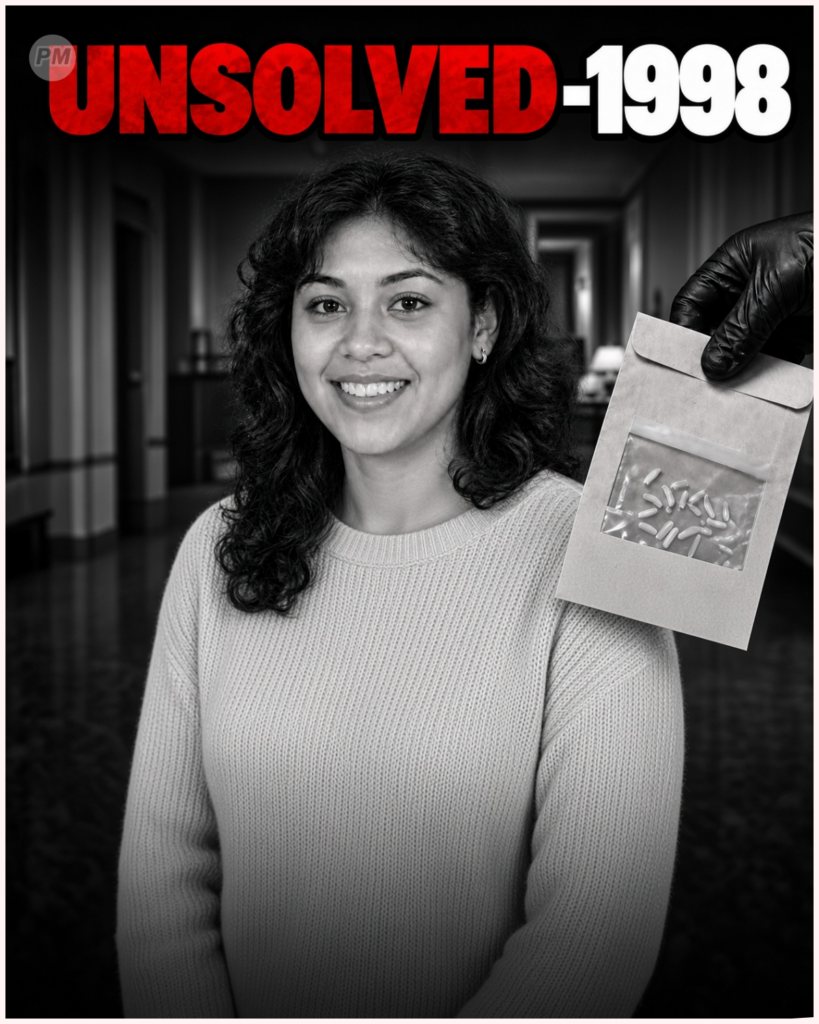
On the evening of December 29th, 1998, Jackie Sodto’s landlord arrived at the home in the 500 block of Buchanan Street in Gary and made a discovery that would launch a homicide investigation lasting more than a quarter of a century.
He found Jackie inside the home lying face down on the floor. Her body was positioned in a pot.
Christmas lights had been wrapped around her neck. She was not breathing. She was already dead.
When Gary police officers responded to the scene and homicide detectives began processing the home.
What they found was not a clean crime. It was sustained deliberate violence followed by a clumsy attempt at misdirection.
Blood was present throughout the home, not confined to one room, but spread across multiple areas, suggesting either a prolonged struggle or post-mortem movement of the body, or both.
Broken glass was scattered across the floors. Bloody shoe prints had been tracked through the hallway and up the staircase, then back down again, as though someone had moved through the house methodically.
After the violence had already occurred, checking rooms, touching surfaces, trying to accomplish something beyond just the killing itself.
A pair of broken eyeglasses lay near Jackie’s body. Suspected drug paraphernalia was found inside the home.
Consistent with what investigators already knew about the drug activity connected to the address. And then there were the details that made detectives pause and look more carefully.
A television set was missing from the house, but its external speakers had been left behind, still sitting in the room where the television had been.
Dresser drawers in the bedroom had been pulled out from the furniture and left on the floor, their contents disturbed.
At first glance, the scene might have read as a burglary gone wrong. Someone breaks in, robs the place, encounters the occupant.
Things turn violent. It’s a narrative that would be plausible in a city with Gary’s crime rate, but that reading did not survive closer scrutiny, and the detectives processing the scene did not buy it.
If you’re burglarizing a home and you take the television, you take the speakers, too.
You don’t carefully disconnect one component and leave the other sitting in plain sight. That’s not how theft works.
And pulled out dresser drawers are one of the oldest staging techniques in the criminal playbook.
It’s what someone does when they want a crime scene to tell a story that isn’t true.
They want the police to see a ransacked bedroom and think robbery before they think anything else.
Detectives believed based on the physical evidence and the inconsistencies in the scene that this murder had been staged.
Whoever killed Jackie Sodto had tried to disguise a targeted personal killing as a random property crime, and they hadn’t done a particularly convincing job of it.
The autopsy confirmed what the crime scene already strongly suggested. Jackie Sodto’s official cause of death was asphixxia due to strangulation.
The medical examination revealed extensive soft tissue hemorrhaging in and around her neck, indicating sustained compressive force along with multiple neck abrasions consistent with the ligature marks from the Christmas lights.
She had also suffered blunt force trauma to the back of her head and lacerations on her face.
These additional injuries suggest that the attack was not limited to the strangulation itself. Jackie had been beaten before, during, or after the strangulation.
The Lake County Medical Examiner classified her death as a homicide. Strangulation is a significant detail, and it’s worth pausing on why.
In homicide investigation, the method of killing often tells investigators something about the relationship between the perpetrator [music] and the victim.
Strangulation is what criminologists call a close contact method of killing. It requires physical proximity, sustained effort, and a duration that most experts estimate at between 4 [music] and 10 minutes to produce death by asphixxia.
It is one of the most physically intimate forms of homicide, and it is overwhelmingly associated with perpetrators who have a personal relationship with their victim.
Strangers rob, shoot, and stab. People who strangle tend to be people who know the person they are killing.
This was not a stranger crime. The staging, the method, the lack of forced entry, the killer’s familiarity with the layout of the house.
Every piece of evidence pointed in the same direction. Jackie Sodto was killed by someone in her own circle.
And then came the detail that would change everything 27 years later. During the autopsy, the forensic examiner followed standard protocol and clipped [music] Jackie’s fingernails, both hands.
The clippings were collected, labeled, sealed, and placed into evidence storage in 1998. This was a standard part of homicide autopsy procedure.
Fingernail clippings are standard because if a victim struggled against their attacker, skin cells, blood, tissue, or other biological material from the asalent can become trapped beneath the nails during defensive scratching or clawing.
But in 1998, the DNA extraction technology needed to recover and accurately analyze trace amounts of biological material from something as small as a fingernail clipping was either non-existent or in its earliest and most unreliable stages.
The clippings were [music] preserved because that’s what the protocol required. It was a box that got checked, a step in a process.
Nobody standing in that autopsy suite could have predicted that those clippings would sit in evidence storage for 27 years, waiting for science to catch up with the crime.
The investigation that followed Jackie Sto’s murder began the way most homicide cases begin in a city like Gary.