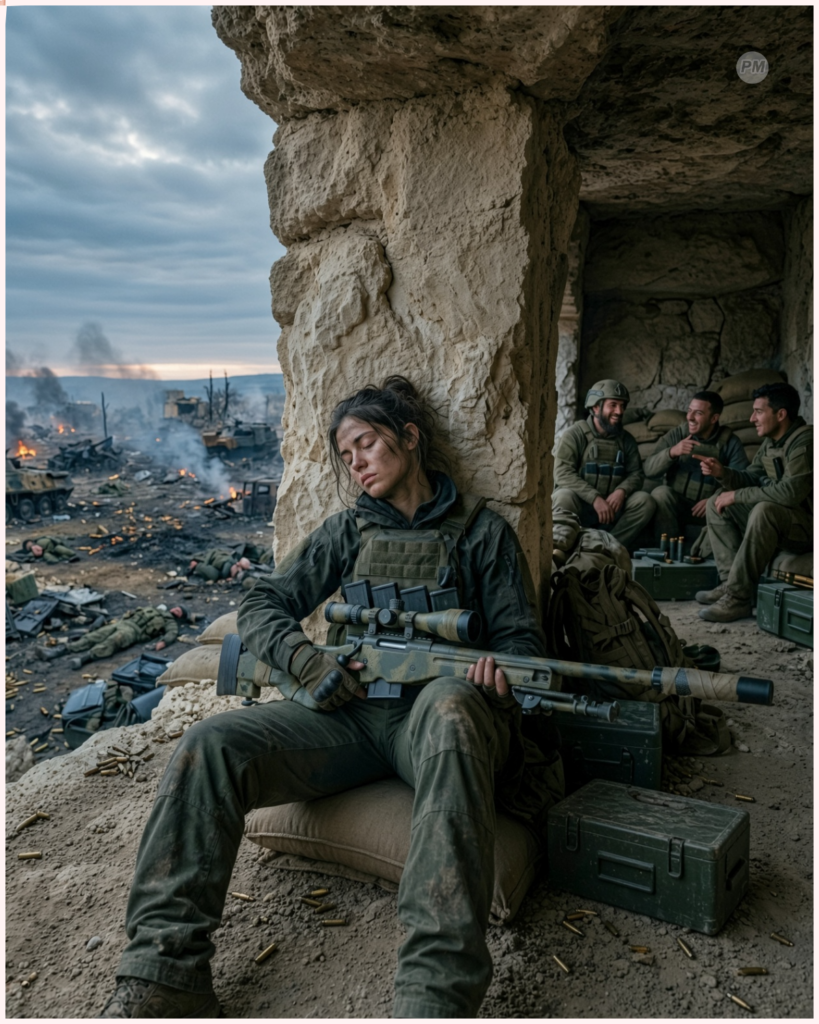
The clock was ticking
The clock was ticking. And I was the only one who could hear it. That afternoon, Sergeant Wade found me on the northern perimeter wall.
Still photographing the ridgeline. Still taking notes. He climbed up beside me without saying anything at first.
Just watched me work for a few minutes. LT told me about the meeting. I didn’t stop photographing.
Click. Adjust angle. Click again. Then you know, nobody believes me. Wade was quiet for a moment.
When he spoke, his voice carried the weight of 15 years watching soldiers die in ways that could have been prevented.
You really think they’re coming? I lowered the camera. Looked at him directly. I don’t think, Sergeant.
I know. I showed him my latest photographs. Pointed to fresh vehicle tracks in a wadi that cut through the northern approach.
The images were timestamped from this morning’s patrol. Look at this. Someone drove in there recently.
No reason for locals to be in that area. It’s all rocks and scorpions. Wade studied the image.
His expression shifted from skepticism to uncertainty. Could be Taliban moving weapons or personnel into position.
Could be. Probably is. I lowered my camera completely. Met his eyes. But without definitive proof, nobody’s going to do anything until it’s too late.
So, what are you going to do? I looked at him with unwavering focus. What I always do, Sergeant.
I’m going to be ready. When they come, and they will come, I’ll be in position.
Rifle in hand, waiting. Wade shook his head slowly. That’s a hell of a way to live, Mercer.
It’s the only way I know how to keep people alive. That evening, the platoon gathered in the barracks.
The tension around me had grown palpable. Hollis was openly calling me paranoid. Others exchanged concerned looks whenever I sat motionless on my bunk, rifle across my lap, staring at the northern wall like I could see through it to the mountains beyond.
Callahan tried to bridge the gap between me and the team. Maybe she’s right. Maybe we should take extra precautions.
Hollis countered immediately. She’s been here less than a week, and she’s got everyone jumping at shadows.
Next, she’ll be telling us the cook is a Taliban spy. I heard every word, but I said nothing.
I’d learned that arguing was pointless. People believed what they wanted to believe, saw what they wanted to see.
Comfort was easier than vigilance. Doubt was safer than preparation. I checked my rifle again, already perfectly maintained, but the ritual was calming.
My go bag sat at the foot of my bunk, packed and ready. Extra ammunition, medical supplies, water, batteries, everything I’d need for a sustained firefight.
It sat there ready to grab in seconds. Lieutenant Thorne entered the barracks, clipboard in hand.
Listen up. We’ve got enhanced guard rotation starting tonight. 4-hour shifts instead of six. Northern towers get an extra set of eyes.
Stay alert out there. After he left, Hollis muttered loud enough for everyone to hear.
All this because the new girl has nightmares. I finally spoke, my eyes never leaving the northern wall.
Not nightmares, specialist. Memories. And the people who ignore memories are doomed to create new ones.
As darkness fell over FOB Sentinel, most soldiers settled into their evening routines. Card games, letters home, movies on laptops, normal life in an abnormal place.
But I sat in the gathering shadows, rifle held close, eyes fixed on the northern perimeter.
Somewhere beyond that wall, beyond the wire and sensors and guard towers, the enemy was preparing.
I could feel it. The way animals feel earthquakes coming. A primal certainty that transcended evidence.
72 hours. Maybe less. The clock was ticking, and I was the only one who could hear it.
Day two at FOB Sentinel began the same way day one had ended. With me already awake.
Already working. Already watching. By evening, I’d filled another notebook with observations. Documentation of everything that felt wrong.
The compound that had housed 17 people now showed only four heat signatures on our thermal imaging.
The market in the nearest village that normally bustled with activity had been nearly empty during today’s patrol.
Small things. Individually meaningless. Together, they painted a picture. I cross-referenced my photographs with patrol schedules.
Village census data from previous weeks. Radio intercept summaries that the intelligence shop had filed away as routine chatter.
The pattern was there. Clear as daylight to anyone willing to look. At 200 hours, I sat on my bunk in the darkness.
Rifle across my lap. Staring at maps covered in red markings. 60 hours until new moon.
60 hours until the darkest night of the month. 60 hours until they came. Callahan woke around 2:30.
Found me in exactly the same position. Still working by the light of a small red lens flashlight.
Sergeant, did you sleep at all? I looked up from my notes. And in that moment, Callahan saw something in my eyes that she’d remember for the rest of her life.
Not exhaustion. Not fear. Just absolute crystalline certainty. Sleep is for people who aren’t being hunted, Iris.
She sat down on the edge of my bunk, her medic instincts warring with her growing concern.
What does that mean, Elena? You’re scaring people. You’re scaring me. I set down my pen.
Looked at her directly. It means I need to talk to Lieutenant Thorne at first light.
Because FOB Sentinel is going to be attacked. And when it happens, people are going to die unless someone is ready.
How can you know that? Because I’ve seen it before. At 05:45, I stood in Lieutenant Thorne’s office with Captain Drummond.
My 17-page threat assessment spread across the makeshift desk. Every photograph. Every timeline. Every pattern I’d identified.
Drummond read through it slowly. His expression growing harder with each page. When he finished, he looked up at me with something that wasn’t quite anger.
More like disappointed certainty. Sergeant Mercer, I’ve read your psychological evaluation history. He pulled a different file from his desk.


