Completely wrong
Completely wrong. You’re not crazy. You’re not broken. You’re the most squared-away soldier I’ve ever served with.
And I’m honored to be on your team. One by one, the others stood as well.
Wade, Callahan, Thorne, even Captain Drummond. A spontaneous show of respect for a soldier who’d borne the weight of vigilance alone, who’d been mocked and doubted, yet had saved them all.
I remained seated, uncomfortable with the attention. I just did my job. Negative. Wade said firmly.
You did everyone’s job. You saw what we missed, prepared when we slacked, stood watch while we slept.
That’s not just doing your job. That’s being the kind of soldier the rest of us aspire to be.
The medical evacuation helicopter was landing now, coming to transport the three wounded defenders to better medical facilities.
I watched it touch down, remembering another medevac helicopter two years ago that had carried away my fallen teammates in body bags.
“James would be proud of you.” Thorne said quietly, following my gaze. “You honored his memory last night.
You saved lives the way you couldn’t save his. That matters, Mercer. That means something.”
My throat tightened. “I hope so, sir. God, I hope so. Because I carry him with me every day.
Every night I don’t sleep. Every moment I’m scanning for threats. Every time I check my rifle one more time, he’s there.
The Cartier 7 are always there.” Callahan’s voice was gentle. “Maybe that’s not a burden, Elena.
Maybe they’re guardian angels. Keeping you sharp. Keeping you ready so you can protect others.”
It was a beautiful thought. One I’d never considered. I’d always framed my hypervigilance as a curse.
A wound that wouldn’t heal. But perhaps it was also a gift. A painful gift bought with blood and trauma.
But a gift nonetheless. The next 3 weeks passed in a blur of debriefings, investigations, pattern analysis.
The army wanted to understand what had happened at FOB Sentinel. How one soldier had identified and prepared for an attack that intelligence professionals had missed.
My methods were documented. My photographs studied. My pattern recognition techniques analyzed and broken down into teachable components.
A award ceremony came on a Tuesday afternoon. The entire company assembled in the open courtyard.
Captain Drummond stood at a makeshift podium. The American flag rippling behind him in the mountain breeze.
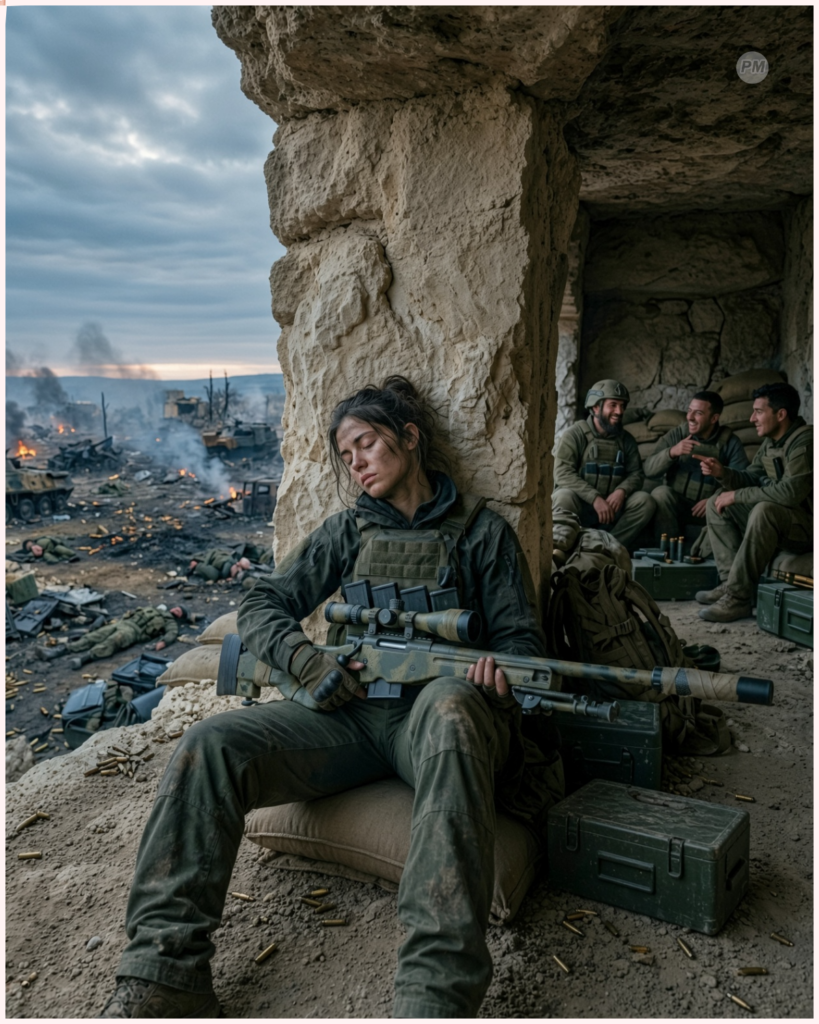
I stood at attention, my rifle slung across my back. Even now, even during a formal ceremony, I wouldn’t be separated from it.
Staff Sergeant Elena Mercer. Drummond’s voice carried across the assembled soldiers. For conspicuous gallantry and intrepidity at the risk of your life above and beyond the call of duty, you are hereby awarded the Silver Star.
Your second such decoration. He pinned the medal to my uniform. But more than that, you’ve changed how this entire FOB approaches defense.
You’ve taught us that vigilance isn’t paranoia, that preparation isn’t fear, and that sometimes the soldier everyone thinks is crazy is actually the only one seeing clearly.
The company erupted in applause. Hollis whistled. Callahan wiped her eyes. Wade stood with his hand over his heart, pride evident on his face.
But the ceremony was just formality. The real changes had been happening organically over the past 3 weeks.
I’d begun conducting informal training sessions, teaching soldiers my pattern recognition methods, how to read terrain analytically, how to spot surveillance signs, how to identify behavioral changes that might indicate impending violence, how to trust instincts while verifying them with evidence.
The session started with just my platoon, but they grew. Now soldiers from across the FOB attended, sitting in the dust while I drew diagrams, shared photographs, explained the methodology that had saved their lives.
Observation isn’t just about seeing, I explained during one session to 30 attentive soldiers. It’s about noticing what’s different.
Humans are creatures of habit, villagers even more so. When patterns change, traffic routes, market attendance, children’s presence, there’s always a reason.
Your job is to figure out if that reason is benign or threatening. Callahan had taken my lessons furthest.
She’d requested transfer to sniper training, determined to develop the same skills that had made me effective.
“I want to be able to protect people the way you do.” She told me.
“I want to see what you see.” I’d been touched and terrified in equal measure.
“Iris, be careful what you wish for. This ability comes with a cost. Once you start seeing threats everywhere, you can’t unsee them.
It changes you fundamentally.” She’d replied without hesitation. “I know, but after that night, I realized that staying comfortable is a luxury we don’t have.
Someone needs to watch. If not me, then who?” The answer had reminded me so much of my own transformation that I’d immediately agreed to mentor her personally.
Hollis had changed, too. The jokes had stopped completely. He now kept a detailed journal of his observations during patrols.
Unusual vehicle placements, changes in civilian behavior, inconsistencies in local stories. He brought it to me weekly, asking me to review his assessments.
“Am I seeing threats that aren’t there, or am I finally seeing what’s actually there?”
He’d asked during our first review session. I’d read through his observations carefully. “Both, actually.
Some of these are overreach. You’re pattern matching too aggressively. But these three entries here, these are legitimate concerns.
You’re learning to distinguish between the two. That’s the hard part.” Even the FOB’s command structure had evolved.
Captain Drummond had instituted what he called Mercer protocols, a formalized system for reporting and investigating pattern-based threat assessments.
No longer would soldiers’ concerns be dismissed as paranoia. Every observation would be logged, analyzed, cross-referenced.
“We almost died because we didn’t listen to you.” Drummond had told me privately. “I won’t make that mistake again.
And I don’t want any other commander in this theater making it, either.” My methods were being written up as a case study for the Army’s Intelligence School.
My photographs, my timeline analysis, my tactical predictions, all of it packaged into a training module titled “Pattern Recognition in Asymmetric Warfare Lessons from FOB Sentinel.”
But perhaps the most meaningful change was the tradition that had started organically and had now become official.
Mursa Watch. Every night one soldier volunteered for an extra duty shift, specifically focused on long-term pattern observation.


