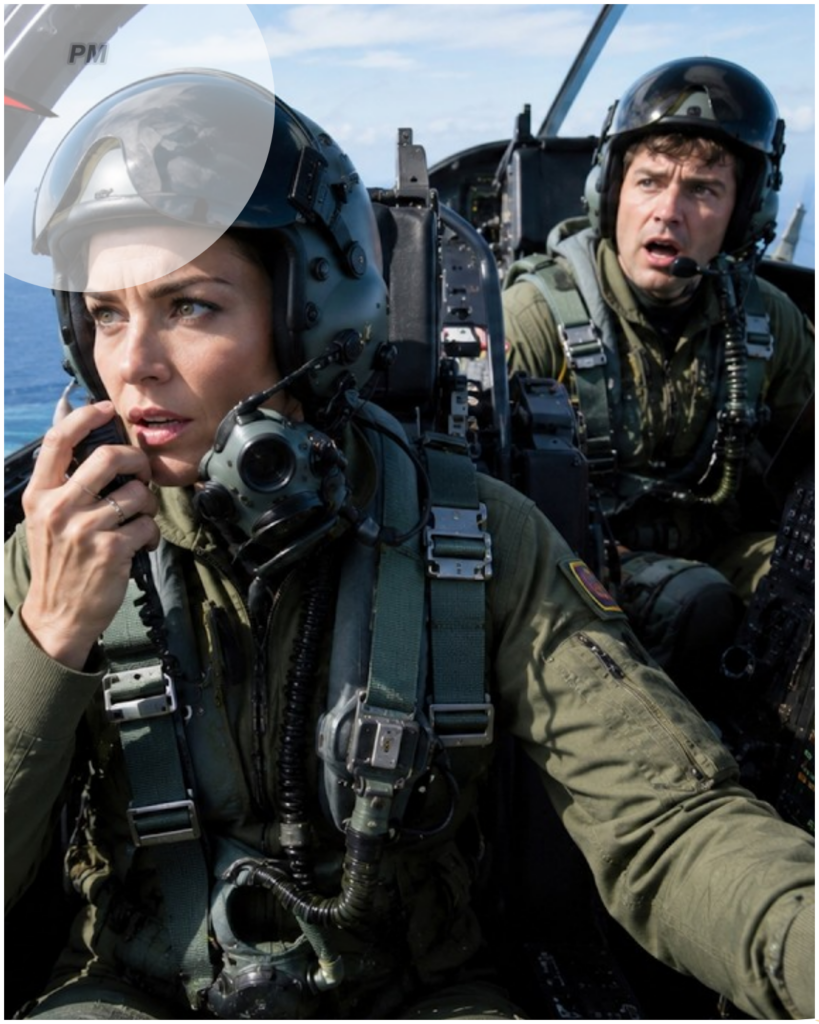
The Goliath was a post-Panamax freighter, built to…
The Goliath was a post-Panamax freighter, built to carry boxes across oceans, not to sprint, and every knot of speed she gained was a small victory against her own weight.
Varger watched the wind indicator and the heading and the closing speed, and he did the simple arithmetic of a seaman.
The faster his ship moved into the wind, the slower the jet would close on him, and the slower the jet closed, the better its chances of touching down without tearing itself apart.
It would not be enough. He knew it would not be enough. But it was all he had to give, and he gave it, and then he picked up the radio again and told the pilot he was turning, and he said God help you, and he meant that too, because God was the only one left in the conversation who had any authority over what happened next.
Captain Varger, do not comply. Dwayne screamed over the radio, entirely breaking protocol. Nata, you are going to kill us.
Eject. Eject. Now. If you pull those handles, Dave, I will break your fingers. Nata snapped over the internal comms, cutting him off from the main frequency.
We hit the water, we die, we hit the ship, we have a 50/50 shot.
She switched back to the external channel. Captain, I am going to bring this aircraft in low.
I’m going to drop her right on top of your container stacks. I need everyone off the upper decks.
Clear the bridge wings. We are coming in hot and there will be fire. 21.
This is control. Trevon broke in, his voice stripped of its AWACS, calm. You are ordering a civilian vessel into a collision course.
I cannot authorize this. I’m not asking for authorization, Trevon. I’m telling you to have the rescue birds ready to pick our charred asses off a cargo ship.
Through the canopy, the clouds broke. Just a sliver, but it was enough. Below them, a microscopic white rectangle sat amidst the churning black swells.
The Goliath. It looked like a floating shoe box. Nata pushed the stick forward, initiating a steep dive.
The altitude numbers rapidly unwound. 20,000 15,000. The wind howled against the canopy, a hollow, rushing scream.
The vibrations in the stick grew violent, rattling the bones in her forearms. She could smell the fear in the cockpit now.
It wasn’t just Dwayne’s panic. It was her own. It smelled sour, like old pennies and stomach acid.
Her hands were finally shaking, but she locked her wrists against her knees to steady the inputs.
“Varger, I see you,” Nata said. Through the canopy, the clouds broke, just a sliver, but it was enough.
Below them, a microscopic white rectangle sat amidst the churning black swells, so small it could have been a scrap of paper on a dark table.
The Goliath. It looked like a floating shoebox, a child’s toy left in a bathtub, and for a moment Nata could not believe that this tiny thing was supposed to save her life.
Then she pushed the stick forward and the jet answered, and the altitude numbers began to unwind, twenty thousand, fifteen thousand, the wind howling against the canopy in a hollow rushing scream, the vibrations in the stick growing violent, rattling the bones in her forearms.
She could smell the fear in the cockpit now, and it was not just Dwayne’s panic.
It was her own, sour, like old pennies and stomach acid, and her hands were finally shaking, but she locked her wrists against her knees to steady the inputs, and she kept flying, because there was nothing else to do and no one else to do it.
The ship grew with every second, the white rectangle resolving into a hull, the hull resolving into containers, red and blue and rusted orange, stacked in a mosaic that was never meant to be a runway.
She stared at the top of the stack and saw the truth of it. It was not smooth.
There were gaps between the boxes, and tie rods, and ventilation housings, and any one of them could catch the nose of the jet and cartwheel them into the sea.
She checked her fuel. One minute. She pulled the throttle back on the surviving engine, and the jet groaned, the nose dipping heavily, and she was not flying a plane anymore.
She was managing the trajectory of a fifteen-ton brick, and the brick was falling, and the only thing she could control was where it fell.
She lined up the nose with the stern of the ship, and the freighter was massive up close, towering out of the water like a steel cliff, and the wind was tossing the heavy aircraft side to side, and she worked the stick and rudder in rapid violent jerks, fighting the crosswinds, fighting the dead weight of the left side, fighting the jet’s own desire to roll and die.
Fifty seconds of fuel. Five hundred feet above the water. The bridge structure rushing toward them.
The smoke stack rising like a wall. She banked hard right, narrowly dodging it, and the smell of the freighter’s diesel exhaust came through the cockpit vents, thick and choking and industrial, and then she leveled out over the containers, and the flat surface was rushing up at them at a hundred and sixty miles an hour, and there was no more time to think, only to do.
Behind her, Dwayne was crying. She could hear it over the intercom, a ragged sob, a young man saying he did not want to die here, not here, and she answered him the way she had to answer him, softly, almost maternally, the cynicism gone, replaced by a cold calculating focus that surprised even her.
She told him he was not dying today, and she knew it was a lie, and she said it anyway, because that was her job in that moment, to hold him together for ten more seconds.
She told him to lock his harness and put his head back and not to touch the ejection handles, and she said his name, quietly, the way you say a name when you want someone to hear you through fear, and then she turned her whole attention to the ship, to the containers, to the gap, to the one flat stretch of steel that might just be wide enough to hold them, and she whispered gear up to herself, because the landing gear would only snag the containers and flip them, and they had to slide, and then she said brace, and the world ended.
“Are you turning into the wind? Turning now, 21. God help you. Down below, the tiny white shoe box began to pivot, cutting a massive white crescent of foam into the dark ocean.
Nata checked her fuel. One minute. She pulled the throttle back on the surviving engine.
The jet groaned, the nose dipping heavily. She wasn’t just flying a plane anymore. She was managing the trajectory of a 15-ton brick.