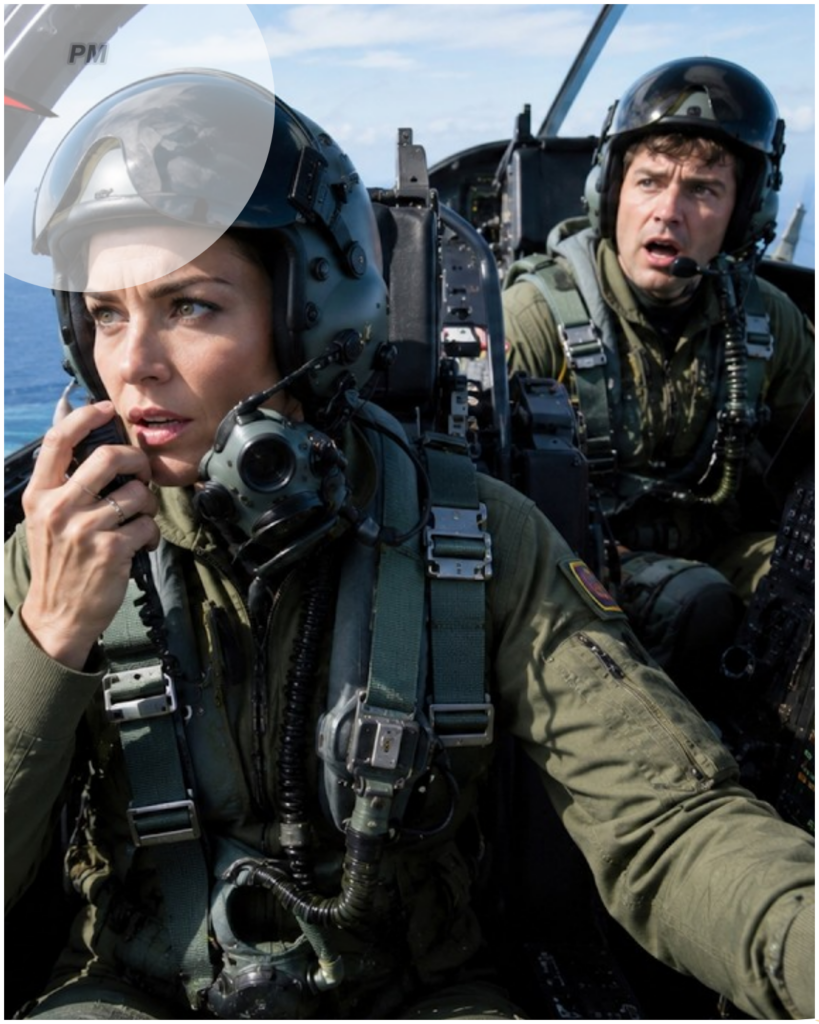
The friction generated a deafening howl through th…
The friction generated a deafening howl through the cracked canopy. Nata watched the ship’s superstructure rushing toward them.
A massive steel wall painted industrial white. Sparks, brilliant and blindingly orange, fountained up over the sides of the cockpit as the jet’s underbelly ground itself to powder against the metal boxes.
The left wing clipped a raised ventilation housing on one of the containers. The sheer force of the collision snapped the wingroot cleanly.
The jet jerked violently to the left in a sickening yaw. Nata was thrown hard against the side of her seat, her ribs grinding against the rigid survival vest.
They were crabbing sideways now, completely out of control, skidding toward the edge of the stacks.
Beyond that edge lay a 90 ft drop into the freezing, churning black water. Nata slammed her boots onto the right rudder pedal, desperate to straighten the nose, but the hydraulics were entirely dead.
She was standing on useless metal. “We’re going over.” The thought was surprisingly quiet. It wasn’t panicked.
It was just a cold, logical conclusion. She hated the feeling of being a passenger in her own aircraft, but the missing left wing changed their center of gravity.
The broken stub dug savagely into the roof of a heavy refrigerated container. The metal gouged, folded, and finally bit deep.
The violent snag acted like an anchor. The deceleration was brutal. It ripped the breath from Nata’s lungs.
The harness snapped her back into the seat with enough force to bruise her spine.
Then motion stopped. The transition from 160 mph shrieking slide to complete stillness was disorienting.
The heavy, deafening roar of friction vanished, replaced immediately by the low, steady thrum of the ship’s diesel engines vibrating through the steel boxes beneath them.
Nata didn’t move. She couldn’t. Her hands were locked onto the control stick in a death grip.
Her knuckles were bone white, the muscles in her forearms burning with lactic acid. She forced herself to breathe in, out.
The air tasted of atomized rust, burnt rubber, and the sharp toxic tang of aviation fluid boiling off hot metal.
“Dave!” She croaked. Her throat felt full of glass. Silence from the back seat. “Dave, sound off.”
She hit the internal comm switch harder. A ragged wet gasp crackled in her ear.
“I’m breathing.” “Are you injured?” “I don’t know,” Dwayne stammered. His voice was shaking so violently the words barely formed.
She called his name, and the silence answered her, and for a moment she was sure he was dead.
She had flown him into a ship, and she had told him he would not die today, and she had lied, and now he was dead in the back seat, and she would have to live with that for whatever was left of her life.
She hit the internal comm switch harder, and she called again, her voice cracking, her throat full of glass, and then the sound came, a ragged wet gasp crackling in her ear, and the relief hit her so hard her hands shook.
He was breathing. He did not know if he was injured. His left arm felt wrong, hot, the words barely forming through the shaking, and she understood what that meant.
Dislocated, or broken, pressed awkwardly against the seat, the shoulder gone. He was alive, and he was hurt, and that was better than the alternative, and it was worse than she had hoped, and it was enough.
It had to be enough. She forced her fingers to uncurl from the stick, and they were completely numb, and she reached up with a heavy uncoordinated arm and gripped the manual canopy release handle, and she said they needed to egress, her voice lacking any command or heroism, just profoundly tired, the voice of a woman who had used up everything she had.
If there was fuel pooled under them, the whole stack could go up, and they were sitting on top of it.
She told him to pull his pins and unstrap, and she yanked the release, and the explosive bolts, mercifully still armed, fired with a sharp pop, and the heavy acrylic canopy lifted, caught instantly by the violent ocean wind.
The cold hit her like a physical blow, thirty-four degrees carried by forty-knot gusts, slicing straight through her Nomex flight suit, and it smelled of brine and diesel exhaust and raw freezing moisture, and it was the most alive she had felt in hours.
She hauled herself up, her legs trembling uncontrollably, and it was not fear anymore. It was the adrenaline crash, the body purging the chemical cocktail that had kept her hyperfocused for the last twenty minutes, and she turned and looked back at Dwayne, and what she saw nearly broke her.
He was fumbling with his harness restraints with one hand, his left arm hanging limply at his side, his face beneath the raised visor the color of wet chalk, and he had thrown up all over his chest.
He looked small, and terrified, and incredibly young, and she did not offer him a comforting platitude, because she did not have the energy, and because there was nothing comforting to say.
She climbed over the console, balancing on the edge of the cockpit rail, the wind threatening to push her right off the jet, and she reached down into the back seat, and she said give me your good hand, and she planted her boots against the ejection seat rail, and she pulled.
Her bruised ribs screamed in protest, a sharp white-hot pain lancing through her side, and she hauled him upward, dragging him out of the metal tub until he spilled over the side of the jet, collapsing onto the corrugated roof of the shipping container.
She dropped down beside him, and the metal under their boots was slick with sea spray, and God knew what fluids leaking from the wrecked F-15, and she looked at her plane, the Strike Eagle, a fifty-million-dollar apex predator of the sky, reduced to a mangled heap of scrap.
The nose was flattened, the canopy gone, the left wing sheared off entirely. It rested precariously across two rusted red shipping boxes, the right wing jutting out into empty space over the ocean.
It looked pathetic, and small, and she felt a strange grief for it, the way you grieve for a horse that carried you somewhere and died doing it.
Then heavy boots clanged against metal, and she turned, and five men in heavy bright yellow weather slickers were climbing the steep metal stairs, and at the front was a burly man with a thick beard and eyes narrowed against the biting wind, and she knew him before he spoke, because there was only one man on this ship who could look at her the way he was looking at her, like a problem he had not ordered and could not return.
“My arm, my left arm feels wrong. Hot.” Nata finally forced her fingers to uncurl from the stick.