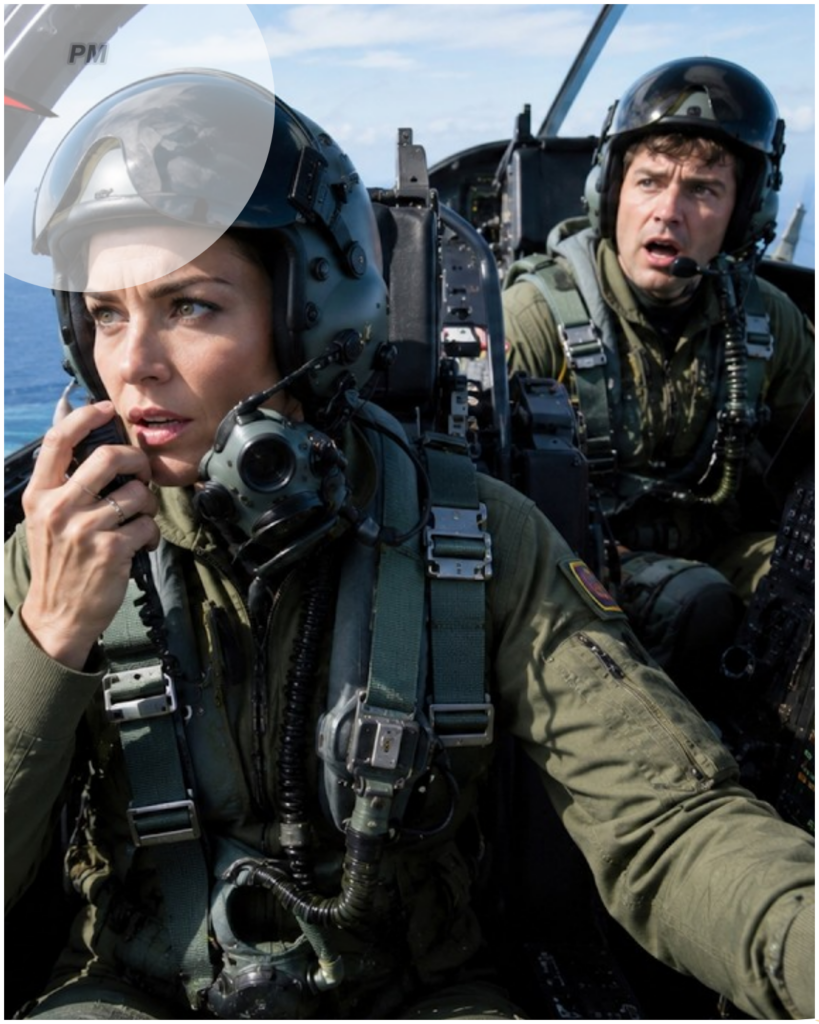
Varger's crew was there instantly, grabbing them,…
Varger’s crew was there instantly, grabbing them, hauling them down the narrow walkway, rough calloused hands pulling at their survival vests, and someone shoved a thick wool blanket over her shoulders, smelling strongly of mildew and engine grease, and she barely felt it.
She barely felt anything except the rolling of the ship and the pain in her ribs and the weight of Dwayne leaning on her, and the knowledge that they were alive, which did not feel the way she had expected it to feel.
It did not feel like victory. It felt like the moment after a car crash, when the noise stops and your ears ring and you are not sure what is broken yet.
Varger grabbed her arm and shouted over the wind, asking if she was the commander, and she looked at him, and her helmet was still on, the visor cracked, and she reached up and fumbled with the chin strap and pulled it off, letting it drop onto the metal grating, and her hair was plastered to her forehead with sweat, and her lip was bleeding freely down her chin, and she said yes, she was, her voice terrifyingly flat, the voice of a woman who had nothing left to prove and nothing left to hide.
He said she was insane, and he did not mean it as an insult, but as a statement of sheer bewildered fact, and he stared past her at the wreckage, and he said she had ruined his boxes, and a sharp hysterical laugh bubbled up in her throat, and she choked it down, coughing instead, because laughing would have meant losing control, and she had only just gotten control back.
She told him to send the bill to the Pentagon, because they had deep pockets, and she meant it as a joke, and she meant it as the truth, and she meant it as the only answer she had for a man who had just risked his ship for two strangers.
Varger shook his head, and he gestured for his men to help Dwayne down the next flight of stairs, and he said the bridge was this way, and it was warm, and they had a medical kit, and Nata followed the crew, her boots heavy on the grating, and the ship rolled heavily over a swell, and her knees buckled, and she caught the handrail just in time, her knuckles white.
She was not a hero. She was a middle-aged pilot with a sore back, and a bleeding face, and a massive stack of paperwork waiting for her at a base eight hundred miles away.
And she was alive, and Dwayne was alive, and that was the whole of it.
They reached the heavy watertight door of the bridge superstructure, and Varger yanked it open, and the heat hit Nata like a physical wall.
The air inside smelled of stale coffee, tobacco smoke, and body odor, and it was the most beautiful thing she had ever smelled, because it was the smell of people, and warmth, and a room with a roof, and safety.
Inside, the bridge was dim, lit by the green glow of radar screens, and the noise of the wind was muffled, reduced to a heavy distant thudding against the reinforced glass.
A young crewman nervously handed Nata a handheld radio mic, and he told her that her people were yelling very much, and she took the heavy plastic mic, and she pressed the transmit button, and she said the words she had been carrying since the moment the left engine died.
Control, Eagle 21. And then there was silence, a profound stretching silence, and then a chaotic burst of static, and then Trevon Mitchell’s voice, and it was not calm AWACS protocol.
It was ragged. It was the voice of a man who had spent the last twenty minutes believing two people were dead, and who had just heard a ghost speak.
He asked if it was her, and she said affirmative, and she leaned her back against a metal bulkhead and slid slowly down until she was sitting on the cold linoleum floor, and she closed her eyes, and she told him the words that mattered.
Eagle 21 is down safely on deck. They have deep pockets.” Varger shook his head, gesturing for his men to help Dwayne down the next flight of stairs.
Bridge is this way. It is warm. We have a medical kit. Nata followed the crew, her boots heavy on the grating.
The ship rolled heavily over a swell and her knees buckled. She caught the handrail just in time, her knuckles white.
She wasn’t a hero. She was a middle-aged pilot with a sore back, a bleeding face, and a massive stack of paperwork waiting for her.
They reached the heavy watertight door of the bridge superstructure. Varger yanked it open and the heat hit Nata like a physical wall.
The air inside smelled of stale coffee, tobacco smoke, and body odor. It was the most beautiful thing she had ever smelled.
Inside, the bridge was dim, lit by the green glow of radar screens. The noise of the wind was muffled, reduced to a heavy, distant thudding against the reinforced glass.
A young crewman nervously handed Nata a handheld radio mic. Your people, they are yelling very much.
Nata took the heavy plastic mic. She pressed the transmit button. “Control, Eagle 21,” she said.
A profound stretching silence answered her. Then a chaotic burst of static followed by Trevon Mitchell’s voice.
It wasn’t calm AWACS protocol. It was ragged. “21 Nata, is that you?” “Affirmative, Trevon,” Nata replied, leaning her back against a metal bulkhead and sliding slowly down until she was sitting on the cold linoleum floor.
She closed her eyes. Eagle 21 is down safely on deck. “Copy that 21,” Trevon said.
She could hear him exhale, a sound that conveyed a thousand miles of stress leaving his body.
Coast Guard rotary is spinning up from Keflavik. ETA is 2 hours. You did good, Nata.
Nata looked across the room. Dwayne was sitting in a swivel chair, grimacing as a crewman awkwardly tried to cut away his flight sleeve to examine his arm.
He looked small, terrified, and incredibly young. She looked down at her own hands. They were covered in grease, sea salt, and drying blood.
The right hand was still locked in a slight claw shape from gripping the stick so hard.
Yeah, Nata muttered into the radio, her voice dripping with exhaustion and a deep, unshakable cynicism.
We did great. Bring coffee when you come get us. She let the radio drop to her lap.
She didn’t feel victorious. She felt the heavy vibrating thrum of the ship beneath her, the absolute finality of the dark ocean outside, and the sudden overwhelming urge to finally let herself cry.
She didn’t, of course. She just sat there, waiting for the bruising to set in, listening to the relentless hum of the engines.
𝐷𝑖𝑠𝑐𝑙𝑎𝑖𝑚𝑒𝑟: 𝑇ℎ𝑖𝑠 𝑐𝑜𝑛𝑡𝑒𝑛𝑡 𝑚𝑎𝑦 𝑏𝑒 𝑐𝑟𝑒𝑎𝑡𝑒𝑑 𝑏𝑦 𝐴𝐼 𝑓𝑜𝑟 𝑒𝑛𝑡𝑒𝑟𝑡𝑎𝑖𝑛𝑚𝑒𝑛𝑡 𝑝𝑢𝑟𝑝𝑜𝑠𝑒𝑠. 𝐴𝑛𝑦 𝑟𝑒𝑠𝑒𝑚𝑏𝑙𝑎𝑛𝑐𝑒 𝑡𝑜 𝑟𝑒𝑎𝑙 𝑝𝑒𝑟𝑠𝑜𝑛𝑠, 𝑒𝑣𝑒𝑛𝑡𝑠, 𝑜𝑟 𝑝𝑙𝑎𝑐𝑒𝑠 𝑖𝑠 𝑐𝑜𝑖𝑛𝑐𝑖𝑑𝑒𝑛𝑡𝑎𝑙.