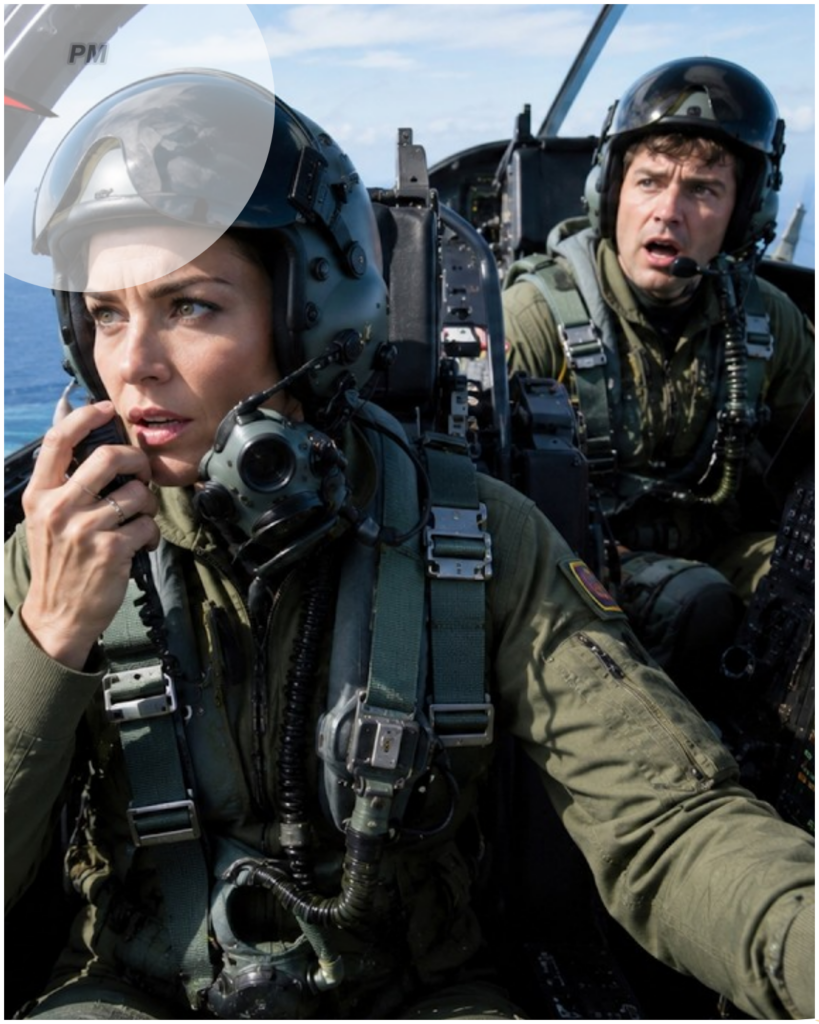
She stared at the top of the container ship
She stared at the top of the container ship. It was a mosaic of red, blue, and rusted orange boxes.
It wasn’t smooth. There were gaps, tying rods. If the nose dipped into one of those gaps, the jet would cartwheel and explode, turning them into ash before they even felt the impact.
“Dave,” Nata said quietly. A sob echoed over the intercom. I don’t want to die here, Nata.
Not here. You’re not dying today. She lied, her voice softer now, almost maternal. The cynicism was gone, replaced by a cold, calculating focus.
Lock your harness. Put your head back. Do not touch the ejection handles. She lined up the nose of the F-15 with the stern of the ship.
The freighter was massive up close, towering out of the water like a steel cliff.
The wind was violently tossing the heavy aircraft side to side. Nata worked the stick and rudder in rapid, violent jerks, fighting the crosswinds.
50 seconds of fuel. “Gear up,” Nata whispered to herself. She didn’t touch the lever.
The landing gear would only snag the containers and flip them. They had to slide.
They were 500 ft above the water, roaring toward the back of the bridge structure.
“Clear the tower,” Nata screamed into the radio. She banked hard right, narrowly dodging the ship’s towering smoke stack.
The smell of the freighter’s diesel exhaust actually permeated the cockpit vents, thick, choking, and industrial.
She leveled out over the vast expanse of stacked containers. The flat surface was rushing up at them at 160 mph.
Brace, Nata commanded. The impact was not a boom. A boom would have been simple, a single sound and then silence.
This was a prolonged, ear-shattering shriek of tearing titanium and vaporizing paint, the belly of the jet slamming into the corrugated steel tops of the shipping containers and then not stopping, but sliding, bouncing, the uneven ridges of the cargo acting like a washboard under fifteen tons of metal moving at a hundred and sixty miles an hour.
The impact threw Nata violently forward against her shoulder straps, and her helmet smacked the front console, cracking the visor, filling her vision with a blinding constellation of white stars, and the taste of copper flooded her mouth again, but this time it was her own blood, from a bitten lip.
They did not just slide. They bounced. The nose pitched up violently and then slammed back down, crushing the radar dome like a plastic cup, and Nata roared at Dwayne to keep his head down, spitting blood onto her microphone, not knowing whether he could hear her, not knowing whether he was even conscious, the friction generating a deafening howl through the cracked canopy, the whole jet shaking itself apart around them.
Sparks fountained up over the sides of the cockpit, brilliant and blindingly orange, as the jet’s underbelly ground itself to powder against the metal boxes.
The left wing clipped a raised ventilation housing on one of the containers, and the sheer force of the collision snapped the wing root cleanly, and the jet jerked violently to the left in a sickening yaw.
Nata was thrown hard against the side of her seat, her ribs grinding against the rigid survival vest, and they were crabbing sideways now, completely out of control, skidding toward the edge of the stacks, and beyond that edge lay a ninety-foot drop into the freezing churning black water.
She slammed her boots onto the right rudder pedal, desperate to straighten the nose, but the hydraulics were entirely dead, and she was standing on useless metal, and the thought came to her with a terrible clarity.
We are going over. It was not panicked. It was just a cold, logical conclusion, the same voice that had done the fuel math, telling her the last true thing it would ever tell her.
She hated the feeling of being a passenger in her own aircraft, hated it with a fury that surprised her, but the missing left wing had changed their center of gravity, and there was nothing left to fly with, and nothing left to do but wait for the edge.
And then the broken stub dug in. The jagged remains of the left wing, torn and sharp, caught the roof of a heavy refrigerated container, and the metal gouged, and folded, and finally bit deep, and the violent snag acted like an anchor, and the deceleration was brutal, ripping the breath from Nata’s lungs, snapping her back into the seat with enough force to bruise her spine.
And then motion stopped. The transition from a hundred and sixty miles an hour of shrieking slide to complete stillness was so abrupt it felt like a mistake, like the world had forgotten how to move.
The heavy, deafening roar of friction vanished, replaced immediately by the low, steady thrum of the ship’s diesel engines vibrating through the steel boxes beneath them.
Nata did not move. She could not. Her hands were locked onto the control stick in a death grip, her knuckles bone white, the muscles in her forearms burning with lactic acid.
She forced herself to breathe, in, out, and the air tasted of atomized rust, burnt rubber, and the sharp toxic tang of aviation fluid boiling off hot metal, and somewhere behind her, in the back seat, there was silence, and the silence was the worst sound she had ever heard.
The right engine coughed, sputtered, and died. Complete fuel exhaustion. The cockpit displays went entirely black as the main generators tripped offline.
The heavy silence of the dead engines was instantly replaced by the deafening rushing roar of the wind.
They were falling. Gravity reclaimed them instantly. Without the thrust of the engines, the F-15 Strike Eagle ceased to be an aircraft and became a 30,000-pound anvil.
The belly of the jet slammed into the corrugated steel tops of the shipping containers.
The sound was not a boom. It was a prolonged ears shattering shriek of tearing titanium and vaporizing paint.
The impact threw Nata violently forward against her shoulder straps. Her helmet smacked the front console, cracking the visor and filling her vision with a blinding constellation of white stars.
The taste of copper flooded her mouth again, but this time it was her own blood from a bitten lip.
They didn’t just slide, they bounced. The uneven ridges of the cargo containers acted like a washboard.
The jet’s nose violently pitched up, then slammed back down, crushing the radar dome like a plastic cup.
“Keep your head down!” Nata roared, spitting blood onto her microphone. She couldn’t hear if Dwayne responded.