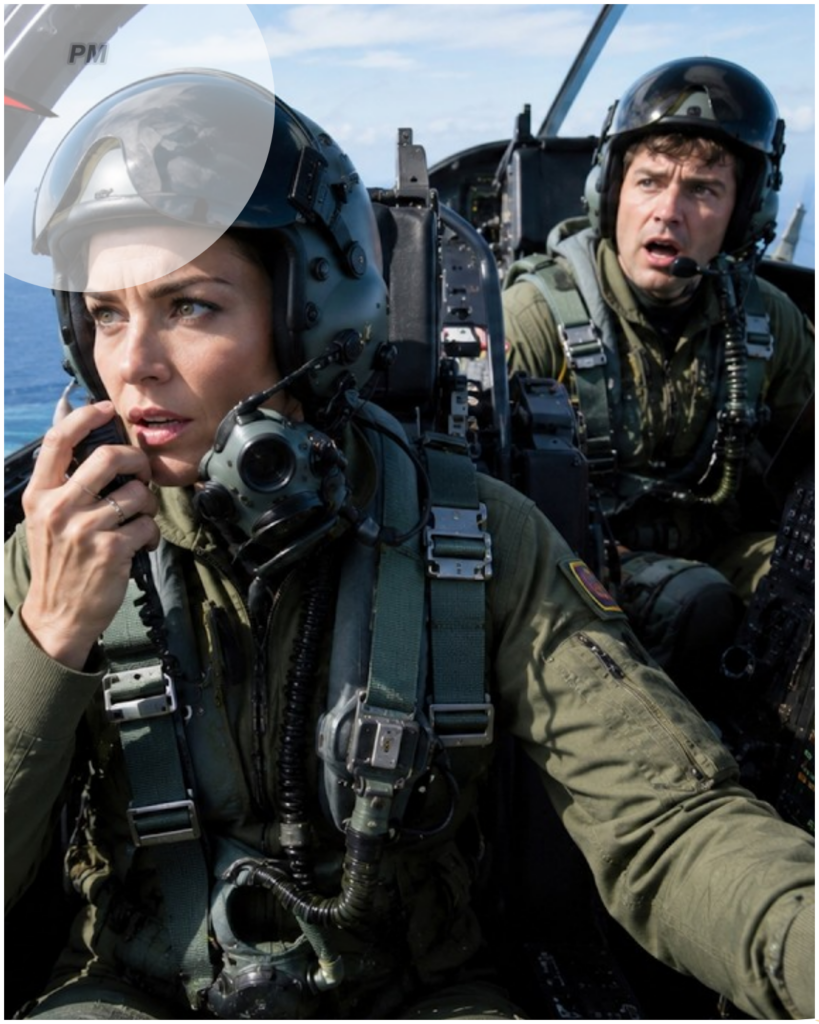
Get him on the horn
Get him on the horn. Nata, you’re out of your mind. Dwayne hissed from the back seat.
We punch out near the ship. We parachute down. They pick us up. That’s the protocol.
Dave,” Nata said, her voice dropping an octave, finding a cold, hard resonance that surprised even herself.
“Look at the wind drift indicator on your screen. Surface winds are gusting at 45 knots.
If we punch out at altitude, we’ll drift 2 mi from that ship before we hit the water.
In 34° swells with parachutes dragging us under, they will never fish us out in time.
The ship takes four miles just to turn around. We die in the water. So, what’s your plan?
Belly land on shipping containers. We’ll be smeared across a mile of steel. Only if I miss the gap, Nata muttered.
The radio clicked. A heavy accented voice broke through the white noise. The audio quality was terrible, sounding like it was being routed through a tin can and a string.
Unknown military aircraft. This is Captain Varger of the motor vessel Goliath. We have been advised of your emergency by your control.
Nata swallowed. Her mouth was incredibly dry, her tongue sticking to the roof of her mouth.
She could feel a single drop of sweat tracing a line down her spine, chilling her skin under the heavy flight suit.
Captain Varger, this is Eagle 21. I am flying a crippled fighter jet. I have roughly 6 minutes of fuel remaining and my navigator and I cannot survive an oceanic ditching in these conditions.
What is your current deck configuration? A long pause. Nata could hear the low thrum of the ship’s massive diesel engines bleeding through the captain’s microphone.
21. We are a post-Panamax freighter. We carry shipping containers. We do not have a deck.
We are stacked five high from the bridge to the bow. Is it a flat stack?
Nata asked. Her eyes flicked to the fuel gauge. 3 minutes of usable fuel. The right engine sputtered, starving for a millisecond before catching again.
The whole airframe shuddered violently. It is uniform. Varger replied, sounding profoundly confused. But you cannot land here.
The gantry cranes. “Listen to me very carefully, Captain,” Nata interrupted. She didn’t shout. Her voice was terrifyingly calm, stripping away any room for argument.
“I have two souls on board. I have no landing gear, no left engine, and no runway for 800 miles.
You are my runway.” “Madness,” Varger breathed over the channel. Maybe turn your ship into the wind.
Give me maximum knots. I need you to reduce my closure rate as much as possible.
On the bridge of the Goliath, Captain Varger held the radio handset and stared out at the black water, and for a long moment he said nothing at all.
Around him, the bridge was dim and warm, lit by the green glow of radar screens, smelling of stale coffee and tobacco smoke and body odor, the smell of men who had been at sea for weeks.
His crew stood in the doorway, watching him, waiting to see what their captain would do with the impossible thing a voice from the sky had just asked of him.
Varger had been at sea for thirty years. He had ridden out storms that tore containers off his deck and threw them into the ocean like toys.
He had watched men die in engine rooms and men die in lifeboats. He had never once been asked to turn his ship into a runway.
He had never once been told that a fighter jet was going to land on his cargo.
He looked at the radio in his hand, and then he looked at his first mate, and then he looked back out at the water, and he understood the shape of the choice in front of him.
If he refused, two people would die in the sea a few miles from his ship, and he would have to live with that for the rest of his life.
If he agreed, he might kill his own crew, wreck his ship, and lose his cargo, his livelihood, and possibly his command.
There was no safe answer. There was only the answer he could live with. He gave the order.
Turn into the wind. Maximum knots. The helmsman repeated it back, his voice tight, and the great ship began to pivot, slow and ponderous, cutting a massive white crescent of foam into the dark ocean.
On deck, the crew moved with the discipline of men who had drilled for emergencies they had never imagined, clearing the upper decks, pulling men off the catwalks, securing the loose gear, shouting over the wind in three different languages.
Varger watched the radar, watched the tiny contact closing on them at a speed that made no sense, a military jet coming down out of the sky toward a ship that was never built to receive it, and he thought about the boxes stacked five high from the bridge to the bow, and about the gantry cranes, and about the superstructure rising out of the water like a steel cliff, and he thought that this woman, this pilot, had to be either the bravest person he had ever spoken to or the maddest.
He said so over the radio, one word, madness, and he meant it as a statement of fact, not an insult.
He was a merchant captain. He dealt in cargo and schedules and fuel consumption. He did not deal in miracles.
But the ship was turning, and the jet was coming, and whatever happened next was going to happen on his deck.
Below, in the engine room, the diesels rose to maximum revolutions, and the whole ship thrummed with the effort, the vibration coming up through the steel, through the soles of the crew’s boots, through the deck plates.