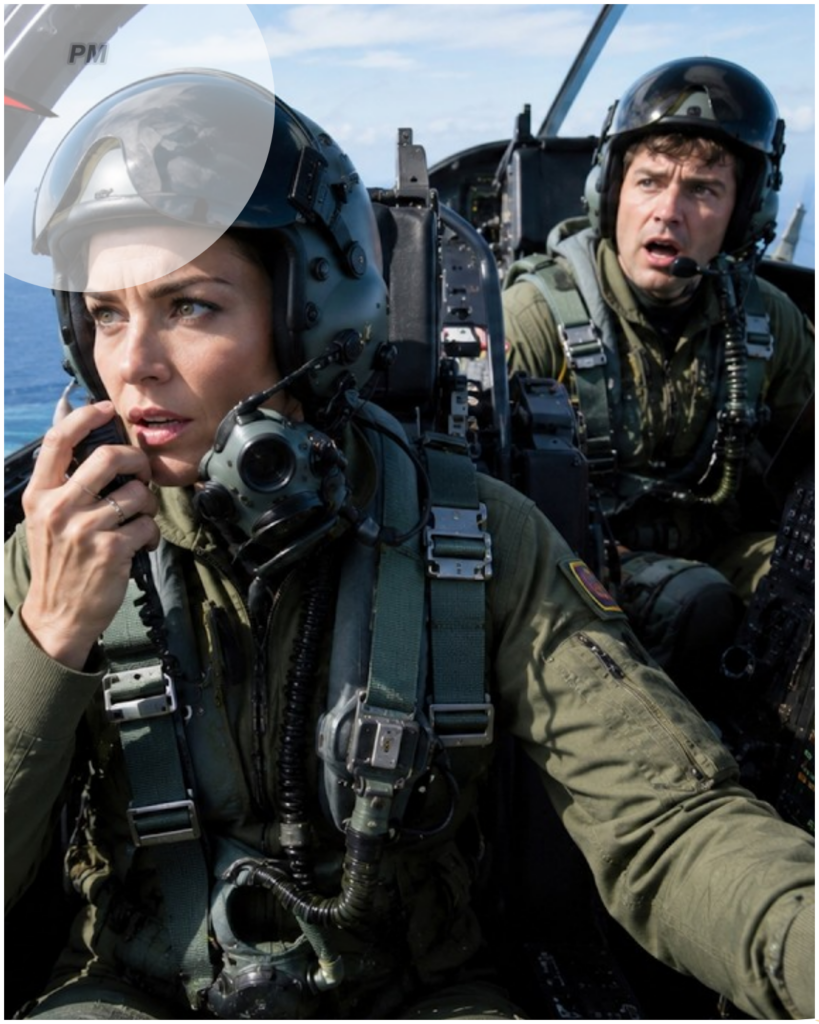
Maybe 14 if she throttled back to a crawl
Maybe 14 if she throttled back to a crawl. But pulling back the throttle meant dropping altitude, which meant burning more fuel in the thicker air.
A zero sum game. We have maybe 10 minutes of sustained flight. Eagle 21, stand by,” Trevon said.
The slight hesitation in his voice gave him away. The AWACS crew was looking at their screens, drawing a circle around Nata’s coordinates and realizing the circle contained absolutely nothing but freezing water.
“Nata,” Dwayne said over the internal comms. The use of her first name meant he had done the math, too.
We have to ditch. Nata looked down at the ocean. The water temperature was 34° F.
Even with their exposure suits, the shock of hitting the swells, the struggle to inflate the raft in 20 knot winds, the sheer crushing isolation.
It wasn’t a survival scenario. It was a delayed funeral. We aren’t ditching, Nata said softly.
Dwayne said her first name, and that told her everything. On the intercom he always called her by rank or callsign, the way the Air Force taught him, the way the checklist taught him.
Her first name meant he had done the math too, and the math had scared him past the training.
He said they had to ditch, and he was right, in the way that the checklist was right, in the way that every procedure ever written for this situation was right.
Punch out near the ship. Parachute down. Get picked up. It was the protocol, and the protocol existed because someone, somewhere, had thought it through and decided it was the best bad option.
But Nata had already looked down at the ocean, and the ocean had told her something the protocol did not say.
The water was thirty-four degrees. The swells were running in twenty-knot winds. The surface gusts were hitting forty-five knots.
If they punched out at altitude, the wind would carry them two miles from any rescue before their parachutes even opened, and then the parachutes themselves would become anchors, dragging them under in the swells while the cold shut their bodies down in three minutes.
The ship would need four miles just to turn around. By the time it got to them, there would be nothing left to fish out of the water but flight suits.
She was thirty-four, and he was twenty-six, and that arithmetic felt obscene to her in a way the fuel arithmetic did not.
He was engaged. He had a golden retriever waiting at home, a dog that would sit by the door for weeks not understanding why its person never came back.
She was divorced, and her only dependent was a fern on a windowsill that she had already half killed through neglect.
It felt fundamentally unfair that they had to share the same casket, that his whole unlived life and her half-lived one would end in the same cold water for the same stupid reason, a frayed wire arcing against a titanium bulkhead somewhere behind her left shoulder.
She said they were not ditching, softly, and she heard his voice crack when he answered, the professionalism fraying at the edges, the panic bleeding through in a way he could not hide and should not have had to hide.
He was twenty-six years old and he did not want to die here, not in the dark, not in the cold, not in a place with no name on any map.
She understood. She did not want to die here either. But wanting was not a plan, and the protocol was not a plan, and the only plan that had any chance at all was the one she was about to say out loud.
We don’t have a choice, Dwayne’s voice cracked. The professionalism was fraying. The panic was bleeding through.
He was 26 years old, engaged, with a golden retriever waiting at home. Nata was 34, divorced, and her only dependent was a neglected fern on her windows sill.
It felt fundamentally unfair that they had to share the same casket. I said, “We aren’t ditching Dave.
Shut up and let me fly the jet.” Nata’s right hand gripped the stick tighter.
The rubber felt greasy against her palm. The left engine finally spooled down, vibrating the airframe with a sickening thud as the turbine blades seized.
The master warning light erupted in the cockpit, a blinding red glare accompanied by a blaring claxon that drilled directly into her temples.
She slapped the master caution reset button, silencing the alarm. The quiet that followed was far worse.
The jet pulled sluggishly to the left, dragging its dead weight. Nata compensated with heavy right rudder, her calf muscle burning as she forced the pedals down.
The F-15 was flying lopsided, fighting its own aerodynamics. Control 21. Nata transmitted. Left engine is offline.
Fuel state is critical. I need surface contacts within a 50-mi radius right now. 21 control.
Searching surface tracks. I have a weather buoy 200 miles north. And Trevon paused. The static hissed like frying bacon.
I have a civilian maritime contact commercial freighter. The Goliath Panama Registry heading 090. How far?
Nata snapped. 32 mi off your nose. You’re practically on top of him. 32 mi.
At their current air speed. That was a little over 3 minutes away. Give me his maritime frequency.
Patch me through. Nata commanded 21. What is your intention? They don’t have a flight deck.
It’s a container ship. You cannot put a strike eagle on a civilian freighter. I am not asking for a runway.
Trevon, Nata said, the cynicism bleeding into her tone. I’m asking for a landing pad.