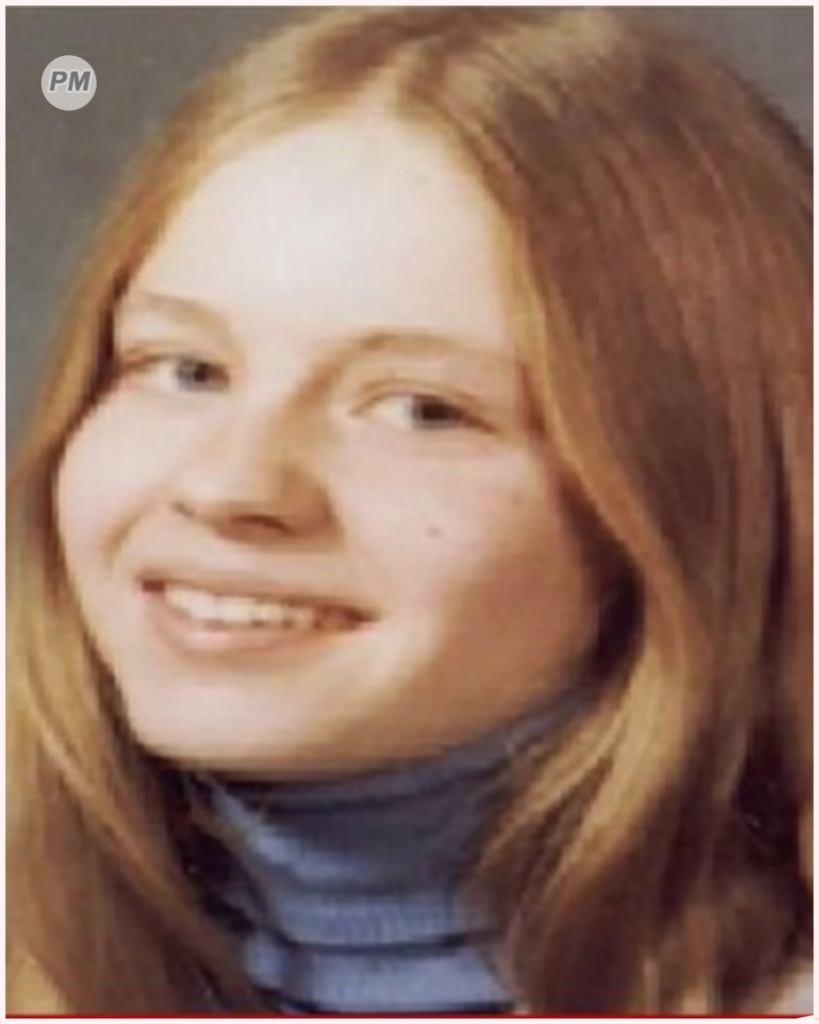
In a field in Lango, Quebec on the first day of Ap…
In a field in Lango, Quebec on the first day of April 1975, investigators stood over the body of a 16-year-old girl and wrote down what lay around her.
Clothing of hers 6 ft away in the mud. White tape, partly chewed, tangled in her hair and stuck to her wrists, and a man’s shirt, size 17, collar, 34 in sleeves, a shirt cut for a man roughly 6 ft tall and roughly 200 lb.
It did not belong to her. It had never hung in her closet or been washed in her mother’s machine.
It had never belonged to her father or her brother or her boyfriend. Detectives looked at it and concluded it had been used to tie her hands.
That shirt went into an evidence box and it stayed there. It stayed there while her mother grew old.
It stayed there through 13 investigators and more than 100 suspects who were questioned and let go.
It stayed there for 48 years, 1 month and 24 days, 17,587 days. For nearly all of that time, it was the strongest piece of physical evidence in one of the most famous unsolved murders in Canadian history.
And it pointed at absolutely nobody. So, this is not really the story of a murder that took 48 years to solve.
It is the story of what a piece of cloth can hold, of one mother who would not let anyone close the file, and of what it finally took to make that shirt say a name, which turned out to be a court order in West Virginia, [music] an excavator and a judge willing to let Canadian police open an American grave.
[music] And it starts on an ordinary Saturday afternoon in a [music] kitchen in Montreal with eight hard-boiled eggs.
Welcome to the channel. We tell these stories the long way with the names and the dates and the paperwork because the people inside them earned that.
If you want more, subscribe now. That’s Saturday. Cheron Kim Prior was born on February 9th, 1959 to Ivonne Prior.
She had twin sisters, Dorene and Moren, two years younger. She had a younger brother, the family called Jojo, who was 11, and she had a 4-year-old foster brother named Steven.
Her father had served in the Canadian military. Her parents had separated. Home was 445 Congregation Street in Pont St.
Charles. To understand that address, you have to understand the neighborhood because the neighborhood is part of how this happened.
Point to St. Charles, known to everyone in it as the point, sits southwest of downtown Montreal, cut off from the rest of the city by the Lasheen Canal and a raised railway line running through its middle.
It was built in the 1860s to house the men who dug that canal and worked the rail yards and the foundaries.
Irish first, then English, Scottish, French Canadian, then Polish and Ukrainian. By 1975, the work had been draining out of it for 15 years.
The seaway had opened, the canal had closed, and the factories had gone dark one after another.
It was one of the poorest neighborhoods in Canada and one of the most stubborn.
Its residents had already forced the city to abandon a boulevard through the middle of it and had built a medical clinic that became the model for the entire province.
And in the spring of 1975, Montreal was one year from hosting the Olympics. Here is what was normal there and then that is not normal now.
Children walked. A girl of 16 walking five blocks after dark to meet friends was not a decision anybody thought about.
And the Corner Pizzeria was not a restaurant. It was the social world of a generation.
Now, Saturday, March 29th, 1975, Easter weekend. What follows is the family’s own record of that day, written out hour by hour on the website they built for her, which is still online tonight.
Her mother went out that morning for the last few things for Easter dinner, including the chocolate eggs.
At 1:00, Sharon hard-boiled eight eggs and left them to cool because she had decided to paint them.
At 3, her mother came home and sat at the kitchen table to watch her do it.
Sharon asked whether the paint would be dry by morning. Her mother told her to paint half of each egg standing in an egg cup and turn them over later.
At 3:45, she walked over to the Boys and Girls Club to pick up her Leo’s Boys jacket.
She had earned that jacket by selling books of raffle tickets. She had been going to that club since she was 6 years old for [music] swimming and basketball and floor hockey.
She took Steven with her. [music] When she got there, they did not have her size.
So, they gave her a receipt and told her to come back another day. She was already thinking about ordering a smaller one for Steven because he did not have a spring coat that fit him properly.
At 4:15, she was back at the kitchen [music] table painting. At 4:30, the family’s reverend stopped in [music] to wish them a happy Easter, brought a box of chocolate turtles, and stayed 45 minutes.
When Sharon asked if there was a book in the house she could read to the four-year-old about the Easter Bunny, he told her to tell him herself how [music] Easter really came about.
Supper was stew. Her grandmother, [music] her mother, the twins, Jojo, Steven, and a family friend sat down to it.
None of the children liked stew. She ate some anyway. Afterward, she washed the dishes.
Moren and Dorine dried, and she put the painted eggs high on a shelf [music] so Steven would not break them.
Between 6:00 and 7, a girlfriend from the same block came by. Chiron kept changing her top and checking the mirror, and her friend laughed at her for it, and in the end, she borrowed one of her mothers.
It was drizzling, and she was worried about her brown suede [music] jacket. Her mother said it was not enough rain to hurt it.
She left her bus pass on the table. [music] She left her money. She said goodbye to her mother and her mother said goodbye.
Be careful the way she always did. In the pocket of that brown suede jacket was the receipt for a coat she had earned and had not yet been given.


