Pete never said a word to him about the tracks
Pete never said a word to him about the tracks. He had heard about the figures from Gail Hakkinen, so he took his own picture of that birch.
He mailed me a print with a note on the back in his big square handwriting.
Lars, is your township getting crowded? The next one did not walk up out of any lake.
It came with a pack of wolves, and three of them were wearing radio collars.
Number nine, Iron County, Wisconsin, south of Mercer, February of 2009. Wolves came back to Wisconsin on their own in the 1970s.
They wandered over from Minnesota [snorts] after they had been gone from the state for years.
The state started trapping and radio collaring them in 1979 to keep track. From a handful of packs, they grew to hundreds of wolves.
Part of the job for the biologists is listening to those collars from a truck or a small plane.
They track where the packs go and what they are doing. That February, a wolf biologist I knew named Dale Witt called me.
One of his packs, five wolves, three of them collared, had not moved in 3 days.
They were not hunting. They were not traveling. They were sitting in one spot in the middle of a big block of state forest.
Dale was afraid somebody had trapped or poisoned them. He wanted a warden along. So, we strapped on snowshoes and went in.
It took us half a day. The snow was deep and soft, and it was 20 below in the shade.
Every so often, Dale stopped and held up his antenna, and the little receiver beeped, steady and strong.
Dale told me he had flown over the spot the day before in the little plane they used for tracking.
From the air, he said, the wolves looked like five dark beads around a single tree.
All around them, a great white sheet of snow. The pilot had circled three times.
The wolves had never once looked up at the plane. Halfway in, we crossed their old trail from 3 days before.
Five sets of tracks coming in from the west in single file, the way a pack travels.
They did not wander. They did not stop to smell anything. They went straight as a surveyor’s chain, and I knew that kind of straight by then.
Every 40 ft or so along that trail stood a tree with an old gray blaze on it, healed over and half gone.
The wolves had walked the line. When we came over the last rise, there they were.
Five wolves sitting up in the snow in a ring, maybe 40 ft across, facing in, sitting the way a dog sits at a back door waiting to be let in.
A single white pine stood at the center. Five heads came around to look at us.
Then, one at a time, they went back to the tree. Dale had worked with wolves for 20 years.
He whispered that he had never seen anything like it. They did not run. They did not even stand up.
We crouched in the snow and watched them for most of an hour until my feet went numb.
Once the biggest of them lifted his nose and sniffed at the pine, a gray male with frost in his ruff.
He sniffed the way a dog sniffed at a coat somebody left on a chair.
Then, he settled again. Then, all at once, as if somebody had told them they could go, the five of them got up.
They trotted off into the timber in single file. They did not look back. The snow inside their ring was packed down hard, 3 days of wolves sitting on it.
But, the snow right around the trunk of the pine was smooth as a bedsheet.
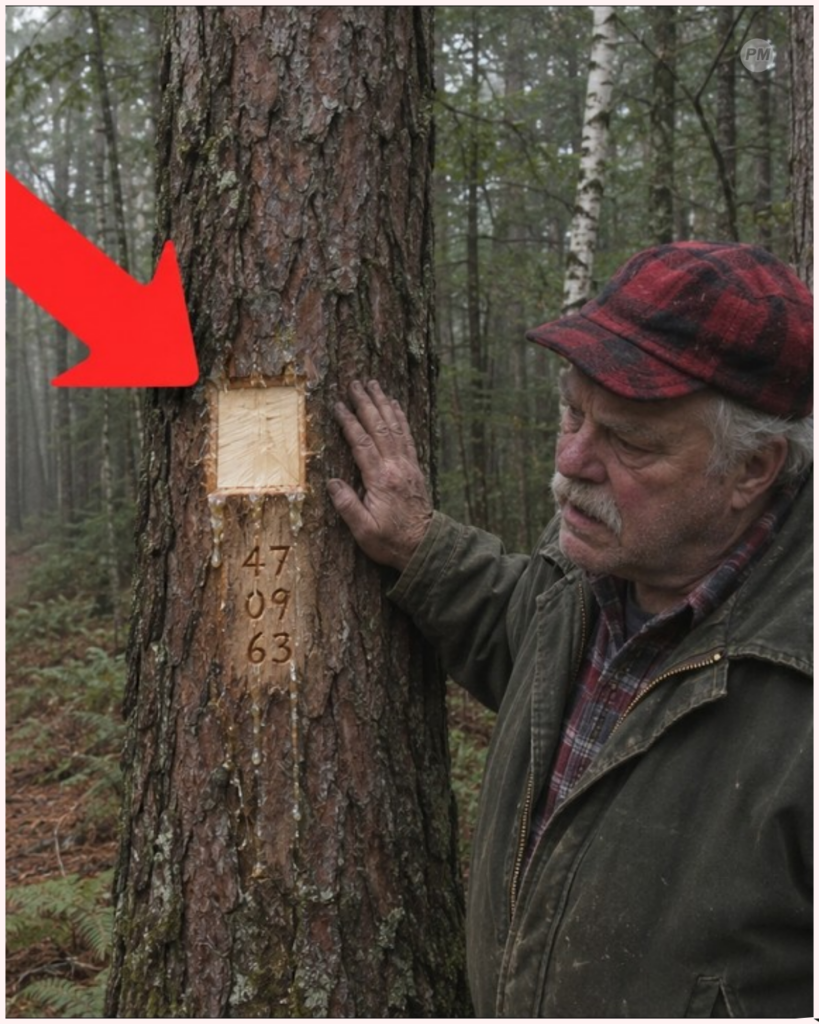
There was nothing on it at all. On the pine, at chest height, there was a fresh blaze, the notch on top, the figures under it.
I did not need to bend down. I knew what it said. Dale asked me why I had gone so quiet.
So, I told him about the figures. Every one of them, over 20 years. It was the first time I had told the whole thing to anybody.
Dale was a scientist. He heard me out to the end. Then, he said, “Lars, have you ever just looked up where that section is?”
I had. Of course I had. On a plat map at the courthouse, years before.
It was a square mile of mixed woods with a little lake in it, over in the next county east, in another warden’s district.
I had never had any business there. I had never been there. And I told myself that meant it had nothing to do with me.
But Dale had put the thought in my head, and it would not leave. That spring, I bought the biggest map of northern Wisconsin and the upper peninsula I could find.
I tacked it to the wall of my garage. I stuck a red pin in every place I had found a blaze, or been told about one.
Nine pins. Then I went back through my notes and my patrol log. For each pin, I drew a short pencil line.
Where there had been a line of blazes, I drew the way it ran. Where there had been only one, I drew the way its face was turned.
Which way Mel pointed. Which way Vic’s line ran into the lake. Which way that black stump on the turtle was facing.
I stood back and looked at it. Nine short lines from nine places in two states.
None of them wandered, and none of them crossed. Lay a yardstick along any one of them and keep going.
Each line ended in the same small square on that map. A square mile of mixed woods with a little lake in it.
Township 42 north, range six east, section 20. I took the map down that same night.
I rolled it up tight and pushed it up into the rafters of the garage.