There was no way around, no boat, nothing on the n…
There was no way around, no boat, nothing on the near bank. Whoever cut that line had walked straight across that water and kept on going.
I stood there until the light started to go. I remember the new ice along the shore making a small sound like a fingernail tapping on glass.
Then I turned around and walked back to my truck, a lot faster than I walked in.
That night, I sat in the truck at the end of the logging road. The engine was running for heat.
I kept telling myself what I had seen. A thief with a canoe hidden somewhere.
A thief who could jump a log that tall without leaving a footprint in the snow.
I could not make it add up. And I was too new on the job to call anybody and ask.
A rookie warden who calls his supervisor about a ghost will not stay a warden long.
So, I did what a lot of young men do. I went and asked an old one.
There was an old trapper on that stretch of river named Ovid Bribois. He was past 80, and he had trapped the Flambeau since before the war.
He had a little tarpaper place by the river that smelled of wood smoke and muskrat pelts drying on boards.
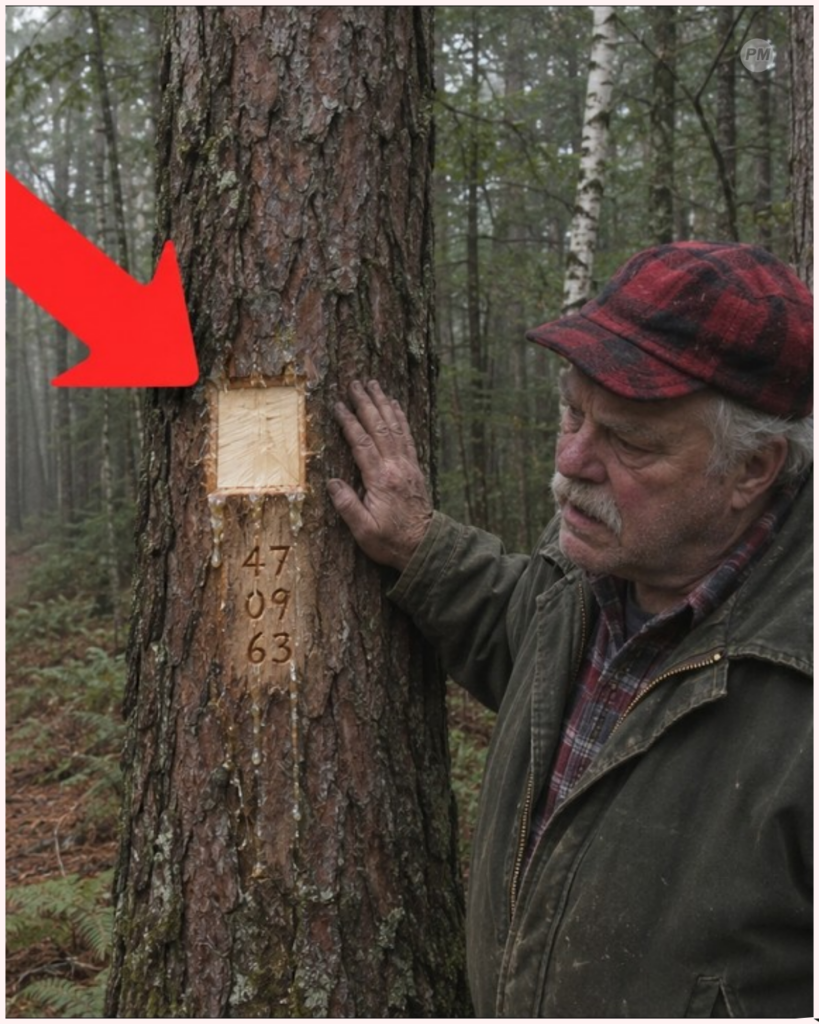
The next morning, I stopped there and told him about my timber thief. I described the blazes.
When I got to the little notch on top, he set his coffee cup down, very carefully, like it might break.
He asked me if I had followed the line. I said I had. He asked me how far.
So, I described the floage and the blaze on the far side of the open water.
Ovid sat there without saying anything for so long that I wondered if he had heard me.
Then he told me about Ezra Pel. His own father had found one of those blazes, he said.
That was in 1926, cutting cordwood up the Flambeau. His father came home that night and sat at the table with his hat still on.
The next week, he moved the whole family to Park Falls. He never cut wood in that country again.
When Ovid was done, he said it to me. Pel marks it, and the crew comes for it.
And then he said, “You do not follow a blaze like that, son. It is not marking trees.”
>> [snorts] >> “So, what is it marking?” I said. He let that one go by.
Instead, he had a question of his own. “Did you see the figures on there?”
When I told him I could not make them out, he let out a breath, and he looked relieved.
That night all of it went into my patrol log. The time, the place, the line of blazes, the water.
I left a blank where the figure should have gone. It would be two years before somebody filled in that blank for me and they did it on a lake where the big trees had been left standing on purpose.
Number two, the Sylvania wilderness in the Ottawa National Forest, July of 1990. Sylvania sits just over the line in Michigan in Gogebic County.
It is about 18,000 acres of old forest with 34 lakes in it. In 1895, a Wisconsin lumberman bought land on Clark Lake there planning to cut the pine.
He walked in, looked at what he had bought and decided to keep it standing instead.
Wealthy friends bought the land around him. For about 70 years the whole place was a private retreat.
The Forest Service bought it in the late 60s and today it is wilderness. Some of those hemlocks were already old trees when the first lumber camps went up in Wisconsin.
In other words, there was never any reason for a cruiser to run a line in there.
Everybody knew those trees were not for cutting. A Michigan conservation officer named Vic Ruona told me this one at a training week in Ironwood that fall.
Vic and I worked a lot of cases together along the state line. Fish running across it, deer dragged across it, people who thought a river was a good place to hide from a warden.
Vic was a big quiet Finn with hands like shovels. He did not scare easy.
That July two school teachers from Green Bay were canoe camping on one of the back lakes in Sylvania.
Careful women, both of them. They had paddled that country for 20 years. On their second night, around 2:00 in the morning, the older one woke up because somebody was talking.
The voice came from back in the hemlocks behind the tent. A man’s voice. Slow and flat and even, the way a man talks to himself while he works.
And it was saying numbers. 1,100, 1,400, 900, a pause between everyone. Soft footsteps in the needles.
Then another number. She shook her friend awake and the two of them lay there in their sleeping bags and listened.
It went on for most of an hour. It moved slowly along the ridge behind their camp.
Then it quit halfway through a number. The younger one told Vic she kept waiting for it to turn into something else, a scream, a laugh, anything.
It never did. Just numbers, one after another, steady as a man counting change at the end of a long day.
Once, between two numbers, she heard him clear his throat. They did not sleep after that.
When it got light, they went to look. They found the line. Fresh blazes every 40 ft or so on hemlocks so big that the two of them together could not reach around one.
A straight line from the ridge, straight to the water. And on the biggest tree of all, beside their tent, the blaze had the little notch above it and figures cut under it.
They copied the figures into their trip journal because they were school teachers and that is what school teachers do.
Then they packed up, paddled out a day early, and reported vandalism to the old growth.
Vic went in to look. He told me the blazes were real and fresh. Good ax work, the kind you do not see anymore.