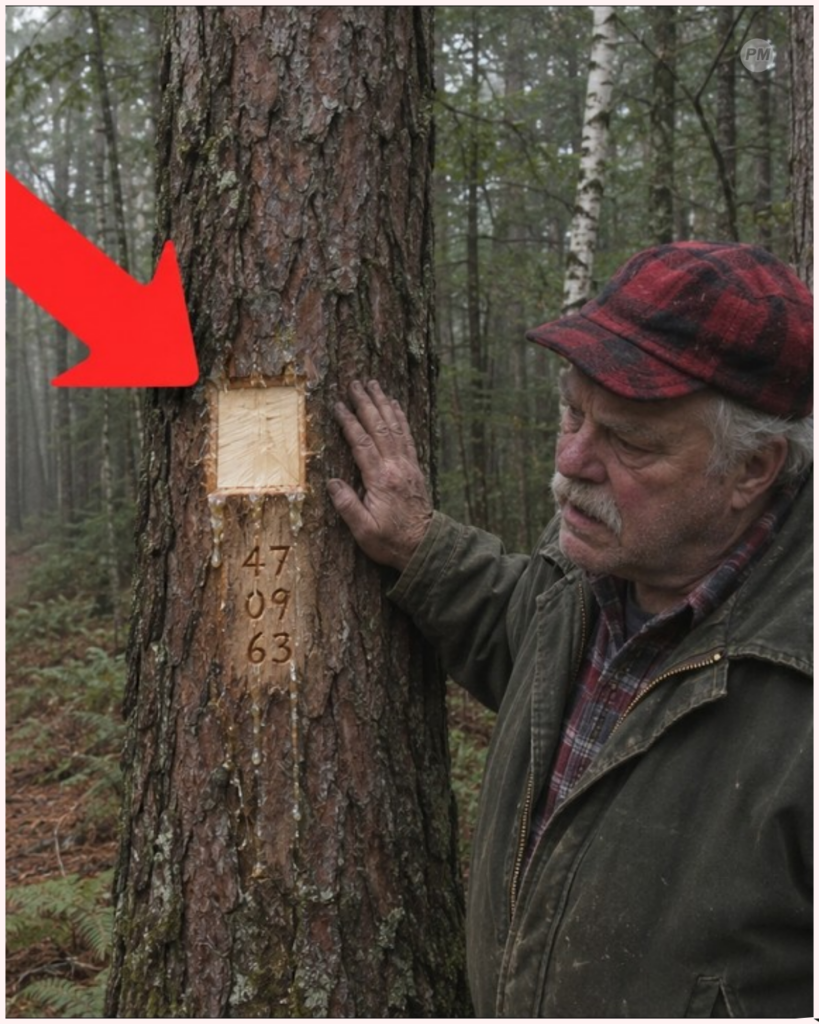
I looked at that blaze a long time before we walke…
I looked at that blaze a long time before we walked him out. The sap was still wet.
Mel’s fire had burned all night right under it, and the pitch had not even run.
Mel was fine. He was hunting again by Thanksgiving, but he never carried a compass again.
He said he would rather trust the sun or nothing at all. Anything but a needle that knew where somebody wanted him to walk.
After Mel, I started looking at every blaze I came across, the way you check every face in a crowd once you know who you were looking for.
Almost all of them were ordinary. Old property lines, old trails, survey marks gone gray and grown over.
The next one I found was on an island, and getting to it cost me the worst quarter hour I ever spent in a boat.
Number four, the Willow Flowage, Oneida County, August of ’94. The Willow is a reservoir on the Tomahawk River, northwest of the town of Tomahawk, about 6,000 acres of water, near 80 miles of shoreline, and islands everywhere you look.
The state owns most of it and keeps it wild. On a summer night with no moon, it is one of the darkest places I know.
You cannot see the shore. You cannot see your hand. That summer, the department loaned me to the Oneida County warden, who was laid up after a knee operation.
I was running a night patrol alone in my boat. I was looking for people setting illegal lines and spearing fish out of season.
Around midnight, out past the islands, I saw a light on the water. One small white light, low to the surface, maybe a quarter mile off.
It was moving slow and steady at about the speed of a man pulling oars.
I cut my motor to listen. Out there on a still night, you can hear a man breathe at 100 yards.
You can hear a fish roll on the far side of a bay. I heard nothing.
No oarlocks creaking, no splash, just that one light coming across the black water toward me.
There was an old fishing guide on the Willow named Hank Rasmussen. He had guided out of the resorts there since the ’40s.
He used to say it plain, “At night on the flowage, a boat that makes no sound has the right of way.”
I always thought he was teasing the canoe people. I hit it with the spotlight.
It was a skiff, an old flat-bottomed wooden skiff, gray and weathered, the kind nobody has built in 50 years.
One man sat in the middle of it with his back to me, pulling the oars.
He wore a long wool coat and a felt hat that had lost its shape.
And when the oars came forward and went down, they did not touch the water.
The blades dropped to the surface and went right through it like it was air.
No ripple, no drip coming off them, and the boat moved anyway, steady as a clock.
His head never moved. He did not look into my light. He pulled past me at maybe 30 yards and went on toward the islands.
I held the light on him with my heart going like a drum. I let him have the right of way.
He landed on a little island to the north. The light went out. I did not go over there that night.
I am not proud of that, but I am telling you the truth. I ran back to the landing with every light on the boat burning.
Every hair on my arms was standing straight up. I was back out there at dawn.
The island was maybe an acre of red pine and blueberry with a little gravel beach.
There was no skiff on the shore. There was no mark on the gravel where a boat had come in.
And I looked. I got down on my knees and looked, but in the middle of the island, on the biggest red pine, there was a fresh blaze.
Notch on top, sap running. And under it, the figures. Township 42 North, Range 6 East, Section 20.
The Willow is nowhere near that ground. I checked it on the plat books at the courthouse that afternoon.
It was in a different county altogether. I copied it into my log. That was three in my own hand.
And that night, for the first time, I laid the entries side by side on the kitchen table.
Four places, two states, six years, one set of figures. I sat there a long time.
Then I put the log away and went to bed, and I did not sleep.
A few weeks later, I ran into Hank at the bait shop in Tomahawk. I told him about the skiff.
I expected him to laugh. He did not. He said his own father had seen that same boat in the ’30s.
He was guiding a party of fishermen from Chicago at the time. One white light, a man in wool, oars that never wet.
His father [snorts] told the fishermen it was a game warden, so they would not be scared.
Hank looked at me in my uniform and said, “I guess he was half right.”
The next one turned up in a town that had been empty for a hundred years on a night when the stone was still warm.
Number five, Fayette on the Garden Peninsula in Michigan, October of ’96. A Michigan conservation officer named Gail Hykanen once put her bare hand on a blast furnace.
It was a cold October night. It was warm, warm like a wood stove the morning after a good fire.
That furnace had been cold since before her grandmother was born. Gail was one of the best officers I ever worked with and the hardest person to rattle I have ever met.
She once talked a very drunk deer poacher down out of a tree stand. All she had was a flashlight and a lecture about what his mother would think.