Fayette is a ghost town on Big Bay de Noc, on the…
Fayette is a ghost town on Big Bay de Noc, on the north shore of Lake Michigan.
From 1867 to 1891, it was a company town. The Jackson Iron Company built two blast furnaces on a little harbor there called Snail Shell Harbor.
To feed those furnaces, they burned charcoal. To make the charcoal, they cut the hardwood off the country around them for miles.
When the hardwood ran out and the price of iron fell, the company shut down.
Almost 500 people had made their homes there and nearly all of them left. Today, it is a state park.
The old furnace complex and the hotel still stand under white limestone cliffs. That October, the park had shut for the season.
A man camping down the shore called in about lights in the old town. Gail drove out to see.
She told me the first thing she noticed walking in from the road was the smell, charcoal.
A campfire smells soft and sweet. This was that flat, sharp, dusty smell of charcoal burning down in a kiln.
She had smelled it once as a girl at a county fair and she knew it right away.
There were lights in the furnace complex, yellow and low, moving behind the empty window holes.
And there were voices, a lot of them. Men’s voices with the steady racket of a crew at work under them.
Something heavy rolling on stone, a shovel scraping, somebody laughing at a joke she could not quite hear.
She checked the old hotel first because the lights seemed to come from that end.
The doors were locked the way the park staff had left them. Through the windows, she could see the empty rooms, the bare floors, a wooden chair standing by itself.
Nobody, but the voices were still going, louder now, from down by the furnaces. And there was a sound under them she could feel in her boots more than hear, a low, steady rumble, like a big fire drawing hard up a chimney.
Gail walked right up to the furnace stack, because that is the kind of officer she was.
And when she got there, the lights were gone and the voices were gone. Just the old stone in the dark and the little waves slapping in the harbor.
That is when she put her hand on it. The locals in the town of Garden had a saying about that place.
When the stack is warm, the company is hiring. She found the blaze the next morning, up on the limestone bluff over the harbor.
It was on a big beach, one of the few old ones the charcoal crews had somehow left.
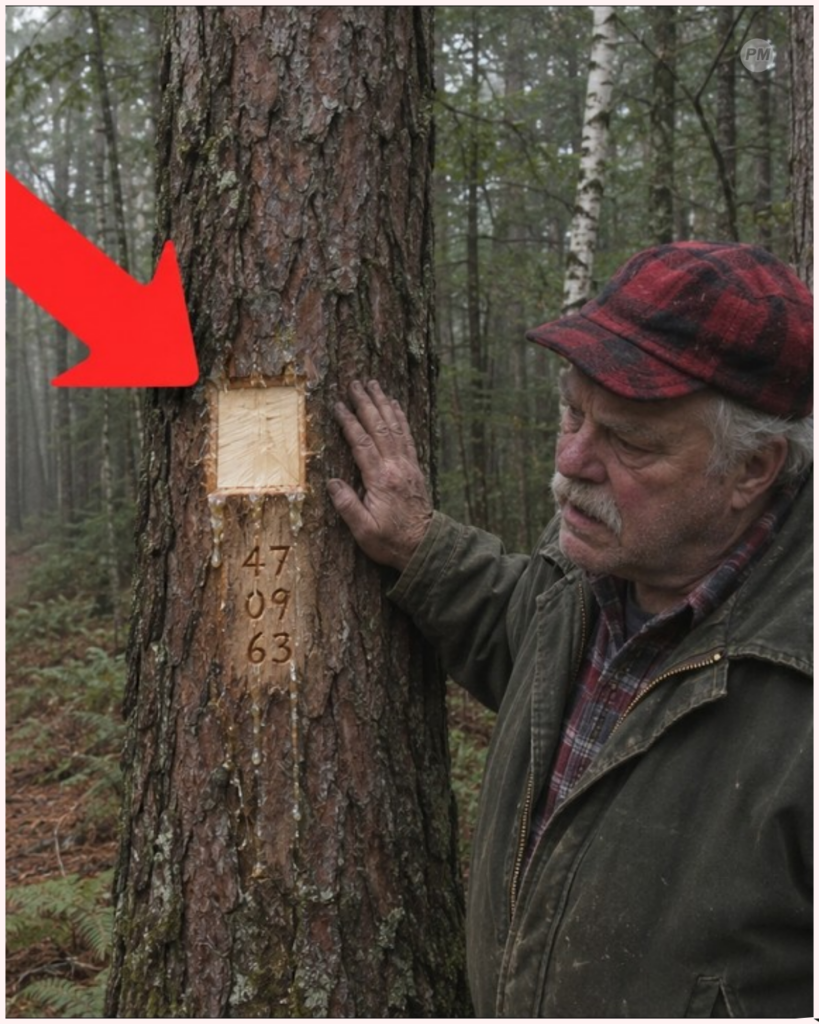
Fresh, with the notch above it. She took a picture and she copied the figures.
That winter, at a training session in Escanaba, she showed me the picture over coffee.
I did not have to look at my log. Township 42 north, range 6 east, section 20.
I asked her if she knew where that was. She said she had looked it up.
It was somewhere in northern Wisconsin, a long way from the Garden Peninsula. Then she asked me if I knew the place.
I said, “No, I had never set foot on it.” That much was true. That made five, two in Wisconsin, three in Michigan.
One on a river, one in old growth, one on the iron. One on an island and one on a bluff over a ghost town.
The only thing they had in common was the axe work, the notch and the figures.
Each of them turned up after dark or in bad light. The next one came in the middle of a clear blue afternoon.
Number six, the Turtle Flambeau Flowage, Iron County, July of ’99. After the big pine was cut, the north woods burned for decades.
The crews left the tops and branches lying where they fell, Piles of dry slash to the horizon.
Every dry summer it caught. The old people up here grew up on stories of those fires.
Smoke so thick at noon the chickens went to roost. The Turtle Dam went in on the Flambeau in 1926.
The water came up over about 13,000 acres of that burned over country. Today it is islands and wild shoreline.
And under the water the old pine stumps are still standing. That July I was out there checking fishing licenses.
Riding along with me was a state forestry technician named Chuck Vande Hey. He needed to look at some campsites on the islands.
Late in the afternoon it was hot and still and perfectly clear. Blue from one side of the sky to the other.
And it started to snow. That is what it looked like. Little gray flakes drifting down out of a blue sky.
Landing on the water, on the boat, on our arms. Chuck held out his hand and caught one and rubbed it between his fingers.
It was ash. Soft gray wood ash. The kind that comes off a big fire.
Then we both smelled the smoke. Heavy and old and pitchy. Like a whole country of pine slash burning somewhere upwind of us.
There was no fire. No smoke on any horizon. We called it in. The fire towers had nothing.
The dispatcher had nothing. Chuck was a forestry man and he knew smoke. He had gone white as a sheet.
His grandmother grew up near Mercer and she had one rule she drilled into him as a boy.
When you smell the old smoke get to the water. Then with the ash still coming down on us he told me why.
When she was a small girl a fire came through the cut over country near Mercer one dry fall.
Her family ran for a little lake behind their farm and stood in the water all night with the cows.
She remembered the sky turning the color of a stovepipe. And she remembered a man in a long coat walking along the far shore in the middle of the fire, slow.