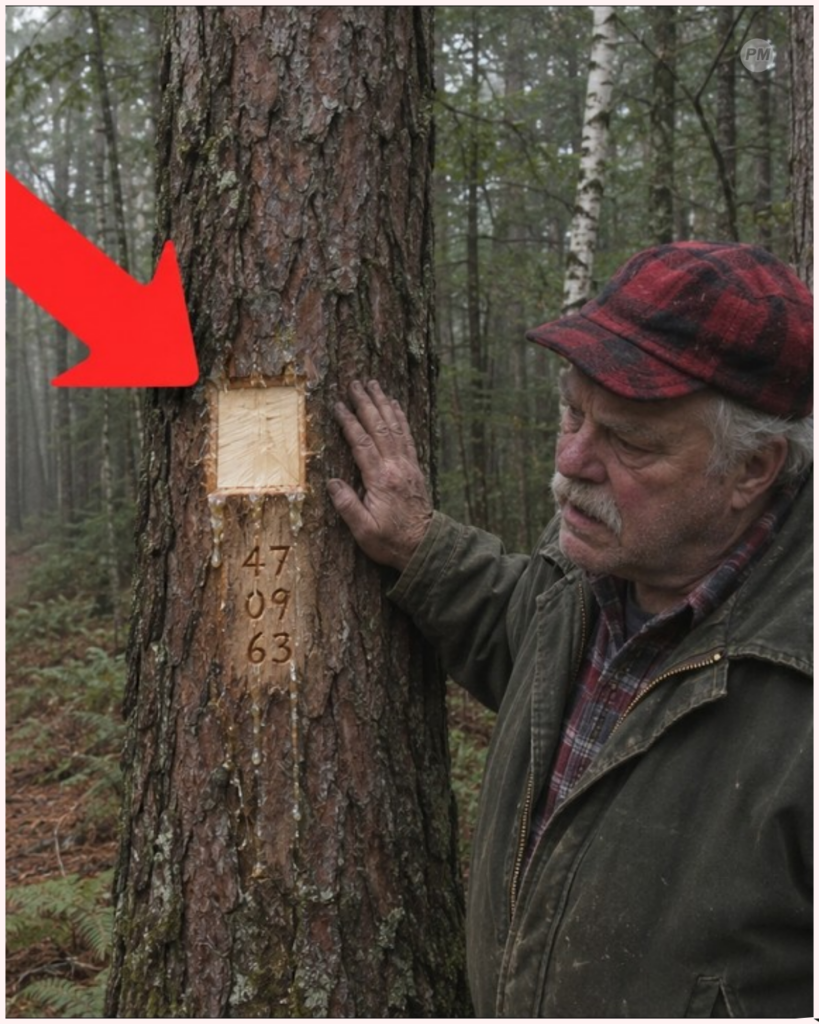
And he told me what the numbers in the night were,…
And he told me what the numbers in the night were, board feet. That is exactly what a cruiser calls out as he walks a stand.
A man sizing up timber, one tree at a time, and saying it out loud so he will not forget.
Vic walked the line himself. He told me it ran dead straight for about a quarter mile, from the ridge to the lake, up and over everything in its way.
He counted the blazes as he went. That is what an officer falls back on when nothing else comes to mind.
36 of them. When the line hit the water, it did not stop or turn.
The last blaze was on a hemlock leaning out over the lake. The next one, as near as Vic could tell, was somewhere on the far shore.
He did not take the canoe across to find it. He told me he stood on that shore for a long time.
He said it was the quietest place he had ever been. No loons, no squirrels, even the mosquitoes had let him alone.
Then Vic showed me the page from their journal. I copied it into my log that night, into the blank I had left 2 years before.
Township 42 North, Range 6 East, Section 20. Vic explained it to me. That is the old government survey system.
When surveyors first laid out this country, they cut it into townships 6 mi square.
Each township was cut into 36 sections, 1 square mile each. A cruiser would cut those figures to mark which square mile he was standing in.
Except Sylvania’s not in Township 42 North, Range 6 East. It is not anywhere near it.
Those figures belong to some other piece of ground altogether. Neither one of us knew where.
And for a while, neither one of us went looking. The next time those figures turned up, a lost man spent the whole night sitting under them.
Number three, the Gogebic iron range, north of Ironwood, October of ’92. In September of 1844, a survey crew was working near Teal Lake in what is now Negaunee.
Their compass needles swung wild. The man in charge told them to look around. There was iron ore in the rocks at their feet.
That is how the first iron in the Upper Peninsula was found, by compasses that would not tell the truth.
Up on the Gogebic range, the old miners had a saying that came out of that.
On the iron, the needle lies. Walk by the sun. Mel Tollefson was a grouse hunter from Hurley, on the Wisconsin side of the Montreal River.
He was 60 years old, a retired school bus mechanic, and the most careful man you ever met.
He checked his tires before every trip and carried two compasses. That October, he went out on the Michigan side, north of Ironwood.
Rough country, full of old mine pits and second growth popple. Around noon, a low gray overcast came in, the kind with no sun behind it at all, just a flat lid on the world.
And Mel got turned around. He took out his compass. The needle would not settle.
It swung and stopped and swung again. He took out his second compass. Same thing.
And every time the needle stopped, they pointed at the same tree, a big white pine, maybe 50 yards off, standing alone in the popple.
Mel walked over to it because there was nothing else to walk toward. On the side facing him, there was a fresh blaze, the little notch above it and figures cut under it.
He took his compass out again. The needle swung and settled and pointed at the next tree.
Another blaze, another notch. Then the next one. A line of them going off into the gray.
He told me later he knew it was the iron. He kept telling himself it was the iron, but he also knew that iron never chopped a blaze into a tree.
He did not follow the line. His grandfather had worked underground in the Montreal mine, and Mel remembered the saying, “On the iron, the needle lies.”
There was no sun to walk by. So, he settled in against that first pine, built a small fire, and waited for the sun to come back.
He waited all night. He said every hour or so he took the compass out, just to see.
All night long the needle pointed down the line of blazes. Then, a little before dawn, he took it out one last time.
The needle had swung all the way around. It was pointing straight behind him, at the pine he was leaning on, as if whatever it had been waiting for had arrived.
He put the compass away and did not take it out again. Mel told me one more thing about that [snorts] night.
There always small sounds in the woods after dark. Mice in the leaves, an owl somewhere, a branch letting go.
Around 3:00 in the morning, all of it stopped, like a switch had been thrown.
He sat there with his fire popping and nothing else in the world making a sound.
He said he put more wood on that fire than he needed, just to hear it.
The search was a joint one. Michigan conservation officers, Gogebic County deputies, and every Wisconsin warden within a couple of hours, me among them.
Mel was a Wisconsin man, and his truck was parked on our side of the river.
We found him that morning because he did the smartest thing a lost man can do.
He stayed put and kept his fire going. When we walked up, he was sitting against the pine, wrapped in his hunting coat.
He had a pencil and a little notebook out. He had copied down the figures under the blaze.
He said it gave his hands something to do in the dark. Township 42 North, Range 6 East, Section 20.
I did not tell him I had the same figures in my log. I did not tell anybody that time.
I just asked Mel which way the line of blazes had been running. He pointed south and a little east, back across the river into Wisconsin.
It was the first time anybody had told me which way the line was going.