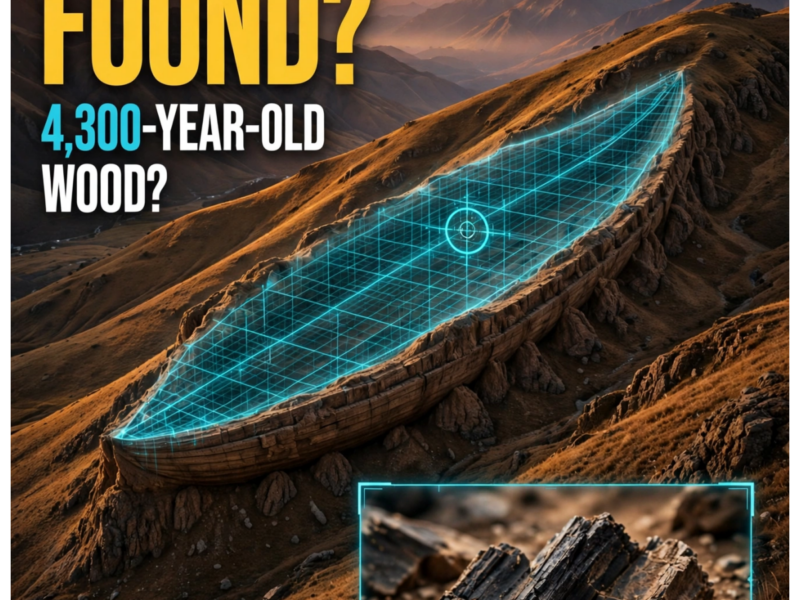
This charred fragment came from a boat-shaped hillside in Turkey, the site some believe holds Noah’s Ark.
According to the research team, rain exposed wood in the hillside’s western face.
More fragments followed and two samples went to a laboratory.
Their carbon dates have now come back.
We can follow the discovery from that exposed face to the published results.
Then examine the marks that researchers think were made by human hands.
The age is one part of the mystery.
What were these pieces part of before they ended up here?
Durupinar lies in eastern Turkey near Mount Ararat.
The formation stretches roughly 157 m or 515 ft across the hillside.
That scale has attracted attention for decades.
But the recovered material presents a smaller testable object, wood, that still carries carbon absorbed by a living tree.
Radiocarbon testing can estimate when that carbon became part of the wood.
Identifying what the fragment belonged to requires a different kind of evidence, including its position in the surrounding sediment and any connection to other remains.
A laboratory age gives the material a place in time.
Archaeological context gives it a place in human activity.
Rainwashed soil from Durupinar’s western face, according to the team’s account, exposing wood in the slope.
The researchers say Professor Chanker Atila noticed the material and led the investigation that followed.
They report recovering further fragments as they worked farther inward from the exposed face.
The reported position was about 30 ft or 9 m below the formation’s upper surface and about 3 ft or 1 m inward from its western face.
Those measurements describe two directions, the distance down from the top and the distance [music] into the hillside from the side.
Access came through the exposed slope.
The team says [music] these fragments were collected by hand from exposed material rather than retrieved through core drilling.
Rain had opened the recovery point, allowing researchers to approach the wood from the western face.
The discovery was not announced immediately.
In their public account, the team attributed that delay to a desire to protect the site while the work proceeded.
With several fragments recovered, the investigation could move from locating the material to establishing its age.
A reproduced cover letter dated November 18th, 2026 lists two selected fragments.
Sample one and sample two submitted through Civas Chumhury University.
They formed the first reported submission to a US laboratory.
Two samples in one submission do not amount to confirmations from two separate laboratories.
The test measures carbon 14, a radioactive form of carbon that slowly decays.
Once carbon becomes locked into a tree’s wood, its radioactive portion diminishes at a known rate.
[music] Measuring what remains allows scientists to estimate when that part of the tree grew.
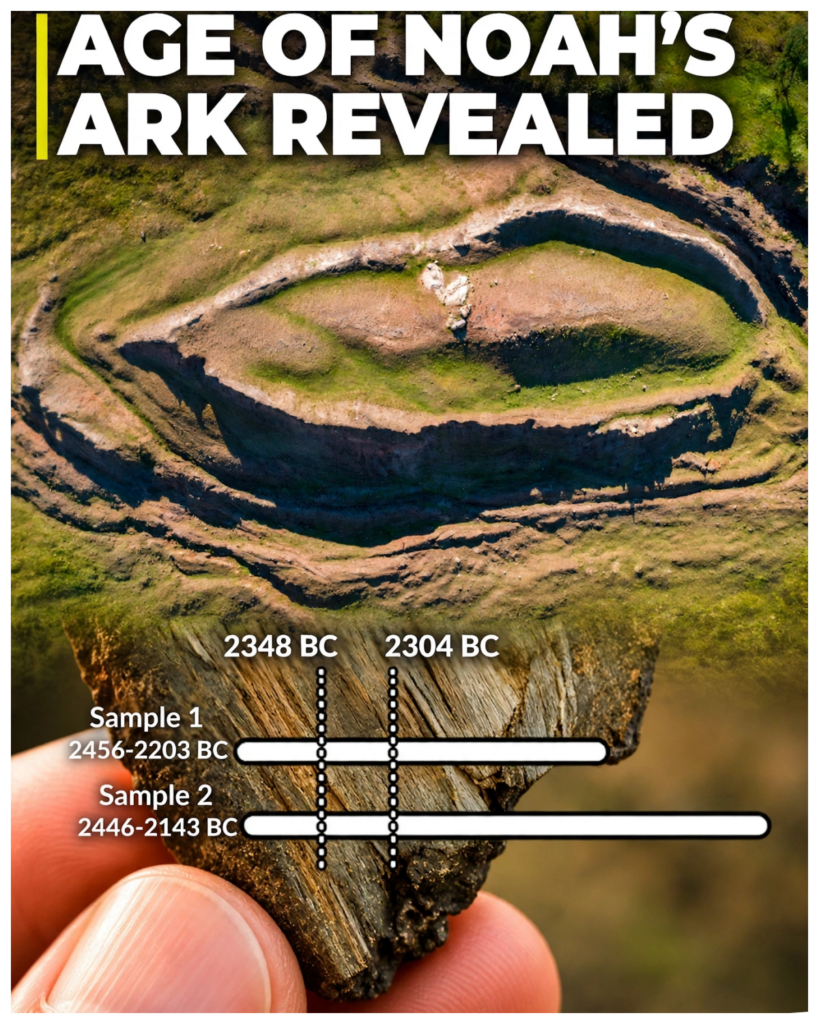
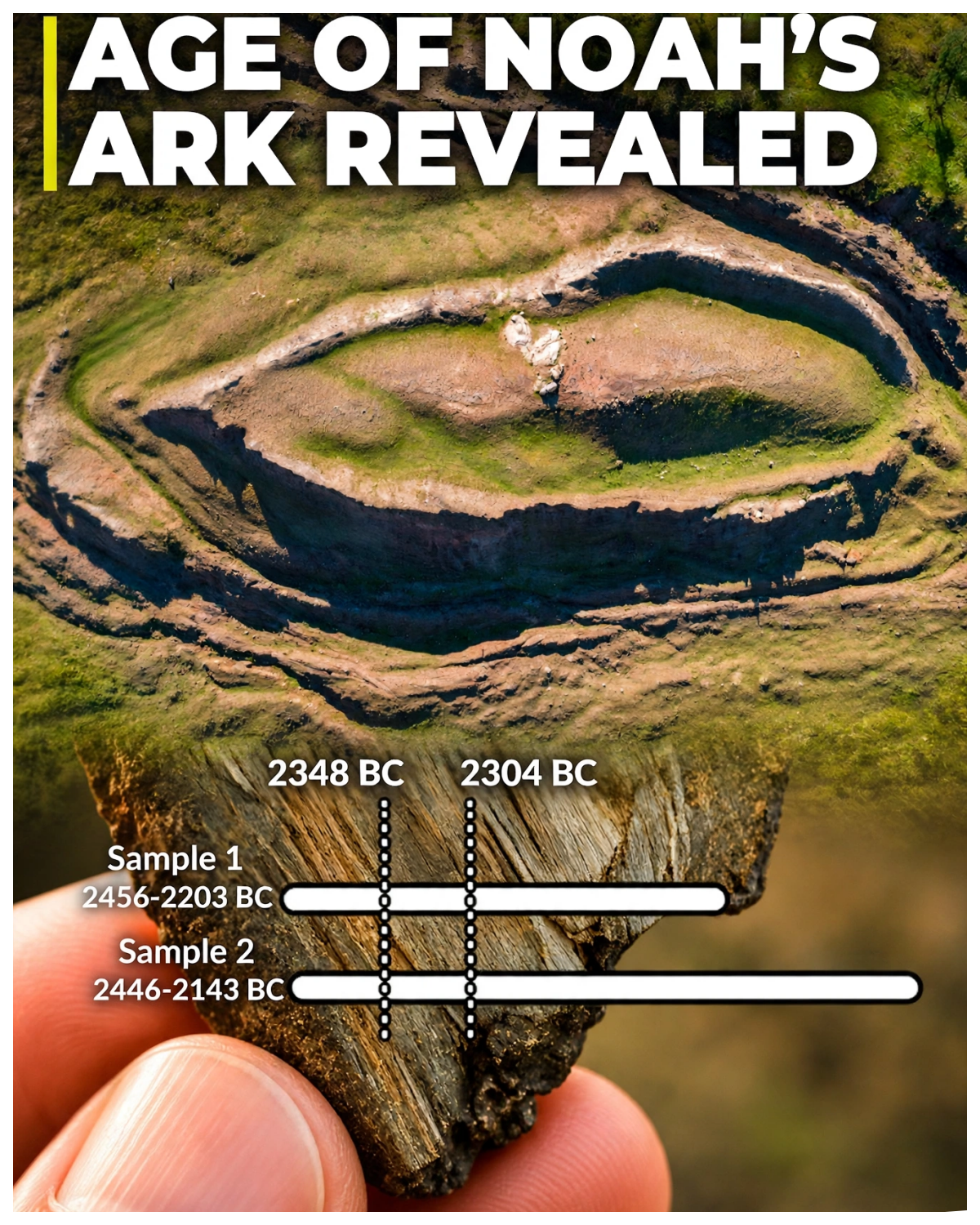
The published sample result graphic presents dates for both fragments.
The team summarized the result as about 4,300 years old.
That estimate places the wood thousands of years before its recovery from the hillside.
It does not date its shaping, burning, or arrival there.
The attention came from a comparison.
The reported ages overlap dates that some traditional biblical chronologies assign to the flood.
Sample 1’s reported calibrated dates extend from 2,456 to 2,23 BC.
Sample 2’s outer limits run from 2446 to 2,143 BC.
Those end points describe the overall reach of each result.
Within them, the graphic retains separate intervals and gaps.
Each result should not be read as one unbroken stretch.
The highlighted portions are from 2,410 to 2,269 BC for sample 1 and from 2,349 to 2,193 BC for sample 2.
These belong to the same two results.
[music] They are not additional tests or separate laboratory confirmations.
Alongside those results sit two reference years, 2348 BC and 234 BC.
Both come from traditional flood chronology calculations based on biblical timelines.
Neither is a year measured by the laboratory.
Both markers fall within the highlighted portions, making the comparison visually striking.
But sharing a period does not connect these fragments to a flood event or identify what they once belong to.
The fragments also carry physical details, darkened surfaces, visible grain, cracks, and edges that the researchers have examined for possible signs of shaping.
Some areas are described as flat with sharply defined edges interrupting the fragments otherwise irregular surfaces.
Professor Chanker Atila interprets these features as possible evidence of deliberate shaping.
In his account, the edges suggest that someone may have worked the wood with tools.
That interpretation depends on how those surfaces formed.
Wood can split along its grain, leaving a relatively flat face and a sharp edge.
Burning and later breakage can further alter its outline.
[music] A worked piece and a naturally fractured piece can therefore share features when examined by eye.
The distinction rests on evidence that separates [music] cutting from splitting.
No microscopic examination confirming tool marks has been reported.
For now, the flat areas and edges support a question about workmanship rather than a settled identification.
Even confirmed shaping would leave the object’s purpose unresolved.
People worked timber for buildings, household objects, fuel, and boats.
A fragment with a modified surface would not by itself distinguish among those uses or reveal its original setting.
At Durupunar, that leaves two separate questions.
Whether human hands modified this piece and whether it belonged to anything larger within the land form.
The shape of one fragment cannot establish the shape or extent of a buried structure.
The project reports surveying a grid across the formation’s roughly 515 ft length using three methods to probe beneath the surface.
Ground penetrating radar sends radio pulses into the ground and records reflections from changes in buried material.
Electrical [music] resistivity tomography maps how strongly the ground resists an electric current.
Magnetometry measures variations in the local magnetic field.
Each method [music] detects contrasts.
Rock layers, moisture, fractures, and buried [music] objects can all affect the readings.
Identifying their cause requires interpretation and checks against what is actually underground.
The project interprets some survey patterns as organized linear features and possible spaces.
Those descriptions remain interpretations of the signals.
The instruments have not identified rooms and no reported test excavation has confirmed those features as construction.
The scans map subsurface patterns.
The fragments provide material for physical examination and dating.
No published field map directly links the recovered pieces to a particular survey feature.
Establishing that connection would mean recording a fragment’s exact position, the sediment surrounding it, and its relationship to recognizable building materials.
Wood preserved within a joined timber [music] assembly, for example, would offer a much stronger connection than a loose fragment [music] nearby.
Without that relationship, the scans cannot assign the wood a structural role.
Even if construction were established, its timing would still require separating the treere’s growth from the later stages of the timber’s history.
The inner rings of a longived tree can be centuries older than the wood near its bark.
If a dated fragment comes from that older heartwood, its age can substantially predate the treere’s cutting.
Archaeologists call this the old wood effect.
Storage can widen that gap.
Reuse can widen it again.
Timber taken from an older building might serve in a later one.
These are possible ways wood acquires a history, not established stages in the durupinar fragments past.
Tree growth, possible human use, burning, and burial each raise a separate question.
The measured growth age does not automatically supply dates for cutting, shaping, fire, or placement on this hillside.
Burning does not reset the wood’s radiocarbon clock to the moment of the fire.
Consider a hypothetical comparison.
An isolated fragment in mixed sediment could have arrived with displaced soil.
Timber recorded within a surviving arrangement surrounded by undisturbed deposits could offer evidence of use and burial together.
The surrounding layers and relationships among pieces would help archaeologists distinguish those situations.
The team’s [music] pending analyses address other parts of that history.
Species identification could establish what kind of tree supplied the wood.
Surface testing will search for bumen, resin, or sap residues.
Further radiocarbon results could test agreement among measurements, while field documentation would still be needed to connect those findings to an object.
The biblical term gopherwood has no settled modern species equivalent.
Pending identification could name the tree, but it could not establish that this was the timber described in Genesis.
The ark narrative also describes wood treated with pitch, which motivates interest in surface chemistry.
Pending coding analysis could examine possible resin, pitch, or bitumen.
No coding has yet been established.
Even if one were detected, such materials had other uses.
Neither a coding nor a species name would identify a vessel or its origin.
Further dates, still pending, could check agreement or refine age estimates.
They would leave the fragment’s original purpose unresolved.
Archaeological work would need to test relationships between the wood surrounding deposits and any construction materials.
Hypothetically, worked and coated timber securely associated with construction could support a stronger interpretation than those properties measured separately.
That association remains to be established at Durupinar.
The remaining question is what these pieces belong to before they reach the recovery [music] point.
The two tested fragments yielded published age estimates placing the wood in antiquity, overlapping selected traditional flood chronologies.
That comparison brings a laboratory result alongside dates calculated from biblical timelines.
An ancient growth age and a chronological overlap cannot identify a vessel or establish the event in which the wood was used.
The reported recovery setting remains Durupinar’s exposed western slope where the team says rain revealed the fragments.
The dates give those pieces a place in time.
Their relationship to that hillside still requires archaeological context.
What did these pieces belong to before reaching the slope?
For now, the most important responsibility is protecting what remains.
Every future excavation can preserve connections or erase them forever.
That makes careful documentation more valuable than any immediate headline.
The next discovery needs a record others can independently check.
Whatever this site holds, its evidence deserves the final word.