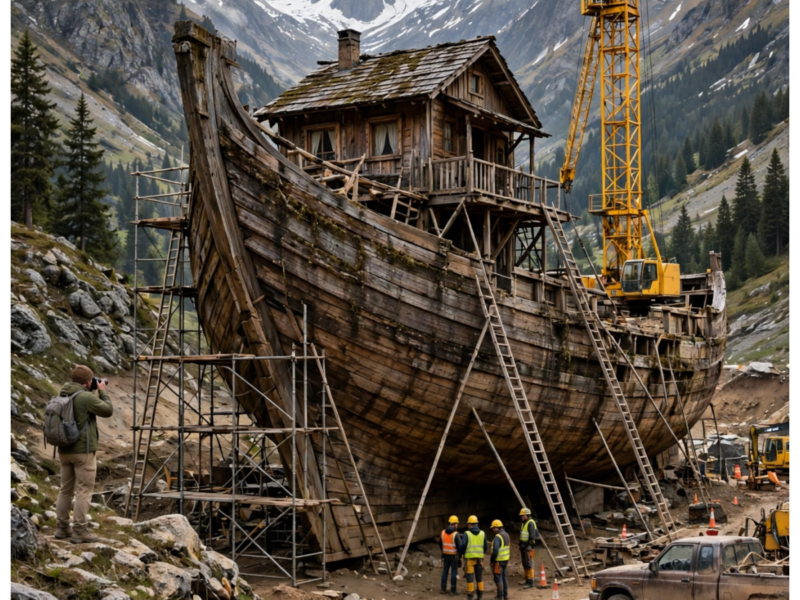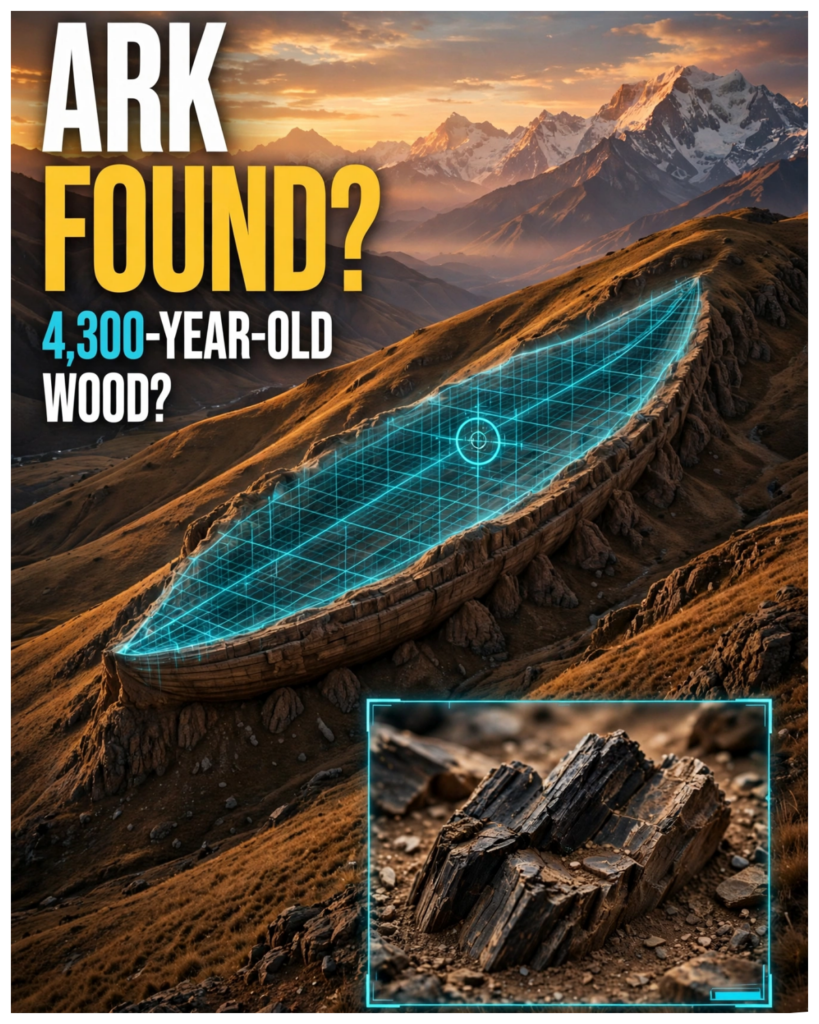
High in the mountains of eastern Turkey, there’s a shape in the earth that stretches exactly 515 ft.
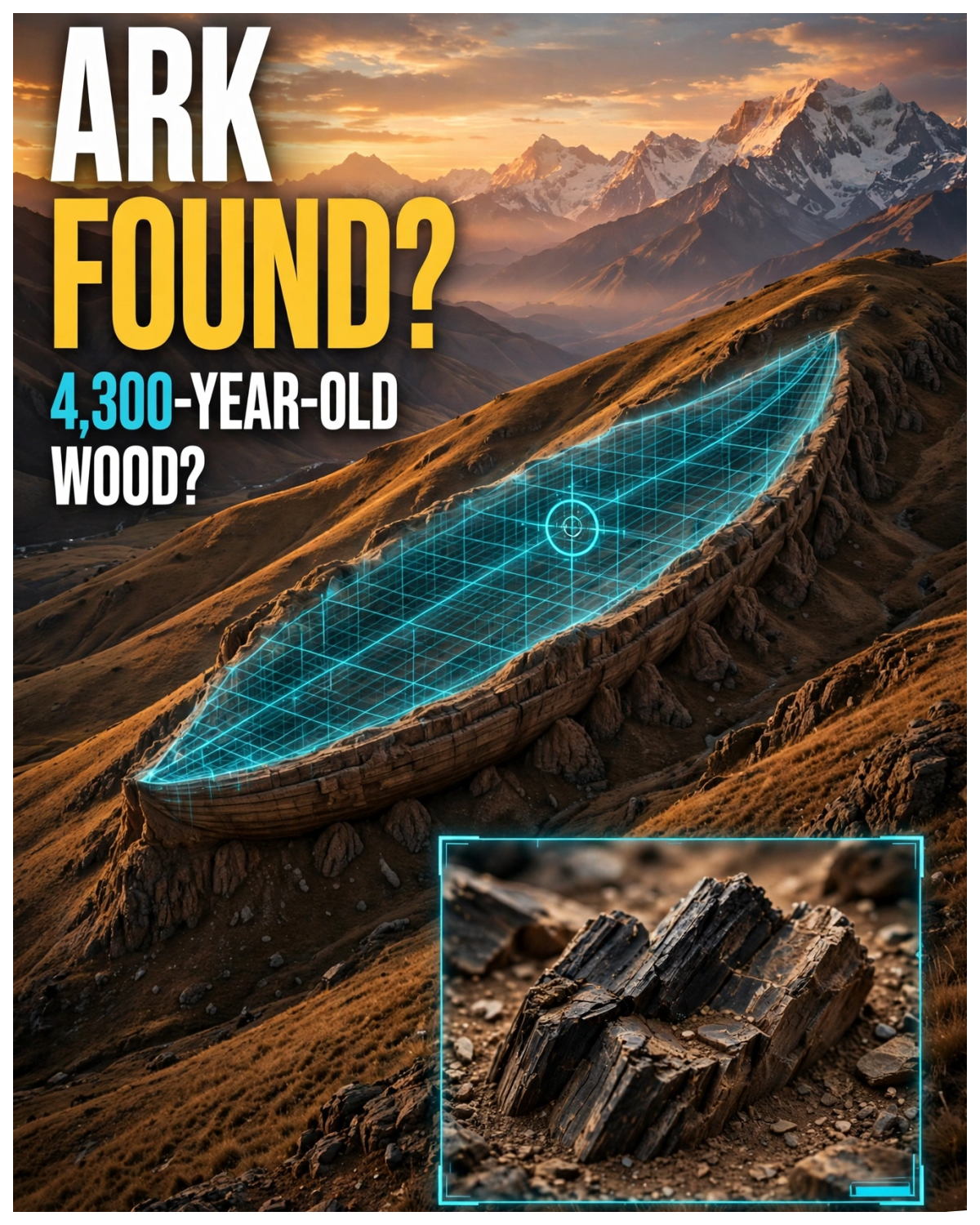
And from above, it looks almost unmistakably like the outline of a boat.
For decades, most scientists dismissed it as coincidence.
Just rock, just geology doing something that happens to look interesting from an airplane window.
Then in 2026, a team of researchers went back with drills, radar, and lab equipment and came back with something that reopened one of the oldest debates in the world.
Some headlines are already calling it 100% confirmed.
Other scientists are calling it nothing new at all.
And the truth, once you actually look at what was found instead of what was claimed, is stranger and far more uncertain than either side wants to admit.
I want you to stay with me through all of this because by the end, you’re going to understand exactly what’s sitting underground right now and exactly why nobody, not even the researchers themselves, can tell you for certain what it is.
Yet the site that won’t go away.
This is thear formation.
First spotted in 1959 by a Turkish army captain flying overhead, scanning aerial photographs for something else entirely and stumbling onto a shape that stopped him cold.
Located near Dogubayazit, close to Mount Ararat, the exact mountain the biblical flood story names as the ark’s final resting place.
The formation has been part of an on andoff scientific and religious debate for nearly 70 years.
What makes 2026 different is the scale of what just happened here.
This wasn’t a handful of enthusiasts with metal detectors wandering a hillside.
This was a formally organized government recognized scientific project.
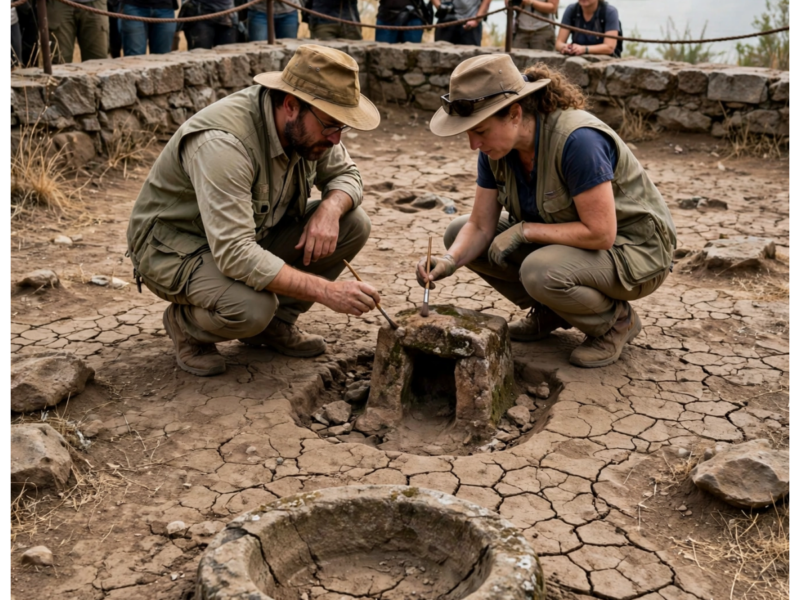
Roughly 20 researchers from five different countries led by professor Chanker Atilla of Civas Chumhurat University spending approximately 90 full days on site methodically working through core drilling, radar mapping, and sample collection.
Whatever conclusions eventually come from this, the process behind it was serious.
The drill bit that broke.
Here’s the first genuinely strange detail to come out of this year’s work.
While drilling core samples deep beneath the formation, the team hit a layer so hard it physically broke their drill bit.
Now, before you get too excited, hard underground layers exist everywhere in geology, and they don’t automatically mean ancient ship.
Rock is rock and mountains are full of surprises.
But researchers on site have said this specific layer doesn’t easily match what you’d typically expect from ordinary bedrock in this exact location.
Fossilized rock formed naturally over millions of years, sitting exactly where geology put it, or is it something structural, something that was once organic material, mineralized and hardened after thousands of years buried underground?
Right now, nobody actually knows.
That answer is sitting unresolved in a lab in Ankara, waiting its turn.
What the radar saw.
While that question sits unanswered, ground penetrating radar was quietly recording something else entirely.
Picked up what researchers describe as straight lines, right angle intersections, and sizable open spaces beneath the surface.
Patterns you don’t typically expect from a purely natural rock formation, which tends to fracture and erode in far more irregular, chaotic ways over time.
Andrew Jones, a researcher connected to the longrunning Noah’s Arc Scans project, has gone as far as describing the images as showing what could be walls, support beams, and interior divisions.
Essentially, the skeleton of a structure, not the inside of a mountain.
But here’s the tension baked directly into that claim.
Pattern recognition on a grainy underground scan is notoriously easy to overinterpret.
Humans are exceptionally good at seeing shapes and order, even in genuinely random noise.
So, is this the layout of an ancient vessel, or is it confirmation bias dressed up convincingly in radar imaging?
Pottery older than the flood.
Then there’s what actually came out of the ground.
Researchers recovered pottery fragments during this year’s excavation, and some early reports suggest these fragments could potentially date to a period preceding the flood chronology described in religious tradition.
That’s an enormous claim if it holds up.
Pottery surviving in identifiable form for that length of time in this exact location would be remarkable evidence worth taking seriously by anyone, believer or skeptic.
Notice the careful wording researchers themselves have used.
Could potentially date, not has been dated, not confirmed.
The fragments haven’t yet been through the laboratory testing required to actually establish their age.
Until that happens, this is a promising lead sitting in a box, not proof of anything sitting in a headline.
A thousand samples, one waiting answer.
Alongside the pottery, the team collected close to a thousand individual soil and core samples from across the site.
An enormous number representing a genuinely serious, methodical scientific effort, not a quick weekend dig with a shovel.
Drilling also recovered layers of organic material buried underground.
Exactly the kind of material you’d want to find if you were hoping to prove something biological, something that once lived, had been buried here for millennia.
Organic material can potentially be radiocarbonated, which means in theory researchers could eventually put an actual defensible number on whatever this turns out to be.
That test hasn’t happened yet either.
Every single one of these threads, the broken drill bit, the radar patterns, the pottery, the organic layers, currently ends at the exact same place, a laboratory waiting with results that don’t yet exist.
The 30-year-old counterargument.
So, where does the skepticism actually come from?
And is it fair?
This is where we have to go back to 1996 because it matters enormously to this entire debate.
That year, a geological study conducted by Fold and Lawrence G.
Collins directly examined stones near this site that had previously been linked to arc theories.
Theories suggesting they’d been carried here from Mesopotamia aboard an ancient vessel.
Their conclusion was blunt.
The stones were local andesite, a naturally occurring volcanic rock, not evidence of anything transported or man-made.
That single study has functioned as the primary counterargument against the entire ark theory for nearly 30 years.
It’s worth being completely clear about something here.
Those specific stones are not part of what was newly discovered in 2026.
The new evidence, the drill bit, the radar scans, the pottery, the organic material is entirely separate.
But the underlying skepticism that 1996 study created still hangs over every new claim to come out of this site.
And honestly, it should.
Extraordinary claims deserve exactly this level of scrutiny applied consistently, not just when it’s convenient for one side of the argument.
Two sides, one one.
This is exactly the tension that’s been missing from most of the coverage of this story.
On one side, you have outlets and researchers eager to declare this the discovery of the century, using words like 100% confirmed for a formation that as of right now has not actually been confirmed as anything beyond geologically interesting and worth serious further study.
On the other side, you have researchers pointing to three decade old rock analysis and treating it as the final word on a completely different, much larger set of evidence that’s only just been collected.
Neither extreme is being fully honest with you.
The actual honest answer sits uncomfortably in the middle.
Something unusual is clearly happening beneath this formation.
We do not yet know what it is.
And anyone telling you otherwise in either direction is telling you more than the evidence currently supports.
What happens next?
Here’s what happens now.
And it’s the part almost nobody is talking about because it’s not as exciting as a headline.
Those soil samples, core samples, and pottery fragments are currently undergoing laboratory analysis.
Researchers are specifically looking for organic remains suitable for radiocarbon dating.
A process that if successful could finally attach a real scientifically defensible number to whatever is buried here.
If that material came back dated to a period consistent with major flood traditions in the region, this becomes one of the most significant archaeological stories in decades.
If it comes back as ordinary geological material or dates to a completely unrelated period, the mystery doesn’t disappear.
It just resets the same way it has after nearly every previous investigation of this site since 1959.
And that’s genuinely the most honest way to leave this story right now because pretending otherwise would be lying to you.
We are quite literally waiting on a phone call from a lab in Anara.
Andrew Jones himself after reviewing this year’s results called it the opening of an entirely new chapter in the investigation, not the final page.
A new chapter means the story isn’t finished.
It means someone somewhere is currently looking through a microscope at a fragment of something that might be nearly 5,000 years old.
And we don’t yet know what they’re going to find.
So, here’s where I’ll leave you.
A formation shaped exactly like a boat.
A drill bit that broke on something unexpectedly hard.
Scans showing right angles where nature usually leaves chaos.
Pottery that might predate a flood.
And an answer that all of it is still waiting on, sitting in a lab unresolved.
When those lab results come back, and they will likely within the coming months, we’re going to be covering it here in full the moment there’s something real to report.
Subscribe to Curionexia now because whatever comes out of that lab is going to change this story one way or the other.
And you’re going to want to be here when it does.