Biblical tales.
God floods the earth, sparing Noah, his family, and two of every animal on board his ark.
Now, an international [music] team of researchers have found new evidence that a famous formation in Turkey could be the site of the ancient vessel.
30 ft beneath a [music] mountainside in eastern Turkey, researchers say they recovered something that could reopen one of history’s most controversial mysteries.
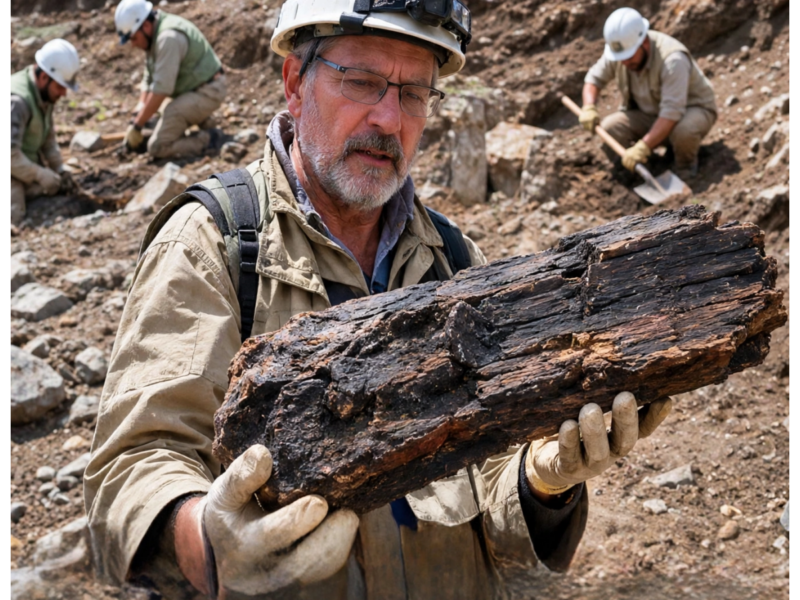
Blackened [music] fragments resembling ancient wood, some apparently bearing marks made by human tools.
Then came an even [music] more extraordinary announcement.
Preliminary testing reportedly placed samples from the site roughly 4,300 years in the past.
The location is a giant boat-shaped formation long associated with Noah’s Ark.
But before anyone declares the biblical vessel discovered, there is a question that could change the entire investigation.
What exactly [music] has been found?
If you’re fascinated by ancient mysteries where remarkable claims meet real investigations, [music] subscribe to Vaults of Antiquity because the evidence emerging from this Turkish hillside deserves a much closer examination than any dramatic headline can provide.
The story begins near Dogbayazat in the rugged eastern mountains of Turkey, not far from the Iranian border.
Here, beneath the imposing presence of Mount Ararat, [music] lies a formation known as Durupanar.
From ground level, it can resemble an unusual ridge surrounded by steep hills and scattered rocks.
From above, however, its outline becomes unmistakably intriguing.
The formation stretches across the landscape in a long tapered shape with a rounded end and sides that suggest the outline of an enormous vessel.
It measures approximately 500 ft [music] in length, depending on precisely where its boundaries are drawn.
That number matters because the book of Genesis describes Noah’s ark as 300 cubits long, 50 cubits wide, and 30 cubits high.
A cubit was an ancient measurement based approximately on the length of a human [music] forearm.
Its exact dimensions varied between civilizations.
Depending on which standard [music] is used, the biblical vessel could have measured somewhere around 450 ft or longer.
The resemblance has inspired generations of speculation.
Yet, the formation shape is only the beginning of the story.
In 1959, Turkish military officer Ilshan Durupanar noticed the strange outline while examining aerial photographs of the region.
The images attracted attention, and in 1960, an expedition visited the site to investigate.
[music] The explorers hoped they might uncover the remains of a vessel described in one of humanity’s most famous religious narratives.
Instead, they encountered earth and stone.
Their investigation produced no convincing evidence of an ancient ship.
For many observers, [music] the explanation seemed straightforward.
The formation was geological, an unusual combination of rock, sediment, and erosion.
But the photographs had already captured the public imagination.
A question had entered the world that [music] refused to disappear.
What if the ark had not survived as a wooden structure standing openly on a mountain, but had instead become buried beneath thousands [music] of years of accumulated material?
That possibility would eventually attract a determined American investigator named Ron Wyatt.
[music] Wyatt was a nurse anesthetist from Tennessee, not a professionally trained archaeologist.
Beginning in the late 1970s, [music] he repeatedly traveled to eastern Turkey, convinced that Durupanar contained the remains of Noah’s Ark.
He reported [music] objects he interpreted as fossilized timber, ancient metal fasteners, and structural features resembling the framework of a ship.
He also drew attention to enormous stones in nearby settlements, some with holes carved through them.
Wyatt believed these might have served as anchors for a vessel of extraordinary size.
His supporters saw a man willing to investigate evidence that established institutions had overlooked.
His critics saw a researcher interpreting natural features through a conclusion he had already accepted, and the geological evidence created serious problems for his claims.
Researchers examining the site found that some supposed metallic components could be explained by naturally occurring iron minerals.
Materials interpreted as petrified wood were also challenged as ordinary geological formations.
The boat-shaped outline itself could be [music] explained through folding, erosion, and movement of rock and sediment.
One especially important critic was David Fold, who had previously supported the possibility that the site contained the ark.
Working with geologist Lorren Collins, Fold eventually participated in research supporting a natural geological explanation.
That reversal mattered.
It demonstrated that even someone deeply invested in the mystery could change his interpretation when confronted with different evidence.
Yet Wyatt’s expeditions left behind a powerful legacy.
They transformed a remote Turkish hillside into an internationally recognized destination for people searching for physical traces of biblical history.
And decades after his work, a new generation returned with technology he could only have imagined.
If stories like this remind you how much of the ancient world remains open to investigation, subscribe to vaults of antiquity.
The most fascinating mysteries are often the ones where every new clue forces us to reconsider what we thought [music] we knew.
Modern investigators associated with Noah’s arc scans began examining Durupanar using ground penetrating radar and other geoysical techniques.
Ground penetrating radar sends electromagnetic signals into the earth and measures reflections produced when those signals encounter changes in underground materials.
The resulting images can help researchers identify buried [music] features without immediately excavating them.
It is a valuable technology used in archaeology, engineering, and geological investigations.
But there is an important limitation.
Radar does not directly photograph an ancient wooden wall or a hidden room.
It records signals that specialists must interpret.
Researchers investigating Durupanar reported patterns they considered unusually organized.
Some appeared linear.
Others suggested intersections, [music] layers, or possible internal divisions.
To investigators already considering the possibility of a buried vessel, these patterns were especially interesting.
Genesis describes an arc containing three levels.
Some radar interpretations appeared to suggest multiple horizontal layers within the formation.
The resemblance was striking, but was it evidence of deliberate construction?
Geologists have long understood that natural processes can create surprisingly regular underground structures.
Folded sedimentary layers, fractures, mineral boundaries, and changes in moisture can all produce signals that appear organized.
[music] A straight line on a radar display is not automatically a wooden beam.
A rectangular-looking anomaly is not necessarily a room, and several apparent layers do not establish the existence of decks.
This distinction would become central to the investigation.
The researchers needed physical material that could be removed, examined, and independently tested.
They also began comparing soil from inside the formation with samples collected outside its boundaries.
The investigating group reported differences in organic content and certain chemical characteristics.
Supporters suggested these differences might be consistent with material left behind by a decaying wooden structure, but soil chemistry can vary significantly across a hillside.
Water movement, vegetation, mineral deposits, and changes in sediment can all affect the composition of the ground.
The challenge was to establish not simply that the soil was different, but why.
Then in 2026, the investigation entered a new phase.
A research project led by Turkish archaeologist Professor Chanker Atilla [music] working with Noah’s arc scans received authorization to conduct field investigations at Durapon.
The team collected samples [music] and conducted drilling operations moving beyond surface observations and remote sensing.
According to reports from the project, 12 drilling locations were positioned inside [music] the formation and four outside it.
Some drilling reached depths of approximately 65 ft.
The researchers reported encountering underground conditions that [music] they considered unexpected.
In particular, they described differences between materials recovered from [music] inside the boat-shaped outline and those collected from surrounding ground.
They also reported that drilling had not encountered the continuous bedrock they expected at certain locations.
For supporters, this raised the possibility that the formation was more complicated than earlier geological explanations suggested.
For skeptics, it raised a different question.
Were these observations actually inconsistent with the known geology?
Or were researchers drawing conclusions before the complete data had been independently examined?
A drilling log can reveal changes in material.
It cannot by itself establish that those changes were caused by an ancient ship.
[music] And then came the announcement that brought renewed international attention to Durupanar.
Researchers reported recovering dark fragments resembling charred wood from approximately [music] 30 ft beneath the surface.
Photographs released by the project showed blackened material with features described as visible wood grain.
Professor Attilla [music] suggested that at least some surfaces appeared to show possible signs of deliberate shaping.
If the material proved to be ancient worked timber, it would represent an important archaeological finding.
But the word if [music] was doing enormous work.
Before the fragments could be associated with a vessel, researchers would need to establish their composition, age, context, and possible relationship to other material at the site.
The pieces were reportedly sent for laboratory examination.
Then in late November 2026, another announcement intensified the debate.
Reports described preliminary dating results [music] placing samples at approximately 4,300 years old within a period around the late 3rd millennium before Christ.
The timing immediately attracted attention because some interpretations of biblical chronology placed the flood narrative [music] within a broadly comparable ancient period.
But an ancient date does not [music] identify an ancient object.
And this is where the investigation takes its most important turn.
Suppose the wood really is 4,300 [music] years old.
Suppose further examination confirms that one fragment was shaped by a human tool.
Would that prove Noah’s ark had been discovered?
Not necessarily.
Ancient wood can reach a location through many different processes.
Trees can burn in wildfires.
Branches can become buried in sediment.
Human communities can leave behind charcoal from fires, construction, or other activities.
Material can also be transported by erosion and water long after its original deposition.
Even a genuine ancient wooden artifact would need to be connected to a larger archaeological structure before researchers could identify the site as a ship.
That connection has not been demonstrated.
And if you’re following this investigation because you want to know where the evidence truly leads, subscribe to Vaults of Antiquity.
The difference between an extraordinary discovery and an extraordinary interpretation is often the most revealing part of the story.
There is another problem that makes the Durupanar [music] mystery even more complicated.
The location traditionally associated with Noah’s ark is not quite as straightforward as modern maps suggest.
Genesis refers to the mountains of Ararat, a geographical expression connected with the ancient region of Uratu.
It does [music] not specifically identify the summit of the modern mountain called Ararat.
Over centuries, religious traditions associated the ark with different mountains across the wider region.
One important alternative is Mount Judy, known in Turkish as Kudi Dahi.
Islamic tradition identifies Aljudi as the resting place of the ark.
Other traditions also developed around mountains farther south.
These differences matter because they remind us that the search is not based on a single precise geographical coordinate preserved [music] from antiquity.
The story has traveled through languages, civilizations, and centuries of interpretation.
And the flood narrative [music] itself is older and more complicated than many viewers realize, long before the modern discovery of Durapanar, ancient Mesopotamian civilizations recorded stories of devastating floods.
One of the most famous appears in the Epic of Gilgamesh.
In that narrative, a survivor named Utnap Pishtim describes receiving a warning about a catastrophic [music] flood and building a vessel to preserve life.
Another important account appears in the ancient story of Atraasis.
[music] These narratives share striking themes with the biblical account.
A warning arrives.
A vessel is constructed.
A catastrophe destroys much of the surrounding world, and survivors emerge into a changed landscape.
The similarities have fascinated historians [music] for generations, but they do not necessarily demonstrate that every account describes one identical event.
Stories can influence other stories.
Traditions can be adapted across cultures.
[music] and societies living near unpredictable rivers often developed powerful memories of destructive floods.
Ancient Mesopotamia was particularly vulnerable.
The Tigris and Euphrates rivers supported thriving communities, but their flooding could also devastate settlements.
To people who had never witnessed an ocean, a flood covering the entire visible landscape might have seemed like the destruction of the whole world.
There is also a separate geological theory that connects ancient flood [music] traditions to the Black Sea.
In the 1990s, geologists William Ryan and Walter Pitman proposed that rising Mediterranean waters [music] may have entered the Black Sea basin in a dramatic flooding event thousands of years ago.
According to their hypothesis, the resulting [music] changes could have displaced communities living around an earlier shoreline.
The idea attracted considerable [music] attention.
Ocean explorer Robert Ballard, famous for locating the wreck of the Titanic, also investigated [music] submerged landscapes in the Black Sea.
The region contains important evidence of changing ancient shorelines and human maritime history.
But researchers continue to [music] debate the timing, speed, and scale of the proposed flooding.
A catastrophic breach is not the only explanation, and no established chain of evidence [music] connects that event directly to the biblical story of Noah.
Nevertheless, the possibility raises a fascinating question.
Could an ancient community preserve the memory of a disaster for generations, gradually transforming a regional catastrophe into a story about the survival of humanity itself?
It is possible for oral traditions to preserve memories of real events.
But establishing a specific connection requires much more than thematic resemblance.
And that [music] brings us back to the mountain in Turkey.
The evidence at Durupanar must be evaluated on its own terms.
Neither the popularity of the flood story nor the geographical proximity of Ararat can establish that the formation contains a vessel.
The same principle applies to the enormous pierced stones sometimes described as anchors.
Stone anchors existed [music] in ancient maritime cultures.
But pierced stones can also serve religious, commemorative, and practical purposes.
Some stones in the region bear Armenian Christian carvings.
Without a securely established archaeological connection, their presence does not prove that they belong to Noah’s ark.
The strongest case for the site would require something much more specific.
Imagine a controlled excavation [music] revealing a coherent arrangement of ancient timbers.
The pieces would need to demonstrate [music] deliberate construction rather than random deposition.
Investigators would examine how the timbers joined together, whether their positions formed a recognizable hull, and whether their materials belonged to a consistent historical period.
They would document the surrounding sediment and establish exactly how each object entered the ground.
Independent laboratories would test samples.
Other specialists would examine the results, and the findings would need to survive critical review.
That is the difference between finding ancient wood and identifying an ancient ship.
Even then, identifying a large ancient vessel would not automatically establish the identity of its builder.
There would still be questions about its date, purpose, location, and relationship to the historical flood traditions.
This is why the latest reports are intriguing without being conclusive.
The reported [music] wood fragments deserve careful examination.
The preliminary age announcements deserve verification.
The radar [music] patterns deserve detailed geological interpretation.
And the drilling results deserve [music] independent analysis.
But none of those observations should be treated as a final verdict.
One particularly revealing aspect of the controversy is that skepticism does not come exclusively from people who reject the biblical flood.
Some religious researchers [music] and creationist geologists have also challenged the identification of Durupanar [music] as Noah’s ark.
Their objections include the geological history of the site and the interpretation of earlier alleged artifacts.
That disagreement makes the story more complicated than a simple conflict between faith and science.
People who share a belief in the flood can still disagree strongly about whether this particular formation contains its surviving vessel.
And people who doubt the literal account can still recognize that the archaeological investigation is worth following.
The question is not whether an ancient story deserves respect.
The question is what the physical evidence can actually establish.
For now, the most important unanswered questions concern the [music] recovered material.
Will the complete laboratory reports confirm the preliminary dates?
Are the apparent tool marks genuinely human-made?
Can the fragments be linked to a larger structure?
And can independent geological studies [music] explain the underground anomalies without invoking an ancient vessel?
The next research season may bring [music] more samples, more detailed scans, and potentially controlled excavation.
It may strengthen the case for ancient human activity.
It may reveal that the unusual [music] features are entirely geological, or it may produce a discovery that nobody on either side of the debate anticipated.
If you want to follow investigations where [music] ancient history and modern discoveries collide, subscribe to Vaults of Antiquity.
The next important answer may come not from another dramatic photograph, but from a laboratory result that can finally be examined by the wider scientific community.
For more than 60 years, Durupanar has challenged everyone who has looked at its extraordinary outline.
Some see the remains of the most famous [music] vessel ever described.
Others see a mountain shaped by geological forces over immense periods of time.
The latest investigation has added something new to that debate.
Physical samples that researchers say may [music] preserve traces of an ancient past.
But the greatest revelation is not that Noah’s ark has finally been found.
It is that the question has moved from an outline on an aerial photograph toward material that can be tested.
Whether those tests reveal an ancient human structure or one of nature’s most remarkable illusions, the answer must come from the evidence itself.
And somewhere beneath that silent [music] Turkish hillside, the distinction between what people have believed for centuries [music] and what the earth can actually prove is still waiting to be understood.