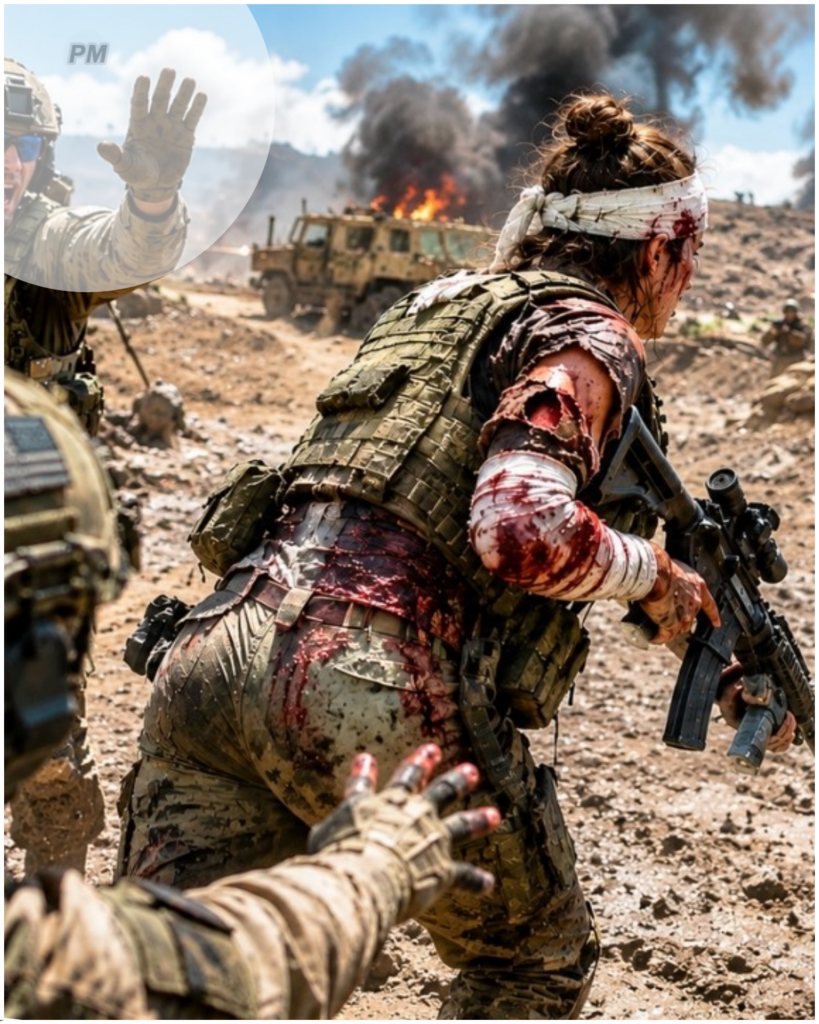
Week two introduced fieldcraft
Week two introduced fieldcraft. Constructing ghillie suits from burlap and natural vegetation. Aninsley’s methodical nature served her well.
She measured thread spacing with precision, matched colors exactly to the Georgia vegetation, created a suit that blended seamlessly with the forest floor.
Harrow examined her work. This looks like something from a museum. Well done, Grant. First praise she’d heard from him.
It felt like winning a medal. Then came stalking exercises, the moment where confidence turned to hubris.
The objective seems straightforward. Move 150 m through wooded terrain toward two Walker instructors who were actively searching for students.
Reach a firing position undetected. Time limit 3 hours. Aninssley had shot perfect all week.
She’d constructed the best ghillie suit in the class. She’d proven herself under actual combat conditions.
This exercise felt almost trivial by comparison. She moved too fast, impatient to demonstrate her skill, confident that her natural talent would carry her through.
At 100 meters, a walker blew his whistle. Sharp, loud, final. Busted. Stand up, student.
Aninssley stood. Mud and leaves fell from her ghillie suit. Her face burned with humiliation.
The walker approached. He was older, gray in his hair, eyes that had seen everything and were unimpressed by all of it.
What’s your name? Grant. Sergeant. Well, Grant, you just got yourself and your entire team killed.
Your impatience, your overconfidence, your failure to respect the fundamentals. He pointed back toward the start line.
Walk back and think about what you did wrong. The walk of shame took forever.
Other students watched from concealment. She felt their eyes tracking her felt their judgment. The combat veteran who couldn’t handle a basic stalking exercise.
Harrow waited at the start line. His expression was worse than anger. It was disappointment.
What happened out there, Grant? I moved too fast, Sergeant Firstclass. I was overconfident. Yes, you were.
He crossed his arms. Combat gave you a false sense of capability. You think because you performed once under fire, you’ve mastered the fundamentals.
You haven’t. You got lucky and luck runs out. The words hit harder than any curse would have because they were true.
That night, Aninsley lay in her bunking the failure. The whistle, the walk back, Harrow’s disappointment.
She’d proven herself in Afghanistan only to fail at a training exercise. What did that say about her actual skill level?
Maybe she didn’t belong here after all. The next morning, a student approached her at breakfast.
He was older than most, early 30s, infantry veteran based on his unit patch, lean and weathered with kind eyes.
Saw you get walked yesterday. I’m Brixton Fallon. Everyone calls me brick. He sat down without asking.
Happened to me on my first attempt, too. Happens to most people. How’d you pass the retest?
Slowed down. Trusted the process. He took a bite of terrible scrambled eggs. Slow is smooth.
Smooth is fast. Rushing gets you killed. Or in this case, walked. Over the next 3 days, Aninsley practiced obsessively.
Spent 8 hours in the woods moving at glacial pace. Lay motionless in underbrush while mosquitoes covered every exposed inch of skin.
Didn’t scratch, didn’t move, just breathed and waited and learned patience at a cellular level.
Morse’s words echoed in her memory. Patience defeats panic. The retest came on January 2nd.
Same course, same walkers, different Aninsley. She took 2 hours and 40 minutes to cover 150 m, moved 6 in at a time at her slowest points, froze completely when walkers passed within 10 ft, became part of the forest rather than something moving through it.
She reached the firing position undetected, set up behind her rifle, acquired the target through her scope.
Perfect. Harrow was waiting at the extraction point. He looked at her differently now. The disappointment was gone, replaced by something harder to define.
Respect, maybe better. Much better. He actually smiled. Small, brief, but genuine. You learned the lesson.
Week three brought sleep deprivation. Random wakeups at 0200, 0330, 0445. Surprise drills in full gear.
Four mile runs followed immediately by weapons qualification. The purpose was testing whether they could maintain shooting accuracy while exhausted.
Aninssley discovered that exhaustion made everything harder. Her hands shook. Her vision blurred. Simple calculations took twice as long.
But Morse had trained her for this, had pushed her in those evening sessions until she could barely stand.
The muscle memory remained even when conscious thought failed. Students continued dropping. Week three, 26 became 21.
Injuries took two. Voluntary withdrawals took two. Academic failure took one who simply couldn’t calculate windage under pressure.
Aninssley watched each departure with mixed feelings. Relief that she was still here, fear that she might be next.
Week four introduced nutritional restriction, MRS only, deliberate calorie deficit, simulating field conditions where food was limited, and the mission continued regardless.
Anley lost 8 lbs in two weeks. Her uniforms hung loose, her face became gaunt, but her shooting remained precise.
Week five brought urban operations, mockup city terrain with three-story buildings in narrow alleys, limited sight lines, moving vehicles, pop-up targets that appeared and disappeared in seconds.
This was where Aninsley’s mathematical mind excelled, calculating angles through building windows, compensating for elevation changes, reading wind patterns disrupted by urban canyons.
Third floor window, 15° downward angle, 280 m, wind negligible in the urban corridor. She made the calculations automatically.
Fired. Perfect hit. Harrow watch from behind. Your mind works fast. Good instincts for geometry.
Then came the critical test. January 24th. 10 shots. 10 different urban scenarios. Must hit eight out of 10 minimum to continue.
Aninssley approached the firing line feeling good, confident, but not overconfident. She’d learned that lesson.
Shot one, hit clean. Shot two, hit. Shot three, miss. She’d misjudged wind through a building gap.
The bullet went 6 in right. She felt panic rising, pushed it down, breathed, refocused.
Shot four, hit. Shot five, miss. She flinched on the trigger. Pulled instead of squeezed.
Rookie mistake from someone who should know better. The panic grew stronger. Two misses already.
Could only afford one more. Shot six. Miss. Complete mental blank. Forgot to compensate for elevation.
The bullet struck two feet low. Three misses, seven out of 10. Failure, Aninsley lowered the rifle, feeling numb.
Around her, other students were finishing their qualifications. Brick shot nine out of 10. The blonde female student shot perfect again, but Ansley had failed.
Harrow approached. He didn’t yell, didn’t curse, just looked at her with that devastating disappointment.
See me after formation, Grant. The rest of the day passed in a fog. Classes on range estimation, practical exercises on wind reading, Aninsley went through the motions, but her mind was elsewhere.
Replaying those three missed shots, analyzing what went wrong, understanding that the problem wasn’t technical, it was mental, she choked under pressure.
After formation, she reported to Harrow’s office. He sat behind a desk covered in paperwork and range cards, gestured for her to sit.
You want to tell me what happened out there? I choked. Sergeant first class lost focus.
Made mistakes I shouldn’t make. Why? His eyes were sharp, probing. You’ve performed under actual combat conditions.
You’ve killed enemy fighters while bullets were flying at you. Why did a simple qualification break you?
Aninsley didn’t have an answer. Or rather, she had one but didn’t want to admit it.
I don’t know, Sergeant First Class. Yes, you do. He leaned forward. You’re exhausted, sleepdeprived, undernourished.