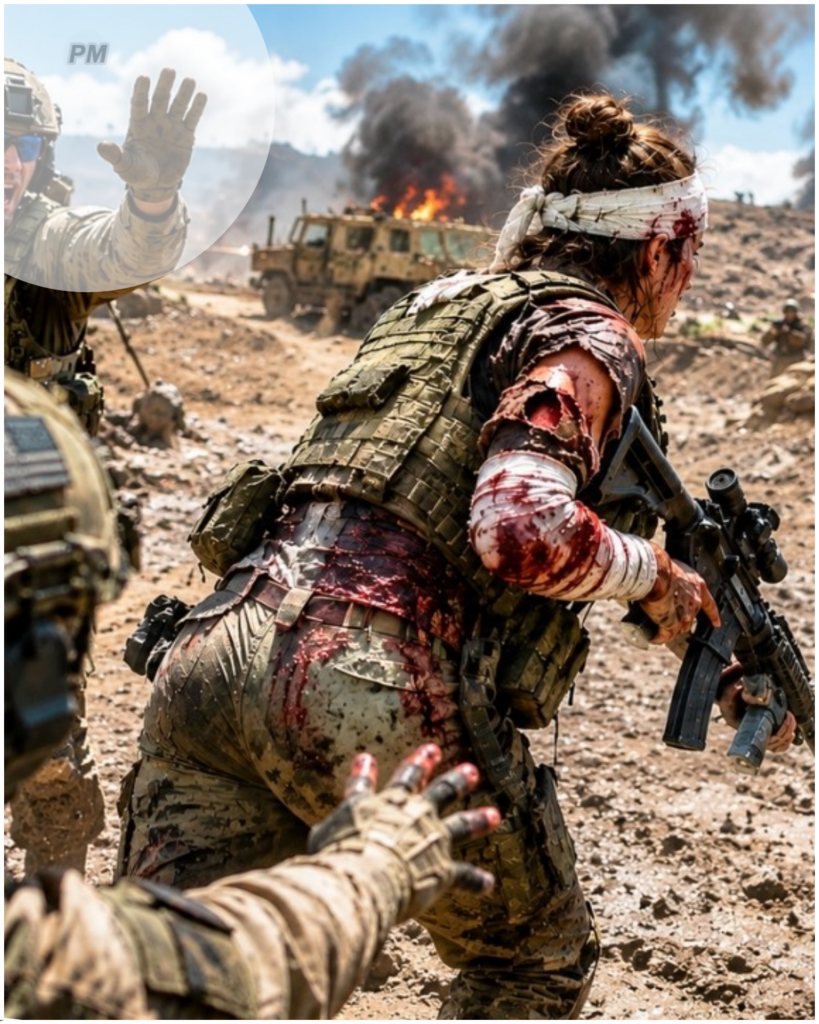
The faces were already starting to blur together i…
The faces were already starting to blur together in her memory. Young men, old men, fighters who probably believed they were defending their homeland from invaders.
She waited for the guilt to hit. The horror, the moral crisis that should come from taking human lives.
But all she felt was exhausted numbness. And underneath that, something else, something she didn’t want to examine too closely, satisfaction.
The knowledge that she’d performed under extreme pressure, that her shots had been clean and precise, that she’d done exactly what needed doing.
Was that wrong? Was she supposed to feel worse about it? The extraction helicopters came in loud and fast.
Medevac birds with red crosses painted on their sides. A security team established a perimeter while medics rushed to the wounded.
Sullivan went first. They had him on a stretcher. IV bags hanging from poles. Marcus walking alongside still giving instructions despite his own injury.
The SEAL sniper’s face was pale from blood loss, but he was conscious. As they carried him past Aninsley’s position, he turned his head and caught her eye.
He didn’t say anything, just nodded once. Acknowledgment between two snipers. Recognition of what she’d done.
Then Marcus, the combat medic, argued with the other medics the entire time, insisting he could walk, that his leg wound was minor, that others needed treatment first.
They ignored him and loaded him onto the second bird. Anyway, Aninsley climbed down from the rocks on shaky legs.
Her body felt like it belonged to someone else. She moved through a haze of exhaustion in shock, gathered her scattered gear, picked up her supply pack, counted magazines without thinking about it, 12 empty, four still full.
Marcus appeared beside her before boarding the helicopter. He took Sullivan’s rifle from her hands gently, reverently.
Sullivan’s going to want to thank you himself when he’s out of surgery. Marcus’s face was gray with pain, but his eyes were clear.
You pulled our asses out of the fire, Grant. Don’t let anybody tell you different.
He limped toward the helicopter, turned back once more. “Also, you might want to see the doc about that concussion.
You’ve got a serious head wound bleeding all over the place.” Aninssley touched her scalp.
Her hand came away crimson. She hadn’t even noticed. Funny how pain became irrelevant when you were fighting for survival.
The flight back to FOB Griffin took 20 minutes. Aninssley sat in the helicopter staring out the open door.
The battlefield receded below. Bodies scattered across the sand. Smoke rising from destroyed vehicles. Brass casings glinting in the early sunlight.
Evidence of violence that would be covered by desert sand within days. She thought about the faces she’d seen through the scope, wondered if they had families, children, people who would grieve them.
Then she pushed those thoughts away because that path led to madness, to paralysis, to an inability to function.
Morris had warned her about this. The weight you carry, the faces you see in the dark, the price of doing what needed doing.
She hadn’t understood then, but she was beginning to understand now. Back at FOB Griffin, everything happened in a blur.
Medical processing, a doctor shining lights in her eyes and asking questions about the date and her name and how many fingers he was holding up, eight stitches in her cheek, 12 more in her scalp, anti-nausea medication for the concussion, orders for 48 hours rest.
Anley nodded and agreed to everything. Then she went to her bunk and lay down fully clothed and stared at the ceiling while her mind replayed every shot in photographic detail.
Face number one, young man with a wispy beard, maybe 20 years old, setting up the PKM, dropped by her first shot, center mass, clean kill.
Face number two, runner between positions, mid30s, scarred face visible even at 300 yd. Led him perfectly, dropped him midstride.
Face number three, the commander, gray in his beard, authority in his posture, eliminated, and the entire attack collapsed.
How many more? She’d lost count after seven or eight, but each face was burned into her memory with perfect clarity.
Young and old, scared and determined, all dead by her hand. Sleep wouldn’t come, not even close.
Her body was exhausted, but her mind raced like an engine stuck in high gear.
Every time she closed her eyes, she saw the scope view. Crosshairs settling on human targets, the kick of recoil, the knowledge that another person had stopped existing because of her actions.
At 0400, she gave up trying to sleep. Walked to the shower facility in the pre-dawn darkness.
The water ran scalding hot. She stood under it until her skin turned red, scrubbed at the dried blood in her hair, watched pink water swirl down the drain.
She scrubbed until her skin felt raw, until the water ran clear, but she still didn’t feel clean, wondered if she ever would again.
The messaul was nearly empty at 0530. Aninsley poured herself a cup of coffee that tasted like battery acid and motor oil.
Sat at a corner table watching the sun rise over the blast barriers. Other soldiers filtered in gradually.
Some glanced at her. Word had already spread about what happened during Operation Valkyrie. About the logistics specialist who became a sniper.
She was no longer invisible. No longer just the quiet girl who counted bullets. People saw her differently now.
Saw someone who had stepped up when it mattered. Saw a warrior. The attention made her want to disappear.
She wasn’t a warrior. She was someone who’d picked up a rifle because there was no other choice.
Someone who’d done what needed doing and now had to live with the consequences. Footsteps approached.
She looked up and saw Master Sergeant Callahan Morse standing beside her table. He didn’t ask permission, just sat down heavily, his bad legs stretched out to the side.
His weathered face showed deep concern. How you holding up, kid? Anley shrugged, sipped her terrible coffee.
I’m fine. That’s a lie. Morse’s voice was gentle but firm. Nobody’s fine after their first combat.
Not ever. They sat in silence for a while, the messaul gradually filling with morning personnel, voices in clatter of trays, the normal sounds of military life continuing despite the violence that had happened just hours ago.
Finally, Morris spoke again. Grenada, 1983. I was 37 years old. First time I killed someone through a scope.
Aninssley looked at him. He was staring at his coffee cup like it held answers.
Insurgent at 600 yd. Clear shot. Perfect conditions. I pulled the trigger and he dropped.
Morse’s jaw tightened. Then I threw up behind my position, heaved my guts out while my spotter pretended not to notice.
He looked up at her. His eyes were wet. Nightmares for months, his face on repeat, wondering if I could have wounded him instead, wondering if he had kids, if his wife would cry when she learned he was dead.
He paused. The guilt nearly broke me. Anley felt something loosen in her chest. The knowledge that this legendary instructor had experienced the same horror she was feeling.
“Does it get easier?” Her voice came out smaller than she intended. “No.” Morse’s answer was immediate and honest.
“It never gets easier, but you learn to carry the weight better. You learn to put those faces in a box and only open it when you can handle it.”
He leaned forward. “Here’s what matters. You did the right thing for the right reasons.
Those men were trying to kill your team. You protected them. That’s not murder. That’s war.
And war is ugly and horrible, but sometimes necessary. I keep seeing them, Anley whispered.
Every time I close my eyes. You will for a long time, maybe forever. Morse reached across and gripped her hand.
But you’re still you. You’re still the girl from Montana who counts bullets and takes pride in doing things right.
What you did last night doesn’t erase that. It adds to it. He pulled back, took a drink of coffee, made a face at the taste.
I lost my daughter because I never learned to process this stuff. Never talked about it.
Kept it locked inside until it poisoned everything. His voice cracked. Don’t make my mistakes, Angley.
Don’t let this consume you. The use of her first name hit different. He’d always called her Grant or kid.
This felt personal, like a father talking to a daughter. Tears ran down his weathered cheeks.
Teaching you has been the closest thing to redemption I’ll ever get. Watching you discover what you’re capable of.