Second place, Lieutenant Commander Daniel Patterso…
Second place, Lieutenant Commander Daniel Patterson. Professional performance despite equipment limitations. Third place, Lieutenant David Chen.
Solid shooting hampered by technology failures. Fourth place, tied. Multiple competitors including Lieutenant Ryan Mitchell.
Struggling to adapt when their tools failed them. >> [clears throat] >> As competitors filed out of the observation bunker toward vehicles that would take them back to dry buildings, several approached Grace.
Their skepticism had evaporated like steam replaced by something that looked like respect, even reverence.
Captain Anderson, the Army Ranger who’d been polite but doubtful from the beginning, extended his hand.
His grip firm and genuine. “Ma’am, I owe [clears throat] you an apology, A serious one.
I didn’t think you belonged here. Thought this was political correctness compromising excellence. I was completely wrong.
That shooting was beyond anything I’ve ever witnessed. You didn’t just compete with us, you dominated in conditions that defeated everyone else.
I’m honored to have watched you work. No apology necessary, Captain. You just didn’t know what I was capable of.
Now you do. Others followed with similar acknowledgements, quiet nods, requests to learn techniques. The tide had turned completely.
Grace was no longer the outsider being tested. She was the standard, the competitor everyone else was chasing.
The embodiment of something they’d forgotten in their rush to embrace technology. But not everyone was pleased.
Lieutenant Mitchell stormed past without a word. His face dark with anger that went beyond professional frustration.
This was personal now. His expensive equipment had failed. His assumptions about technology superiority had been shattered.
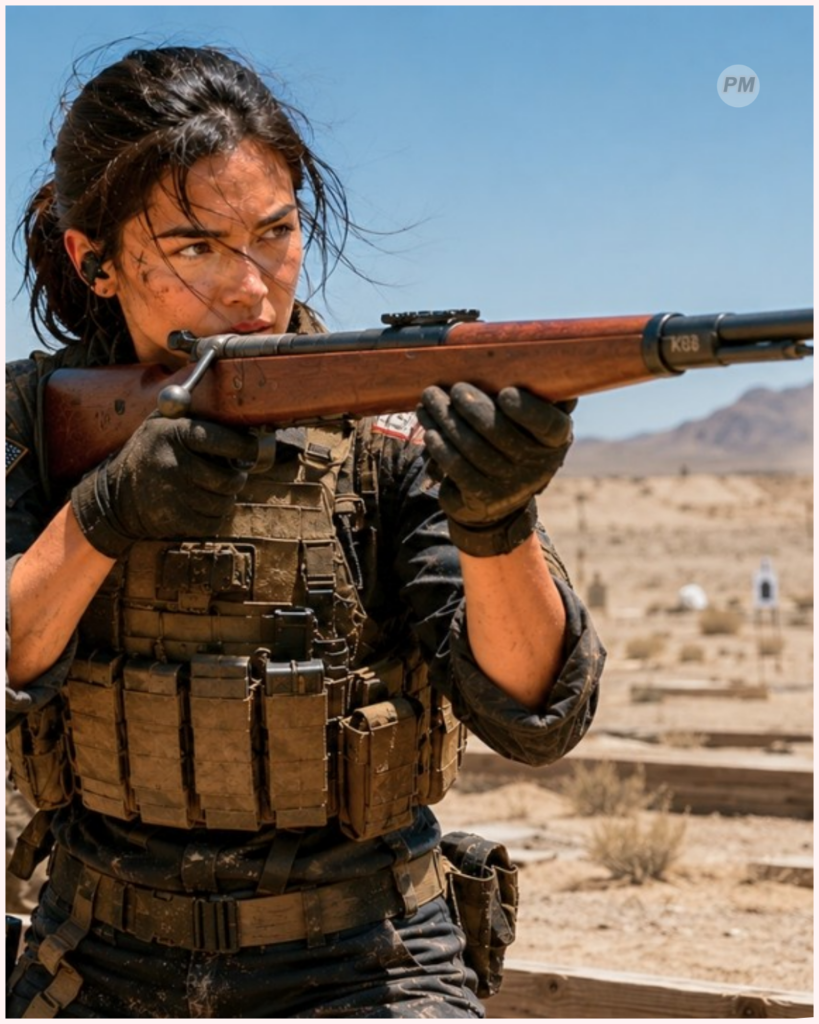
And a woman shooting a Vietnam era rifle with iron sights had beaten him decisively.
And watching from the command post through rain-streaked windows, Commander William Stryker scowled at the scoreboard.
His arms crossed, his expression showing fury that transcended competition. This wasn’t about scores anymore.
It was about world views being challenged, about beliefs being proven wrong, about everything he’d built his career on crumbling like wet sand.
Patterson noticed Stryker’s expression. Moved close to Grace as they walked toward the transport vehicles.
Watch out for Stryker. He’s escalating. I’ve seen that look before, in combat. When men feel cornered.
When everything they believed is being proven wrong. They get desperate. They get dangerous. I can’t control what he does, sir.
I can only control what I do. I know. Just be careful. Keep your equipment secure, your ammunition locked.
Trust your instincts. If something feels wrong, it probably is. Before Grace could respond, Master Chief Reeves’ voice boomed across the parking area.
Captain Thornton, a word. In my office. Now. Grace followed Reeves through the rain. His office was warm and dry, almost shocking after hours in the storm.
He gestured for her to sit, closed the door. His expression was serious. I need to tell you something about your father.
The full story. Something I should have told you earlier, but the time wasn’t right.
Grace sat, water still dripping from her uniform. Sir? Reeves pulled out a folder from his desk, opened it.
Inside were photographs yellowed with age, documents, official reports. February 24th, 1968, Huey City, third week of the battle.
The NVA had us pinned in the MACV compound. >> [snorts] >> We lost all communication with higher command.
Radio equipment destroyed, couldn’t call for artillery support, couldn’t request air strikes. The weather was terrible.
Smoke from fires, rain. Visibility maybe 50 m on a good day, 20 m most of the time.
He pulled out a black and white photograph, showed it to Grace. Young Marines, dirty, exhausted, scared, but determined.
That’s me, 19 years old. I was a combat correspondent, not supposed to be fighting, but when the NVA attacked, everyone became infantry.
We didn’t have the luxury of specialization when the enemy was trying to kill us all.
Reeves pulled out another document. An after-action report typed on an old typewriter. There was an NVA sniper, professional, patient, deadly.
He’d positioned himself somewhere in the citadel. We never found his exact location. Never even saw muzzle flash through the smoke.
But he’d been methodically eliminating us for 6 hours. Seven Marines killed that morning. Four more wounded seriously.
He was breaking our will, making us afraid to move, to evacuate casualties, to do anything but hide and wait to die.
His voice took on a quality Grace had never heard before. Reverence mixed with remembered terror.
Your father was positioned on the roof of the Treasury building, 400 yards from our position.
He had no radio communication with us. Couldn’t coordinate. Couldn’t call for spotting information. He was operating completely independently.
But through smoke and rain that made seeing nearly impossible, he was watching, analyzing, hunting, using skills that didn’t require technology or communication.
Reeves pulled out another document. Official recommendation for valor award. 850 yards through visibility that made the shot seem impossible.
Your father eliminated that NVA sniper with one shot. One perfect trigger press. Iron sights.
No laser rangefinder. No ballistic computer. No thermal optics to see through smoke. Just skill and discipline and the fundamentals he’d mastered through years of training.
Grace felt her throat tightening. But he didn’t stop there. While everyone else was celebrating the sniper’s death, your father had identified another threat.
11 NVA soldiers were attempting to flank our position, moving through rubble and destroyed buildings, trying to get behind us where they could finish off the entire compound with grenades and automatic weapons.
Reeves’ voice roughened with emotion. Your father eliminated all 11 of them. 11 shots, 11 kills, ranges from 400 to 900 yards, through smoke so thick we couldn’t see them, through rain that made accurate shooting seem impossible.
He was operating on pure instinct and skill, seeing targets we couldn’t see, making calculations that defied the conditions.
He met Grace’s eyes directly. Your father’s shooting that day saved 37 Marines. I was one of them.
I was certain I was going to die in that compound, certain my mother would receive a telegram, my name would be added to a memorial wall.
Your father’s skill was the difference between me standing here telling you this story and being a statistic, a name, a memory that fades with time.
Grace couldn’t stop tears now. They mixed with rainwater on her face. But here’s what you don’t know, the most important part.
Reeves pulled out another document, Silver Star recommendation. Your father was recommended for the Silver Star that day.
The paperwork was submitted properly, witness statements collected from survivors, everything documented according to regulations.
But during the chaos of the Tet Offensive, during the massive counteroffensive and the confusion that followed, the paperwork was lost, misfiled or destroyed in one of the attacks on administrative centers.
Your father never received his medal, never got the official recognition he earned for saving 37 American lives.
He closed the folder carefully, like it was precious. “I’ve spent the last 3 years tracking down surviving witnesses from that day, finding the men who were there, collecting their statements all over again, rebuilding the documentation from memory and fragments of records that survived.
Your father is finally going to receive his Silver Star. It’s 56 years late, but justice delayed is not justice denied.”
Grace wiped tears with shaking hands. “When?” “Award ceremony, after this competition concludes. Regardless of where you place, you’ll accept it on his behalf, because you’ve earned that honor by carrying his legacy forward, by proving that the skills he mastered still matter.”
Reeve stood, placed his hand on her shoulder. “Tomorrow is day four, night shooting. Your iron sights will be at severe disadvantage.
The others have thermal imaging and night vision equipment worth $50,000. They can see in total darkness, turn night into day.
You’ll be shooting essentially blind, but I’ve watched you these past 3 days. You’re not just your father’s daughter, you’re his legacy.
You’re proof that warriors aren’t made by their equipment, they’re made by their will, their discipline, their refusal to accept that anything is truly impossible.”
“I won’t let you down, Master Chief. I won’t let him down.” “You couldn’t if you tried.
Now get dried off, get warm, get some rest. Tomorrow night is going to test you in ways the storm didn’t.”
That evening, Grace sat in her barracks with a chair wedged under the door handle.
She checked every window lock, inspected every piece of equipment. Her ammunition was secured in a locked case.
Her rifle cleaned and maintained with extra care. She stared at her father’s photograph, young and strong, ready to save 37 Marines through shooting that seemed impossible.
I understand now, Dad, why you never talked about Hue, why the Silver Star mattered so little that you never even mentioned it.
Because the medal wasn’t the point. The point was the 37 men who went home to their families.
The 37 mothers who didn’t get telegrams. That was your reward, the only one that mattered.
She lay back on her bunk. Tomorrow would bring darkness, would test her with challenges that seemed designed specifically to defeat her iron sights.
But she was ready. Because she was her father’s daughter, and she’d proven that fundamentals could overcome any obstacle.
Now it was her turn to prove it again. Day four arrived with darkness that seemed absolute and complete.
Grace woke at 0400 to prepare her equipment and her mind. But preparation for shooting in total darkness with iron sights seemed almost futile.
How do you prepare for something that’s essentially impossible? By 1930 hours, the sun had set over the Pacific, painting the sky in blood reds that faded to deep purple before surrendering completely to black.
Full darkness descended like a curtain falling. No moon, cloud cover blocking the stars, the kind of primal darkness that city dwellers never experienced, complete and absolute.
15 competitors, now 13 after day three’s withdrawals, stood on the night firing range watching as others checked their equipment.
Thermal imaging scopes glowed with faint electronic light. Night vision devices cast eerie green illumination on the faces of men who wore them.
Laser rangefinders with infrared capabilities were tested and retested, electronics humming with power. Every shooter had technology specifically designed for darkness, equipment that turned night into day, that made targets visible as clearly as noon, that gave them every possible advantage.
Every shooter except Grace. Her M14 had no mounting rails for night vision, no thermal capability, no electronic aids whatsoever.
In the darkness, she was as blind as any soldier from her father’s generation, relying on eyes that nature had designed for daylight, not for hunting in the dark.
Master Chief Reeves’s voice carried across the range through speakers positioned around the course. Day four, test your ability to operate in denied environments.
Night combat. No ambient light beyond starlight, which tonight is blocked by cloud cover. Targets at ranges from 400 to 1,200 yd.
He paused to let that sink in. Maximum [clears throat] range in total darkness. Tonight, we add complexity.
Hostage situations. You’ll see silhouettes, some hostile, some civilian. You must identify friend from foe, engage threats, preserve innocent lives.
Shoot a hostage and you’re disqualified immediately. No second chances. No appeals. Hesitate too long and the scenario counts the hostage as killed by the enemy.
You’ll have three seconds per scenario to assess and engage. Eight scenarios total. Grace’s stomach tightened.
This wasn’t just about shooting anymore. It was about judgment, about life and death decisions compressed into heartbeats, about moral calculations made when you could barely see.
Captain Thornton, Reeve’s voice carried careful neutrality, professional distance. You’re aware your equipment lacks night vision capability.
Yes, Master Chief. You’re authorized to withdraw from tonight’s competition without penalty. Your day four score would be calculated as your average from previous days.
Given your performance so far, that would still maintain your lead. Every eye turned toward her.
In the darkness, Grace could feel their gazes, even if she couldn’t see faces clearly.
Some probably hopeful she’d quit. Others curious to see if she’d actually attempt this impossible task.
Ma’am, Patterson’s voice came from nearby, concerned, almost pleading. This isn’t like the storm. In daylight, you could at least see the targets, even if conditions were terrible.


