Grace could taste salt on her lips, feel the wind…
Grace could taste salt on her lips, feel the wind trying to physically push her off balance.
This was nature at its most hostile. Conditions that separated warriors from shooters. Day three.
Reaves’ voice somehow boomed over the storm. Cutting through wind and rain with the force of absolute authority.
Today is about adaptation. Combat doesn’t wait for perfect weather. Your enemy doesn’t care if conditions are ideal.
He attacks when he has advantage. When conditions favor him and hurt you. Today you prove you can perform when everything is against you.
He gestured toward the targets, barely visible through rain and mist that turned the world into shades of gray.
Distances from 600 to 1200 yards. Five targets total. Variable wind conditions that will change not just between shots, but during flight time.
Your equipment will be tested. Your skills will be tested. Most importantly, your mind will be tested.
Your ability to adapt and overcome when every advantage has been stripped away. Grace glanced down the line at her competition.
Several shooters were already struggling before the competition even began. Rain hammered their advanced optics, creating condensation inside supposedly sealed scopes.
Water droplets on external lenses distorted sight pictures. Fogging that wouldn’t clear no matter how much they wiped.
Lieutenant Mitchell’s expensive ballistic computer flickered and died as Grace watched. Moisture had penetrated the waterproof casing.
$15,000 of technology reduced to useless weight by water that didn’t care about specifications or warranties or the engineers promises.
Commander Patterson stood stoic. His SR-25 wrapped in a waterproof rain cover. His expression unreadable.
But Grace could see tension in his shoulders. Even the best equipment struggled in conditions like these.
Lieutenant Chen looked frustrated, constantly adjusting his Nightforce scope as water droplets created optical aberrations.
Refraction patterns that turned precision instruments into liability. And then there was Grace. Standing in the deluge with her father’s M14 and its simple iron sights.
No electronics to short circuit. No glass to fog. No batteries to fail in the moisture.
No computers to crash when water found microscopic gaps in seals. Just steel and wood and fundamentals.
The same tools warriors had used for generations before technology promised to make them obsolete.
“Due to weather conditions,” Reeves announced over the howling wind, “anyone who wishes to withdraw can do so without penalty to their overall standing.
Your day three score will be recorded as your average from days one and two.”
Two competitors immediately stepped forward, an Army Ranger and an Air Force sniper, both experienced warriors who recognized when conditions exceeded equipment capabilities.
There was no shame in their decision, just pragmatism, understanding that some battles couldn’t be won with the tools available.
13 remained. “Shooters will engage in alphabetical order,” Reeves continued. “Lieutenant Briggs, you’re first.” Briggs was a SEAL with three combat deployments and a reputation for cold precision.
His rifle was state-of-the-art. Yesterday, it would have given him every advantage. Today, it was betraying him with every shot.
Through the spotting scope in the observation bunker, Grace watched his first shot go wide by several feet.
The ballistic computer struggling to calculate wind values that changed every second had given him catastrophically bad data.
His second shot was closer, but still missed the target completely at 800 yards. By his fifth shot, struggling with electronics that kept crashing and restarting, he’d scored only two hits out of five possible.
He stood from the line, clearly frustrated, walked away shaking his head. A professional warrior defeated not by lack of skill, but by equipment that couldn’t handle the conditions.
The storm was winning. Second shooter managed three hits. Third shooter, one hit. The tempest was systematically stripping away technology’s advantages, revealing the difference between warriors who could adapt and those who depended on tools that had failed them.
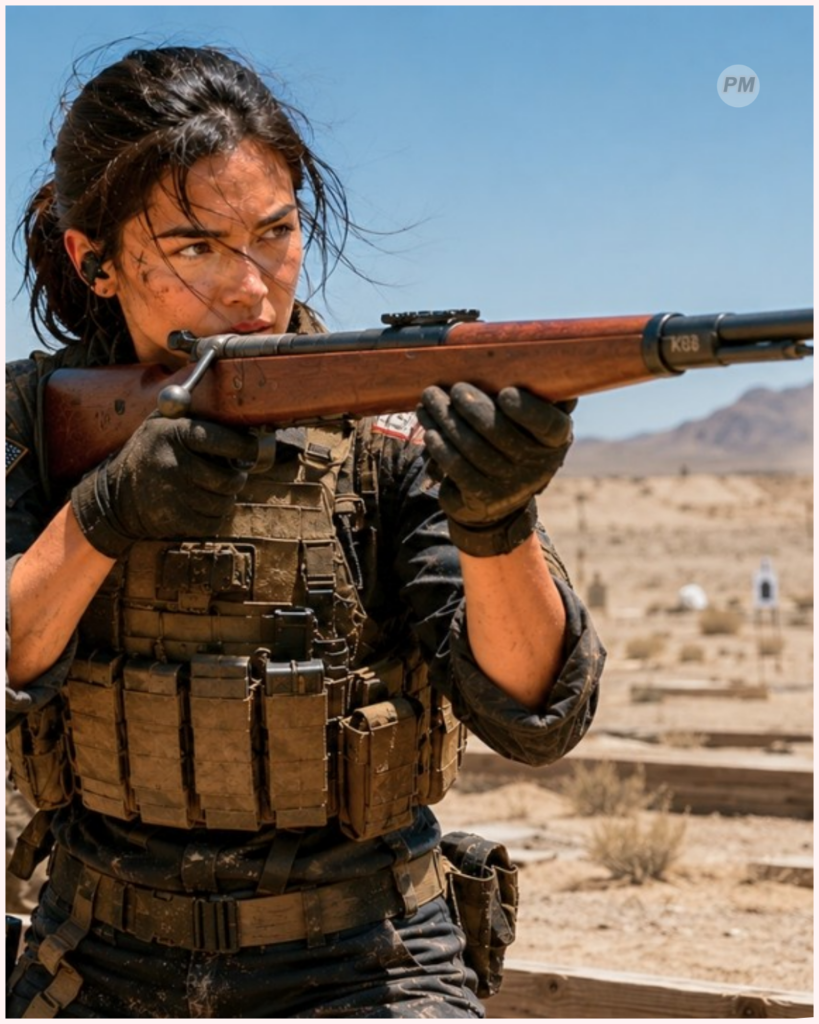
Captain Thornton, you’re up. Grace moved to the line, her M-14 slick with rain but functioning perfectly.
Every component made of materials that didn’t care about water. Wood that had swollen slightly with moisture but remained stable.
Steel that was wet but unaffected. Mechanisms that worked through simple physics that rain couldn’t change.
She assumed prone position, feeling cold water soak immediately through her uniform. The discomfort didn’t matter.
Pain was temporary. Performance was permanent. That’s what her father had taught her in Montana winters, when fingers went numb and breath froze in the air.
Through her iron sights, she could barely see the first target at 600 yards through the rain and mist.
The world had turned into gradations of gray, shapes more imagined than seen. But visibility wasn’t everything.
Sometimes it was barely anything. Grace closed her eyes, felt the wind against her face, against her hands, against every exposed part of her body.
It came from the west, hard and steady with the weight of ocean behind it, with a slight upward component as air hit the cliff face and was forced higher, creating thermal currents that would push bullets up and sideways in ways that no ballistic computer could accurately predict.
Her father’s voice echoed in memory, a lesson taught on a foggy morning in Montana when she was 14 years old.
When he’d taken her hunting in conditions that made seeing impossible. When you can’t see, you feel.
The wind talks to you if you listen. The air has weight. It has texture.
It has personality that changes moment to moment. Trust your senses. They’re older than technology, older than civilization.
Your ancestors hunted in darkness and fog for thousands of years before the first rifle was invented.
Grace opened her eyes, made calculations based on feel more than formulas. Wind 40 mph from 270°.
At 600 yd that meant she didn’t calculate exact numbers. She felt it. The bullet would drift massively right without compensation.
She aimed 3 ft left of the target. So far off that to anyone watching, it looked like she was aiming at nothing.
Like she’d given up. Like the pressure had finally broken her. She fired. 600 yd down range, the bullet curved through the storm in a parabolic arc that looked impossible.
Physics in ballistics in wind resistance all combining in ways that required more faith than calculation.
The round punched dead center into the silhouette. The range officer’s voice carried genuine surprise.
Hit. Center mass. Even the observation bunker had gone quiet. Grace could feel their eyes on her.
Trying to understand what they just witnessed. Grace chambered her second round with mechanical precision.
The second target was at 800 yd. The wind had shifted. She could feel the change, not see it, not calculate it from flags that were being torn apart by the gusts, but feel it on her skin, in her [clears throat] bones.
Northwest now, stronger, maybe 45 mph with the upward component even more pronounced as the storm intensified.
She adjusted her point of aim even further left and higher, compensating for wind and thermal that would push her bullet off course, trusting feel over formulas.
Hit. The sensor confirmed what her body already knew. The shot had been perfect. Third target, 1,000 yd.
The rain intensified into a gray wall that made seeing impossible. Vision became irrelevant. Grace waited, breathing slowly, feeling for a lull in the wind, a momentary calm in the chaos.
There, perhaps 2 seconds, a brief window when the storm seemed to take a breath, when the horizontal rain eased slightly and the wind dropped from 45 to maybe 30 mph.
She fired immediately, trusting instinct over thought. Hit. Fourth target, 1,200 yd, 3/4 of a mile through Pacific storm, the maximum effective range of her rifle, even in perfect conditions.
In this tempest, it should have been impossible. Grace’s calculations became pure instinct. Years of training and thousands of rounds fired compressed into split-second decisions that bypassed conscious thought entirely.
Lead left. Compensate up and right. Fire during the microsecond pause between gusts when the wind allows it.
The M14 roared, recoil solid against her shoulder. Hit. Fifth and final target, 900 yd, but positioned at an angle that created complex wind patterns, currents swirling around the observation buildings.
Eddies formed by terrain features creating chaos that even the most sophisticated computers would struggle to model accurately.
Grace studied it for 10 full seconds, precious time that ate into her window, but she was reading information that couldn’t be rushed, watching how the rain fell, how the mist moved at different elevations, understanding that wind wasn’t one thing, it was layers, streams at different altitudes and velocities, rivers of force flowing over and around obstacles in ways that created pockets of calm and zones of violence.
She aimed what seemed like 5 ft from the target. So far off course that several observers thought she’d made a catastrophic error.
That the pressure had finally overwhelmed her judgment. Grace squeezed the trigger one final time.
The bullet curved through space and storm following a path that looked impossible, but was actually inevitable.
Physics expressed through skill earned over decades of discipline. Hit. Five for five. Perfect score for Captain Thornton in storm conditions.
The competitors watching from the observation bunker fell silent. Even Mitchell, who’d been skeptical and hostile from the beginning, stood with his mouth slightly open.
Staring at the target verification display like it showed something that violated the fundamental laws of nature.
Commander Patterson had been preparing for his own run, checking his equipment, reviewing his notes, but he stopped, set down his rifle, walked to the edge of the bunker where he could see Grace emerging from the shooting position through the rain.
Water dripped from her uniform, streamed down her face. Her hair was plastered to her head, but her expression showed only calm focus.
Like she just completed a routine training exercise instead of something that would be discussed in sniper schools for decades.
Patterson approached as she entered the bunker dripping and cold. That was supernatural, Captain. He paused, searching for words adequate to capture what he’d witnessed.
You couldn’t even see the targets clearly. How did you do that? Grace wrung water from her sleeves, her voice matter-of-fact.
Like she was explaining basic mathematics instead of performing what most shooters would consider magic.
Sometimes you don’t need to see everything. You just need to feel what matters. Wind isn’t invisible.
It has weight, temperature, patterns. If you pay attention, if you’ve trained yourself to read the information that’s always there.
Your father taught you that. It wasn’t a question. In the mountains of Montana, he’d take me hunting in fog so thick you couldn’t see 10 ft, in snow that came sideways, in conditions where technology was useless and instinct was everything.
He said it would make me a better shooter when conditions were clear. That training and hardship makes performance in normal conditions feel easy.
Patterson shook his head slowly. A mixture of admiration and something close to awe. I’ve got a computer that cost taxpayers $15,000.
It has algorithms developed by MIT engineers. Processing power that can perform millions of calculations per second.
And it can’t tell me what the wind is doing because the conditions change faster than it can adapt.
You’re doing it by feel, by instinct, by skills that don’t require batteries or processors.
Computers are great tools, sir, until they’re not. When they fail, you need to know the fundamentals.
Otherwise, you’re just carrying expensive weight that can’t help you. The competition continued through the morning.
Patterson managed three hits out of five. An impressive performance given the conditions. His experience and adaptability allowing him to overcome some of his equipment’s limitations.
But nowhere near Grace’s perfection. Chen struggled with fogged optics. Condensation that wouldn’t clear, creating refraction patterns that made accurate aiming impossible.
He scored only two hits. A professional warrior brought low by technology that promised advantages but delivered vulnerability.
Mitchell’s dead computer left him essentially shooting blind. He attempted all five shots but couldn’t compensate for wind he couldn’t measure.
Scored zero hits. Stood from the line looking like he’d been personally betrayed by the rifle that had cost more than a new car.
The remaining shooters fared even worse. Some couldn’t see their targets at all through rain-soaked optics.
Others fired hoping their computers would somehow pull miracles from chaos. Technology that was supposed to give them advantages had become liability in conditions that didn’t care about engineering promises.
By noon, when Reeves finally called a halt to the competition as the storm reached truly dangerous levels, the standings had shifted dramatically.
First place, Captain Grace Thornton. Perfect score in impossible conditions. Leading by a margin that seemed insurmountable.


