That connected all warriors who'd pulled triggers…
That connected all warriors who’d pulled triggers in anger. Who’d taken lives to save lives.
He sounds like he was a wise man, a good man. He was. He taught me that being a sniper isn’t about killing, it’s about protecting.
Every shot you take saves friendly lives. That’s the burden and the honor. The responsibility that keeps you awake at night and gets you up in the morning.
I wish more shooters understood that. Patterson glanced back at the range where technicians were collecting targets for official scoring records.
Day two tomorrow. Moving targets in variable conditions. Weather forecast says possible rain and wind by afternoon.
Your iron sights might actually give you an advantage if the electronics start acting up in the moisture.
We’ll see, sir. Every challenge is different. Every day brings new variables. Indeed it does.
Patterson paused, then added quietly, “For what it’s worth, Captain, I’m glad you’re here. This competition needed someone to remind us what marksmanship looked like before computers did our thinking for us.”
But as Grace walked toward her barracks, she felt something nagging at her. A sense that something was wrong, off.
Like the feeling you get when someone’s been in your room while you were gone.
She reached her door. The lock looked normal, but when she opened it, her equipment had been moved.
Subtle, nothing obvious, but Grace was trained to notice details. Her ammunition box sat on the table in the wrong position, rotated 90° from where she’d left it.
She opened the box carefully, counted the rounds, 35 cartridges. She’d organized 50 rounds last night, counted them twice to be absolutely certain, arranged them in neat rows of 10.
15 rounds were missing. Grace examined the door lock more closely. Fresh scratches around the mechanism.
Amateur work, but effective. Someone had picked it, entered while she’d been at the range, stolen ammunition that could mean the difference between winning and losing.
She sat on her bunk, stared at the evidence of sabotage. Her first instinct was to report it immediately.
March straight to Master Chief Reeves and demand an investigation. Demand justice. But something her father had taught her echoed in memory.
Never make excuses, Grace. The world doesn’t care why you failed. It only cares that you failed.
Excuses are what weak people use to justify their inadequacy. Warriors adapt. They overcome. They win despite the obstacles.
She pulled out her notebook, documented everything. Time discovered, number of rounds missing, description [clears throat] of lock scratches.
Everything that might matter later for an official investigation. But she didn’t report it. Not yet.
Because complaining would play into their hands. Would prove she needed special treatment. Would confirm the suspicion that she couldn’t compete on equal terms.
Instead, she inspected every remaining round with meticulous care. Checking for damage, for tampering, for anything that might cause a malfunction at the worst possible moment.
Looking for scratches on the brass casings, dents in the primers, anything that suggested someone had done more than just steal ammunition.
Everything appeared intact. Whoever had taken the rounds had been careful not to leave obvious evidence of tampering with what remained.
Grace cleaned her rifle, maintained it with the same ritual her father had taught her.
Because some things mattered more than competition, more than winning, the discipline, the care, the respect for tradition that connected generations of warriors.
She disassembled the bolt, cleaned every component, inspected the firing pin for wear, checked the extractor tension, examined the barrel throat for erosion.
The ritual was meditative, calming, a connection to her father and to every warrior who’d maintain weapons with the same care.
Tomorrow would bring moving targets, a new challenge, a new test, scenarios that would require split-second calculations and instinctive shooting, the kind of shooting where Ironsides would be at maximum disadvantage against computer-assisted optics.
But tonight, someone had declared war, not with bullets, but with sabotage, with the kind of attack that happened in shadows, that couldn’t be answered with marksmanship.
Grace lay back on her bunk, stared at the ceiling. Her father’s photograph watched from the footlocker, young and strong and certain, >> [clears throat] >> ready to face whatever Vietnam would throw at him.
“They’re trying to make me fail, Dad,” she whispered to the image, to the memory, to the legacy.
“But you taught me better than that. You taught me that excuses don’t matter, only results.
That the measure of a warrior isn’t how they perform when everything goes right. It’s how they perform when everything goes wrong.”
Sleep came slowly, but when it came, it brought dreams of Montana, of mountains, of a father teaching his daughter that the only person who could truly defeat you was yourself.
Day two arrived with complications Grace hadn’t anticipated. At 0400, while preparing her equipment in the pre-dawn darkness, she discovered something that made her stomach tighten with controlled anger.
The competition bulletin board had no posting about practice sessions. But when she overheard two Army Rangers discussing yesterday’s familiarization training while walking to breakfast, reality became crystal clear.
“Yeah, that moving target system is tricky. Good thing we got those 3 hours of practice yesterday afternoon.
Learned all the timing sequences. Got a feel for the different speeds.” “Definitely. I’d hate to go in cold on that course.
No way you’d score well without practice time.” Everyone else had practiced on the moving target system yesterday afternoon.
Run through the course multiple times. Learn the patterns. Got comfortable with the timing. Everyone except Grace.
She kept her face neutral as she walked to the range. Showed nothing. Revealed no emotion.
But internally, the sabotage was escalating. First, the missing ammunition. Now denied preparation time. Someone was determined to see her fail.
Determined to prove she didn’t belong. By 0600, 15 competitors stood on the modified range.
The morning was perfect. Clear. Calm. No excuses. The moving target system was impressive. Engineering marvel.
Silhouettes mounted on rails that could move in any direction. Parallel to the shooting line.
Perpendicular to diagonal angles that created complex lead calculations. Each target appeared at random intervals controlled by computer.
Stayed visible for exactly 3 seconds before disappearing into concealment behind barriers. Electronic sensors recorded hits and misses with unforgiving accuracy.
No disputes. No arguments. Just data. Master Chief Reeves stood at the command post. His voice carried the authority of decades leading warriors in combat.
Day two, moving targets, distances from 400 to 1,000 yards. Speeds from 2 to 15 mph.
Directions are random, computer-controlled, unpredictable patterns. You’ll have 3 seconds per target. See it, calculate lead and drop, engage.
10 targets total. Miss and you lose points. Simple as that. He paused, let the difficulty sink in.
This tests your ability to make instant calculations under pressure. In combat, targets don’t wait for you to consult your ballistic computer.
They don’t stand still while you dial in your scope. They move. They evade. They try to survive.
Today you prove you can hit them anyway. Grace studied the range during the safety brief, trying to understand movement patterns, looking for rhythms or predictability, anything that would compensate for her lack of practice time.
But the system was truly random. Computer-generated patterns that didn’t repeat. The only advantage practice time would have given was familiarity with the interface, understanding how targets appeared and disappeared.
An advantage she’d been deliberately denied. Shooters will engage in order of current standings, Reeves continued.
Lieutenant Chen, you’re first. Captain Thornton, second. Chen approached the line with confidence. His Nightforce Optics allowed smooth target tracking, wide field of view, high magnification.
He could acquire targets early and follow their movement through the scope. First target appeared at 600 yards, moving left to right at moderate speed.
Chen’s rifle barked. Hit. Second target, 400 yards, moving perpendicular. Hit. He worked through the sequence professionally, competently, but Grace noticed he hesitated slightly on the longer shots, the ones where calculation became more complex.
Third target, miss. The target had changed speed mid-sequence, an acceleration that threw off his lead calculation.
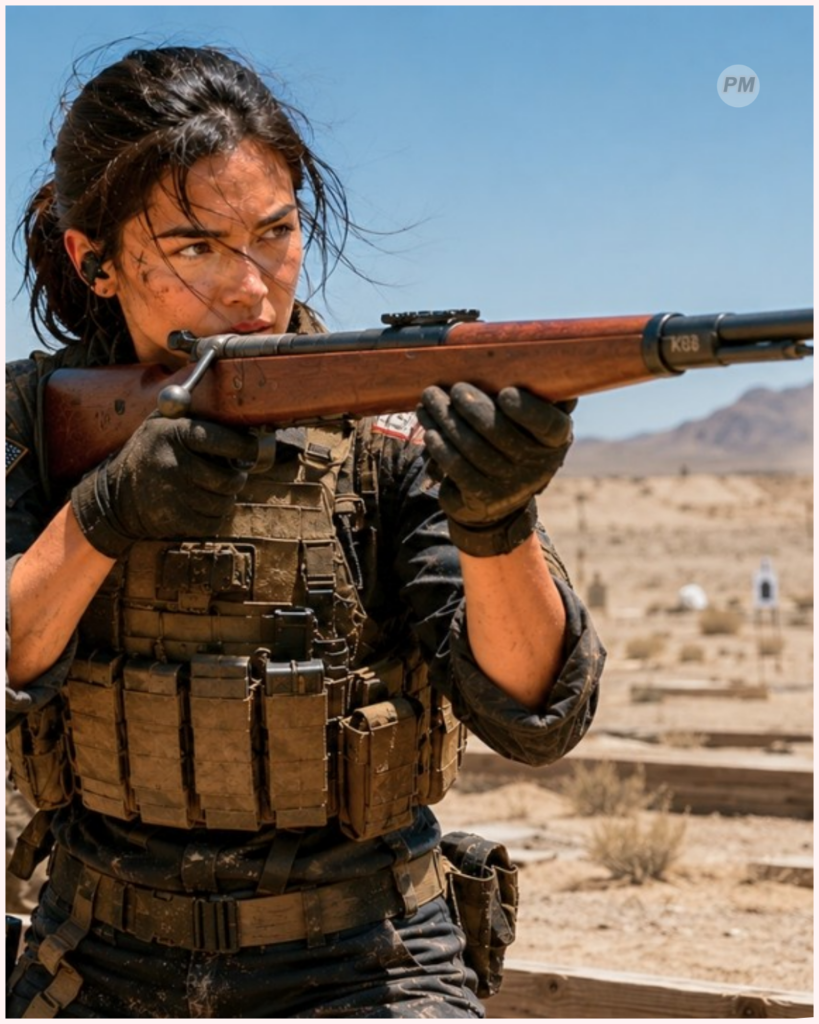
By the end, Chen had scored seven hits out of 10. Respect just her eyes and her training and thousands of hours of practice compressed into instinct.
The first target appeared at 500 yards, moving diagonally across her field of view, northeast to southwest, maybe 8 miles per hour.
Grace’s mind processed variables in microseconds. Distance, 500 yards. Velocity, 8 miles per hour means target moving roughly 12 feet per second.
Time of flight at this distance, approximately 0.7 seconds. Target will travel 8 to 9 feet during flight time.
Lead by approximately 3 feet given the angle. Wind 3 miles per hour from the west, adds maybe 6 inches of drift.
Barrel temperature, cool. First shot, no compensation needed. Her front sight post led the target by what felt right.
What thousands of hours of practice had burned into muscle memory, she squeezed. Hit. The sensor light illuminated green, confirming what she’d felt.
Target two appeared at 900 yards moving perpendicular to her position, west to east, faster now, maybe 12 miles per hour.
Longer distance meant more flight time, more lead required, more wind drift to compensate for, more variables to calculate in the fraction of a second before the target disappeared.
Grace adjusted, her breathing controlled, fired, hit. She moved through the sequence like flowing water.
Each decision happening faster than conscious thought. Each shot feeling correct before the sensor confirmed it.
Target three, 500 yards, moving toward her at an angle, closing distance, lead calculation complicated by the geometry.
Hit. Target four, 700 yards, erratic movement, speed changes. Grace watched for half a second, identified the deceleration pattern, led it appropriately.
Hit. Target five, 600 yards, moving fast, perpendicular, simple calculation. Hit. Six, 800 yards, diagonal.
Hit. Seven, 400 yards, close and fast. Hit. Eight, 1,000 yards, moving slow but maximum distance.
Hit. The ninth target appeared at maximum range, 1,000 yards, moving at maximum speed, 15 miles per hour, appearing from behind cover for only 3 seconds.
This was the nightmare scenario. Maximum distance, maximum speed, minimum time. Grace saw it appear, tracked its movement for 1 second, calculating frantically.
Thousand yards meant approximately 1.5 seconds flight time. Target moving 15 miles per hour meant 22 feet per second.
During flight time, target would travel 33 feet. Lead required was massive. She aimed what felt like a full body length ahead of the silhouette.
Fired. The sensor remained dark. Miss. She’d led too far. Anticipated acceleration that hadn’t happened, overcompensated for the distance.
Grace cleared her mind, refused to dwell on failure. One target remained, one chance to finish strong.
The 10th target appeared at 650 yards, moving erratically. Speed changes designed to fool even computer-assisted calculations, accelerating and decelerating in a pattern that seemed random.
Grace watched for one full second, burning precious time, but identifying the pattern. It wasn’t truly random.
There was rhythm, predictability hidden in apparent chaos. The target accelerated for 2 seconds, decelerated for 1 second, repeated.
She waited for the deceleration phase, led the target accounting for its slowing speed, fired, hit.
“Nine hits, one miss,” the range officer announced, his voice neutral but carrying a note of surprise.
“Captain Thornton ties Lieutenant Chen for day two lead with nine hits each.” The range fell silent.
Tying the competition’s best shooter while using iron sights against computer-controlled moving targets exceeded what anyone had expected.
It was one thing to shoot static targets at known distances. It was entirely different to engage moving targets that required instant calculation and instinctive shooting.
Commander Patterson shot next after Grace. His SR-25 with advanced ballistic computer and tracking optics gave him every advantage.
The computer calculated lead automatically based on target velocity. The scope’s tracking feature allowed him to follow targets smoothly.
He managed nine hits, same as Grace and Chen. Excellent performance that demonstrated why he’d earned his reputation.
Lieutenant Mitchell followed. His expensive rifle with integrated ballistics should have given him an edge, but something was wrong.
His shots were rushed, hurried, like he was trying to prove something instead of just shooting well.
He scored eight hits. Good, professional, but not exceptional. His frustration was visible as he cleared his weapon and left the line.


