Chen had set the bar high
Chen had set the bar high. Proven that perfection was possible under these conditions. Now everyone else would be chasing that standard.
Captain Thornton, you’re up. Grace walked to the firing line. Every eye followed her movement.
She could hear the whispered comments even though the competitors tried to keep them low.
Let’s see what she’s got. Iron sights at 600. This should be interesting. Probably won’t even hit the target.
Give her credit for trying at least. Grace tuned them out. Years of competitions had taught her how to build walls in her mind, creating a space where only she and the target existed.
Where doubt and pressure and expectation couldn’t follow. Where there was only breath and trigger and mathematics.
She set down her shooting mat. The same one her father had used. Worn canvas that had absorbed the sweat and blood of a hundred shooting positions.
Assumed a solid prone position that her body knew better than her own heartbeat. Left leg straight, right leg bent at the knee, supporting hand under the rifle’s fore-stock, shooting hand gripping the pistol grip with just enough pressure to control without tensing.
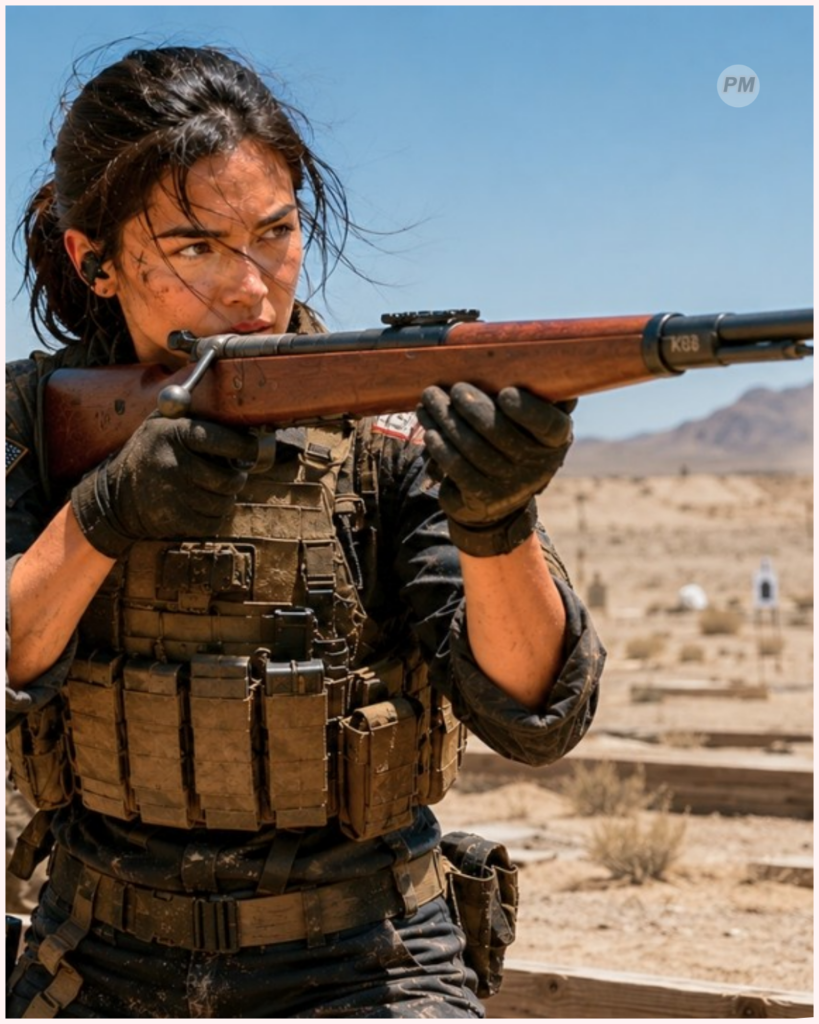
She loaded five rounds into the M14’s magazine. The brass cartridges caught the morning sun as she chambered the first round.
The bolt moved forward with a solid click of mechanical certainty. A sound that had meant readiness for generations of warriors.
600 yards down range, her target waited. A simple silhouette, black against white backing. Without optics, it appeared small, barely larger than her thumbnail from this distance.
A dot on the horizon that she was supposed to hit five times in succession.
But Grace didn’t need to see details. She needed to see fundamentals. She settled her cheek against the wooden stock, feeling its familiar contours.
The slight dip where her father’s cheek had rested for decades. The smooth wear pattern from a lifetime of proper technique.
Through the iron sights, she aligned the front post with the rear aperture, creating that perfect figure eight that her father had drilled into her consciousness until it became involuntary.
The target sat at the top of her front sight post. Exactly where it needed to be.
Floating there like a promise waiting to be kept. Now came the mathematics. The calculations that separated marksmen from shooters.
That turned lead and brass into precision instruments of warfare. Range 600 yards. Wind 3 mph from 280 degrees, quartering from the left.
Call it a quarter minute of angle, maybe a hair more. At 600 yd that meant the bullet would drift approximately 2 in right without compensation.
Elevation, sea level. No significant adjustment needed for altitude. Temperature, 68°. Cool morning, air is dense.
Bullets will fly true with predictable trajectory. Humidity, 45% moderate, negligible effect at this distance, but worth noting.
Her father’s voice echoed in her memory. Not words exactly, more like a feeling. A certainty that transcended language.
The rifle doesn’t think, Grace. You do the thinking. You do the math. The rifle just does what you tell it.
Grace made her adjustments, mental calculations that happened faster than conscious thought. Shifted her point of aim ever so slightly to compensate for the gentle westerly breeze.
Not much, just enough. A fraction of an inch that would become 6 in of correction at target distance.
The difference between center mass and a miss. She controlled her breathing. Let it settle into the rhythm she’d practiced 10,000 times.
Inhale for four heartbeats. Exhale for four heartbeats. Natural pause for two heartbeats. The world narrowed to a single point.
Her finger caressed the trigger. Slowly. Gently. Like touching something precious that might break if handled roughly.
The M-14 roared, recoil sharp but manageable, driving straight back into her shoulder. Honest force that didn’t lie or compensate or make promises it couldn’t keep.
Down range through the iron sights, she couldn’t see where the bullet had struck. But she felt it.
Center mass, perfect. The shot had felt exactly right. That indefinable sensation when every variable aligned.
Grace chambered her second round. Her movements were economical, practiced. She’d learned long ago not to rush between shots.
Each one deserved its own moment. Its own calculation, its own respect. The wind hadn’t changed.
She could feel it on her face. Still 3 mph from the same direction. Temperature steady.
But, she made an infinitesimal adjustment anyway. The rifle’s barrel had warmed slightly from that first shot.
Maybe 5°. Which would affect the bullet’s trajectory by mere centimeters as the expanding metal changed harmonics.
But, at 600 yd, centimeters mattered. They were the difference between perfection and almost. Her second shot broke clean.
That perfect surprise when the trigger breaks at exactly the right moment in exactly the right way.
Third shot. The barrel was warmer now, settling into its rhythm. Grace adjusted her point of aim by a microscopic amount.
Compensating for the harmonics she could feel more than calculate. Fourth shot. Wind had picked up slightly.
Maybe half a mile per hour. She led the target a fraction more. Fifth shot.
Final round. The one that would determine if she’d match Chen’s perfect score or fallen short.
Grace went through her entire process again. Breathing. Wind [clears throat] check. Barrel temperature assessment.
Sight alignment. Trigger press. The rifle fired. Each shot had felt perfect. That indefinable sensation when everything aligned.
Breath and trigger and sight picture and the universe itself seeming to hold still for that fraction of a second when physics and skill and will all converged into a single point of impact.
Grace cleared her weapon, stood, stepped back from the line, her face betrayed nothing, but her heart hammered in her chest.
She’d done everything right, felt every shot land true, but without a spotting scope, she couldn’t see her results.
Couldn’t know if feeling translated to reality. The range officer walked down range with binoculars, examining her target.
The silence stretched. Grace could feel every competitor’s eyes on her back. The weight of their judgement, their skepticism, their certainty that iron sights couldn’t compete with modern technology.
The range officer’s voice crackled over the loudspeaker. Stand by for scoring. Master Chief Reeves walked to the observation post, took the binoculars, looked for himself.
His weathered face remained impassive, but Grace noticed his eyebrows rise slightly. The first crack in his stoic expression she’d seen since arriving.
Reeves lowered the binoculars, keyed his radio. Confirm that score, Petty Officer. A pause, then the response crackled back.
Confirmed, Master Chief. Five 10s. Group measures 3.5 inches. Reeves’ voice boomed across the range with a quality Grace couldn’t quite identify.
Pride, maybe, or vindication, or something deeper that only another warrior could understand. Five 10s.
Perfect score 50. All rounds within a 3.5 inch group. The silence that followed was deafening.
Grace allowed herself the smallest smile. Not because she was surprised. She’d felt every shot land true, but because she could feel the shift in the air around her.
The whispers had stopped. The smirks had vanished. The certainty that she didn’t belong had cracked like ice under pressure.
Lieutenant Commander Patterson was the first to speak. He’d moved closer to the observation post to see her target through the spotting scope.
His expression showed something Grace hadn’t expected. Genuine respect. “That’s a tighter group than mine was.”
Patterson said loud enough for others to hear. “And I was using a scope that cost $8,000 with a computer that does half the thinking for me.”
“Beginner’s luck.” Someone muttered from the back of the group. Grace didn’t see who, didn’t need to.
Patterson turned, his eyes hard. The kind of hardness that came from leading men in combat.
From making life and death decisions in fractions of seconds. From knowing the difference between skill and chance.
“Luck doesn’t put five rounds in 3 and 1/2 inches at 600 yards. Luck is one good shot.
Five perfect shots is skill. That’s discipline. That’s fundamentals mastered to the point where they become unconscious.”
Captain Anderson approached Grace, extended his hand. His grip was firm, honest. The handshake of someone who recognized excellence regardless of who demonstrated it.
“Hell of a shooting, Captain. That was impressive. Truly impressive.” “Thank you, sir.” But not everyone was convinced.
Lieutenant Ryan Mitchell crossed his arms. His expensive rifle slung across his chest like a statement.
Like proof that modern ways were better ways. “One good run doesn’t prove anything. Let’s see if she can keep it up when the challenges get harder.
When the pressure increases.” Grace met his eyes, kept her voice level, professional. Gave him nothing to use against her.
Looking forward to it, Lieutenant. The competition continued through the morning. Patterson shot next after Grace.
His performance was flawless. Five perfect 10s with a 4.2-in group. Excellent shooting by any standard.
Better than 99% of trained marksmen could achieve. But not quite matching Grace’s precision. Mitchell followed.
His AI-assisted ballistic computer calculated every variable. Wind, temperature, barometric pressure, even the rotation of the earth itself and how it affected bullet trajectory over distance.
His rifle was a marvel of engineering. A weapon system that cost taxpayers $50,000 when you included all the electronics.
He shot a perfect 50, but his group measured 5 in. Good, professional, but not extraordinary.
By noon, all 15 competitors had completed their runs. The scoreboard told a story nobody had expected.
First place, Lieutenant David Chen and Captain Grace Thornton. Tied with perfect scores of 50 points.
Grace’s tighter group size gave her the technical edge on the leaderboard. Third place, Lieutenant Commander Daniel Patterson.
49 points with excellent group size. Fourth place, Lieutenant Ryan Mitchell. 50 points, but larger group dispersion than the leaders.
Master Chief Reeves consulted his clipboard. His voice carried across the assembled shooters with the weight of judgment earned through decades of combat.
Current standings after round one. Lieutenant Chen and Captain Thornton tied for first place with perfect scores.
Captain Thornton’s group size of 3.5 in versus Lieutenant Chen’s 4 in gives her the number one position.
Lieutenant Commander Patterson in third with 49 points. Lieutenant Mitchell in fourth. He looked up.
His gaze sweeping across the assembled warriors like a searchlight finding targets. This competition is far from over.
We’ve got four more days and increasingly difficult challenges ahead. Day two starts at 600 tomorrow.
Moving targets at variable distances and speeds. The targets won’t wait for you to calculate.
You’ll have 3 seconds from appearance to impact. Get some rest. Check your equipment. Tomorrow separates the shooters from the snipers.
As the group dispersed toward the mess hall for lunch, Patterson caught up with Grace near the equipment shed.
His expression was thoughtful. Calculating. Like he was trying to solve a puzzle that didn’t fit his expectations.
That was legitimate shooting back there, Captain. Not luck. Not beginner’s advantage. That was mastery.
Just doing what I was trained to do, sir. Your father. You said Hue City, 1968.
Grace nodded. The memory of her father was always close. Always present. Like he was watching from somewhere beyond reach, but never beyond influence.
Colonel James Thornton. First Battalion, 26 Marines. He had over 60 confirmed kills during the Tet Offensive.
The siege of Hue lasted 26 days. He was there for all of them. But he never talked about the number.
He said every shot was a human life. And that weight never leaves you. It shouldn’t leave you.
The day it does, you become something less than human. Patterson’s expression softened. Recognition of something that transcended competition.


