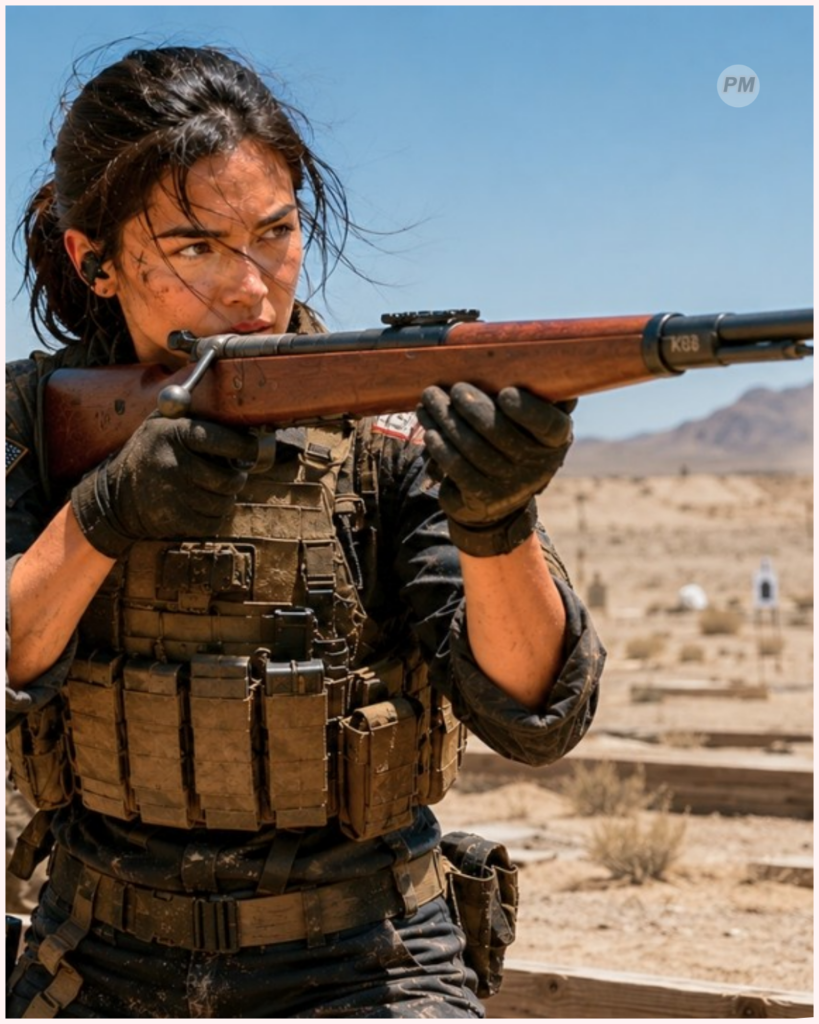
The California sun hammered down on Naval Special…
The California sun hammered down on Naval Special Warfare Command like a physical weight, turning the asphalt into shimmering mirrors of heat.
Captain Grace Thornton stepped out of the government sedan, >> her Marine Corps dress uniform crisp despite the 100° afternoon, ribbons gleaming across her chest.
The expert rifle marksmanship badge caught the light. Three gold wreaths surrounded it, the highest designation the Corps awarded.
She’d earned every one of them. Grace adjusted her cover and shouldered her rifle case.
The worn green canvas was older than she was, older than most of the men watching her from across the parking lot.
Inside that case lay a piece of history, a piece of her father, a piece of a war that had ended before she was born, but had shaped everything she’d become.
Navy SEALs clustered near the equipment shed. Their conversations died as she approached. Some crossed their arms.
Others exchanged glances that said everything their words didn’t. A few didn’t even try to hide their skepticism.
Grace had expected this. She’d been the first woman in every shooting competition she’d ever entered since joining the Marines 7 years ago.
The doubt, the whispered comments, the barely concealed hostility masquerading as concern, it was old news, background noise she’d learned to tune out like static.
But this was different. This wasn’t a local competition or even [clears throat] a Marine Corps championship.
This was the Naval Special Warfare Command Advanced Sniper Competition, an invitation-only event where America’s most elite marksmen gathered to prove who was deadliest, who was best, who deserved to be called a warrior in a world where that word had lost its meaning.
And she was the first woman who’d ever qualified attend. Grace walked toward the main building.
Every step felt deliberate, measured, like walking through water that didn’t want her to pass.
She could feel their eyes tracking her movement, analyzing, judging, waiting for her to fail before she’d even fired a shot.
A voice cut through the tension. “Captain Thornton.” >> [clears throat] >> Grace turned. A mountain of a man approached from the command post.
Master Chief Jack Reeves was a legend in special operations circles. 68 years old, but built like he’d been carved from California granite.
Silver beard trimmed with military precision. Eyes that had seen too much combat in too many places.
The Navy Cross ribbon sat prominently on his khaki uniform alongside a cluster of other decorations that told stories most men couldn’t bear to hear.
Vietnam, multiple tours, Hue City, Khe San, places where young men went to become old or become ghosts.
Grace snapped a salute. Reeves returned it with the casual precision of someone who’d performed the gesture 10,000 times.
“Master Chief.” Reeves studied her face, not the way the others had looked at her.
This was different. He was searching for something, some quality that couldn’t be measured by gender or politics or the bureaucratic mandates that had brought her here.
“Your father and I served together.” The words hit Grace like a physical blow. Her father had never mentioned this man’s name, never talked about specific people from Vietnam beyond generalities.
The war had been something he’d carried in silence, a weight that had shaped him, but never broken him.
“Sir, he never mentioned “The best ones never do.” Reeves’ weathered face remained impassive. Marines taught him to shoot, Vietnam taught him to survive.
[clears throat] What did he teach you? Grace met his eyes, no flinching, no hesitation.
That fundamentals outlast fashion, sir. The corner of Reeves’s mouth twitched. Not quite a smile, something harder, something earned through blood and sacrifice.
We’ll see. He gestured toward the equipment shed. Let’s get you checked in and issued your gear.
Competition starts at 600 tomorrow. You’ll bunk in building three tonight. As they walked, Grace noticed the conversations resuming behind them, hushed but animated.
She caught fragments drifting on the hot California breeze. Political statement. Won’t last a day.
They’re really doing this. The equipment shed was a treasure trove of military hardware. Long tables displayed an impressive array of rifles that represented the cutting edge of American engineering and lethality.
Modern SR-25s with advanced optics packages that could resolve a man’s face at 1,500 yards.
Barrett M82s that could punch through armor at 2,000 yards. Precision instruments that cost more than most people’s cars and embodied decades of research into making killing efficient.
Grace’s pulse quickened despite herself. She trained on standard issue equipment at Quantico. Good rifles, reliable, but this was next-level gear.
The kind of weapons that turned good shooters into legendary ones. All right, people, listen up.
Reeves’s voice boomed across the shed like artillery fire. 15 men turned to face him.
The best snipers from every branch of the military, SEALs, Marine Scout Snipers, Army Rangers, Air Force special operations.
Each one had been selected because they represented excellence in the deadliest form of warfare.
And Grace, the only woman, the only question mark. “We’ve got 15 competitors this year.”
Reeves continued. “Mix of services, mix of experience, but all of you are here for the same reason.
To prove you’re the best marksman in America’s arsenal.” A young SEAL with lieutenant bars stepped forward with a clipboard.
He began calling out names and equipment assignments. His voice was crisp, professional. Each assignment met with satisfied nods from the recipients.
“Lieutenant Commander Patterson, SR-25 with Schmidt & Bender PM II scope.” A lean man with calculating eyes stepped forward.
“Commander Daniel Patterson, call sign Ghost. Four deployments to Afghanistan. 37 confirmed kills, according to the whispered stories that followed him.
He accepted the rifle like it was an extension of his own body, something he’d been born knowing how to use.
Captain Anderson, Barrett M82A1 with Leupold Mark 5HD. Staff Sergeant Chen, M40A6 with Nightforce ATACR.”
The list continued. Each competitor received weapons that matched their skills. Tools that would give them every advantage that American technology and taxpayer money could provide.
“Lieutenant Mitchell, custom SR-25 with integrated ballistic computer and thermal optics package.” A SEAL in his early 30s stepped forward with barely concealed satisfaction.
“Lieutenant Ryan Mitchell, rising star in Naval Special Warfare. He’d made no secret of his opinion that this competition should remain what it had always been.
A proving ground for warriors, not a stage for political theater. Mitchell examined his rifle with the reverence of a craftsman receiving a master work.
The optics package alone cost $15,000. It calculated windage automatically, compensated for temperature and humidity, measured range with laser precision, even accounted for the Coriolis effect, the rotation of the earth itself affecting bullet trajectory.
“Like having a PhD in every shot.” Mitchell said to the SEAL beside him, loud enough for everyone to hear, loud enough to make his point clear.
Grace kept her face neutral, showed nothing. Her father had taught her that reaction was weakness.
Emotion was ammunition you handed to your enemy. “Captain Thornton.” Grace [clears throat] stepped forward.
Every eye in the ship turned toward her. The moment stretched. Reeves reached beneath the table and pulled out a battered green case that looked like it had survived a war, because it had.
The metal clasps were tarnished with age and exposure. The canvas covering was frayed and stained with decades of use and abuse, and the honest wear that came from being trusted in places where trust meant survival.
Reeves set it on the table with a heavy thunk that echoed in the sudden silence.
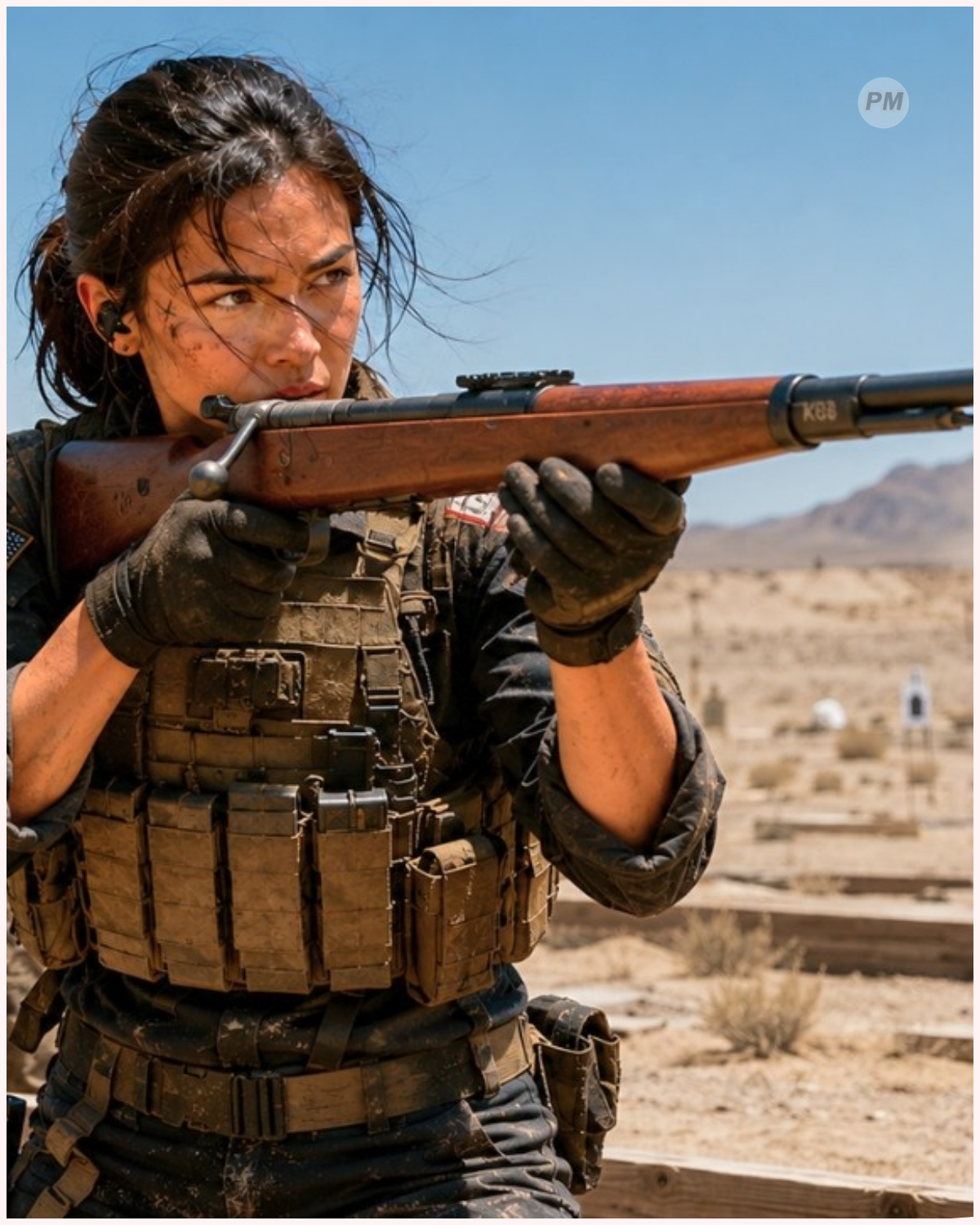
“Your rifle, Captain.” Grace opened the case slowly. Inside, nestled in deteriorating foam that had lost its cushioning decades ago, lay an M-14 battle rifle, Vietnam era.
The woodstock was scratched and worn smooth by countless hands. The barrel showed honest use, character earned through combat and maintained through care.
And mounted on top was a scope that had clearly seen better days. Better decades.
The mounting bracket was bent at an angle that made it useless. Through the glass, Grace could see the reticle was completely misaligned, twisted almost 45°.
Shattered internal mechanisms visible through cracks in the housing. The shed fell absolutely silent. Grace ran her fingers along the rifle’s receiver.
She knew this weapon. Had cleaned it. Had fired it. Had learned the fundamentals of marksmanship with it in the mountains of Montana, where her father had taught her that being a warrior wasn’t about equipment.
It was about will. It was about discipline. It was about mastering fundamentals that didn’t change regardless of technology or fashion or time.
This was her father’s rifle. The one he’d carried through Hue City in February 1968.
The one he’d used to save 37 Marines during the bloodiest urban combat of the Vietnam War.
The one he’d brought home and maintained with the same care he’d given it in combat.
The same ritual cleaning, the same inspection, the same respect for a tool that had kept him alive when everything else had failed.
But the scope was completely unusable. Anyone could see that. The mounting screws were stripped.
The internal mechanism was damaged beyond any field repair. This scope would never function properly again.
Is there a problem, Captain? Reeve’s voice was neutral. But his eyes were challenging her.
Testing her. Every person in that shed was watching, waiting, expecting her to complain, to demand equal equipment, to prove she needed special treatment.
Grace examined the scope more closely. The mounting screws that weren’t stripped turned easily in her fingers.
She removed the damaged optic and set it aside carefully, with reverence, because even broken, it represented her father’s service.
Beneath the scope mount, she found what she was looking for. The rifle’s original iron sights, simple, reliable, no batteries, no glass, no technology to fail, just steel and skill, and the fundamentals that had kept warriors alive for centuries.
She worked the action to ensure it functioned smoothly. The bolt moved with well-worn ease.
A weapon that had been maintained by someone who understood that a rifle was more than metal and wood.
It was a trust, a responsibility, a tool that deserved respect. She checked the barrel, clean, properly maintained.
Someone had cared for this rifle, even if they’d given it to her as a test.
Grace looked up at Master Chief Reeves, met his eyes with absolute certainty. No problem, Master Chief.
If it was good enough for my father at Hue, it’s good enough for me here.
She chambered an empty round, tested the feel, the weight, the balance of a weapon that had proven itself when everything else had failed.
Iron sights will do just fine. The shed erupted, not in approval, in disbelief. Murmurs rippled through the assembled competitors like shockwaves from an explosion.
Iron sights at 600 yd? Against our optics? This isn’t 1968. Lieutenant Mitchell actually laughed, a short bark of sound that carried more derision than humor.
You’re going to shoot iron sights against AI-assisted ballistic computers? Ma’am, with all due respect, that’s suicide.
You won’t make it past day one. >> [clears throat] >> Commander Patterson studied her with renewed interest.
Unlike the others, he wasn’t smiling. He wasn’t mocking. He was evaluating, calculating, trying to understand if she was brave or foolish or something else entirely.
Master Chief Reeves raised his hand. The shed fell silent immediately. The kind of silence that only came from absolute authority earned through decades of leading men in combat, through making decisions that sent warriors into hell and brought them back alive.
“Gentlemen, Captain Thornton.” His voice carried weight, history, truth that couldn’t be argued with. “We’ve spent millions of dollars on technology that makes you better shooters, computers that calculate what you used to have to learn, optics that see what you used to have to feel, electronics that compensate for what you used to have to master.”
He paused, let the words sink in like water into dry ground. “But when that technology fails, and it will fail, what’s left?
The warrior or the machine?” His eyes swept across the assembled shooters, lingered on Mitchell, on Patterson, on the others who carried weapons that cost more than some people earned in a year.
Then he looked at Grace. “Some of us believe the warrior makes the weapon deadly.
Others think it’s the other way around.” He picked up her father’s M-14, held it like it weighed nothing, like it was sacred.
“This rifle fought at Hue City in 1968, saved American lives when everything else had failed.
Technology broke, radios died, modern weapons jammed, but this rifle kept working. This rifle kept killing America’s enemies.


