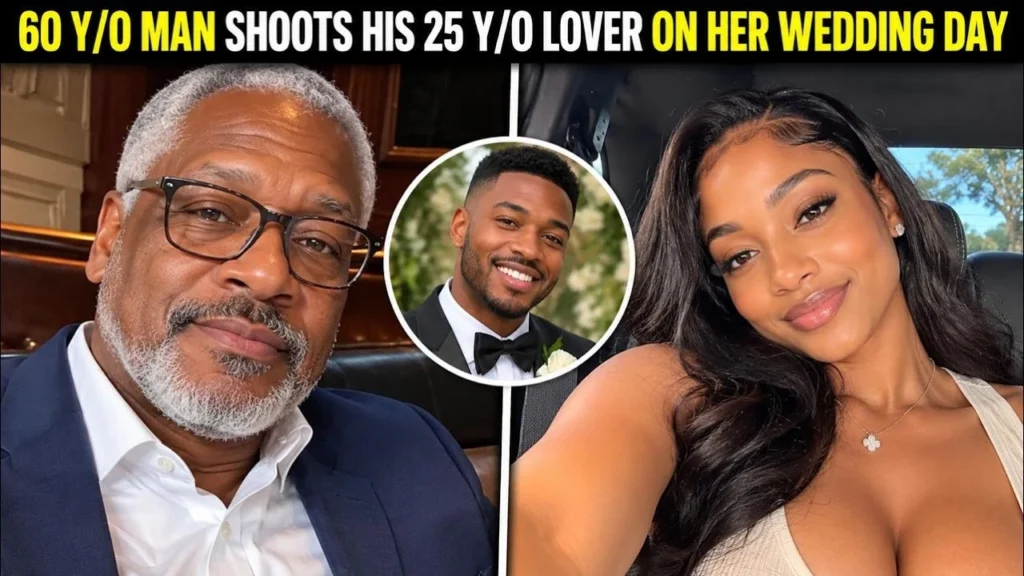
She was marrying Omari
She was marrying Omari.
That should have been the end.
Instead, Wendell continued contacting her.
He sent photographs of places they had visited together, restaurants, weekend trips, a hotel in Houston where they had celebrated his birthday, a photograph of Zariah sitting beside him at a private dinner, smiling at something outside the camera.
Wendell attached messages reminding her of everything they had shared.
He told Zariah that she could not simply erase almost 2 years of their lives.
Zariah responded only twice.
The first time she apologized for misleading him.
The second time she told him to stop contacting her.
Wendell did not stop.
He began calling from unfamiliar numbers.
He left messages asking for another conversation.
He drove past her apartment twice.
Although Zariah did not know about either visit until investigators recovered surveillance footage.
And 4 days before the wedding, Wendell transferred another $6,000 into Zariah’s bank account.
That payment confused investigators more than almost anything else because by then Wendell knew the truth.
He knew Zariah was marrying Omari Whitfield.
He knew she had been using his money to finance the ceremony and he knew she had rejected his requests to cancel it.
Yet, he sent her more money.
Detective Karen Baptiste would eventually discover that the payment was not another wedding contribution.
It was connected to one final agreement Wendell believed he had made with Zariah.
According to messages recovered from his phone, Wendell had offered to forgive the money she owed if she agreed to meet him privately before the wedding.
Zariah initially refused.
Wendell continued asking.
Eventually, she agreed to speak with him one last time.
They met in the parking area of a restaurant in North Dallas two evenings before the ceremony.
The meeting lasted approximately 40 minutes.
Investigators later recovered security footage showing Wendell’s vehicle arriving first.
Zariah arrived 11 minutes later.
She remained inside Wendle’s vehicle for most of the conversation.
The camera did not record audio and neither person recorded the meeting.
What happened inside that vehicle had to be reconstructed from the messages they exchanged afterward.
Wendell asked Zariah to leave Omari.
He offered to pay off her remaining debts.
He promised to finalize his divorce.
He told her they could move away from Dallas and start again somewhere nobody knew about their relationship.
Zariah refused.
She told Wendell that she loved Omari and intended to marry him.
Then Wendell asked whether she had ever genuinely loved him.
That question would become one of the most significant parts of the investigation.
Because Zariah’s answer was not what Wendell wanted to hear.
She admitted that she had cared about him.
She admitted that he had helped her during a difficult period.
But she also told him that the relationship had become something she no longer wanted.
Wendell reminded her of the car, the apartment, the money, and the wedding expenses.
Zariah said she understood.
She promised to repay what she could, but she would not cancel the wedding.
The conversation ended without an agreement.
Zariah left first.
Wendell remained in the parking area for another 23 minutes.
Later that evening, he sent her a message.
He said she had humiliated him.
Zariah replied that she was sorry.
Wendell told her that an apology would not return what he had lost.
Then he sent the message prosecutors would eventually present to the jury.
You don’t get to take everything from me and walk away smiling.
Zariah did not respond.
Instead, she blocked his number.
That was the final direct communication between them.
Or at least that was what investigators initially believed because Wendell Pritchette had one more way to reach her and he used it on the morning of the wedding.
The ceremony was scheduled for 4:00 in the afternoon.
Zariah arrived at the venue shortly before 11.
Her mother, Bernice Bellamy, arrived with her.
Tama Ransom was already there.
The bridal suite was on the second floor of the building, separated from the main ceremony hall by a corridor and a private staircase.
The room had large windows overlooking the garden.
There were mirrors along one wall, flowers on a table, and several garment bags hanging near the entrance.
Zariah’s wedding dress was the most expensive item of clothing she had ever owned.
It was ivory, fitted through the waist with delicate detailing around the shoulders.
Bernice helped her into it.
Tamika adjusted the veil.
The photographer took pictures.
For most of the morning, nothing seemed unusual.
Zariah laughed with her bridesmaids.
She called Omari once, but he refused to answer because they had agreed not to speak before the ceremony.
She ate a little breakfast.
She checked her makeup, and she repeatedly looked at her phone.
Tama noticed.
She asked whether Wendell was still contacting her.
Zariah said no.
Tamika asked whether she had told Omari the truth about the older man.
Zariah said she would explain everything after the wedding.
Tamika did not like that answer.
She told Zariah that marriage was not the place to begin with a secret.
Zariah agreed, but she said she could not deal with another confrontation that day.
She wanted to get married.
She wanted the relationship with Wendell behind her, and she wanted to begin a different life.
At approximately 1:30 that afternoon, Zariah received a message from an unfamiliar number.
It contained no greeting, no explanation, just a photograph.
The photograph showed the front entrance of the wedding venue.
Underneath it were four words.
I know you’re here.
Zariah recognized the number was unfamiliar, but she believed the message came from Wendell.
She showed it to Tamika.
Tamika immediately suggested contacting security.
Zariah refused.
She said Wendell was probably trying to frighten her.
She believed he would eventually leave and she did not want Omari learning about the relationship in the middle of their wedding preparations.
That decision would haunt Tamika afterward because she had seen the warning.
She had understood that something was wrong and she had allowed Zariah to convince her that the situation was under control.
At approximately 2:15, Wendell Pritchett’s vehicle entered the parking area.
He parked away from the main entrance.
Security footage showed him sitting inside the vehicle for more than an hour.
At one point, he stepped outside and looked toward the building.
Then he returned to the driver’s seat.
He made two phone calls.
Neither was answered.
He sent one final message to Zariah.
I paid for this day, too.
There was no response.
At 3:40, the ceremony began.
Guests were seated in rows facing the front of the hall.
Omari Whitfield stood beside the officient.
He wore a black tuxedo, white shirt, and black bow tie.
He was nervous, not because he suspected anything was wrong, because he was about to marry the woman he loved.
Omari had spent weeks preparing for that moment.
He had written his vows three different times.
He had asked his older brother to review them, and he had carried the folded paper in his jacket pocket all afternoon.
The music began.
Guests stood.
Zariah entered the hall with Bernice beside her.
For several seconds, Omari could not stop smiling.
Then he noticed Zariah looking toward the side entrance.
Her expression changed.
A man had entered through the doorway, older, silver-haired, wearing a navy blue suit, Wendel Pritchette.
At first, Omari assumed the man was a late guest, but Zariah stopped walking.
Bernice looked at her daughter, and Wendell called Zariah’s name.
The music continued for another few seconds before somebody stopped it.
Wendell walked toward the front.
He asked Zariah why she had done this to him.
Nobody understood the question.
Omari stepped forward.
He asked Wendell who he was.
Wendell looked at Omari.
Then he looked back at Zariah and according to several witnesses, he told her that she had promised him this wedding.
Zariah asked Wendell to leave.
He refused.
Omari moved closer.
Wendell reached inside his jacket and the first shot was fired.
The sound was so sudden that several guests initially believed something had fallen.
Then Zariah collapsed.
People screamed, chairs overturned.
Omari rushed toward her.
A second shot was fired.
Wendell remained standing near the front of the hall.
He did not attempt to chase Omari.
He did not fire at the guests running toward the exits and he did not immediately leave.
Instead, he stood looking towards Zariah.
A guest called 911.
Another helped move people away from the front of the room.
Omari knelt beside Zariah, trying to keep her conscious.
The white fabric of her dress was becoming stained.
Bernice was screaming for somebody to help her daughter.
Tamika stood near the aisle, unable to understand what had just happened.
Police arrived within minutes.
Wendell was arrested at the venue.
Zariah was transported to a hospital.
Doctors attempted emergency treatment, but her injuries were too severe.
Zariah Bellamy was pronounced dead that afternoon.
She was 25 years old.
Her wedding ceremony had never been completed, and Omari Whitfield, who had arrived expecting to become a husband, left the hospital carrying the vows he had never been able to read.
The investigation began with what appeared to be a straightforward act of jealousy.
An older man had discovered that his younger lover was marrying somebody else.
He had confronted her and he had shot her during the ceremony, but Detective Karine Baptiste quickly realized that the financial evidence made the case more complicated.
Wendell had not simply been surprised by the wedding.
He had helped pay for it and he had continued sending money after discovering the groom was another man.
Detective Baptiste began reconstructing the relationship from the beginning.
She interviewed Tama Ransom.
She spoke with Bernice Bellamy.
She questioned Darnell Pritchette.
and she obtained financial records covering nearly two years.
Those records showed that Wendell had transferred substantial amounts of money to Zariah.
Some payments covered ordinary expenses.
Others were connected to the wedding.
The largest single transfer was $18,500, but there were additional payments to vendors, including the florist, catering company, and photographer.
Wendell had been financing a ceremony he believed was connected to his own future.
The evidence also showed that Zariah had deliberately concealed Omari’s identity from him.
That was a painful discovery for Omari.
He had known Zariah was receiving occasional financial assistance from an older businessman, but he believed the man was a former professional contact.
He had no idea the relationship was romantic, and he had never imagined that some of the wedding expenses were being paid by somebody who believed he was supposed to be the groom.
During his interview, Omari repeatedly asked the same question.
Why hadn’t Zariah told him? Detective Baptiste could not answer.
The investigation could establish what Zariah had done.
It could recover messages.
It could trace payments, but it could not fully explain what Zariah had been thinking.
That uncertainty would remain with Omari long after the case ended.
Then investigators searched Wendell’s house and what they found inside a guest bedroom changed their understanding of the final weeks.
Hanging inside a wardrobe was a cream colored wedding dress.
It was not the dress Zariah had worn at the ceremony.
It was another gown still inside its protective garment bag.
Beside it was a velvet jewelry box containing a diamond ring.
On a nearby table were printed documents from a private wedding venue.
The reservation had not been finalized, but the names were clearly written.
Wendell Pritchette, Zariah Bellamy.
Wendell had been preparing for a ceremony of his own even after learning that Zariah was engaged to Omari, even after confronting her, even after being told she would not marry him.
He had kept the dress.
He had kept the ring.
And he had continued holding on to the possibility that Zariah would change her mind.
Detective Baptiste initially believed this was the final revelation, but there was one more piece of evidence.
It came from Wendell’s phone.
Investigators recovered a photograph Darnell had sent his father 3 weeks before the wedding.
The original image showed Zariah standing beside Omari.
Both were smiling.
Underneath the photograph was the wedding announcement.
Wendell had saved a second version.
In that version, Omari had been cropped out.
Only Zariah remained.
That photograph became a disturbing symbol of the way Wendell had approached the relationship.
He knew Omari existed.
He knew Zariah had chosen him, but he continued imagining a future in which Omari was simply absent.
The prosecution would later argue that Wendell had not acted because he suddenly discovered the truth.
He had known the truth for weeks.
He had time to accept it.
He had time to seek help.
He had time to walk away.
Instead, he arrived at the ceremony with a gun, and he directed his violence at Zariah.
That distinction mattered because Wendell’s attorneys attempted to present him as a man who had been emotionally manipulated and financially exploited.
They argued that Zariah had deliberately encouraged his expectations of marriage while using his money to finance another relationship.
They pointed to the bank transfers.
They pointed to the wedding invoices.
and they pointed to the messages in which Zariah had promised Wendell a future together.
But the prosecution did not need to prove that Zariah had behaved honestly.
The question before the jury was whether Wendell had intentionally killed her.
And the evidence was overwhelming.
He knew the wedding date.
He knew the location.
He had arrived early.
He had waited outside.
And he had entered the ceremony carrying a loaded handgun.
The prosecution presented security footage showing Wendell’s arrival.
They presented the messages exchanged before the wedding.
They presented testimony from Darnell Pritchette confirming that Wendell had discovered the engagement weeks earlier.
And they presented the photograph Wendell had edited to remove Omari.
During the trial, Wendell remained largely expressionless.
He listened as witnesses described the shooting.
He listened as Omari explained how he had tried to help Zariah.
And he listened as Bernice Bellamy described seeing her daughter collapse in the wedding dress she had helped her put on that morning.
When Wendell was given an opportunity to speak, he maintained that Zariah had deceived him.
He said he had believed they were going to be married.
He said he had spent money because he loved her.
And he said the discovery of her engagement had devastated him.
But none of those statements changed the central fact.
Zariah had the right to end their relationship.
She had the right to marry somebody else.
And no amount of money gave Wendell ownership over her future.
The jury convicted Wendell Pritchette of murder.
He received a life sentence.
For Bernice Bellamy, the conviction brought a measure of accountability, but it did not return her daughter.
Bernice had spent the morning of the wedding helping Zariah prepare for what should have been one of the happiest days of her life.
She had fastened the dress.
She had adjusted the veil.
She had told her daughter how beautiful she looked.
And only hours later, she was sitting in a hospital waiting room being told that Zariah was dead.
Tama Ransom struggled with a different kind of grief.
She had known about both relationships.
She had warned Zariah that the situation could not continue.
And she had seen the message Wendell sent on the wedding morning.
For a long time, Tamika questioned whether contacting security might have changed what happened.
But the responsibility for the shooting belonged to the man who brought the gun, not the friend who failed to predict what he would do.
Omari Whitfield eventually moved out of the apartment he had prepared for married life.
Some of Zariah’s belongings remained there for months.
Her shoes, her clothes, a small collection of photographs, and the wedding invitation they had chosen together.
Omari kept the invitation.
He also kept the vows he had written.
[clears throat] He never read them aloud and he never returned to the wedding venue.
The financial discoveries complicated his memories of Zariah.
He learned things about her life that he had never known.
He learned about the money.
He learned about the promises.
He learned about the relationship she had continued while planning their marriage.
But he also knew that none of those secrets justified what happened.
Zariah had made decisions that hurt people.
She had concealed important truths.
She had accepted money under false pretenses.
and she had allowed two men to believe they were building separate futures with her.
Those decisions were part of the story, but they were not a death sentence.
And that is what made the final discovery inside Wendell’s phone so revealing.
The photograph with Omari cropped out was not evidence that Wendell did not know the truth.
It was evidence that he knew and refused to accept it.
He had seen the wedding announcement.
He had confronted Zariah.
He had been told the relationship was over.
Yet he continued acting as though the future he imagined was still possible.
Wendell Pritchette was not a man who discovered his lover’s betrayal at the altar.
He was a man who had known about it for weeks.
He had paid for the wedding.
He had tried to stop it.
And when Zariah refused to abandon the man she had chosen, Wendell decided she would not have that future.
Zariah Bellamy was 25 years old.
She had spent months preparing for her wedding.
The dress was ready.
The guests had arrived.
The groom was waiting and the man who had secretly financed the ceremony walked into the room and ended her life before she could say her vows.
Bernice eventually chose one photograph from the wedding morning to display in her living room.
It showed Zariah standing beside a window holding her bouquet.
Her dress was perfect, her hair was finished, and she was smiling.
The photograph had been taken less than an hour before the shooting.
Bernice kept it because it showed her daughter as she wanted to remember her alive, happy, and looking forward to a future she never got to have.
If this story stayed with you, subscribe to the channel for more true crime stories about hidden relationships, betrayal, and the investigations that reveal what happened behind closed doors.
Hit the like button and tell us in the comments where you’re watching from.
We read your comments, and your support helps the channel grow.
Thank you for watching.


