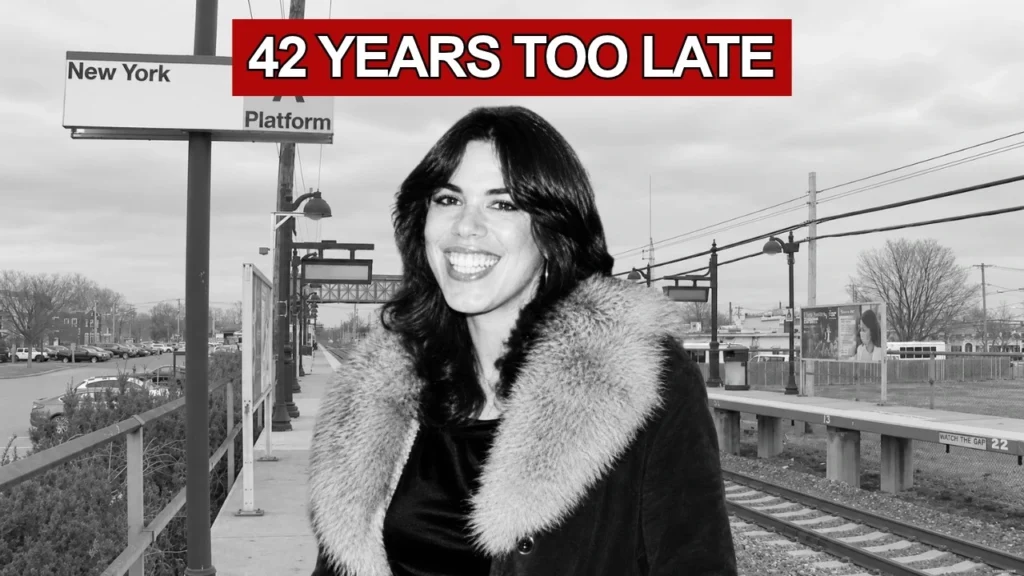
On a Friday night in March of 1980, a 20-year-old secretary went to dinner and a movie in Manhattan with a friend from work.
Afterward, they went back to his apartment and she fell asleep while she waited for the last train home.
He woke her in time to catch it.
It was the kind of night that doesn’t feel like it will ever matter.
A Friday, a movie, a commute she had made over and over.
Her friend took her to Penn Station.
At 12:39 in the morning, her train pulled out bound for Bay Shore, Long Island.
The ride took about an hour.
After that, there was a 10-minute walk to her apartment.
She never got to her door.
Three days later, she was found on a front lawn a few minutes from the station where she had stepped off.
The years went by, one decade and then another, and for 42 years there was no name and no answer.
This is the story of Eve Helene Wilkowitz.
42 years is a long time to wait for an answer.
Eve is not just a case file.
If you agree, like this video and subscribe and help more people know her name now.
Let’s [snorts] go back to that night.
In the spring of 1980, Eve was 20 years old and already building towards the life she wanted.
She had recently started work as a secretary at Macmillan Publishing in Manhattan.
Her younger sister Irene has called it her dream job.
Eve lived in Bay Shore on Long Island’s South Shore in an apartment she shared with her boyfriend, according to the district attorney.
Every working day, she rode the Long Island Railroad into the city and back out again.
On Friday, March 21st, she was in Manhattan with Jack Dempsey, a young writer she knew through work.
What we know of that evening comes from his own written account and not from an official record.
By the time her train left, it was the early hours of Saturday, March 22nd.
Dempsey also writes that he offered to ride with her and that Eve said no.
She told him she would take a taxi from the Bay Shore station rather than walk.
That detail comes only from him, but if it’s true, it tells us that Eve was already thinking about the walk.
Bayshore sits on Long Island South Shore, about 42 miles from Manhattan along the edge of the Great South Bay.
It is one of the older communities on Long Island.
For generations, it was a place New Yorkers came to get away from the city.
[snorts] The Long Island Railroad brought them out to the shops and resorts and ferries carried them across the bay to Fire Island.
After the Second World War, new housing spread across what had been farmland and the population grew.
The station has long served two kinds of travelers, commuters heading into the city and vacationers heading out to the beaches.
By the time Eve was living there, Bayshore was also going through a harder stretch.
Local histories describe a decline that began in the late 1970s with many of the storefronts along Main Street left empty.
Efforts to restore the downtown wouldn’t start until the 1980s.
That was the setting around Eve’s walk.
The station, then residential streets of houses with front lawns from the station to her apartment was a 10-minute walk, one she routinely made at night.
According to people close to her, it was a walk she felt uneasy about.
They’ve said she had mentioned men following her on the way home and that one man had asked her out more than once, even after she said no.
When Eve didn’t come home, her live-in boyfriend reported her missing that same day, according to the district attorney.
And then came silence.
No phone calls, no one stepping forward to say they had seen a young woman on those streets after the last train.
To this day, no eyewitness has been publicly identified who saw what happened to Eve once she reached Bayshore.
Eve’s family was waiting for news.
Her younger sister Irene was 17.
On Tuesday, March 25th, 1980, Eve was found.
She was on the lawn of a house at 26 Center Avenue, reportedly spotted by a neighbor that morning.
It close to the station and close to the route she took home.
Her coat, her shoes, and her pocketbook were missing.
Investigators treated her death as a homicide.
They also collected samples from Eve that contained biological material that did not belong to her.
Detectives told the family that Eve may have been held for about three days before she died.
Irene repeated that in an interview in 2016.
But officials have never publicly established where Eve was taken or exactly how long she was held.
That’s one of the pieces we simply don’t have.
The lawn at 26 Center Avenue was only blocks from the Bayshore train station in the same neighborhood where Eve lived.
Suffolk County Police treated Eve’s death as a homicide and the investigation started with a problem.
Eve’s last confirmed sighting was at Penn Station in Manhattan.
After that, no one had come forward to say they saw her in Bayshore.
That left the neighborhood itself.
So detectives went door to door.
According to later reporting, they canvassed dozens of streets and interviewed hundreds of people.
The FBI helped with the original investigation.
The goal of a canvas is simple.
Find someone who saw or heard something.
They also looked at the people closest to Eve.
Jack Dempsey has written that he was one of them.
He says that as the last person known to have seen her, he was treated as a suspect at first.
He recalls taking a polygraph and years later giving a DNA sample that excluded him.
That is his own account and I couldn’t confirm it in an official source.
Nothing in the public record ties him to the crime.
Some pieces of that night were never explained.
Eve’s coat, her shoes, and her pocketbook were missing when she was found and the public record doesn’t say whether detectives ever located them.
Nobody had a name.
One of the doors the detectives knocked on belonged to a woman on Center Avenue.
She told them she hadn’t noticed anything.
Her answer went into the file as one routine interview among hundreds.
Nobody had a reason to look at it twice, not for 42 years.
In 1980, the biological material collected from Eve couldn’t be used to identify anyone.
DNA profiling didn’t exist yet, but someone kept it.
In May of 2000, 20 years after Eve was found, the Suffolk County police homicide squad sent the swabs back to the lab.
A new method called STR testing could examine specific stretches of DNA that vary from person to person.
By July of 2000, the Suffolk County crime laboratory had a result.
From the evidence, the lab developed a DNA profile of an unknown man.
For the first time, there was a genetic record of the person responsible.
Investigators entered it into CODIS, the national database of DNA from people convicted or arrested for certain crimes.
No match.
The next part of this story explains how cases like Eve’s are being solved today.
If you want to see how, like and subscribe.
A DNA profile only gives you a name if there’s someone in a database to match it to.
CODIS only holds profiles from people who were required to give a sample.
A man who never was might as well not exist as far as the database is concerned.
Years went by.
In about 2019, a detective named Jeffrey Botari was assigned to Eve’s case.
He asked the crime lab for a Y-STR analysis.
The Y chromosome passes from father to son, so a close male relative in the criminal database might show a partial link.
It’s called a familial search.
The lab produced a full Y-STR profile, and Detective Botari sent it to the New York State Division of Criminal Justice Services.
It produced no leads.
Every standard tool had now been tried.
The answer was inside the evidence, and the police couldn’t reach it.
While detectives waited, Irene did not.
She grew up.
She went to college and worked.
She got married and raised two children.
When she had a son, she named him Evan after Eve.
Their father Alfred died in 2010.
He never learned who was responsible for his daughter’s death.
After that, Irene was the last person in the family who could speak for Eve, and she did.
On every anniversary, she gave interviews to local news to keep Long Island from forgetting.
She emailed detectives for updates every few weeks.
She has told reporters what she wants people to know.
Eve wasn’t famous.
She was Irene’s sister, and she mattered.
She was outgoing and had lots of friends.
She loved horses.
She loved music.
She liked to read, to write, and to draw.
And mostly, Irene says, Eve liked being a big sister.
Irene lived with a fear that never left.
She has said she spent 42 years afraid that the person responsible would come for her.
She has said that her goal was to be a mom, and that beyond that, she didn’t allow herself to dream.
In 2018, Evan told his mother about something that had just happened in California.
Police had identified the Golden State Killer using a technique called investigative genetic genealogy.
Everyone shares DNA with their relatives, and the closer the relationship, the more they share.
Even distant cousins carry a few matching pieces.
Public genealogy databases hold the results of people who took ancestry tests and chose to share them so they could find those relatives.
Investigators use that overlap in reverse.
They take the unknown DNA from a crime scene and look for anyone in the database who matches part of it.
Those matches aren’t the person responsible.
They are his relatives, and they may never have heard of him.
From there, the work is done by genealogist.
They take each match, build out the family with public records, and follow the branches until they meet at a handful of possible people.
It doesn’t need the person to have a criminal record.
It only needs a relative who took a test.
In January of 2019, Irene contacted CeCe Moore, one of the best-known genetic genealogists in the country.
Moore couldn’t take the case.
In New York, a private lab needed a permit from the State Department of Health to do this kind of work, and no lab had one.
Irene pressed Lieutenant Kevin Bearer, the homicide investigator who oversaw Eve’s case.
He was frustrated, too.
Then, in December of 2019, Suffolk County found a way.
They asked the Department of Health for permission to send the DNA to the FBI, which had helped with the original investigation in 1980 and wasn’t bound by the state’s permit rule.
The state agreed.
The FBI agreed.
And 40 years after Eve was found, the genealogy work began.
FBI agent Lori Giordano specialized in this kind of analysis.
With the Suffolk County Crime Laboratory, she built a new kind of DNA profile from the evidence.
The older STR profile checks a limited set of markers.
This one was a SNP profile.
SNPs are tiny variations at individual spots in your DNA, and SNP profile can be compared with public genealogy databases to find relatives, even distant ones.
Months passed.
In July of 2021, agent Giordano called the Suffolk County detectives.
She had found a distant relative of the unknown man, and along with that match, a family name, Rice.
The detectives traced the family tree to one man, Herbert Rice.
In March of 1980, Herbert was 29.
He lived on Center Avenue in Bay Shore, four houses from where Eve was found and within walking distance of the train station.
He had died of cancer in 1991.
He was buried on October 18th of that year at Oakwood Cemetery in Bay Shore.
Here’s what the detectives learned.
In 1980, Herbert had been staying with his mother.
According to detectives, his wife had recently kicked him of the home they shared.
His mother was the woman on Center Avenue who had told detectives she hadn’t noticed anything.
Her name was right there in the file.
Herbert himself had never come up.
He had a short record of arrest for minor nonviolent offenses, which did not require him to give a DNA sample.
That is why his profile was never in CODIS.
District Attorney Raymond Tierney later said that Rice often hung around the Bayshore Station drinking and called the murder a crime of opportunity.
That’s the prosecutor’s assessment, and I want to be clear about its limits.
The public record doesn’t establish that Herbert planned this, followed Eve, or knew her.
It doesn’t tell us where the attack happened.
And nothing in the public record connects him to the men Eve had described following her.
Those men have never been named.
Prosecutors have said they don’t believe he was responsible for any other murder.
At this stage, the detectives had a family name and a theory.
They needed proof.
Herbert Rice had two sons.
According to Detective Battari, neither of them knew what their father had done.
Detectives first tried to get a DNA sample from one of the sons without his knowledge.
It didn’t work.
So Detective Battari did something simpler.
He knocked on the man’s door and told him the truth.
The son said he hadn’t been close to his father and he agreed to a cheek swab.
In late August of 2021, the Suffolk County Crime Laboratory compared his DNA with the unknown profile.
It showed that the DNA from Eve’s case belonged to a biological relative of the son.
That relative was his father.
The son and his mother filled in more of the story, including that Herbert had been kicked out of their house around the time of the murder and had moved in with his mother.
And according to police, the son said he wished he could apologize to Eve’s family.
He had done nothing wrong, but that was what he wanted to say.
On December 6th, 2021, Detective Battari and a sergeant from the homicide unit drove to Rhode Island.
Irene was her kitchen.
She had braced herself, thinking they had come to tell her the case had hit a dead end.
She introduced them to Evan.
They made small talk.
Detective Batara used FaceTime to bring the FBI agent into the call.
Then he said it, we identified the person responsible for the death of your sister Eve.
Irene’s legs began to shake.
She hugged Evan.
She cried, she said, because she never thought she would hear those words.
After the detectives left, she leaned on the kitchen counter and cried.
Then she called Lieutenant Bearer to thank him.
She has said she feels sorry for Herbert’s family who now have to live with it too, but the answer didn’t undo the years.
Irene has said there are questions she can never ask.
Why did he do it? Why did he pick a woman who was just walking home? There is no one left to answer them.
The son’s DNA was strong evidence, but investigators wanted to be certain before saying anything publicly.
They wanted DNA from Herbert Rice himself.
Detective Batara asked the district attorney’s office for a warrant to search Herbert’s burial plot.
New York Supreme Court Justice John Collins authorized it.
On March 10th, 2022, police, cemetery staff, the medical examiner’s office, and the crime laboratory gathered at Oakwood Cemetery.
Herbert’s remains were exhumed and the Suffolk County chief medical examiner removed bone for DNA extraction.
On March 23rd, a crime laboratory analyst confirmed it.
The DNA from Herbert’s remains matched the unknown profile from Eve’s case.
It was almost exactly 42 years after Eve boarded that train.
One week later, on March 30th, District Attorney Tierney and Police Commissioner Rodney Harrison announced the case was solved.
Tierney called it a study in persistence and said that without DNA it would never have been solved.
Harrison thanked the detectives and thanked Irene for keeping her sister’s memory alive.
Irene was there.
She saw a photograph of the man for the first time.
She had known his name for months, but hadn’t looked him up.
She didn’t want to see the last face Eve saw.
Lieutenant Barrer said Irene deserved the credit.
He called her the star of the case.
There was no trial.
Herbert Rice died in 1991 and was never arrested or charged.
Authorities identified him as the person responsible based on DNA.
Some details remain unknown.
We don’t know where Eve crossed paths with him, whether she knew him, or where she was taken.
We don’t know what became of her missing belongings or why he did it.
What we do know is how it ended.
People collected evidence in 1980 and kept it safe for decades without knowing what it would one day be able to say.
A detective knocked on a door.
A son said yes, and a sister never stopped calling.
Eve Wilkowitz was 20 years old.
She loved horses and music, and she liked being a big sister.
She took the last train home, and her story is still being told.
If this one stayed with you, share it with someone who would want to know how a 42-year-old case was solved.
And if you’d like more stories like this one told with care, like and subscribe.
I’ll see you in the next one.


