In my years on the force, I've seen hundreds of di…
In my years on the force, I’ve seen hundreds of disappearances.
But the case of Dorothy Vance was different.
She walked out of her home in a light dress and simply vanished into the winter woods without a trace.
The truth was far more clinical than a con murder.
The answer was within arms reach all along, hidden behind a stolen identity and a perfect lie.
It was an ordinary winter afternoon when an elderly woman walked out of her trailer after arguing with her husband over a small unpaid bill.
Dressed only in a lighthouse dress in the freezing cold, she took nothing with her.
No coat, no money, no keys.
Her husband thought she had gone on one of her usual forest walks to collect wild herbs and flowers and would return before dark.
He waited for hours before calling the police late in the evening.
Officers found the trailer in perfect order with her unfinished clay pieces still on the workspace.
Dozens of volunteers and tracking dogs searched the woods, but the scent ended after 50 m at the road.
No body, no struggle, no foul play were found.
After 6 months, the case was suspended as unsolved.
She had simply vanished into the winter forest until a sealed steel case hidden beneath an old workbench in the shed was discovered decades later and finally exposed the truth.
Before we dive deeper, let us know in the comments where you’re watching from.
We’d love to hear from you.
And don’t forget to hit that subscribe button so you never miss any of our upcoming videos.
On January 1st, 1988, Dorothy Vance vanished from her home in the remote woodlands outside Greenville, South Carolina.
The 62-year-old woman lived with her husband, Clarence, 65, in a modest trailer situated 8 miles from the city limits, deep in forested and nearly inaccessible terrain.
The couple had relocated there after Clarence’s retirement from a manufacturing job in a bustling metropolis, seeking solitude and tranquility away from urban chaos.
Their existence was frugal, sustained entirely by fixed pension payments that barely covered basic necessities.
Dorothy suffered from chronic pain and severe depression following two devastating car accidents over the previous two years.
The injuries had left her with limited mobility and persistent physical discomfort that no medication seemed to adequately relieve.
Her sole comfort came from artistic pottery, a passion she pursued with remarkable dedication despite her physical limitations.
She spent hours wandering the surrounding forests, collecting wild herbs and flowers whose impressions she meticulously pressed into clay bowls, creating distinctive patterns that became her artistic signature.
She occasionally sold ceramic beads and bowls at the local senior center, generating minimal but psychologically meaningful income that gave her a sense of purpose and independence.
Around 1:30 that afternoon, Clarence sat in their cramped living area, watching a football broadcast on their small television set.
Between plays, he mentioned casually that he needed to drive into town the following day to renew their trailer license with the county office.
Dorothy working at her pottery table near the window inquired about the renewal cost.
When Clarence stated the amount, $33.
60, the woman reacted with what he later described to police as genuine horror and distress against the backdrop of their dire financial situation, mounting medical bills from her accidents and her existing depression.
This seemingly modest sum appeared completely insurmountable.
According to Clarence’s subsequent statement to investigators, Dorothy said absolutely nothing in response to the figure he had quoted.
She simply stood from her chair with a blank expression and walked directly toward the door without any explanation or farewell.
The circumstances immediately struck responding officers as profoundly peculiar when they arrived that night.
January temperatures in South Carolina hovered near freezing with weather reports indicating overnight lows would drop below 0° C.
Yet Dorothy had departed wearing only a thin cotton house dress with short sleeves.
She took no winter coat from the hooks by the door, no wallet containing the small amount of cash she kept from pottery sales, no keys to anything.
The couple had no second vehicle Dorothy could use, and the nearest bus stop required an hour’s walk through unmarked forest trails that even experienced hikers found challenging to navigate.
Clarence explained to officers that he had not immediately called police because he assumed Dorothy had simply gone for one of her usual walks to collect plants for her pottery work.
He stated he had searched the immediate vicinity around the property on foot for approximately 2 hours, calling her name repeatedly through the woods.
As darkness fell and temperatures plummeted, he claimed growing concern finally prompted him to contact authorities at 10:30 that evening, nearly 9 hours after she had walked out.
Police launched extensive search operations at First Light on January 2nd.
Dozens of volunteers from Greenville and surrounding communities combed the dense woods, steep hillsides, and ravines in the area surrounding the vans property.
Tracking dogs brought in from the state, police picked up Dorothy’s scent immediately at the trailer doorstep, but lost it completely after merely 50 m directly at the edge of the dirt road that provided the only vehicle access to the property.
This pattern strongly indicated she had either entered a waiting vehicle voluntarily or her trail had been deliberately obscured through some method.
Detectives interrogated Clarence extensively over multiple sessions during the first week.
He consistently insisted his wife had been profoundly depressed due to unrelenting health problems and their mounting debts from medical expenses.
He portrayed her as increasingly unstable emotionally, prone to sudden mood changes and irrational responses to minor stressors.
Investigators pursued multiple theories with equal vigor.
Depression and her documented mental health struggles pointed clearly towards suicide as the most probable explanation, but exhaustive searches of the terrain, nearby bodies of water, including streams and ponds, and abandoned structures, yielded absolutely nothing.
Accidental death remained possible as Dorothy could have become disoriented in the unfamiliar deep woods, and succumbed to hypothermia.
When nighttime temperatures plummeted to -5° C, yet no remains surfaced despite search teams covering a 5m radius.
Murder emerged as the third serious possibility with Clarence as the obvious primary suspect given statistical patterns of spousal disappearances.
However, the property showed no signs of physical struggle, no disturbed earth suggesting burial, and the trailer interior remained absolutely immaculate with no evidence of cleanup attempts.
Even though suspicion lingered around the husband, no concrete proof ever materialized to support charges against him.
The scene contained no traces of blood anywhere on the premises, and a careful examination of the surrounding ground revealed no signs that the earth had been disturbed or dug up at any point.
After six full months of sustained investigative work, the case reached a formal suspension.
Dorothy Vance received an official designation as a missing person.
All active search activity ceased and she effectively dissolved without a trace into the winter landscape of South Carolina, leaving behind nothing more substantial than the collection of still damp clay bowls on a workspace.
The silence surrounding the case lasted until October 2012.
Clarence Vance had passed away from natural causes 7 years earlier in 2005.
Because the couple had no children and Dorothy was still legally listed as missing, the property in Greenville fell into a state of severe neglect.
Eventually, the land was declared as sheet and reverted to the ownership of the state of South Carolina.
The government subsequently put the plot up for auction where it was purchased by a local developer.
The new owner intended to clear the land of all dilapidated structures to prepare for new construction.
During the demolition of an old wooden shed that Clarence had used as a woodworking shop, the construction crew uncovered a hidden compartment.
This secret space was located beneath a heavy workbench that had been bolted directly into the floor.
Underneath the rotting floorboard sat a hermetically sealed steel tool case.
Hoping to find items of value, the workers forced the case open, but instead found a dense archive of personal documents and stacks of bank checks.
The most suspicious detail was the condition of the papers, many of which had photographs that were crudely glued over or substituted.
Recognizing the hallmarks of financial fraud and identity theft, the foreman halted work, and contacted the local police department.
Detective Elijah Morgan, 42 years old and known for meticulous attention to detail and complex investigations, received the sealed steel toolbox on October 18th, 2012.
During preliminary examination conducted in the evidence processing room, he methodically cataloged each item while wearing latex gloves and photographing everything in place before removal.
The contents painted a disturbing picture of systematic identity frauds spanning years.
An official death certificate bore the name Sarah Vance dated August 15th, 1985 at age 55.
A social security card carried the identical name Sarah Vance, but featured a photograph clearly glued over the original image, showing a woman who appeared roughly 60 years old rather than 55.
Multiple government benefit checks made payable to Sarah Vance covered dates ranging from 1986 through 1994, all bearing endorsement signatures and deposit stamps from a bank in Richmond, Virginia.
Most intriguing were payment receipts from a private medical facility called Quiet Haven, located in Virginia, showing monthly charges for residential care covering the period from January 1988 through March 1994.
Morgan conducted preliminary verification checks through state and federal databases.
Government benefit payments issued to Sarah Vance, who had officially died in August 1985 at age 55 in Greenville County, South Carolina, had continued being deposited monthly and cashed regularly for 9 years beyond her recorded death.
The systematic fraud had persisted undetected due to absent cross agency database verification systems during the 1980s and early 1990s.
Social Security Administration computers did not automatically cross-reference death certificates filed with state vital records offices, creating a gap that savvy criminals occasionally exploited.
The checks had been deposited into an account at First Virginia Bank in Richmond under the name Sarah Vance.
The detective began investigating by establishing the last property owner’s identity through county tax records.
Learning the land and workshed had belonged to Clarence Vance, who died in 2005, Morgan requested archive family composition data from Social Security Administration record.
This official documentation confirmed that Sarah Vance, deceased in August 1985, had been Clarence’s only biological sister, born in 1930, 3 years before Clarence.
Continuing his methodical examination of family history through public records, the detective encountered something unexpected.
A cross- reference search of Clarence Vance’s name in county criminal justice databases returned a missing person’s case from January 1988.
The case involved Clarence’s wife Dorothy reported missing on January 1st, 1988 from their rural property outside Greenville.
Morgan requested the complete archive case file from storage, receiving three boxes of materials, including investigative reports, witness statements, search operation logs, and photographs.
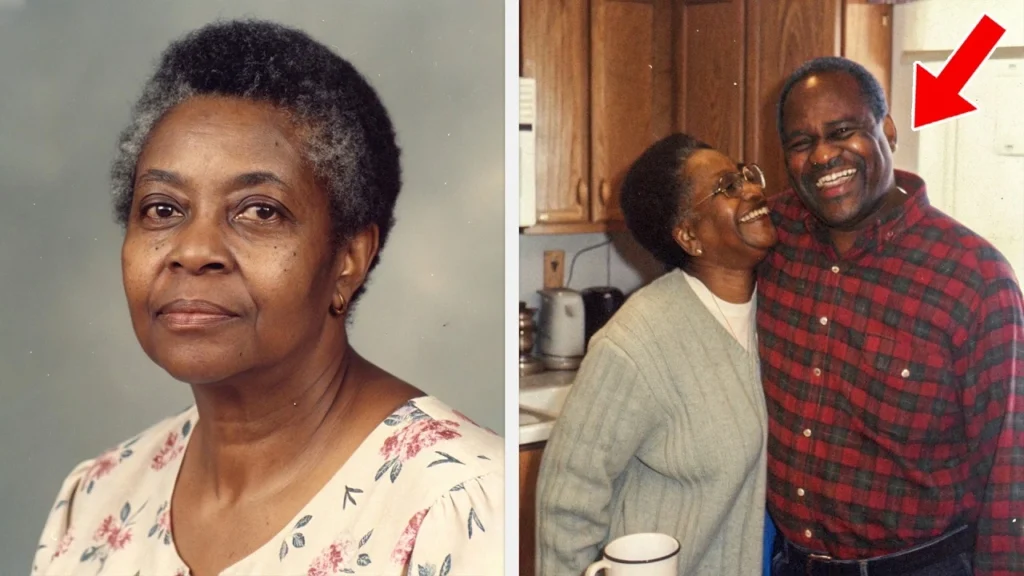
After thoroughly reviewing the cold case materials over two days, Morgan placed two photographs side by side under his desk lamp.
One showed Dorothy Vance from the official missing person’s bulletin distributed in January 1988.
A formal portrait apparently taken several years before her disappearance.
The other displayed the replacement image from the fraudulent social security card labeled Sarah Vance found in the hidden toolbox.
Despite differences in photo quality and apparent age of the subject, the facial features matched unmistakably.
The distinctive bone structure, eye spacing, nose shape, and ear configuration were identical.
Morgan consulted with a forensic imaging specialist who confirmed with 95% certainty that both photographs depicted the same individual at different ages.
The pattern became absolutely clear to Morgan’s experienced investigative mind.
Clarence Vance had not merely engaged in routine identity theft by cashing his deceased sister’s government checks for personal gain.
He had employed dead Sarah’s legal identity as sophisticated camouflage to conceal his supposedly missing wife Dorothy in a closed medical institution located across state lines in Virginia.
This explained why Dorothy’s body had never been found despite exhaustive searches in 1988.
She had not died in the South Carolina woods.
Someone had transported her alive to Virginia and hidden her under a false identity in a facility designed to house patients long term without outside contact.
Morgan now faced the complex task of determining what exactly had transpired at Quiet Haven Sanitarium and why Dorothy Vance, still alive in January 1988, had never returned home or contacted authorities to reveal her true identity.
Detective Morgan departed for Richmond, Virginia on October 25th, 2012.
Though Quiet Haven Sanitarium had ceased operations in late 1998, its patient records have been transferred to the Virginia Department of Health for permanent archival storage as required by state medical facility regulations.
Examining the confidential medical file for an emission dated January 3rd, 1988, the detective located information that fundamentally altered the investigation’s direction.
The intake documentation indicated the patient had arrived, accompanied by a man identifying himself as her brother.
Medical staff recorded severe head trauma to the occipital region with visible contusion and swelling.
The admitting physician had diagnosed traumatic brain injury causing retrograde amnesia.


