A timeline that investigators believe was n…
A timeline that investigators believe was not coincidental.
What exactly transpired between the contract visit and the deaths themselves remains, even now, only partially reconstructed.
Pieced together from financial records, a handful of digital communications, and forensic evidence recovered from the property itself.
What is established as a matter of record is this.
Within a span of roughly 2 weeks, Harold and Delia Ashcomb were killed inside their own rental home.
A section of the kitchen subfloor was reopened and reinforced to conceal a hidden space beneath it.
The property management portal received a lease break notice using credentials investigators would later determine had been accessed through the Ashcombs’ own email account.
And Mitchell and Renata Pruitt submitted a rental application for the same address less than 3 weeks later.
This is the detail that would eventually unravel the entire case, and the detail that makes this story different from almost anything else we’ve covered.
The Pruitts were not hiding two victims they themselves had lured into that house.
They built their entire life for the next 23 months directly on top of a family they had murdered specifically in order to take possession of the space that family had been renting.
Now, the raid.
The investigation that led detectives to that house had nothing to do with the Ashcombs at all, at least not at first.
Mitchell and Renata Pruitt had come under scrutiny in connection with a separate financial fraud investigation, unrelated to anything involving their neighbors or their landlord.
Centered on a pattern of identity theft targeting elderly homeowners across three counties, a pattern investigators would only later understand had likely begun in its earliest and most literal form with Harold and Delia Ashcomb themselves.
The search warrant executed at the Pruitt residence was drafted specifically around financial records, computers, documents, evidence of the fraud scheme detectives had spent months building a case around.
Nobody executing that warrant expected to find anything related to a missing person’s case because there had never been a missing person’s case.
The Ashcombs’ daughter, informed by the property notice that her parents had relocated suddenly for family reasons, had spent two years believing her parents were simply distant, difficult to reach, and increasingly estranged.
A painful, but not alarming pattern that many adult children experience with aging parents, made worse, she would later say, by a handful of text messages sent from her mother’s phone in the weeks after the supposed move.
Messages investigators now believe were sent by Renata Pruitt herself using a phone taken from the scene specifically to delay exactly this kind of scrutiny.
The fraud investigation itself had begun nearly 8 months before the search warrant was executed, originating from a series of complaints filed by elderly homeowners in a neighboring county who noticed unauthorized credit inquiries, and in two cases, unexplained changes to property tax records.
Detective Lewis Reinhardt’s task force spent months tracing the digital footprint of these fraudulent filings back through a chain of proxy servers and disposable email accounts before finally connecting the pattern to a physical address, the Pruitt residence.
Through a single unmasked IP address used, investigators believe only once during a moment when Mitchell Pruitt’s usual precautions briefly lapsed.
That single oversight, 8 months into an investigation that had until then produced only digital shadows, was what finally gave Reinhardt’s team the probable cause needed to request a search warrant for the house itself.
Detective Lewis Reinhardt, leading the fraud investigation, has said that the search of the Pruitt house was, for the first several hours, entirely routine.
Computers bagged, filing cabinets searched, nothing suggesting anything beyond the financial crimes already under investigation.
It was one of the younger officers on the search team, running a standard structural check of the kitchen as part of the property inventory, who noticed that a section of tile near the pantry didn’t quite match the surrounding flooring in age or wear pattern, new grout lines against older, more settled tile.
The kind of inconsistency that means nothing on its own in most houses, and everything in this one.
Officers pulled up the mismatched section and found a trap door cut directly into the subfloor, framed and reinforced with lumber that records would later confirm matched materials purchased by Mitchell Pruitt from a local hardware store roughly 2 weeks before the Ashcombs lease break notice was filed.
Beneath it was a crawl space modified far beyond what the original foundation required, a single wooden chair bolted through its legs directly into a concrete support beam, a length of heavy chain secured to an anchor point in the wall, coiled rope on a shelf built into the space specifically to hold it, and at the far end of the crawl space, two shapes, both covered, both unmistakably human, positioned side by side in a manner investigators would later describe in their report as deliberate and disturbingly careful, rather than hastily concealed.
The construction quality of the hidden space itself would become a significant point of forensic interest during the subsequent investigation.
Unlike the improvised rushed concealment attempts investigators typically encounter in similar cases, the crawlspace beneath the Pruitt’s kitchen showed clear signs of careful planning.
Proper drainage to prevent moisture build-up, a support structure strong enough to bear the weight of foot traffic on the tile above without any detectable sagging or creaking over nearly 2 years of daily use, and ventilation adequate enough that the space had not developed the kind of odor that might otherwise have drawn attention from anyone standing in the kitchen above.
Investigators would later note that Mitchell Pruitt’s genuine background in contracting and renovation work was not incidental to the case.
It was, in the assessment of the lead crime scene technician, the specific skill set that made this particular concealment possible for as long as it lasted.
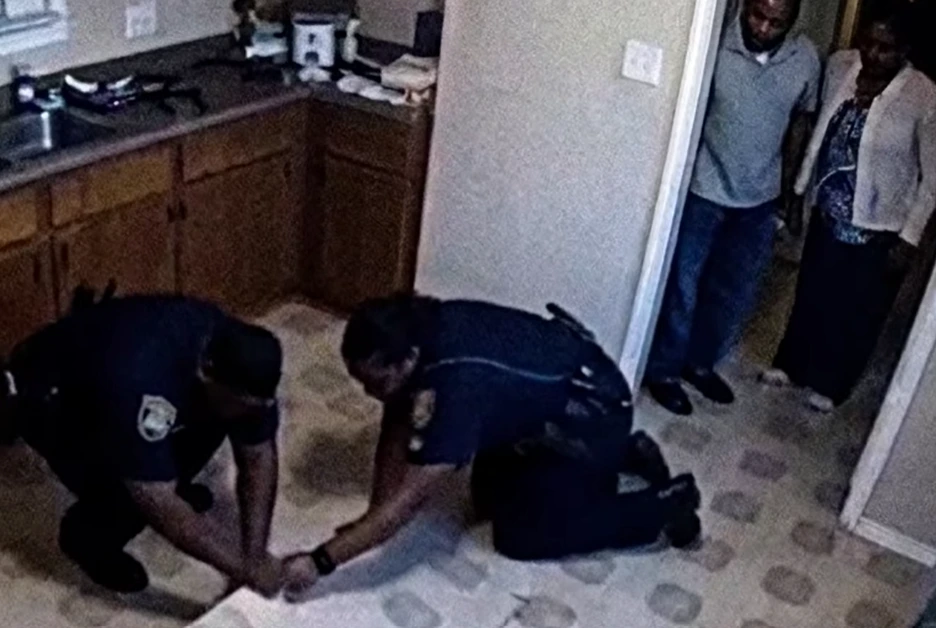
Here is where the recording that has circulated since the case became public actually comes from.
Not the discovery itself, but the 90 seconds immediately after, captured by an officer’s body camera as the team called for the Pruitts, who had been detained in a separate room during the search, to be brought to the kitchen doorway for what standard procedure requires, an opportunity to explain on the record what officers had just found in their home.
Mitchell and Renata Pruitt stood together in that hallway, flanked by officers, looking down into the open trapdoor at the chair, the restraints, and the two covered shapes beneath their own kitchen floor.
Neither one said a word.
The footage shows Mitchell’s face registering nothing, no confusion, no shock, no protest of innocence, the specific absence of reaction that the reviewing detective would later describe as the look of two people watching a bill finally come due, rather than two people encountering something for the first time.
Renata, standing beside him, did not look at the trapdoor at all after the first several seconds.
She looked instead at her husband, and then at the floor near her own feet.
Her expression, according to the same detective’s report, flat in a way that read less like shock and more like arithmetic, like she was simply recalculating what happened next.
For nearly 40 seconds, according to the timestamp, nobody in that hallway spoke at all.