Together, accumulating week after week, it…
Together, accumulating week after week, it built into something Odalis found herself unable to simply talk herself out of no matter how many times well-meaning people suggested she was imagining it.
She mentioned it to a co-worker who suggested she was simply adjusting to living alone for the first time.
She mentioned it to her sister who suggested the same thing gently in the way people do when they’re trying to be supportive without validating a fear they suspect might not be grounded in anything real.
Odalis was not entirely convinced by either explanation.
She had, by her own account always trusted her instincts about physical spaces.
A professional habit from years of graphic design work that required close attention to visual detail to what belonged and what didn’t.
Something about her apartment she felt didn’t belong.
Three months in, she purchased a small, inexpensive hidden camera online.
The kind marketed primarily for monitoring pets or catching package thieves, and positioned it discreetly on a bookshelf facing her apartment’s front door, angled to capture anyone entering while she was away at work.
Her stated goal at the time was modest.
Catch her landlord, if he really was entering without notice, and confront him with clear evidence rather than a feeling she couldn’t otherwise prove.
She researched tenant rights before making the purchase, confirming that a hidden camera positioned to monitor her own private space, rather than any shared or common area, sat comfortably within the legal boundaries she needed to stay inside.
A small but telling detail about the kind of person Odalis was.
Methodical, even in her suspicion.
Unwilling to let an unproven feeling push her into anything reckless or legally questionable, even when everyone around her kept suggesting there was nothing there worth investigating at all.
For the first several weeks, the camera captured nothing beyond Odalis’s own comings and goings.
She nearly gave up on the whole idea, chocking her earlier suspicions up to the adjustment period everyone had suggested it might be.
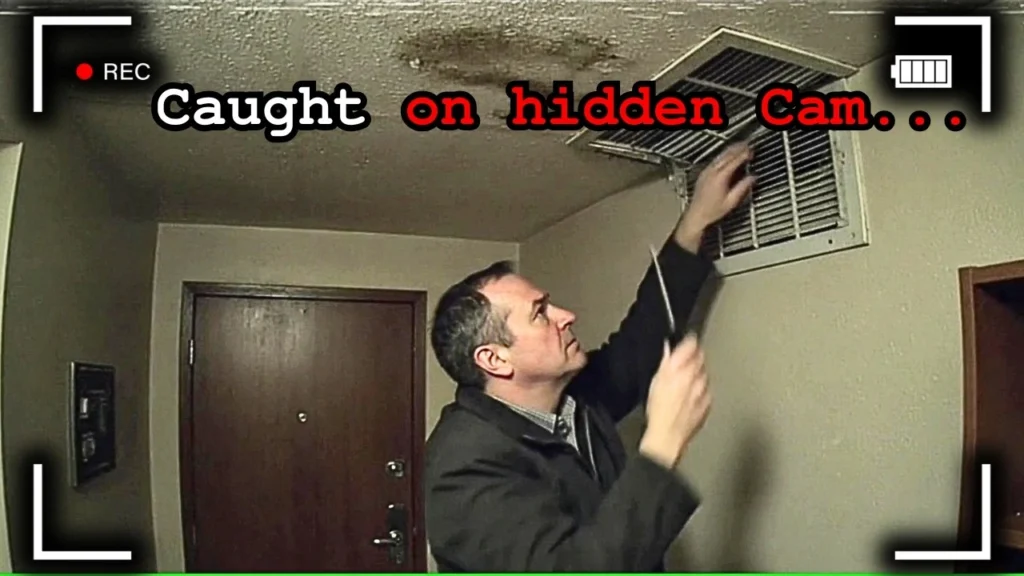
Then, 5 weeks after installing the camera, it caught exactly what you saw at the start of this video.
Reginald, letting himself in on a Tuesday afternoon, going straight for that vent.
The entire visit lasted under 4 minutes, start to finish, conducted with the kind of unhurried confidence of someone who had performed this uh this exact routine many times before, and had no reason to expect interruption.
He did not search the apartment.
He did not look through her belongings.
He went with what the footage made clear was deliberate familiarity to one specific location and nowhere else.
A detail that struck Odalys immediately as strange, even before she understood its full significance.
Long before she had any reason to connect it to anything beyond a landlord’s odd, invasive habit.
He used a screwdriver he’d clearly brought for exactly this purpose, checked something, and put the grate carefully back in place before he left, leaving no trace behind for her to ever notice on her own.
Odalys watched that footage three times before she fully understood what she was looking at.
Her first reaction, she has said since, was simple relief.
Vindication that her instincts had been correct.
That she hadn’t imagined the sense of disturbance she’d felt for months.
Her second reaction, once she thought about it further, was confusion.
Followed almost immediately by something closer to dread.
Why the vent specifically? What could possibly be worth a landlord’s risk of unauthorized entry, checked and rechecked, hidden inside a piece of household infrastructure that any HVAC technician might access during routine service? She did not call the police immediately.
She has said since that she wanted to understand what she was looking at before escalating it into something official.
A decision she now describes with visible discomfort, aware in hindsight of how much time that hesitation cost.
Part of what held her back, she has said, was a fear of appearing paranoid or overreactive.
The same instinct that had made her hesitate to mention her earlier suspicions to anyone beyond a co-worker and her sister.
Both of whom had gently suggested she might be imagining things.
She worried, she has said, that walking into a police station with a video of her landlord checking an air vent might sound out loud like exactly the kind of overblown concern she’d already been quietly told twice to dismiss.
Instead, she waited 3 days working up the nerve before removing the vent great herself on a Saturday afternoon to look inside it directly.
She has described those 3 days as some of the longest of her life.
Going to work, coming home, sleeping in the same apartment, all while turning the footage over in her mind and trying to imagine an innocent explanation that never quite arrived.
What she found inside that vent was a small waterproof bag positioned far enough back that it wouldn’t be visible without deliberately reaching in containing a wallet, a phone, and a set of keys.
All three belonging, according to the identification inside the wallet, to Pria Kalatil, the tenant who had supposedly moved out over a year earlier under entirely ordinary circumstances.
Odalis has described that specific moment, kneeling on her hallway floor, reaching into a vent she’d walked beneath every day for 8 months, as the point where an uneasy feeling she’d been carrying for months resolved into something concrete and far worse than anything she’d let herself imagine.
The phone, when she found it, had long since died.
Its battery drained years earlier, but the wallet’s contents remained perfectly preserved.
A driver’s license, a hospital employee badge, a handful of receipts dated to a week that, once cross-referenced against the building’s leasing records, fell almost exactly at the point when Pria’s official departure had supposedly begun.
I want you to sit with that discovery for a second, the way Odalis herself had to.
A wallet does not end up hidden inside a ventilation duct because someone moved away for a new job.
A phone does not get tucked behind a grate by a person who simply decided to relocate.
People who move to start a new life take their wallets with them.
They take their phones.
They take their keys.
Whatever story the building’s paperwork told about Pria Kalathil’s departure, the physical evidence Odalis was now holding told a different one entirely.
And it told it in a way that left almost no room for an innocent alternative explanation, no matter how many times Odalis tried in that first stunned moment to imagine one.
She called the police that same afternoon without waiting any longer.
The investigation that followed moved quickly once detectives understood what they were looking at.
Pria Kalathil had in fact never been reported missing in any formal sense.
Her family, living several states away and not in frequent contact due to a strained relationship following her decision to move for work against their wishes, had assumed, based on a handful of vague infrequent texts they later determined had not actually come from Pria’s own phone, that she had simply drifted further from the family and chosen not to stay in close touch.
The tension in that investigators learned stemmed from Pria’s decision two years earlier to pursue nursing far from home, rather than the more traditional path her parents had hoped for her.
A disagreement that had never fully healed and that made her apparent silence, however painful, feel to her family like something consistent with an ongoing estrangement rather than a genuine emergency worth escalating to authorities.