Her employer, a hospital two towns over, had proce…
Her employer, a hospital two towns over, had processed her resignation on paper.
A two-week notice submitted according to HR records by email using an account investigators would later determine had been accessed and used by someone other than Priya herself in the days immediately following her actual disappearance.
HR staff who processed the resignation described it in later interviews as entirely unremarkable at the time.
The email cited a family emergency requiring her to relocate.
A plausible and common enough reason that nobody thought to verify it through any means beyond the email itself.
Since no policy at the hospital required anything more than a written notice to close out an employee’s file.
Reginald Truscott Bayer had, in other words, spent over a year maintaining a fabricated narrative of Priya’s voluntary departure across multiple institutions, her family, her employer, the building’s own official leasing paperwork.
A level of sustained methodical deception that investigators found almost as disturbing as the crime itself.
Because it meant nobody, across an entire year, had ever had sufficient reason to look closely enough to question it.
Here is where the story reaches the part I promised would reframe everything.
Reginald had not simply killed a tenant in some isolated singular act of violence and then panicked into covering it up.
Records recovered from his own computer, seized once he became the primary suspect, revealed a pattern investigators believe extended back considerably further than Priya Kurathil.
Financial records connecting him to at least two previous tenants across other properties he had owned and managed personally in earlier years, both of whom had also moved out under circumstances that reexamined with fresh eyes showed the same pattern.
Abrupt departures, minimal paper trails, families and employers quietly informed of a relocation nobody ever independently verified.
Neither of those earlier cases had ever been formally investigated as anything other than ordinary tenant turnover because nobody had ever had a reason to look.
Landlords managing their own properties personally without any oversight from a management company or regulatory body checking in on tenant welfare occupy a specific kind of blind spot in most rental markets.
One built entirely on the reasonable, ordinary assumption that people who sign leases and later choose to leave them are simply people who moved on with their lives.
Investigators reopening those two earlier cases found the same pattern of fabricated resignation notices and reassuring messages to distant family members constructed with what one detective described as an almost administrative patience.
Reginald treating each cover story less like a desperate improvisation and more like a task to be managed carefully over weeks.
Exactly the kind of behavior that made him so difficult to catch across so many years.
Preia Calithea did not survive whatever happened in that building.
The medical examiner’s findings, once her remains were located based on evidence recovered from Reginald’s property during the search that followed his arrest, determined that she had died from injuries consistent with a violent physical altercation with a manner and cause of death that investigators believe occurred within days of her actual undocumented departure from the the Meaning the entire year of fabricated correspondence, resignation emails, and reassuring texts to her family had all been constructed entirely after the fact by a man managing a crime that had already happened, rather than building toward one that hadn’t yet.
Investigators recovered Priya’s remains from a section of crawlspace beneath the building’s foundation, accessible only through a maintenance hatch Reginald had personally installed years earlier under the justification of improving access for plumbing repairs.
A justification nobody had ever questioned, since it was on its face a perfectly reasonable thing for a hands-on landlord to want.
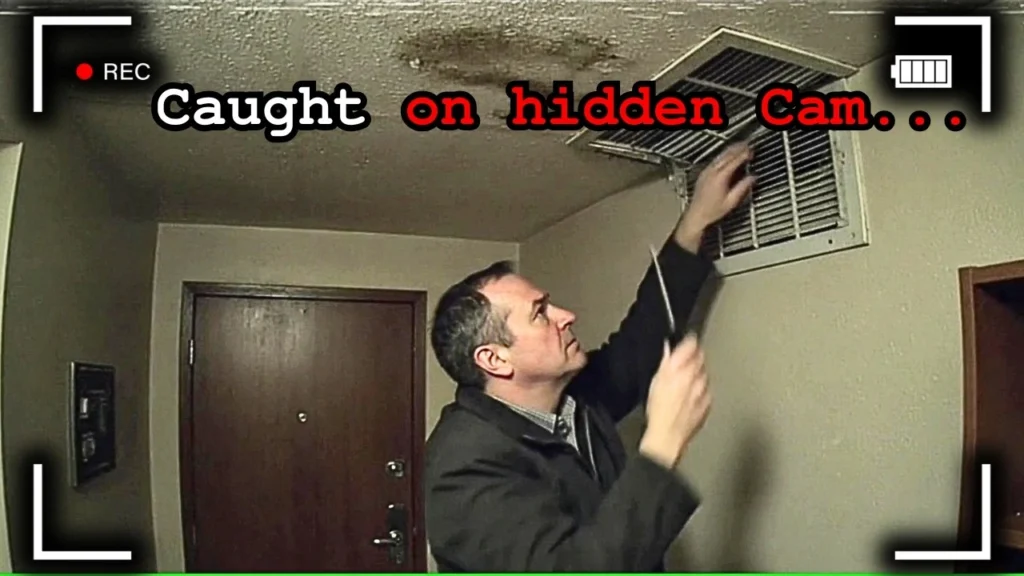
The hatch’s existence, like the vent above Odalis’s apartment, had simply never registered as suspicious to anyone, because nothing about a landlord improving his own building’s infrastructure typically warrants a second look.
I am not going to describe more than what the medical examiner’s report establishes.
What matters is that a young nurse who had simply signed a lease, moved into an apartment, and gone about an ordinary working life did not survive her landlord’s presence in a building she had every legal right to consider her own private space.
Reginald Truscott Bayer was arrested within days of Odalis’s discovery.
Once the physical evidence from the vent cross-referenced against the fabricated resignation email and the text sent from an account investigators determined he had accessed using Priya’s own phone before disposing of most of her remaining belongings made the case against him overwhelming, even before the additional two cold cases were reopened.
He offered, during his initial interview, a partial and inconsistent account of Priya’s final days, alternating between denial and vague admissions that his own attorney would later attempt unsuccessfully to characterize as confusion rather than deception.
At trial, prosecutors leaned heavily on the pattern across all three suspected victims.
The same method of maintaining a fabricated departure narrative, the same exploitation of a rental arrangement that gave him legitimate unsupervised access to every unit in buildings he personally managed.
Prosecutors argued that the pattern itself, even where individual pieces of evidence in the earlier cases remained incomplete, demonstrated a level of premeditated method that made Priya’s murder impossible to characterize as an isolated uncharacteristic act.
The defense attempted to argue that the evidence connecting him to the two earlier cases remained circumstantial, insufficiently proven to the standard required for a murder conviction on those counts specifically, and that the jury should evaluate Priya’s case entirely on its own physical evidence rather than any broader pattern.
The jury agreed only on Priya’s case with full certainty, convicting Reginald of first-degree murder in her death, while the two earlier cases remained at the time this case concluded in the press still under separate ongoing investigation pending additional forensic work on remains recovered from properties Reginald had owned in earlier years.
Reginald was sentenced to life without the possibility of parole for Priya Kalathil’s murder.
At sentencing, he offered no statement of remorse, no explanation of what had driven him to kill her in the first place, a silence that left both Priya’s family and the two other suspected victims’ families without the answer to the one question that mattered most to them, the question of why, which prosecutors acknowledged in their own closing remarks, might never be fully answered at all.
Odalis moved out of the building within a month of the investigation beginning, understandably unable to continue living in the space where she’d made her discovery.
She has said publicly, exactly once, that she still struggles with a particular kind of guilt that she knows, rationally, she shouldn’t carry.
The sense that she lived in that apartment for eight months without knowing what was hidden a few feet above her head, walking beneath that vent every single day without any sense of what it contained.
She has also said, in the same statement, that she has come to see her own hesitation to call the police immediately less as a failure and more as a genuinely difficult human response to discovering something too large to process in a single afternoon.
A reframing her therapist, she has said, helped her arrive at slowly over the months since.
Priya’s family, informed of what had actually happened after more than a year of believing their daughter had simply chosen distance from them, have said the hardest part of the entire ordeal was not the loss itself, but the years spent believing, based on fabricated messages designed to sound convincingly like her, that Priya had been the one choosing silence.
Grief compounded by a false narrative of abandonment that the truth, however devastating, at least finally corrected.
Priya’s mother, in a statement read at sentencing, described the specific cruelty of having spent that year quietly hoping her daughter would eventually reach out and repair their relationship, never knowing that the daughter she was waiting to hear from had already been gone the entire time.
Every unanswered text, a small ordinary hope she now has to carry differently.
I want to end this the way I started it.
Odalis installed that camera to catch something small, a landlord’s unauthorized entry, a minor invasion of privacy she wanted proof of before confronting him.
What she found instead was the answer to a disappearance nobody outside one grieving, confused family had ever thought to properly investigate.
Hidden inside a piece of household infrastructure that any of us walks beneath every single day without a second thought, this is worth sitting with for a moment.
Nobody failed Pria Kalathil through malice or negligence in any obvious sense.
Her family responded to silence the way any strained family might.
Her employer processed a resignation the way any HR department processes hundreds of them each year.
The building’s own leasing records reflected exactly what they were told to reflect.
Every single institution that should have caught something did exactly what institutions are designed to do with ordinary, unremarkable information, which is precisely why a man willing to fabricate that information so patiently was able to disappear a person for over a year without anyone raising an alarm loud enough to matter.
It took one person’s small, private suspicion about something entirely unrelated to finally break through where every official channel had quietly failed for over a year without ever once suspecting it needed to look harder.
Remember her name, Pria Kalathil.
She signed a lease, moved into an apartment, and began an ordinary working life in a new city.
The man who managed that building had already done this before and would do it again if left unquestioned.
It took a stranger’s hidden camera installed for an entirely unrelated reason, and a moment of hesitation turned courage to finally look inside a vent nobody else had ever thought to check, to bring her home to a family who had spent over a year believing the wrong story about why she’d gone quiet.
A landlord who lives in your building and holds every key is not, by itself, a reason for alarm.
It is, as this case proved, exactly the kind of ordinary trust worth remembering can be broken.