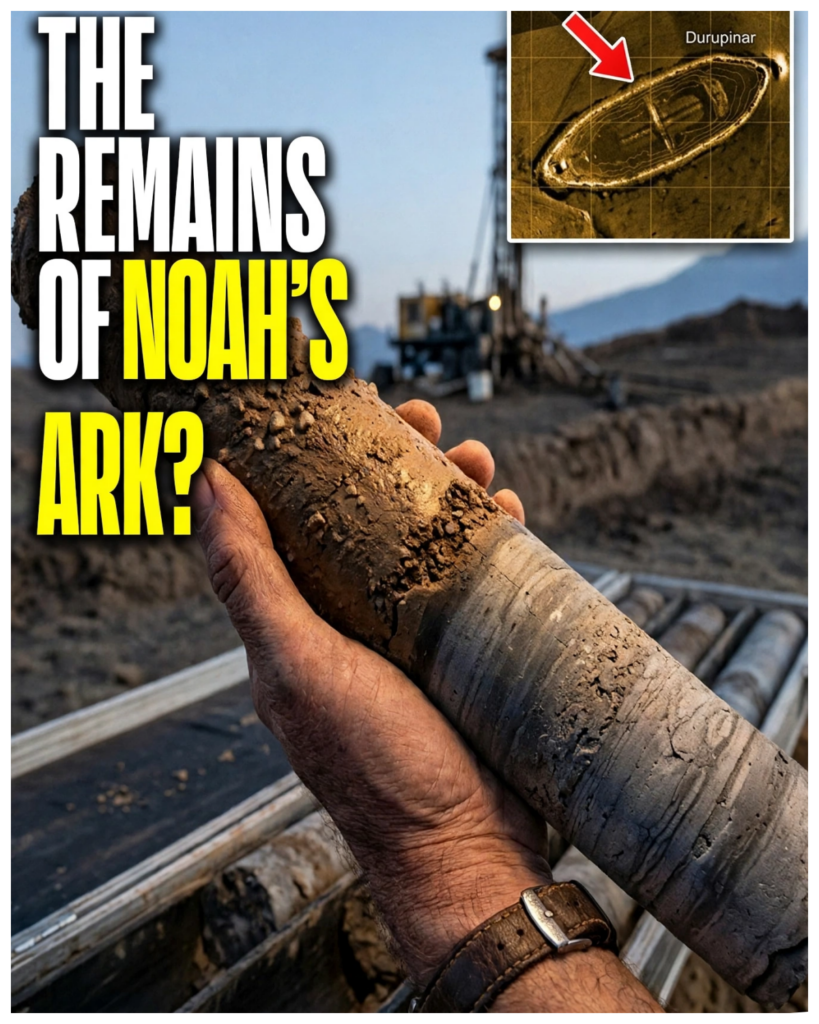
The people behind the dig say it might be petrified wood, and they believe this mound [music] is Noah’s ark.
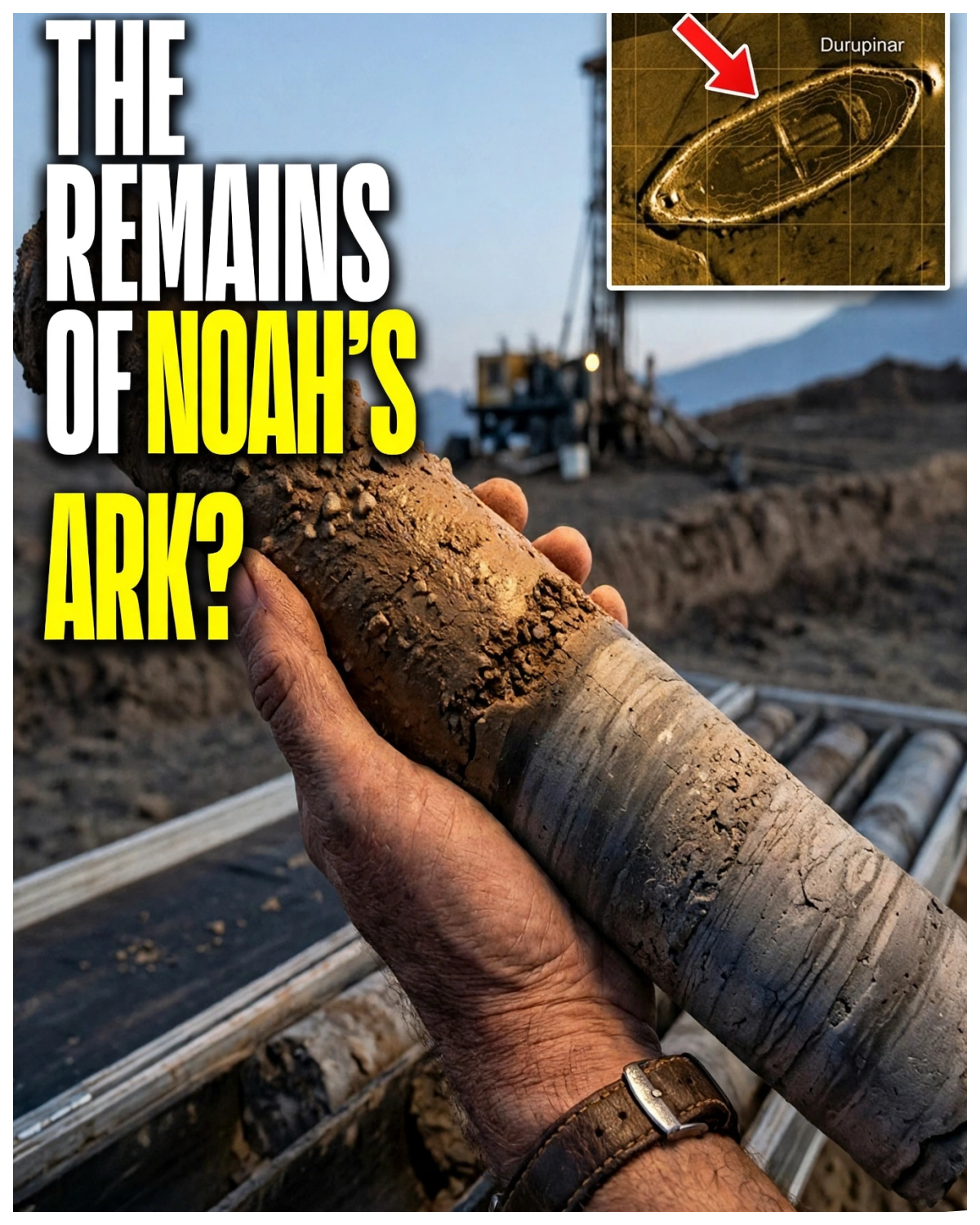
In September 2026, their drill went 4 to 5 m into a ship-shaped hill in eastern Turkey and hit something [music] so hard the bit broke.
Those cores are now in a lab in Ankura.
But this hill has been drilled before.
In 1988, a Christian geoysicist named John Balgardner drilled four holes into it.
What his cores hit at about the same depth is the part you haven’t heard.
So, what did he find?
And can 2026 [music] prove him wrong?
Here’s what he wrote.
The drilling ran from July 28th to August 7th, 1988.
And 12 days after the last hole, Balgardner put the results in a newsletter.
[music] He thanked God that the holes had gone in at all.
Then he got to the cores and he wrote this.
There was, for example, no evidence for wood, petrified or otherwise.
That’s a man of faith.
A man who made eight trips to this hill in 4 years, [music] putting that in writing.
But he didn’t stop at that line.
He added a warning.
[music] And it’s the warning that matters now.
Core drilling, he wrote, is severely limited in its ability to find buried archaeological structure.
[music] So, his holes could have missed something, and so could the ones drilled in 2026.
Keep that sentence in mind because by the end of this video, it’s the thing that decides what those cores in Ankura [music] can actually tell us.
Eastern Turkey, October 1959.
A Turkish captain named Ilhan Durupanar is going through aerial survey photographs from a NATO mapping mission when he stops on one frame.
About 18 miles from the summit of Mount Ararat on a hillside above a small village, there’s a long pointed mound that looks like the outline of a ship.
It’s roughly 500 ft from end to end.
The following September, Life magazine ran the picture under a question, [music] Noah’s Ark.
Boatlike form is seen near Ararat.
That same month, a small team went up to the site with Durupanar himself.
They spent two [music] days digging and they set off dynamite.
All they found was soil and rock.
The team’s own conclusion, as it was reported afterward, was that the mound was a freak of nature and not man-made.
And for most people, that should have been the end of it.
There’s a problem with the shape, too.
And it’s worth knowing before we go any further.
Genesis says the ark was 300 cubits long.
Use the common cubit of about 18 in, [music] and that’s 450 ft.
Use the royal Egyptian cubit of [music] about 20.6 in, and you get roughly 515 ft, which is the number supporters of this site like to quote.
So, the famous match [music] depends on which ruler you pick.
The Hebrew word for the ark means a box or [music] a chest.
It doesn’t describe a pointed hull.
And Genesis 8:4 puts the landing on the mountains of Ararat, plural, which means a whole region rather than one peak.
Now, the site [music] could easily have faded away right there.
And instead it picked up its most famous champion.
An American nurse anesthetist and amateur [music] explorer named Ron Wyatt read about the photo and in 1977 he made his first trip to the mound.
Wyatt became convinced the rock was petrified wood.
He talked about metal fittings in the ground.
And in a village nearby, he pointed to a set of huge standing stones with holes cut through them and said they were drogue stones.
Heavy anchors hung off the back of the ark to keep it steady in the water.
He was joined by another ark hunter, David Facold, who measured the mound at 538 ft.
Then Balgardner, the geoysicist from Los Alamos, joined them in 1985.
And for a while, the story seemed to be winning.
Ron’s widow, Mary Nell Wyatt, has written about the day the government got involved.
It was set for June 20th, 1987.
The provincial governor spoke the dedication in Turkish, and then he lifted the first shovel full of dirt for a new visitor center.
That building, she says, was finished the following year.
So, the Turkish [music] state was now welcoming tourists to a site that has never been fully excavated.
As for the anchor stones, geologists later found they’re made of local volcanic rock, and archaeologists generally read them as old standing stones that had Christian crosses carved into them later.
Nobody has ever dated them.
Pay attention to this next part [music] because it’s the question the 2026 drilling is still chasing.
In July 1987, Balgardner and a Turkish geologist [music] named Sali Baktan from Adaturk University in Erzerum ran ground penetrating radar, seismic [music] tests, and a magnetometer over the whole mound.
The radar picked up a flat sharp surface between 4 and 8 m [music] down under at least half the site.
And their report issued that November was honest [music] about what it didn’t know.
In their words, whether that surface was the transition between the overlying clay soil and underlying bedrock, or alternatively, a material other than bedrock, such as the petrified remains of a large boat, is impossible to answer with the data presently available.
The fix, they wrote, was simple.
Actual sampling of the underlying material is required.
They asked the Turkish authorities to let them drill as early as 1988, and that’s exactly [music] what they got.
If you’re watching this on your TV, you can subscribe without picking up your phone.
Use the arrows on your remote to move up to subscribe.
[music] Press the center button, then move over to the thumbs up right next to it, and press it again.
We put out a new investigation every other day.
The Turkish government required Turkish equipment [music] and a Turkish crew, and Bumgardner later described the work as slow and arduous.
Three holes went in near the center line of the mound, and one went [music] in on the outer flank.
Years later, in 1914, Balgardner laid out what each hole hit.
The first went down 10 m and stayed in mud flow the whole way.
Holes two and three went to about 6 m.
And at 5 m, [music] he said, the material changed abruptly from mud full of p-sized gravel into layered bedrock.
The fourth hole barely went a meter before they realized the bedrock came all the way up to the surface.
There was one flicker of hope.
At three spots in the mud, the cores held nodules of a bright yellow mineral called lmonite.
And Bombgardner wrote at the time that they could be the rusted remains of iron objects.
I mean, think about that for a second.
In the summer of 1988, a Christian scientist was looking at yellow lumps in the mud that he thought just might be rusted iron.
In the end, it didn’t change his mind.
Once the whole picture was in, Balgardner’s verdict was blunt.
The core drilling, he wrote, settled the issue.
As far as I am concerned, the site is a natural formation, nothing more produced by a mudslide as mud flowed around a ridge-shaped block of basement rock.
That ridge of rock, he added, actually breaks the surface along about 40% of the site’s [music] length.
And then he wrote the line that’s hardest to argue with.
I, as a scientist with a PhD in geoysics, but also an earnest Christian, am absolutely convinced the site contains no remains [music] of Noah’s ark.
Byuktutan never fully signed on to that.
In the Turkish press, he’s been [music] reported as saying that the boat shape keeps rising up even after the ground around it collapsed in earthquakes and that there’s something anomalous there.
Hold on to that 5 m layer, though.
[music] It’s going to come back in 2026 at almost the same depth.
So, how does a hillside make something that looks like a ship?
Picture a slope of wet mud sliding downhill after heavy rain or an earthquake.
On the way down, it runs into a hard ridge of rock sticking up out of the ground.
The mud splits, flows around both sides, and settles.
And what’s left is a long mound with a pointed end wrapped around a spine of stone.
That’s the [music] explanation Balgardner landed on.
And Andrew Snelling, a geologist with the creationist ministry answers in Genesis, pointed to a Turkish Air Force photo showing three more boatlike shapes on the lower slopes of Lesser Ararat, the smaller peak next door.
Today’s dig team has an answer to that.
They argue the mound is mostly soil rather than a solid block of rock.
And they ask why soil would hold a ship’s shape at all.
They also point out that the pointed end faces uphill, which they say is the wrong way round for mud flowing around an obstacle.
Then there’s Fac.
Up to this point, he’d been one of the site’s loudest champions, and he’d written a whole book arguing it was the ark.
That was about to change.
In September 1994, he went back to the mound with an Australian geologist named Ian Plymer.
Two months later, [music] a Sydney newspaper quoted Facult saying this.
I believe this may be the oldest running hoax in history.
I think we have found what the ancients said was the ark, but this structure is not [music] Noah’s ark.
In 1996, he co-wrote a paper with a geologist named Lawrence Collins in the Journal of Geocscience Education.
The title didn’t leave much room.
Bogus Noah’s Ark from Turkey exposed as a common geologic structure.
Collins read the mound as a natural fold in the rock, a kind of long sunken trough.
What looked like petrified bark was altered rock and a band of fossil bearing limestone cut across the structure which meant [music] in his reading that the limestone was younger than the so-called ark.
Then the whole thing ended up in court.
In Australia, Plymer sued a creationist lecturer named Alan Roberts over the ark claims Roberts had been making in public lectures and Fel joined the case.
In April 1997, under oath, Facel called the Ark claim absolute BS.
And no, I’m not making that up.
A federal court in Sydney actually heard a case about Noah’s Ark.
Plimer lost [music] his main claim.
The judge, Ronald Sackville, found that Roberts [music] wasn’t acting in trade or commerce, so the consumer law had used simply didn’t apply.
Facult won $2,500 Australian dollars for a drawing that had been copied from his book, and the [music] judge left a warning of his own.
Unless caution is exercised, there is a serious risk that the courts will be used as a means of suppressing debate [music] and discussion.
Fasel died in April 1998, and the people who knew him still can’t agree on where he ended up.
His friend and biographer June Daws wrote that he kept saying there was too much going for the site for [music] it to be dismissed and that he remained convinced it was the fossilized remains of Noah’s [music] ark.
Collins, his co-author, answered that in 2016 [music] in a letter to a journal published by an association of Christians in the sciences.
This is not true.
Both of them knew him well and they remember his last years very differently.
That was the fight the public saw.
Behind it [music] sat something that surprises a lot of people.
Some of the strongest doubts about this site came from inside the faith.
Snelling the answers in Genesis Geologist wrote that these investigators will never be able to establish what is [music] inside this boatshaped formation until such time as they actually excavate the [music] site.
John Morris of the Institute for Creation Research went further [music] and said everything there has a perfectly rational and simple geologic explanation.
Both of them believe in the flood described [music] in Genesis.
And if you’re on your phone right now, there’s a hype button right under this video.
It’s free.
You get a few hypes every week, and each one pushes a smaller channel like this one up YouTube’s hype chart.
By 2019, a new team had picked up where Wyatt left off.
Andrew Jones, a software developer who founded a group called Noah’s Ark Scans, [music] ran new radar surveys over the mound and reported what he read as a corridor running 234 ft through it.
Between 2021 and 2023, [music] researchers from Istanbul Technical University and Agri Ibrahim Tekken University took about 30 rock and soil samples [music] and reported clay and marine material, but a vice director involved in the study cautioned that the dating makes it impossible [music] to say the ark is there.
In April 2026, [music] Noah’s Ark Scans released a soil study built on 88 samples.
They reported about three times more organic matter inside the formation than [music] outside and 38% more potassium.
None of this has gone through peer review, but it was enough to build something much bigger.
In the summer of 2026, what’s been built as the largest study the site has ever seen got underway.
It’s directed by professor Kenkar Atila, an archaeologist at Civas Kumhuryat University with Jones as a vice president of the project.
About 20 people from five countries spent roughly 90 days on the hill.
According to Aila, they took around 1,000 soil samples from about 150 different spots.
The university has said the carbon level inside the formation came out about 40% higher than outside.
They found pottery fragments that haven’t been dated yet.
And a radar engineer named Kosro Baktar, whose company has held US Air Force research contracts, scanned the mound, and the project reported voids that meet at right angles.
Here’s where the two sides of the project start [music] to sound very different.
The university’s framing, as reported in the Turkish archaeology press, is careful.
The work is not based on the assumption that a ship lies underground.
Aila himself sounds more hopeful than that.
He told Turkish television that the data make it more likely every day that this is Noah’s ark, while saying the lab analyses have to be finished first.
The project’s marketing director posted on X that scientists [music] confirm the formation is 100% not geological.
And Jones has said it plainly.
I believe this is Noah’s Ark.
That’s why I’m putting the Durupanar site through the most rigorous [music] testing possible.
The fieldwork itself was paid for largely by donations [music] and the team’s own video carries a paid promotion for a gold dealer.
Then came the drilling.
The team says [music] it used a dry drilling rig with no water at all and that its holes reached as deep as 18 [music] m, close to 60 ft.
In its own video, the team talks about 12 holes inside the formation.
So far, they say no bedrock has turned [music] up in any of them.
And in one hole about 15 ft down, the bit struck a layer Jones described like [music] this.
Whatever the core drill struck was harder than limestone, hard enough to break the bit.
The team also [music] says the 1988 cores were ruined by the water used to cool the drill.
Balgardner, who ran that drilling, described them at the time as reasonably [music] good cores from each of the holes.
And if you’ve seen videos about a [music] sealed chamber, a heat signature, bones, or a door dented [music] from the inside, none of that appears in any statement from the university or from the team.
That story came from somewhere else.
So look at [music] what we actually have.
In 1988, at about 5 m, two holes near the center line went from mud into layered rock.
In 2026 [music] at four to 5 m, a bit broke on something the team says is harder than limestone.
Maybe it’s the same layer and maybe it’s something else entirely.
We can’t say they’re the same spot because the team hasn’t published where its holes were.
And that brings us back to Balgardner’s warning from 1988.
Drilling can miss things and it can also hit things that aren’t what anyone hoped, which is why everything now rides on the lab.
Here’s what those cores in Ankura can actually settle.
First, age.
Attilla said as much himself, telling reporters that with carbon dating of organic material, we will understand whether there really is a ship here.
If the organic layers come back young, that points to soil and roots building up over time.
Second, the thing that broke the bit.
Petrified wood keeps the cell structure [music] of the tree it came from.
And you can see that under a microscope in a thin slice of the core.
Limestone, volcanic rock, and lmonite [music] don’t have it.
So the lab can tell us fairly directly whether that layer was ever [music] wood.
Third, bedrock.
If the 2026 cores show the same layered rock Bombgardner described at 5 m, his reading stands.
If they show something else, the 1988 picture has a real problem.
And fourth, the pottery.
A date on those fragments would show when people were living or working on that hill.
What the lab [music] cannot do is put a name on any of it.
A carbon date only gives you an age.
And Snelling’s point still stands.
Short of excavating the mound, nobody gets a final answer.
So, the fair way to watch 2027 is as a test of specific claims.
Was that layer wood?
Is there bedrock under the ridge?
How old is the organic material?
Those are questions with answers.
And for the first time since 1988, someone has drilled cores to get them.
As of now, the season is over.
Aila announced on September 23rd that the 2026 work had ended after about 90 days.
The cores went to Ankura and he expects the key results over the winter with the full report due in 2027.
38 years after a believer wrote that there was no evidence for wood about this [music] hill.
A new team is about to find out whether he was right.
And if you want the other ark, the one a single man guards and nobody’s allowed to see, that story is on screen right now.

