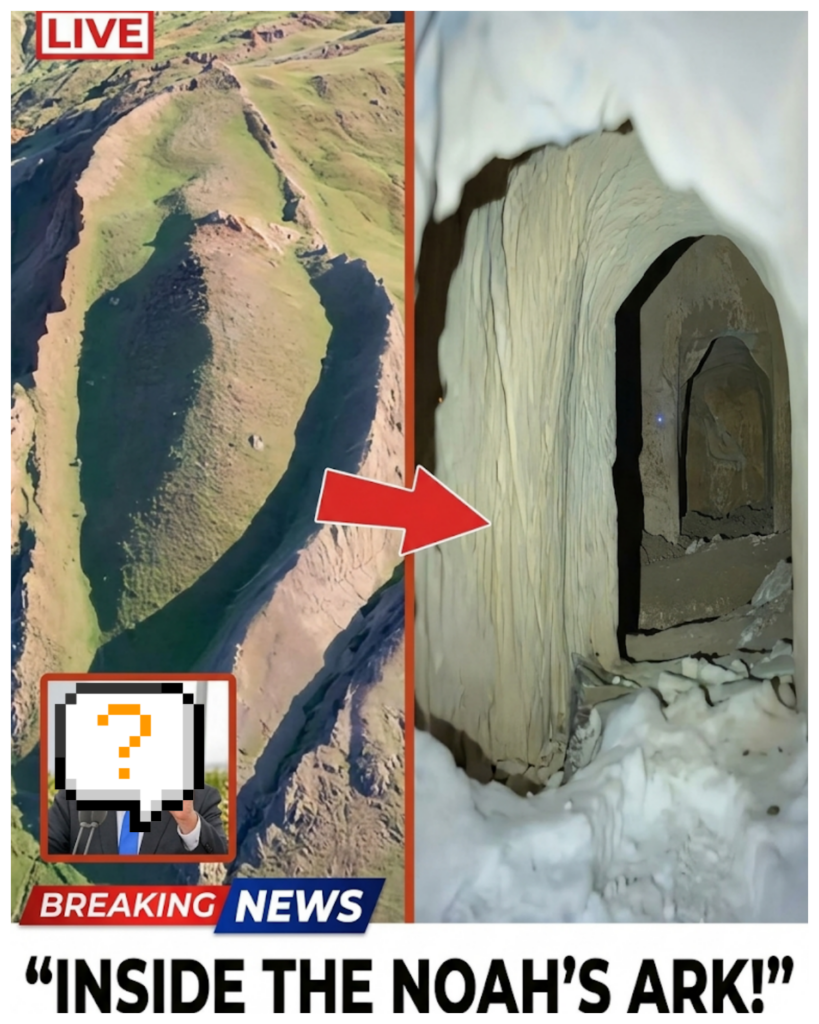
Above where these images were taken.
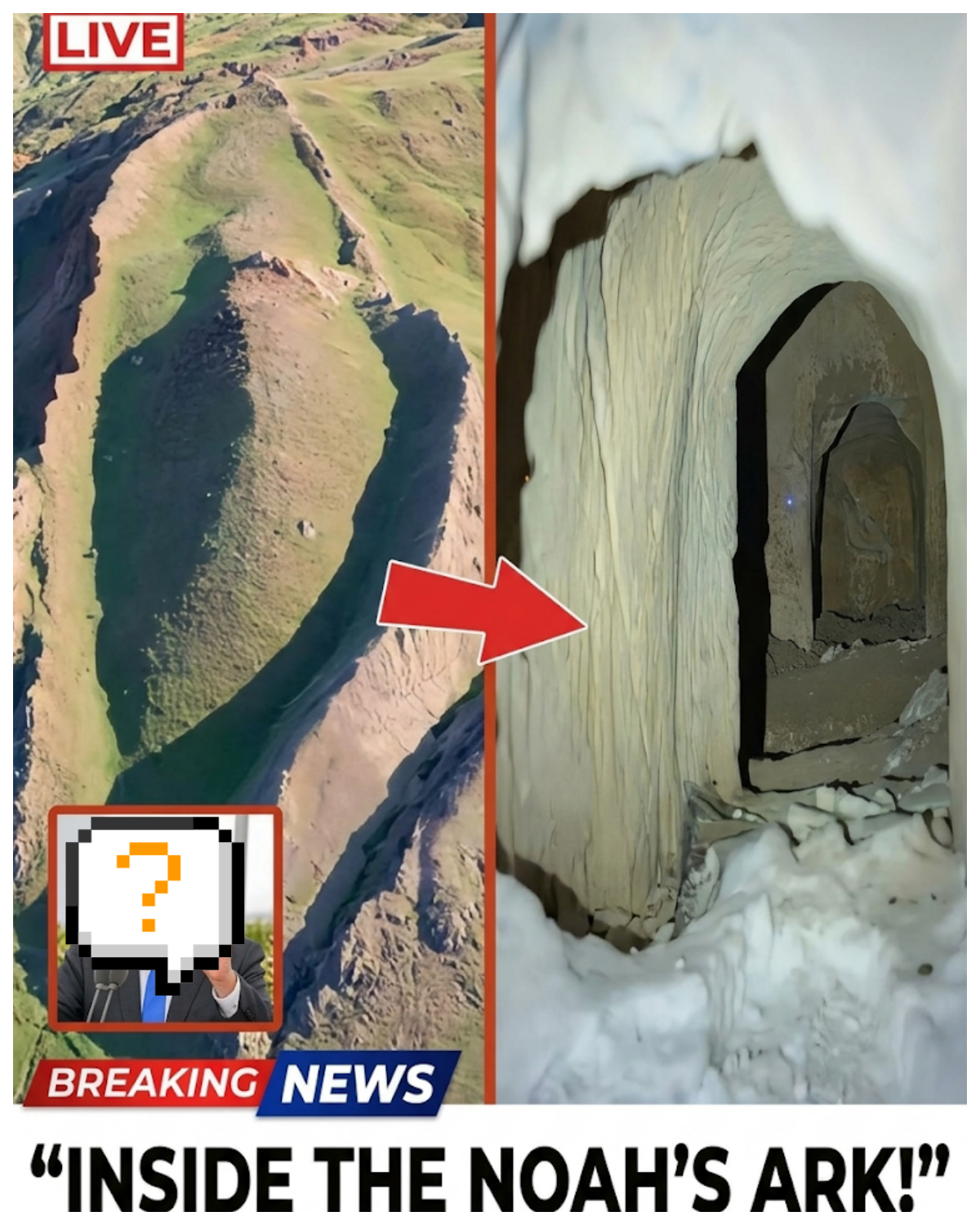
We had them independently analyzed and the data came back showing these tunnels going down the ark and on the inside area of the ship.
This animation revealed here on today.
High in the remote mountains of eastern Turkey lies a strange formation that [music] has fascinated explorers, archaeologists, scientists, and believers for decades.
From above, it looks remarkably like an enormous ship buried beneath the earth.
[music] And according to the biblical account, this is precisely the kind of place where Noah’s ark was said to come to rest after the greatest flood in human memory.
But now, researchers are returning to this mysterious location with modern technology, examining the ground beneath the surface and searching for clues that earlier generations could never have detected.
And there is another mystery that makes this story even more fascinating.
Thousands of years ago in Jerusalem, ancient builders created enormous underground passages using technology that still amazes archaeologists today.
Some of these structures have been scientifically dated to the biblical period.
Could discoveries like these help us understand whether ancient biblical accounts preserve memories of real events?
And could the mysterious formation in Turkey finally provide evidence connected to the story of Noah?
Before we continue, make sure you subscribe to Prophecy and Stone because we are about to travel deep into one of the most controversial archaeological mysteries on Earth.
To understand why the search for Noah’s Ark continues, we have to begin with the ancient story itself.
The book of Genesis describes a world that had become deeply corrupted by violence and wickedness.
Then comes the warning.
God tells Noah that a catastrophic flood is coming and instructs him to construct an enormous vessel capable of preserving his family and representatives of the animal world.
Genesis 6:14 records the command, “Make thee an ark of gopherwood.”
The biblical description is surprisingly detailed.
The ark was to have multiple levels, compartments, and a specific overall shape.
Genesis gives its dimensions as 300 cubits long, 50 cubits wide, and 30 cubits high.
But then comes the most dramatic moment.
[music] The rain begins, the waters rise, the land disappears, and according to Genesis 8:4, after the waters gradually receded, the ark rested upon the mountains of Ararat.
For thousands of years, people have wondered whether that statement refers to [music] the famous Mount Ararat itself or to a wider mountainous region.
And that question eventually brought explorers to a peculiar formation near the Turkish Iranian border.
In 1959, Turkish Army Captain Ilhan Durupanar noticed an unusual boat-shaped feature while examining aerial photographs of eastern Turkey.
The formation was located near Dhubayazit in Agri province and measured roughly 157 m in length.
That immediately attracted attention.
Why?
Because the dimensions were surprisingly close to the traditional biblical measurements of Noah’s ark when converted from ancient cubits.
The formation became known as the Durupanar formation.
To some believers, it looked like a gigantic ship preserved beneath the mountains.
To [music] others, it was simply an unusual geological structure.
And this is where the story becomes much more complicated.
A shape that resembles a ship is not automatically a ship.
Nature can create extraordinary formations through earthquakes, erosion, landslides, volcanic activity, and the movement of sediment.
So, scientists have always faced a crucial question.
Is this actually an ancient vessel?
Or are human beings seeing a familiar shape inside a completely natural formation?
In recent years, researchers connected with the Duropanar site have used non-invasive technologies to investigate what lies beneath the surface.
Ground penetrating radar, electrical resistivity tomography, liar, and geological surveys can reveal variations underground without immediately destroying the formation.
These methods can identify unusual layers, [music] cavities, density changes, and structural boundaries.
But here is the important distinction.
Detecting something beneath the ground [music] does not automatically mean scientists have discovered Noah’s ark.
The current research is still an investigation.
There is no universally accepted archaeological proof that the Durupanar formation is the biblical ark.
And that scientific caution is extremely important.
Because if this really were an ancient wooden vessel, researchers would need much more than a shiplike outline.
They would need convincing evidence of human construction.
They would need datable material.
They would need structural remains consistent with a vessel.
And they would need independent scientific testing that could withstand examination by researchers who do not begin with the assumption [music] that the ark is there.
That evidence has not yet been established conclusively.
But the investigation becomes even more intriguing when we look thousands of kilome away toward Jerusalem.
Jerusalem contains one of the most remarkable underground engineering projects associated with the biblical world.
It is commonly known as the Siloam tunnel or Hezekiah’s tunnel.
The tunnel connects the Guehon spring with the pool of Siloam and passes beneath the ancient city of David.
Imagine [music] ancient workers entering solid limestone from opposite directions, cutting their way through darkness while somehow managing to meet underground.
It sounds almost impossible, yet they did it.
And inside the tunnel, an ancient inscription describes the dramatic moment when the workers finally broke through and water flowed through the passage.
Even more remarkable, scientific investigations have provided evidence placing the tunnel in the Iron Age around the period traditionally associated with the Kingdom of Judah.
A 2003 study published in Nature used radiocarbon and uranium thorium dating and concluded that the tunnel belonged to the Iron Age.
Later archaeological research has debated the precise date with some scholars proposing an earlier 8th century [music] date.
This matters because it demonstrates something extremely important.
Biblical era engineering was not merely imaginary.
Ancient people really were capable of enormous construction projects that from a modern perspective can appear almost unbelievable.
But we must be careful.
The Jerusalem tunnel does not prove that Noah’s ark exists.
The tunnel does not prove the flood happened exactly as described.
Instead, it demonstrates that ancient biblical narratives can sometimes preserve information about real places, technologies, rulers, [music] and historical periods that archaeology can investigate independently.
[music] And that gives us a fascinating framework for examining the ark question.
Researchers studying the Durupanar formation have reported unusual subsurface patterns and geological features.
Some have interpreted these as possible walls, compartments, or internal structures.
Others argue that the patterns can be explained through natural geological processes.
This disagreement is precisely why scientific investigation matters.
A radar image can look extraordinary.
A strange underground signal can create headlines, but archaeology requires something more.
Researchers must determine what produced the signal.
Is it stone?
Is it compacted sediment?
Is it an ancient human-made structure?
Could it be the remains of wood?
And if organic material is discovered, can it be reliably dated?
Even then, dating an ancient object would not automatically prove it belonged to Noah.
It would only establish when the material existed.
The identification would require a much larger body of evidence.
The investigation of the Durupanar formation continues to attract attention because modern technology can examine the site in ways earlier explorers could only dream about.
The 2026 research project at the formation has been described as an officially approved geological and archaeological investigation using techniques including geoysical surveying and core drilling.
But researchers still face the greatest challenge of all proving exactly what the formation is.
If future investigations uncover unmistakable evidence of deliberate human construction securely dated to an appropriate ancient period, the archaeological world would have an extraordinary discovery to examine.
But until that happens, [music] the responsible conclusion is simple.
The formation is intriguing.
The investigation is real.
The biblical story remains enormously influential.
But Noah’s ark has not been scientifically proven to have been found in Turkey.
And perhaps that is what makes the mystery so powerful.
[music] Because beneath those silent mountains, the question remains unanswered.
Was humanity looking at the remains of an ancient vessel all along?
[music] Or has nature created one of the most astonishing illusions on Earth?
For believers, Genesis continues to preserve an ancient warning and a promise after the waters receded.
Noah looked upon a world that had been completely transformed.
And in Genesis 9:13, God says, “I do set my bow in the cloud, and it shall be for a token of a covenant between me and the earth.”
Perhaps the greatest lesson of the ark is not simply where it came [music] to rest.
Perhaps it is what the story asks humanity to remember.
Civilizations disappear.
Mountains remain.
Stone survives.
Wood decays, but questions can survive for thousands of years.
And somewhere beneath the ancient highlands of Turkey, researchers are still searching for an answer to one of the oldest questions humanity has ever asked.
Did Noah’s ark really come to rest here?
Until the evidence speaks for itself, the mountain remains silent.
Thank you so much for watching and God bless.


