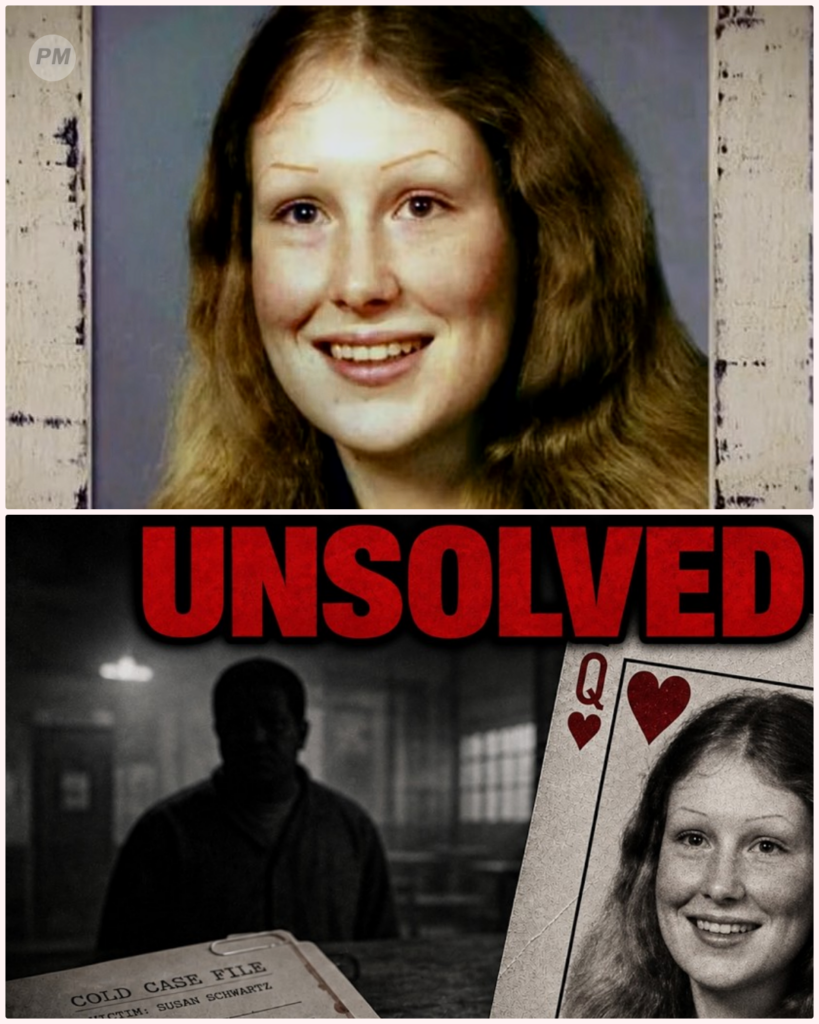
The woman who had finally at the age of 50 found t…
The woman who had finally at the age of 50 found the courage or the safety or simply the moment to say the words out loud.
They embraced her. Whatever anger or confusion they may have felt about the years of silence dissolved in the understanding of what Gregory Johnson had done to this woman, too.
She was another one of his victims. She just survived long enough to tell the truth.
And the family recognized that her testimony, however late, was the reason they were standing in a courtroom watching their sister’s killer plead guilty instead of sitting at home.
Wondering if they’d ever know what happened. When Henry Schwarz, Susan’s 82-year-old father, learned of Johnson’s arrest in 2011, he heard the news from an Associated Press reporter who called him for comment.
His response was the kind of raw, unfiltered emotion that only comes from a man who has been waiting for something for more than half his lifetime.
“My God, isn’t that something?” He said. “I’m breathless. That was the whole expectation for this deck of cards.
Years before anyone had printed Susan’s photograph on the Queen of Hearts, Henry had called his daughter by a different version of the same name.
He said she was the queen of her father’s heart. He’d said it privately, the way parents describe their children when nobody else is listening.
The small endearments that carry more weight than any eulogy ever could. And now that phrase had taken on a meaning he never could have anticipated.
Susan Schwarz’s case became the first murder conviction ever produced by the cold case playing card program in Washington state.
The deck that Jim Sharf and Dave Heitzman had dreamed up in a snowhomeish county office funded by the stillwamish tribe distributed by hand across jails and prisons by detectives who were running out of conventional ideas had done what DNA testing couldn’t.
What witness interviews hadn’t and what three decades of traditional police work had failed to accomplish.
The idea spread beyond Snowhomeish County. King County launched its own cold case deck in 2009.
Florida, Mississippi, and other states followed. The model was simple, cheap, and replicable. A low tech solution to a problem that high-tech forensics sometimes couldn’t touch.
The Snowomish County Cold Case Unit continued its work long after Susan’s case was closed over Detective Jim Sharf’s roughly 17-year tenure with the unit.
The team solved about two dozen cases that had been considered permanently unsolvable. Their most famous success came in 2019 when they used forensic genetic genealogy to identify and convict William Earl Talbot II for the 1987 murders of Canadian couple Jay Cook and Tanya Van Kylenborg.
A case that made national headlines and helped establish genetic genealogy as a legitimate law enforcement tool.
But for the Schwarz family, none of that mattered as much as the resolution of their own case.
The other cold cases, the national headlines, the legacy of the playing card program, all of that belonged to other people.
What mattered to Henry and Gary and Valerie was Susan. Their Susan finally accounted for.
Susan is buried at Sunset Hills Memorial Park in Belleview, Washington, in a plot overlooking the hills of the east side, not far from the suburban neighborhoods where she grew up and the quiet streets she walked as a young woman.
There is a particular kind of injustice in a case like this. Not just the murder itself, but the 32 years that followed.
32 years where a family had to live without knowing when or if justice would come.
32 years where a witness had to live in the shadow of a threat that never lifted.
32 years where a killer walked through the world unpunished for his worst crime, free to collect other convictions while the big one remained invisible.
She died because she helped a friend escape violence. That’s the core of this story, the part that makes it burn even after all these years.
Susan Schwarz wasn’t in the wrong place at the wrong time. She wasn’t caught up in someone else’s crime by accident.
She made a deliberate, conscious choice to help a battered woman get to safety, and a violent man killed her for it.
For 32 years, that choice went unavvenged. The killer walked free. The witness stayed silent.
The family buried their grief so deep it became, as Henry put it, just words.
And then a playing card landed in the right hands. Sherwood Knight, a convicted murderer serving life in prison, saw the face of the woman his half-brother had killed and decided that 32 years was long enough.
The teenage witness, now a middle-aged nurse and mother who had spent her entire adult life under the shadow of a dead man’s threat, heard a knock on her door and whispered the two words that broke the case wide open.
I was there. The Schwarz family finally got answers. Not perfect answers, not a life sentence, not the kind of total satisfying justice that only exists in television dramas, but answers.
A guilty plea, a name attached to the crime. A man in a courtroom forced to say the word guilty out loud, even as he refused to accept a single ounce of responsibility for what he’d done.
Susan’s father was right about his daughter all those years ago, long before anyone ever thought to print unsolved murders on playing cards and hand them to prison inmates.
She was the queen of his heart. And in the end, she was the queen of hearts that brought a killer down.
If you believe these stories deserve to be told, subscribe to Cold Case Redemption. Every case we cover here went cold.
Every one of them found its way back to the light.


