The five hours that followed were the longest of D…
The five hours that followed were the longest of Donovan Hayes’s life, and the quietest.
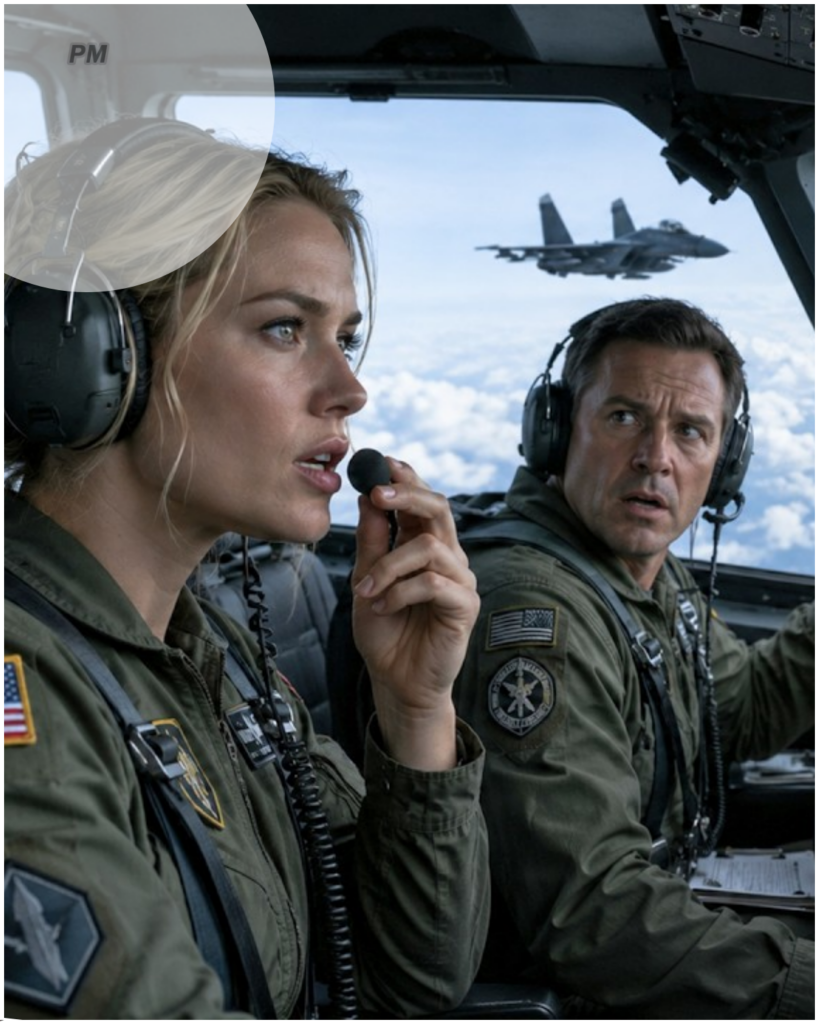
After the fighters broke and the threat displays went dark, the cockpit filled with a silence so complete it felt like a physical thing, broken only by the rushing wind and the heavy breathing of the crew.
Valerie reached out and retracted the aft cargo ramp with a steady hand, and the howling wind died to a murmur, and the C-17 settled back into level flight as if nothing had happened, as if four fighters had not just tried to kill them, as if a drone had not just rewritten the sky.
Donovan sat with his hands on the yoke and did not trust himself to speak, because his arms were burning from fighting the airplane through the turbulence, and his uniform was soaked with sweat, and his heart was still hammering against his ribs.
He kept looking at the instruments, and then at Valerie, and then back at the instruments, the way a man checks that the world is still there.
Gregory Miller, at the engineering station, was shaking so hard he could barely read his gauges, and he kept running the same checks over and over, fuel, hydraulics, engines, as if repetition could make the night make sense.
The jammer was gone. The static was gone. One by one, the radios came back to life, first the VHF, crackling and thin, then the UHF, then the satellite link, and Gregory raised Ramstein on the guard frequency with a voice that shook, and gave the code words for an incident in progress, and listened to the controller’s stunned silence on the other end.
Down in the cargo bay, Agent Harrison Cole stood beside the empty titanium shell with his suppressed submachine gun lowered at his side, staring at the place where the drone had been, and he understood, slowly, what his orders had really meant.
He had been told to protect the cargo at all costs, and he had been ready to order the airplane into the ocean to do it, and now he knew that the cargo had never needed his protection.
The cargo had been the protection, and the woman in the co-pilot’s seat had been the one holding the leash.
He holstered his weapon, and he did not speak, and he did not go back to the cockpit, because there was nothing left for him to say to the people up there, and because a man who has just been outplayed by his own side knows enough to be quiet.
In the cockpit, Valerie sat upright in the right seat, her posture as rigidly perfect as it had ever been, her eyes moving across the instruments in their relentless pattern, radar, engine gauges, fuel, horizon, and she did not relax, and she did not celebrate, and she did not explain herself.
Donovan finally found his voice somewhere over the second hour, and he asked her the question that had been sitting in his chest since the moment she took the aircraft.
“How long have you known?” He said, and his voice was hoarse, and he was not sure what answer he wanted.
“Long enough,” she said, and she did not look at him, and she did not elaborate, and Donovan understood that this was all the answer he was going to get, and that it was enough.
The sun came up somewhere over the third hour, a thin gray line on the horizon that widened into a bruised purple dawn, and the ocean below them turned from black to steel, and the C-17 flew on through the morning, steady and unhurried, carrying its crew home, carrying its empty crate, carrying a pilot who had been declared a disgrace and had just proved, in eleven minutes over a black ocean, that disgrace had been a costume she wore, and not a name she owned.
She thought about the F-35 waiting for her in Nevada, fueled and ready, and she thought about the drone that had saved them, and she thought about the squadron she had not yet asked for, and she knew, with the same cold certainty she had felt in the cockpit, that the Air Force was about to learn what happened when you tried to bury a pilot who refused to stay buried.
Let’s go home.” Donovan slumped back in his seat, his uniform completely soaked in sweat.
He stared at Valerie, utterly speechless. Gregory, the flight engineer, was shaking so hard he could barely read his instruments.
Down in the cargo bay, Agent Harrison Cole lowered his weapon. He stared at the empty titanium shell, a slow, stunned realization washing over him.
The cargo wasn’t what they were protecting. The cargo was the weapon, and the demoted co-pilot was the trigger.
5 hours later, flight 818 touched down on the reinforced tarmac of Ramstein Air Base in Germany.
The sun was just beginning to rise, painting the overcast sky in bruised shades of purple and gray the moment the heavy wheels screeched against the concrete.
A convoy of armored black SUVs and military police vehicles swarmed the aircraft, boxing it in before the engines had even fully spooled down.
When the crew cabin door opened, Donovan and Valerie descended the metal stairs onto the tarmac.
Waiting for them at the bottom was a man wearing the sharp uniform of a four-star officer.
It was General Bradley Mitchell, the head of Joint Special Operations Command. Donovan immediately snapped a crisp salute.
General Mitchell, sir, we had an incident over the corridor. Hostile intercept. They knew exactly where we were.
General Mitchell returned the salute, but his eyes bypassed Donovan entirely, locking onto Valerie. A faint, almost imperceptible smile tugged at the corner of his weathered face.
“I know they knew, Major,” General Mitchell said softly. “Because I leaked the flight path myself.”
Donovan blinked, stumbling backward as if he had been punched in the chest. “You leaked it, sir?
They nearly shot us out of the sky. We had a high-level intelligence leak in European command for 2 years, Major, Mitchell explained, his voice low and serious.
We needed to bait the mole into feeding the Russians a target too good to ignore.
A lone unarmed transport carrying classified cargo through a radar blind spot. It was the perfect trap.
“But you risked my crew,” Donovan said, his voice rising in anger. “You sent us up there to die.”
I didn’t send you to die, Major, Mitchell replied, stepping closer. I sent you up there with an experimental drone capable of blinding an entire squadron.
And more importantly, I sent you up there with the only pilot in the United States Air Force skilled enough to deploy at mid-flight and ruthless enough to make the enemy commander blink.
Mitchell turned to Valerie, reaching into his pocket. He pulled out a pair of silver oak leaves, the insignia of a lieutenant colonel.
Your 18 months of disgrace are officially over, Viper, Mitchell said, handing her the rank insignia.
The mole took the bait. Federal agents arrested him 20 minutes ago in Brussels. The operation was a complete success.
Your fighter wing is waiting for you in Nevada. Your F-35 is fueled and ready.
Valerie looked down at the silver insignia in her palm. Her face completely unreadable. She didn’t smile.
She didn’t celebrate. She simply closed her fist around the metal. Her eyes narrowing as she looked past the general, staring up into the vast open sky above the air base.
“Sir,” Valerie said, her voice carrying the same icy edge she had used against the Russian commander to with all due respect, “I don’t want the F-35.”
Mitchell raised an eyebrow. “Then what do you want, Colonel?” Valerie looked back at the massive hulking C-17 resting on the tarmac.
Its engines still ticking as they cooled in the morning air. “I want the Valkyrie program,” Valerie said flatly.
“And I want my own squadron. If they are afraid of ghosts, General, then I want to give them an entire haunted house.”
Mitchell stared at her for a long moment, a shiver running down his spine despite the morning heat.”
He nodded slowly. The silence on the tarmac was the strangest part. Valerie had expected noise: shouting, engines, the wail of sirens, the chaos of a base that had just learned its airplane had nearly been shot out of the sky.
Instead there was only the ticking of cooling engines, and the low murmur of the military police, and the sound of her own boots on the concrete as she came down the metal stairs behind Donovan.
The sun was just beginning to rise, painting the overcast sky in bruised shades of purple and gray, and the air smelled of jet fuel and rain.
Donovan walked beside her in a daze, his uniform soaked with sweat, his hands still shaking, and he kept looking at her the way a man looks at someone he has just met for the first time.
He had flown with her for eighteen months. He had shared a cockpit with her, a thermos of coffee, a hundred long nights over the Atlantic.
He had thought he knew her. He had thought she was a quiet woman serving out a punishment, a fighter pilot who had lost her edge.
Now he understood that everything he had believed about her had been wrong, and that the woman walking beside him was someone he had never really seen.
He wanted to say something. He opened his mouth, and closed it, and opened it again, and in the end all he managed was her name.
“Valerie.” She looked at him, and her face was unreadable, the same face she had worn in the cockpit when she took the aircraft, the same face she had worn when she spoke Russian to a man who wanted to kill them.
“You saved us,” he said, and his voice was rough, and he was not sure whether he was thanking her or apologizing to her, and he suspected it was both.
“I did my job, Major,” she said, and her voice was flat, and she did not smile, and she kept walking, because there were black SUVs boxing in the airplane, and military police with their hands on their weapons, and a four-star general waiting at the bottom of the stairs, and she knew that whatever happened next, it would not be ordinary.
Behind her, Gregory Miller came down the stairs on unsteady legs, his face white, his hands still trembling, and he looked at the empty titanium shell in the cargo bay and then at Valerie, and he understood, slowly, what the rest of them were only beginning to grasp.
The cargo had never been what they were protecting. The cargo had been the weapon, and the demoted co-pilot had been the trigger, and the flight that was supposed to be a milk run had been a trap from the moment the wheels left the runway.
Valerie stopped at the bottom of the stairs and looked up at the sky, vast and open above the air base, the color of a bruise healing, and she thought about the eighteen months she had spent in the right seat of a transport airplane, and the eleven minutes over the Altanian border, and the voice on the radio counting down from ten, and she felt something she had not felt since that bright morning in Texas when she had first soloed a jet: the clean, simple knowledge of who she was.
She was not a disgraced pilot. She was not a co-pilot. She was Viper Actual, and she had never stopped being Viper Actual, and the Air Force had spent eighteen months trying to make her forget it, and it had failed.
General Mitchell was walking toward her now, his uniform sharp, his face weathered, his eyes locked on hers, and she straightened her shoulders, and she waited, because whatever he was about to say, she was ready to hear it, and she was ready, for the first time in eighteen months, to answer as herself.
“Done. 𝐷𝑖𝑠𝑐𝑙𝑎𝑖𝑚𝑒𝑟: 𝑇ℎ𝑖𝑠 𝑐𝑜𝑛𝑡𝑒𝑛𝑡 𝑚𝑎𝑦 𝑏𝑒 𝑐𝑟𝑒𝑎𝑡𝑒𝑑 𝑏𝑦 𝐴𝐼 𝑓𝑜𝑟 𝑒𝑛𝑡𝑒𝑟𝑡𝑎𝑖𝑛𝑚𝑒𝑛𝑡 𝑝𝑢𝑟𝑝𝑜𝑠𝑒𝑠. 𝐴𝑛𝑦 𝑟𝑒𝑠𝑒𝑚𝑏𝑙𝑎𝑛𝑐𝑒 𝑡𝑜 𝑟𝑒𝑎𝑙 𝑝𝑒𝑟𝑠𝑜𝑛𝑠, 𝑒𝑣𝑒𝑛𝑡𝑠, 𝑜𝑟 𝑝𝑙𝑎𝑐𝑒𝑠 𝑖𝑠 𝑐𝑜𝑖𝑛𝑐𝑖𝑑𝑒𝑛𝑡𝑎𝑙.