Cruising at 32,000 ft, a heavy military transport…
Cruising at 32,000 ft, a heavy military transport plane is nothing but a sitting duck in the sky when four hostile fighter jets suddenly boxed in.
Flight 818. The crew braced for a fiery death. They were unarmed, outmaneuvered, and completely alone.
But the enemy had made one fatal, irreversible mistake. They didn’t know the true identity of the woman sitting in the co-pilot’s seat.
The flight deck of the C-17 Globemaster III was submerged in the dim red tactical lighting standard for night operations.
Outside the thick reinforced glass of the canopy, the world was a sprawling abyss of pitch black sky and a merciless ocean below.
This was the Cardon corridor, a highly contested stretch of international airspace hugging the jagged borders of three nations currently locked in a bitter cold war.
To the air crews of Air Mobility Command, it was affectionately known as the meat grinder.
At the yoke sat Major Donovan Hayes, a 20-year veteran of moving heavy things from point A to point B.
Donovan was a pragmatic by the book aviator whose idea of an exciting flight was one where the coffee maker didn’t break down over the Atlantic.
He was relaxed, his posture slumped comfortably into the sheepskin-covered seat, casually scanning the dancing green digits of the navigation displays.
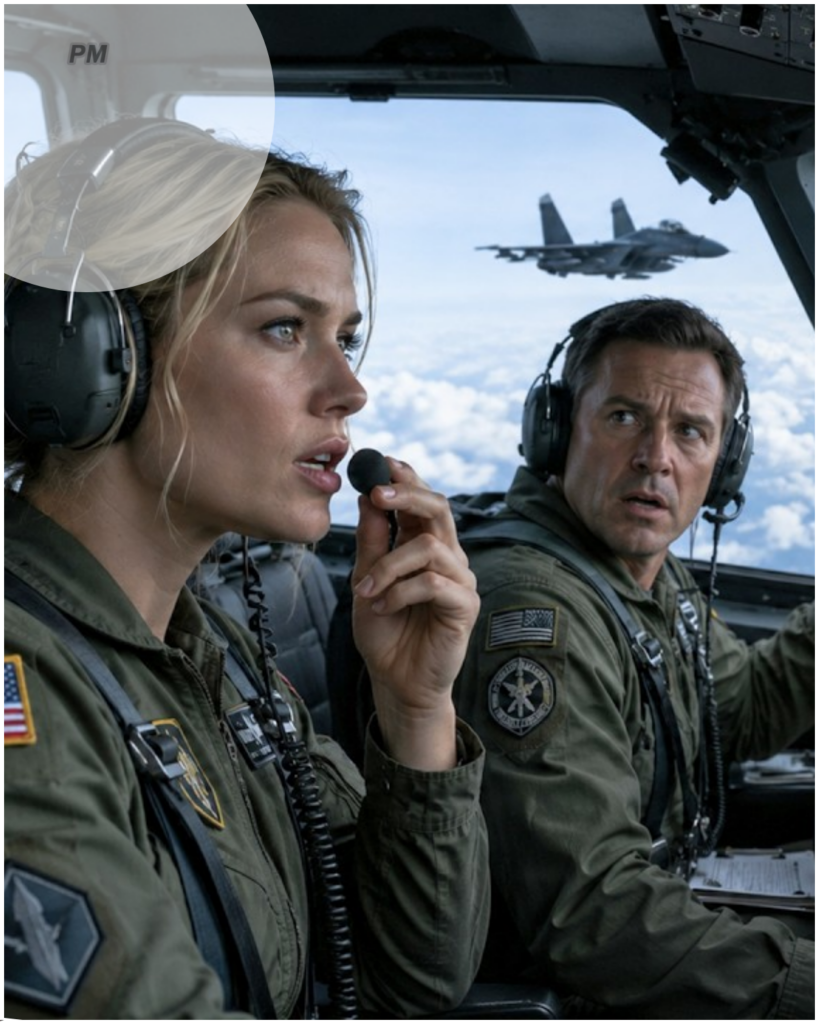
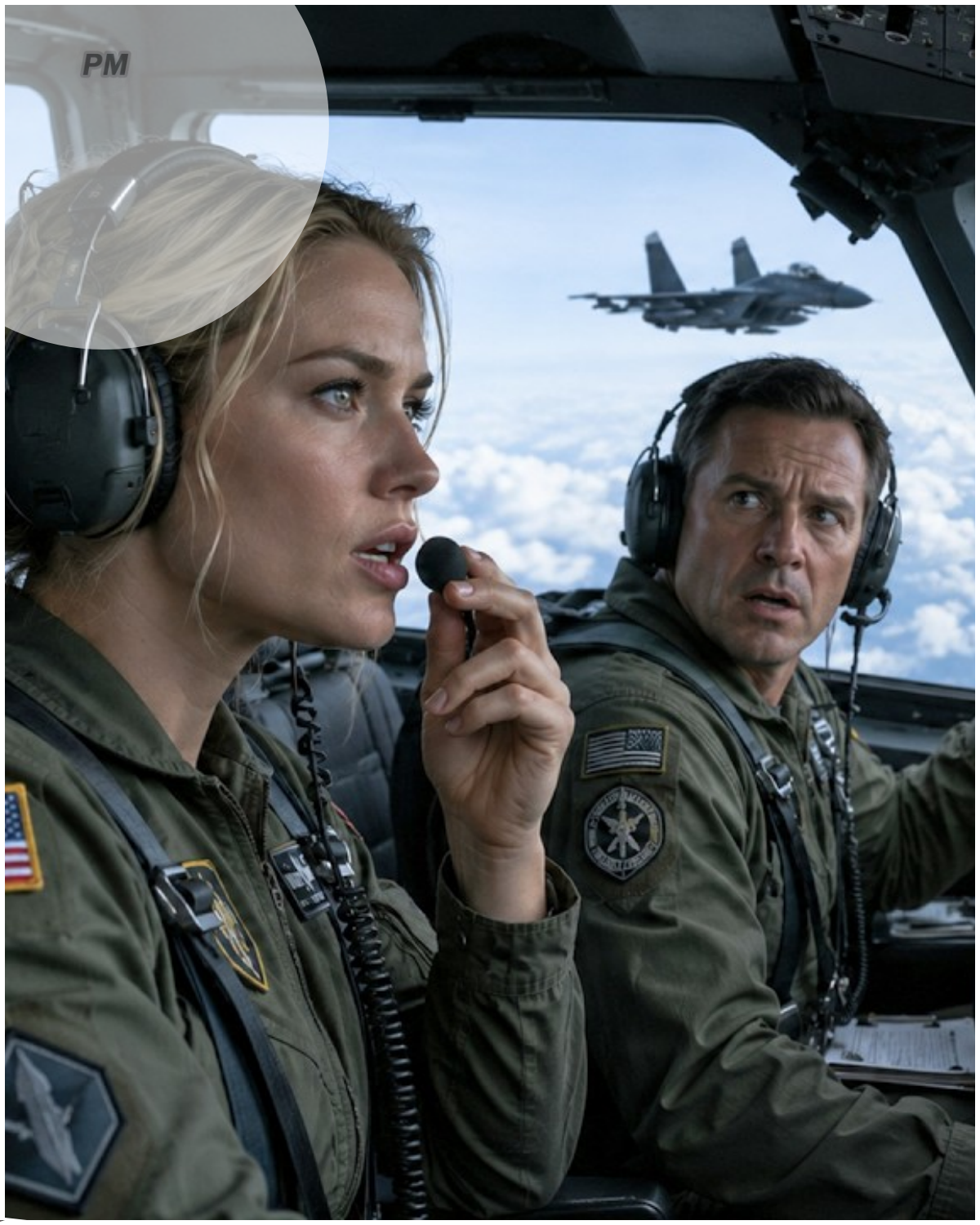
To his right, occupying the co-pilot seat, was Captain Valerie Cross. If Donovan was a relaxed, lumbering bear, Valerie was a coiled spring.
Even in the dead of night, halfway through a tedious 12-hour hall, her posture was rigidly perfect.
Her hands rested lightly near the controls, her eyes constantly sweeping the instrument panels in a relentless, predatory rhythm.
She didn’t belong in a heavy transport, and everyone on the crew knew it. Until 18 months ago, Valerie had been the tip of the spear.
She was a top tier fighter interceptor pilot qualified in the fifth generation F-35 Lightning II.
She was a ghost in the sky, a decorated combat aviator with a classified service record that read like a Hollywood script.
But then came the incident over the Altanian border. A mission so heavily redacted that not even Donovan had the clearance to know the details.
The fallout had resulted in a quiet unceremonious transfer. The incident over the Altanian border had lasted eleven minutes, and Valerie Cross had flown every second of it alone.
The mission brief had been thin even by the standards of classified work: a surveillance pass along a border that officially did not exist, in airspace that officially belonged to no one, watching a radar site that officially had never been built.
She had launched from a base whose name she was not allowed to write down, in an F-35 whose transponder stayed dark from takeoff to landing, and she had flown the first forty minutes in silence so complete that the only sound in her helmet was her own breathing.
Then the sky had opened. Four fighters had come up from below the cloud deck in a climbing turn, and two more had dropped out of the sun, and the radar warning receiver had filled her ears with a tone she had trained for a hundred times and never once heard for real.
A squadron, working as a pack, with a plan, and she was the only target in the sky.
She remembered the moment with a clarity that still woke her sometimes in the dark: the way her hands had stopped shaking, the way the noise in her head had gone quiet, the way the jet had felt less like a machine and more like an extension of her own body.
She had not run. Running would have put her tail to their guns and her life in their hands, and she had decided, in the space of a single breath, that she would rather die turning into them than live running from them.
She had broken hard left, into the lead fighter, and fired, and rolled, and the sky had become a geometry problem she solved one angle at a time.
When it was over, four of the six fighters were falling in pieces toward the mountains, one was limping home trailing smoke, and the last one had simply vanished, running for its border with its afterburners lit and its pride in ruins.
She had landed with two missiles left and a fuel gauge reading almost empty, and she had taxied in silence while the ground crew stared at her jet the way people stare at a survivor of a car wreck.
The debrief had lasted nine hours. Men in suits she had never seen before had asked her the same questions in different words, over and over, trying to find the mistake, trying to find the rule she had broken, trying to find the reason to be angry at her for winning.
In the end there had been no medal and no punishment, only a piece of paper and a quiet transfer.
Her fighter was gone. Her squadron was gone. Her call sign, Viper Actual, was struck from the roster as if it had never existed, and she was sent to sit in the right seat of a transport airplane and learn to be ordinary.
She had learned to be quiet instead. She had learned to watch the radar the way other people watch the weather, to keep her hands near the controls, to say nothing when men who had never been shot at told her she was imagining threats.
She had not forgotten the border. She had not forgotten the sound of her own voice on an open frequency, calm and cold, giving a frightened commander a choice he did not want.
She had only been waiting for the sky to give her a reason to be herself again.
The top brass had clipped her wings, stripping her of her fighter and throwing her into the right seat of a trash hauler to serve out the remainder of her contract in disgrace.
“You’re going to burn a hole through the radar screen cross,” Donovan muttered, his voice a low, gravelly rumble through the intercom headset.
Wait, take a breath. We’re 2 hours out from friendly airspace. It’s a milk run.
Valerie didn’t blink. Radar is clear, Major, but the weatherband is picking up localized atmospheric static.
It’s the kind of interference you see when a high output jamming pod is operating just over the horizon.
Donovan chuckled, reaching for his thermos. Always the fighter jock. Look, the locals down there are always playing electronic grabass.
They turn on their jammers to mess with commercial airliners. It’s noise, Valerie. Just noise.
Behind them, sitting at the engineering station, flight engineer Gregory Miller chimed in. Captain’s right about the static, major getting some weird ghosting on the secondary comms.
Nothing I can’t filter out, but it’s thick. Keep an eye on it, Greg. Donovan replied, taking a sip of his lukewarm coffee.
But don’t go raising the alarm. We have VIP cargo tonight. I don’t want to spook the suits in the back.
Down in the cavernous, unheated belly of the C-17, secured by heavy-duty cargo straps, sat a single, heavily reinforced titanium crate.
It was flanked by four pallets of standard humanitarian rations, a crude disguise for anyone doing a cursory inspection.
Donovan Hayes had flown with a dozen co-pilots in twenty years, and he had liked most of them, and he had forgotten most of them, and Valerie Cross was the first one he could not figure out.
She was the quietest pilot he had ever shared a cockpit with, and the most alert.
Other co-pilots read paperbacks on long hauls, or dozed with their chins on their chests, or talked about their wives and their mortgages and their kids’ soccer games.
Valerie Cross did none of those things. She sat upright for twelve hours at a time, her posture rigidly perfect, her eyes moving across the instruments in a pattern he eventually realized was not random at all: radar, engine gauges, fuel, horizon, radar, engine gauges, fuel, horizon, over and over, the way a fighter pilot scans for threats that are not there yet.
He had asked her about it once, early on, somewhere over the Atlantic, and she had said, “Habit, sir,” in a voice that closed the subject like a door.
He had not asked again. He had decided, the way a man decides things about a person he works beside but does not know, that she was a fighter jock who could not let go of the fighter, a woman serving out a punishment posting and counting the days until her contract ended.
He felt sorry for her in the vague, comfortable way that people feel sorry for someone else’s bad luck, and he treated her with the easy kindness of a man who believes the worst thing in his life is already behind him.
The crew liked her well enough. Gregory Miller, the flight engineer, had told Donovan once that the captain never missed a thing, that she had caught a fuel imbalance on a flight out of Dover before the gauges had even flagged it, that she had a feel for the airplane that was almost unnatural.
Donovan had laughed and said that was what happened when you put a Ferrari driver in a school bus.
He did not mean it unkindly. He simply could not imagine that the quiet woman in his right seat was anything more than a demoted fighter pilot riding out her time.
He did not know that she had spent her evenings in the avionics bay, on her knees in the dark, running cables and rewriting software for a system the airplane was never supposed to carry.
He did not know that she had memorized the blind spots in the radar coverage of the Cardon corridor the way other pilots memorized their checklists.
He did not know that the patience he mistook for resignation was something else entirely: a predator holding still, waiting for the moment when stillness would end.
On the night of Flight 818, as the C-17 lumbered through the dark toward a stretch of sky the crews called the meat grinder, Donovan Hayes was thinking about the coffee in his thermos and the two hours left until friendly airspace, and he was the most relaxed man in the cockpit.
Valerie Cross, sitting upright in the right seat with her hands resting lightly near the controls, was the only person on the airplane who understood that the flight had already begun to go wrong, and that the wrongness had a rhythm, and that she had heard that rhythm before, eighteen months ago, over a border that officially did not exist.
But more telling than the titanium construction were the two men guarding it. They wore unmarked tactical gear, carried suppressed submachine guns, and hadn’t spoken a single word since they boarded the aircraft in Ramstein.
Their presence meant that this was a black-book logistics run. Whatever was in that crate, it was valuable enough to kill for.
The crate had been loaded at Ramstein in the middle of the night, under lights so bright they turned the tarmac white, and the men who loaded it had not spoken to the flight crew at all.
Valerie had watched from the cockpit window while a forklift eased it up the ramp, and she had noted the things that mattered: the titanium shell, the weight distribution, the way the loadmaster kept checking and rechecking the straps as if the crate might decide to move on its own.
She had seen crates like it before, in hangars she was not supposed to enter, on bases whose names she was not supposed to say.